Child Injuries in Bus Accidents in Texas


Every article on this site is researched by our internal team, reviewed for legal accuracy against current Texas law, and held to State Bar of Texas advertising standards before publication. We do not publish content that overstates outcomes or makes promises about results.
Learn more about our
editorial standards .
Key Takeaways
- A child bus injury usually creates two separate claims: the parent's two-year claim for medical costs, which is not paused, and the child's claim, which is paused until age 18.
- Government notice deadlines under the Texas Tort Claims Act are not tolled for minors and can expire in as little as 45 to 90 days, so early action is essential.
- Any settlement for a child must be court-approved under the Texas Property Code, and damage caps apply when a school district or city transit bus is involved.
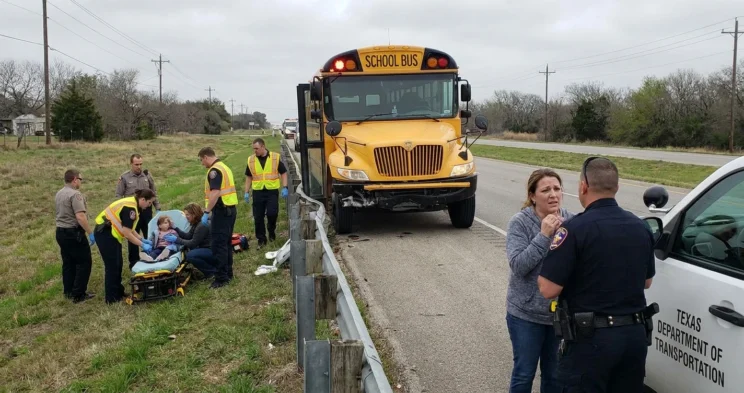
Your child climbs onto the bus the same way they do every morning. Then your phone rings. There has been a crash, and your child is hurt.
At that moment, nothing else matters except getting to your child. But once the emergency passes and you are sitting in a waiting room or driving home with your bandaged kid in the back seat, the questions start. Who is responsible? Will the school or the city pay for the medical bills? And how long do you have to do something about it?
If your child was hurt in a bus accident, you may actually have two separate legal claims, each with its own deadline. Texas law treats injured children differently than adults, and some of those rules protect your child while others can quietly run out on you.
Why Children Face Unique Risks in Bus Crashes
Children are not small adults. Their bodies are still developing, and that makes them far more vulnerable in a crash than the grown-ups around them.
A child’s bones are softer and still forming, their heads are larger in proportion to their bodies, and their necks and spines have less muscle support. The same impact that leaves an adult sore can fracture a child’s bone or cause serious internal harm.
Many school buses also lack seat belts, and even transit buses that have them are rarely designed to fit a child’s body, so restraints do not always protect kids the way they protect adults.
The most common injuries we see in child bus passengers include:
- Traumatic brain injuries (TBI), including concussions
- Spinal injuries
- Broken bones
- Internal injuries and organ damage
- Lacerations and soft tissue injuries
What’s more, a child’s injuries are not always obvious right away. Young children often cannot describe what hurts, and the symptoms of a brain injury or internal bleeding can take hours or even days to appear. A child who seems fine at the scene may have a serious injury that has not yet shown itself.
That is why prompt medical evaluation is so important. A doctor can catch problems your child cannot put into words. And since the legal path for an injured child follows different rules than an adult’s claim, early action is even more important.
Who Can Be Held Liable for a Child’s Bus Injury?
Liability depends on who operated the bus and who caused the crash. In Texas, the answer usually falls into one of a few categories, and the category matters because it changes the rules that apply to your case.
School District Buses
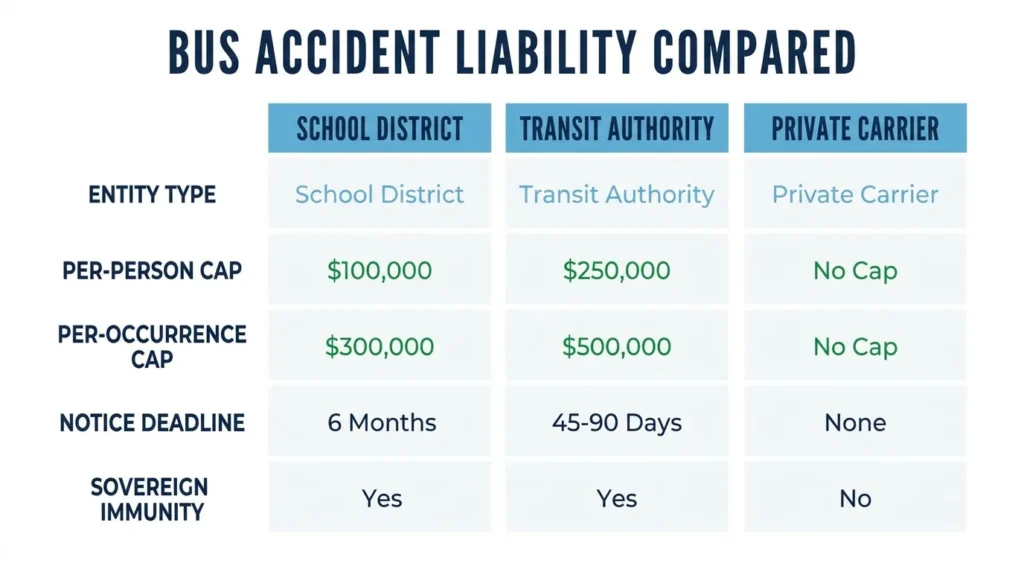
School districts are government entities, which means they are covered by the Texas Tort Claims Act (TTCA), found in Chapter 101 of the Texas Civil Practice and Remedies Code. Government bodies are normally protected from lawsuits by sovereign immunity, but the TTCA waives that protection for injuries caused by the negligent operation of a motor vehicle, including a school bus.
That waiver comes with limits. For school districts, damages are capped at $100,000 per person and $300,000 per occurrence. Those caps apply no matter how severe your child’s injuries are.
City or Transit Authority Buses
Municipal transit authorities, such as a city metro or transit system, are also government entities subject to the TTCA. The damage caps for municipalities are higher than for school districts: $250,000 per person and $500,000 per occurrence.
These entities also have their own notice requirements, which we cover in the deadlines section below. Those deadlines are often shorter than people expect.
Private Charter or Contracted Carriers
Not every bus is run by the government. Private charter companies and contracted carriers are private businesses, so they are not protected by sovereign immunity and they are not shielded by the TTCA’s damage caps. Full civil liability applies.
These companies usually carry commercial insurance. A private carrier can be held responsible for its driver’s negligence under the legal principle of respondeat superior, and it can also be held directly responsible for its own failures, such as negligent hiring, poor training, or inadequate maintenance.
Third-Party Drivers Who Caused the Crash
Sometimes the bus driver did nothing wrong. If another motorist ran a red light or rear-ended the bus, that driver and their insurer may be a separate source of compensation. A thorough investigation should identify every party who may share responsibility before any deadline runs out.
Filing Deadlines: The Two-Track System
This is one of the most misunderstood parts of bus accident law when a child is hurt. When your child is injured, there are actually two separate claims, and they run on two different clocks.
The Parent’s Own Claim
As a parent, you have your own claim for the money you spend on your child’s care, such as reimbursement for medical bills you paid out of pocket. This claim belongs to you, not to your child.
Your claim follows the standard two-year statute of limitations under Section 16.003 of the Texas Civil Practice and Remedies Code, and that clock starts on the date of the accident. Most importantly, the rule that pauses a child’s deadline does not apply to your claim.
If you wait too long, your own right to be reimbursed can expire even while your child’s claim is still alive. Practically, that means you need to act within two years of the accident to protect your own compensation.
The Child’s Own Injury Claim
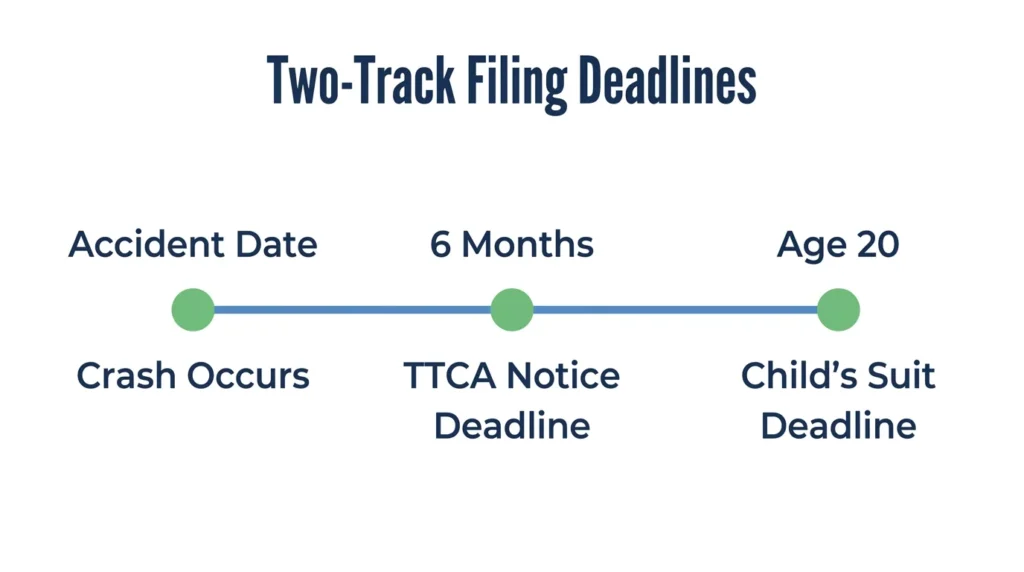
Your child’s claim works differently. Under Section 16.001 of the Texas Civil Practice and Remedies Code, the statute of limitations is tolled, meaning paused, while the injured person is a minor. Your child’s two-year window does not begin to run until they turn 18.
In practical terms, a child injured at age 7 generally has until their 20th birthday to file suit. This rule exists to protect children, who cannot bring a lawsuit on their own.
That said, waiting is rarely a good idea. Evidence disappears, witnesses move away, and medical records become harder to track down. The strongest cases are built while the facts are fresh.
The Critical TTCA Exception
Here is the trap that catches families off guard. When the bus belongs to a school district or a government transit authority, the TTCA requires you to give written notice of the claim within a strict deadline, and that notice deadline is not tolled for minors.
For state entities and school districts, written notice must generally be provided within 6 months of the incident under Section 101.101 of the Texas Civil Practice and Remedies Code. For certain Texas cities, a local charter can require notice in as little as 45 to 90 days. Miss that window and the claim can be over entirely, no matter how young your child is or how serious the injury.
This is why the minority tolling rule can give parents a false sense of security. The child’s lawsuit deadline may be years away, but the government notice deadline can expire in a matter of weeks.
What Compensation Can a Child Bus Accident Victim Recover?
Texas law allows an injured child to seek compensation for the full range of harm they have suffered and will suffer as they grow. Damages generally fall into a few categories.
Economic Damages
These cover the financial costs of the injury, both now and in the future:
- Past medical expenses, including emergency care, hospitalization, surgery, imaging, and medication
- Future medical expenses, such as additional surgeries, specialist care, and assistive devices
- Future therapy and rehabilitation, including physical, occupational, and speech therapy
- Lost future earning capacity, when a severe injury like a TBI or spinal cord damage is reasonably expected to limit the child’s ability to work as an adult
Non-Economic Damages
These cover the human costs that do not come with a receipt:
- Physical pain and suffering, past and future
- Mental anguish and emotional distress
- Physical impairment and disfigurement
Parental Damages
As a parent, you may have your own recovery separate from your child’s. This can include reimbursement for medical expenses you have already paid and compensation for the loss of your child’s services, a concept rooted in the parent-child relationship recognized under Section 151.001 of the Texas Family Code.
Because a child’s injuries can change as they grow, settling before the full picture is clear can permanently cut off future recovery.
How a Child’s Bus Accident Case Is Filed in Texas
Because a minor cannot file a lawsuit in their own name, Texas has a specific process for handling children’s injury cases. These rules exist to protect the child at every step.
Filing as Next Friend
Under Rule 44 of the Texas Rules of Civil Procedure, a child can sue through a “next friend,” usually a parent or guardian, who acts on the child’s behalf. The next friend owes a duty to the child, not to themselves, and no court appointment is needed to start the case. Either parent can typically serve in this role.
Guardian Ad Litem
Under Rule 173 of the Texas Rules of Civil Procedure, a court may appoint a guardian ad litem, an independent attorney whose only job is to look out for the child’s interests. This commonly happens when a settlement is on the table or when there is a potential conflict between the child’s interests and the next friend’s.
The guardian ad litem reviews the proposed terms and reports to the court on whether the settlement truly serves the child.
Court Approval of a Minor’s Settlement
Any settlement of a minor’s claim must be approved by a court under Section 142.005 of the Texas Property Code and Section 142.008 of the Texas Property Code. The judge’s job is to confirm the settlement is fair and in the child’s best interest, not simply convenient for an insurer or a parent.
To protect those funds, a court may order the money placed in a structured settlement or a blocked account that holds the proceeds until the child reaches adulthood. This adds time to the process, but it exists for a good reason.
Steps Parents Should Take After a Child Is Hurt on a Bus
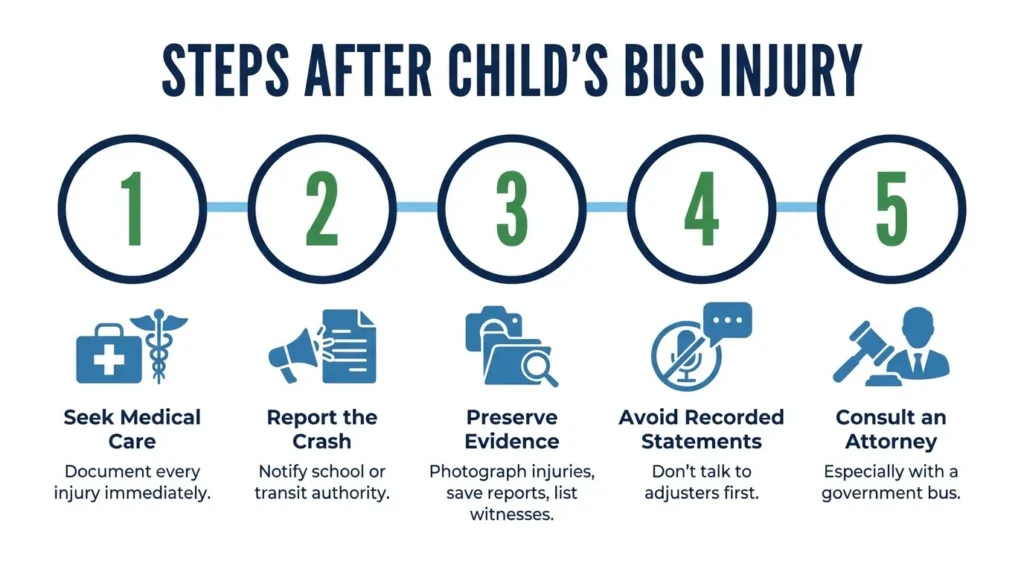
What you do in the days after the crash can shape your child’s case for years. A few steps matter most:
- Seek immediate medical attention, even if your child seems fine, and document every injury from day one.
- Report the crash to the school, school district, or transit authority in writing right away, and keep a copy for yourself.
- Preserve evidence: take photos of injuries and the scene, save incident reports, and write down the names of any witnesses.
- Do not give recorded statements to insurance adjusters before you talk to an attorney.
- Consult an attorney immediately, especially if a government bus is involved, because TTCA notice deadlines can expire in as little as 45 days.
Talk to an Experienced Attorney
When your child is hurt, the last thing you should have to figure out alone is a maze of government claim rules and overlapping deadlines. That is what we are here for.
Angel Reyes & Associates has spent more than 30 years fighting for injured Texans and has recovered over $1 billion for our clients. We handle bus accident cases involving injured children across Texas, and we know how quickly the most important deadlines, especially TTCA notice requirements, can pass.
You pay nothing unless we win your case, and your consultation is always free. There is no benefit to waiting, and a great deal to lose by it.
Schedule a free consultation today.
Past results do not guarantee future outcomes.
Child Injuries in Bus Accidents FAQs
Can I sue the school directly, or does the claim go against the school district?
In Texas, public schools are not separate legal entities you can sue on their own. They are part of a school district, which is the government body that actually owns and operates the buses, employs the drivers, and holds the liability. Your claim goes against the district, not the individual campus. The Texas Tort Claims Act governs that claim, which means the strict notice deadlines and the damage caps discussed above apply.
My child was hurt on a school field trip bus. Does that change anything?
The legal analysis is similar, but the details matter. If the bus was the district’s own vehicle driven by a district employee, the Texas Tort Claims Act applies the same way it would for a regular school bus run. If the district hired a private charter company for the trip, the private company may carry its own commercial insurance and is not shielded by the TTCA’s damage caps.
What if the driver who hit the school bus was uninsured or underinsured?
This situation has multiple potential solutions. First, the at-fault driver can be sued personally, though collecting from an uninsured individual can be difficult. Second, if the bus itself was insured under a policy that includes uninsured or underinsured motorist (UM/UIM) coverage, that coverage may step in to compensate your child. Third, if the bus was a school district vehicle, the district may have separate resources available.
About the Authors

Angel Reyes
Writer
Angel L. Reyes, III is the Founder and Managing Partner of Angel Reyes & Associates. A nationally recognized trial attorney and business leader, Angel has helped over 70,000 injury victims recover more than $1 billion since founding the firm in 1993. Named to the Texas Super Lawyers list annually since 2008, Angel brings Wall Street experience, Ivy League education, and a deep commitment to client advocacy. He is a frequent legal commentator and published author with extensive contributions to legal scholarship, trial strategy, and consumer protection.

Kyle Nicolas
Editor
Kyle Nicolas is the Web Content & SEO Manager at Angel Reyes & Associates. He has more than 10 years of experience as a marketing co...

Angel Reyes
Reviewer
Angel L. Reyes, III is the Founder and Managing Partner of Angel Reyes & Associates. A nationally recognized trial attorney and business...