What Are Crush Injuries & Why Are They Dangerous?


Every article on this site is researched by our internal team, reviewed for legal accuracy against current Texas law, and held to State Bar of Texas advertising standards before publication. We do not publish content that overstates outcomes or makes promises about results.
Learn more about our
editorial standards .
Key Takeaways
- Crush syndrome's worst damage begins after the pressure is released, not during.
- Kidney failure and dark urine can appear days after an unremarkable ER visit.
- Extrication times, serial CK labs, and dialysis records prove crush injury severity.
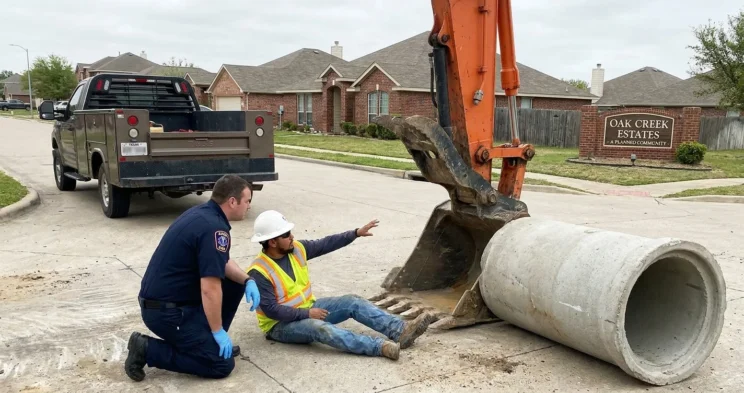
A crush injury is compression trauma to muscle, bone, and soft tissue. It is dangerous for a reason that strikes most people as backwards, because the worst damage usually starts after the pressure comes off.
When a fire crew frees a pinned leg or hip, the released muscle dumps myoglobin and potassium into the bloodstream. The potassium can stop the heart within minutes, and the myoglobin can shut down the kidneys days after a crash that looked survivable.
If you were pinned in a vehicle on I-35 and sent home with a splint, the record from that first night may not show what is already underway.
What Is a Crush Injury in a Car Accident?
A crush injury happens when prolonged external pressure damages muscle, bone, subcutaneous tissue, and skin, a process clinicians call traumatic rhabdomyolysis.
In a collision, that pressure comes from an intruded door, dashboard, steering column, or collapsed frame holding a limb, torso, or pelvis in place.
A crush injury and crush syndrome are not the same thing. The crush injury is the local damage.
Crush syndrome is the systemic complication that follows, described in the literature as major shock and renal failure after a crushing injury to skeletal muscle.
Cabin intrusion creates the compression, and a loaded tractor-trailer drives far more mass into the passenger compartment than a sedan. That mass difference is why intrusion damage tends to be more severe in Texas truck accident claims.
How Crush Syndrome Damages the Kidneys After the Pressure Comes Off
The danger comes from reperfusion, the moment blood flow returns to trapped tissue and starts the cascade, rather than from the compression itself.
While the weight is still on the muscle, the injury stays largely hidden. Cells run out of ATP, sodium and calcium flood in, and the cells swell until their membranes break down.
Restored circulation then disrupts the sodium-potassium-ATPase pump in those damaged cells, releasing myoglobin, potassium, phosphate, creatine kinase, and thromboplastin into the bloodstream at once.
Myoglobin is the central threat to the kidneys. It overwhelms renal filtration, settles in the tubules, generates free radicals, and binds with uromodulin to form obstructive casts. The resulting acute tubular injury is compounded by fluid depletion that cuts renal blood flow at the same moment.
Potassium moves faster. A sudden potassium load can trigger a life-threatening cardiac arrhythmia, which is why some patients collapse at or shortly after release.
Why the Danger Often Doesn’t Show Up Until Days Later
Crush syndrome is progressive, not immediate. Clinical reviews describe casualties who appear normal at rescue and then go into shock.
The systemic signs arrive over hours to days after extrication. Fever, cardiac arrhythmia, dark cola-colored urine, falling urine output, and kidney failure need not appear at the scene or in the first emergency room visit.
Timing drives the risk. CDC and ACEP guidance states that crush syndrome can develop after compression of under one hour, and that delaying intravenous hydration beyond 12 hours increases the incidence of renal failure.
Lab values lag as well. Creatine kinase usually peaks one to five days after the injury, most often between admission day and day three, so a single first-day draw can understate the severity.
A calm initial record does not rule out a developing crush syndrome. Someone examined and discharged on day one can still be early in a serious, evolving injury.
The Medical Evidence That Documents How Severe a Crush Injury Is
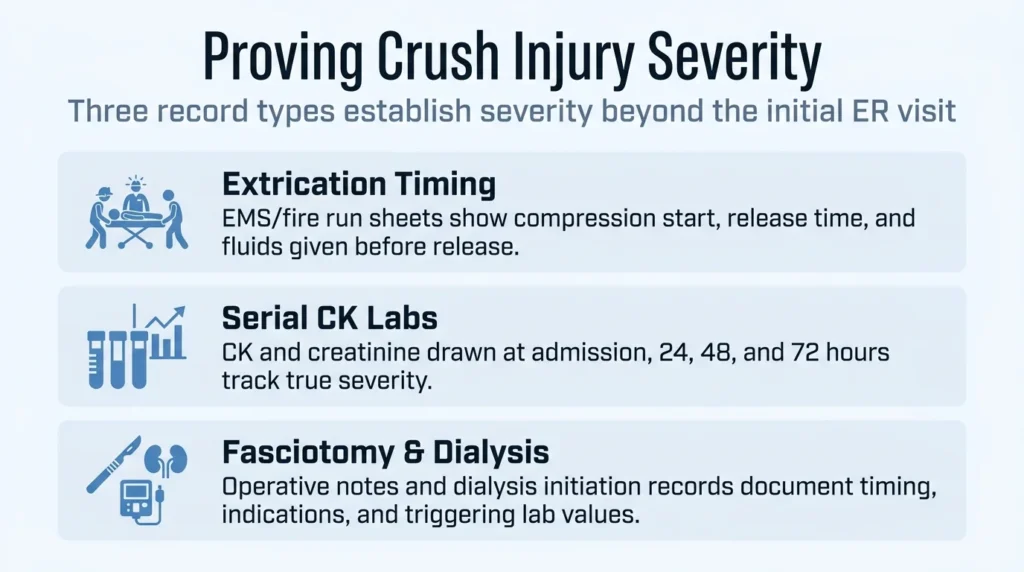
Severity is proven with three categories of objective, time-stamped records, not with how someone looked at the scene.
Extrication Timing and Duration
How long the body stays compressed is meaningful clinical data, not incidental paperwork, because reperfusion injury is triggered by the release itself.
CDC and ACEP guidance notes that large-volume fluid resuscitation is given before or at the moment of release for at-risk patients. Once the pressure lifts, the injured area can sequester up to roughly 12 liters of fluid over 48 hours.
Ask for the EMS and fire run sheet showing extrication start and release times, the dispatch and scene-clear timestamps, and any fluids given before release.
Serial Creatine Kinase & Renal Function Values
Creatine kinase, or CK, is the objective severity marker, and the trend matters more than any single value. Rhabdomyolysis is generally recognized at roughly five times the upper limit of normal, a commonly cited working threshold near 1,000 U/L.
CK level tracks with kidney outcomes. A cohort study of 73,036 adults with CK at or above 1,000 U/L found this gradient:
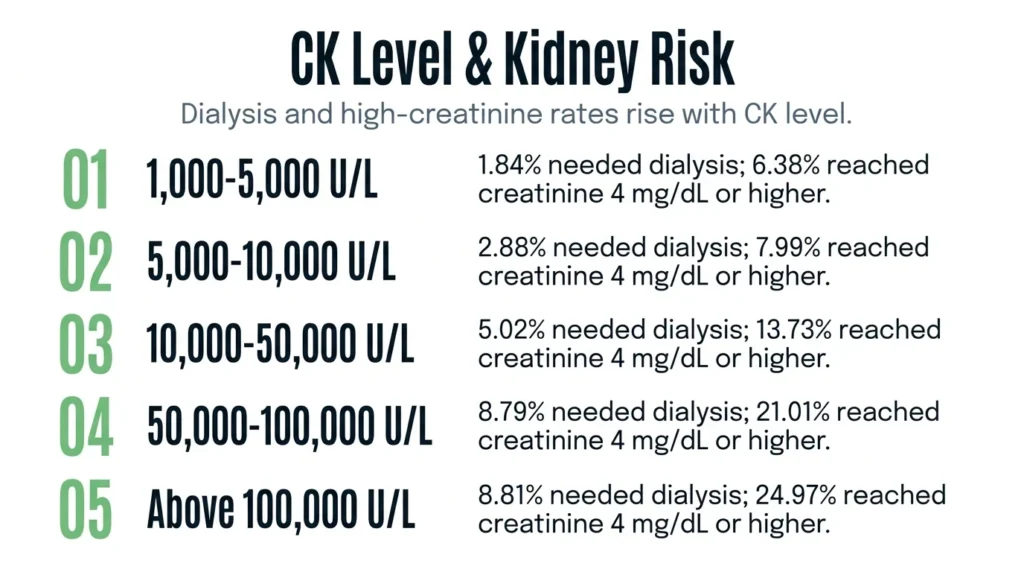
Those figures cover rhabdomyolysis from all causes, not crush injuries specifically, and were not adjusted for that mix. They show how renal risk scales with the muscle-breakdown mechanism that drives crush syndrome.
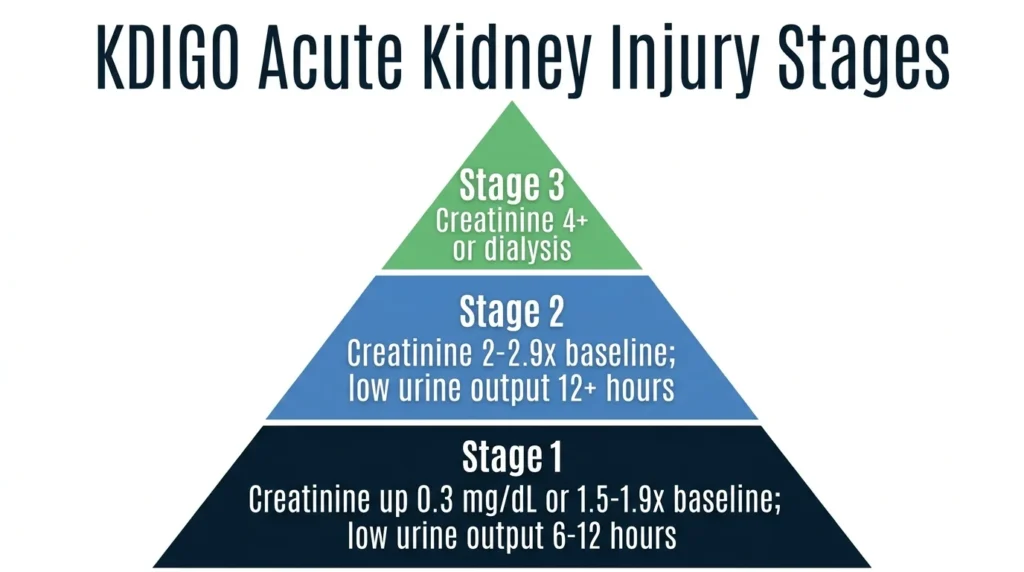
CK by itself is not proof of kidney injury. It correlates imperfectly with dialysis risk and is not an early predictor, so renal function has to be tracked separately against the KDIGO 2012 staging criteria for acute kidney injury:
- Stage 1: creatinine up 0.3 mg/dL, or 1.5 to 1.9 times baseline; urine under 0.5 mL/kg/hr for 6 to 12 hours
- Stage 2: creatinine 2 to 2.9 times baseline; urine under 0.5 mL/kg/hr for 12 hours or more
- Stage 3: creatinine 4.0 mg/dL or higher, 3 times baseline, or dialysis begun; urine under 0.3 mL/kg/hr for 24 hours or more, or none for 12 hours
A complete file holds serial CK draws at admission, 24, 48, and 72 hours, alongside creatinine and urine-output records measured against those stages. That trend shows the progression the first note missed.
Fasciotomy and Dialysis Records
Surgical and dialysis records are documentary proof of severity.
Compartment syndrome is hard to catch on a single exam. The classic warning signs are individually unreliable, and one normal exam does not rule it out, which is why serial re-examination every one to two hours is recommended.
Fasciotomy timing shapes the outcome. Release within six hours is associated with near-complete functional recovery, recovery declines through the six to 12-hour window, and it drops sharply past twelve hours. Delayed fasciotomy is separately associated with roughly double the amputation rate and triple the mortality rate in a 2008 combat-casualty series.
CDC and ACEP guidance reports that roughly half of crush syndrome patients develop acute renal failure, and roughly half of those require dialysis. A potassium level above about 7 mEq/L is a marker prompting urgent dialysis consideration.
Two records deserve particular attention: the operative note and time of incision for any fasciotomy, measured against the extrication time, and the dialysis initiation record showing the date, indication, and triggering potassium and creatinine values.
Why Texas Law Requires Expert Testimony to Link These Injuries to the Crash
Texas does not let “it happened after the crash” stand on its own for an injury like this. Expert medical testimony is required to connect a delayed, complex condition back to the collision.
Guevara v. Ferrer, a 2007 Texas Supreme Court decision, drew that line. Lay sequence-of-events evidence supports causation only for basic, observable injuries with an obvious temporal connection within a juror’s common knowledge, such as a broken bone right after a fall.
Complex conditions, those with several possible causes, and those whose link to a crash is not obvious to a lay observer require expert testimony.
The facts of that case make the point. The plaintiff’s later kidney dialysis followed a collision, and the court held that roughly $1.1 million in dialysis-related and other treatment costs could not stand without expert causation testimony.
Crush syndrome sits squarely in that category, because its renal, cardiac, and compartment complications develop over hours and days after an exam that looked fine. The extrication timeline, the CK and creatinine trend, and the fasciotomy or dialysis records are what an expert needs for that opinion, which is why they are never optional detail in Texas car accident claims.
Talk to an Angel Reyes & Associates Attorney About a Crush Injury Claim
A crush injury can lead to a dangerous heart rhythm within minutes or kidney failure days later, and the first medical record may capture almost none of it. That gap is where these claims get undervalued.
Angel Reyes & Associates has guided injured Texans through the legal process for more than 30 years, with investigators and accident reconstruction specialists who pull EMS extrication timelines, serial lab records, and operative notes.
Contact Angel Reyes & Associates for a free consultation to review your options. The team is reachable 24/7.
Past results do not guarantee future outcomes.
Crush Injury FAQs
What's the difference between a crush injury & crush syndrome?
A crush injury is direct compression damage to muscle, bone, and soft tissue. Crush syndrome is the systemic complication that can follow once the compression is released, as damaged muscle releases myoglobin and potassium into the bloodstream and can cause kidney failure or a dangerous heart rhythm.
Can you file a personal injury claim for kidney failure caused by a Texas car accident?
Potentially, but establishing that the crash caused a delayed condition such as kidney failure generally requires medical evidence and, in complex cases, expert testimony under Texas law.
Can a crush injury cause permanent kidney damage after a car accident?
Yes. Severe crush injuries can cause rhabdomyolysis and acute kidney injury, and some patients may require dialysis or experience lasting renal impairment depending on the severity and complications.
About the Authors

Angel Reyes
Writer
Angel L. Reyes, III is the Founder and Managing Partner of Angel Reyes & Associates. A nationally recognized trial attorney and business leader, Angel has helped over 70,000 injury victims recover more than $1 billion since founding the firm in 1993. Named to the Texas Super Lawyers list annually since 2008, Angel brings Wall Street experience, Ivy League education, and a deep commitment to client advocacy. He is a frequent legal commentator and published author with extensive contributions to legal scholarship, trial strategy, and consumer protection.

Graham Griffin
Editor
Graham Griffin is the Web & Content Manager at Angel Reyes & Associates, where he oversees content strategy, AI-powered workflows, a...

Angel Reyes
Reviewer
Angel L. Reyes, III is the Founder and Managing Partner of Angel Reyes & Associates. A nationally recognized trial attorney and business...