What’s the Difference Between Paraplegia & Quadriplegia?


Every article on this site is researched by our internal team, reviewed for legal accuracy against current Texas law, and held to State Bar of Texas advertising standards before publication. We do not publish content that overstates outcomes or makes promises about results.
Learn more about our
editorial standards .
Key Takeaways
- Quadriplegia affects all four limbs; paraplegia spares the arms and hands fully.
- The ASIA scale, not the label alone, mainly drives spinal injury case value.
- Early, repeat exams and a matched life care plan support fair compensation.
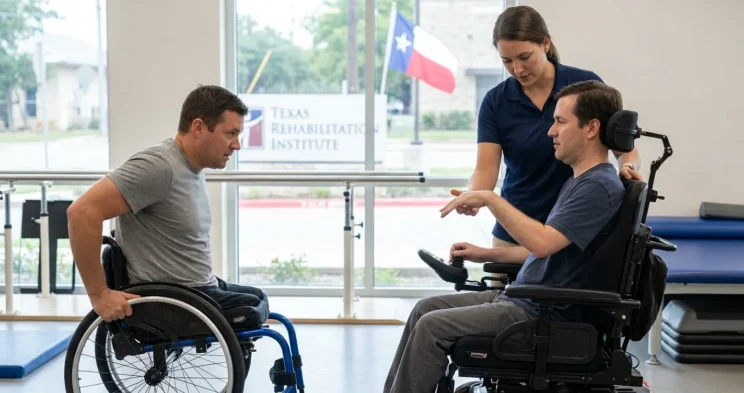
You’re in a hospital room in Texas, and a doctor has just used the words paraplegia or quadriplegia to describe what happened to your body after the crash. Both terms describe paralysis from a spinal cord injury, but they don’t mean the same thing.
Paraplegia and quadriplegia are distinguished by where the spinal cord injury sits and which limbs lose function. A second classification, whether the injury is complete or incomplete, plays an even larger role in prognosis and in what your case is worth.
How Paraplegia & Quadriplegia (Tetraplegia) Differ
Paraplegia and quadriplegia differ first by anatomy, meaning where the spinal cord injury occurs, and which limbs keep working afterward.
Paraplegia results from an injury generally described as running from the T1 or T2 level down through the sacral segments. It affects the trunk, legs, and pelvic organs, while arm and hand function stays intact.
Quadriplegia and tetraplegia describe the same condition. Tetraplegia is the term used in most current clinical and official documentation, though quadriplegia remains common in everyday conversation. It results from an injury between the C1 and T1 vertebrae in the neck, and it affects the muscles that control the head and neck, the shoulders, arms, hands, upper chest, pelvic organs, and legs.
By definition, quadriplegia and tetraplegia are the more severe patterns. They take away function in all four limbs rather than the lower body alone.
How the ASIA Impairment Scale Classifies Complete & Incomplete Injuries
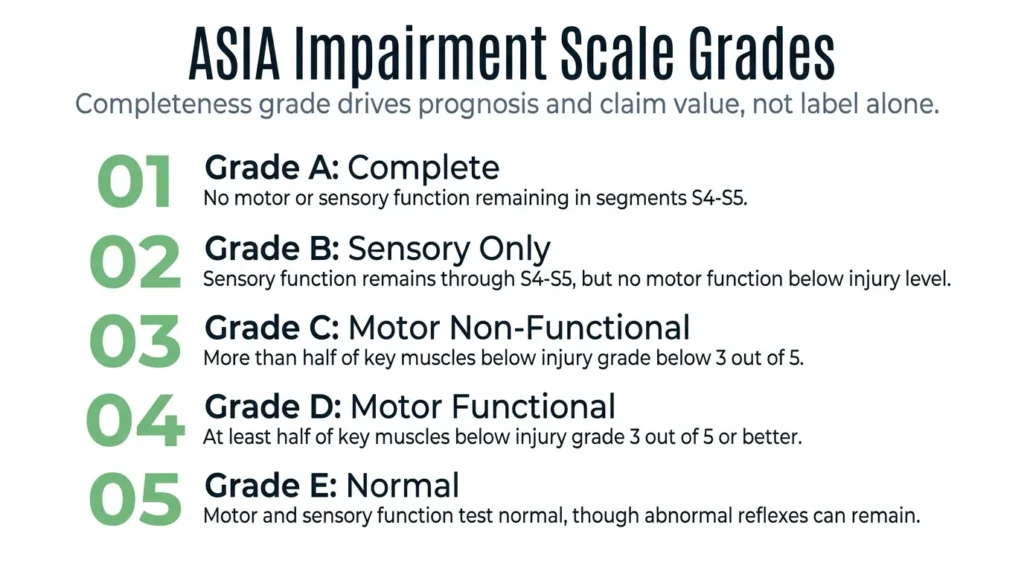
Regardless of whether an injury is labeled paraplegia or quadriplegia, every spinal cord injury also gets a separate grade of A through E on the ASIA Impairment Scale. That completeness grade, not the anatomical label alone, plays the biggest role in prognosis and, later, in what a claim is worth.
The ASIA Impairment Scale is part of the International Standards for Neurological Classification of Spinal Cord Injury, the grading system used across hospitals and rehabilitation centers. NASCIC
- Grade A, Complete: no motor or sensory function remains in the sacral segments S4 through S5.
- Grade B, Incomplete (sensory only): sensory function remains through S4 through S5, but no motor function remains below the injury level.
- Grade C, Incomplete (motor, non-functional): motor function remains below the injury level, but more than half of the key muscles below that level grade below 3 out of 5.
- Grade D, Incomplete (motor, functional): motor function remains below the injury level, with at least half of the key muscles below that level grading 3 out of 5 or better.
- Grade E, Normal: motor and sensory function test as normal, though abnormal reflexes can still show up.
Classifying an injury as complete or incomplete requires the early “spinal shock” period to resolve first. An exam performed right after the crash can be provisional. Doctors properly follow up with a repeat exam once that early shock passes.
The Practical Difference Between Complete & Incomplete Injury
A complete injury means total loss of sensory and motor function below the injury level, including the S4 through S5 segments. An incomplete injury means some sensory or motor function survives below that level, though how much varies widely from person to person.
Only incomplete injuries retain the spared nerve pathways that allow further recovery over time. Nobody can predict in advance how much function will return.
The federally designated UAB Spinal Cord Injury Model System reports that people with complete injuries often regain only one or two levels of muscle function. People with incomplete injuries are more likely to regain additional movement, though again, how much cannot be predicted ahead of time.
Continued improvement over months is a good sign. A long plateau without change points to a lower chance of further recovery.
Peer-reviewed research puts numbers behind this pattern. A Grade A classification carries a 91.7% probability that the patient will not walk independently again within a year. A Grade D classification carries a 97.3% probability that the patient will regain independent walking within a year.
Grades B and C fall in between and are much harder to predict. Fewer than 1% of people with a traumatic spinal cord injury show complete neurological recovery by the time they leave the hospital.
Why Does This Distinction Drive the Value of a Texas Injury Claim?
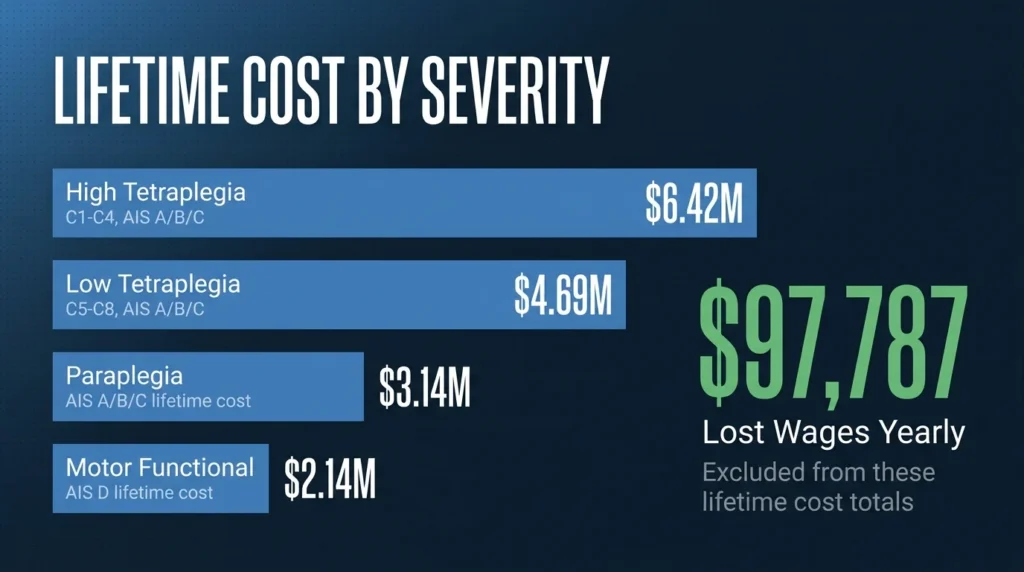
The AIS classification, not the paraplegia or quadriplegia label by itself, is what principally drives the value of a Texas spinal cord injury claim. It determines whether your life care plan is built around rehabilitation or around permanent attendant care, and those two paths carry very different price tags.
The National Spinal Cord Injury Statistical Center tracks average yearly and lifetime costs by injury severity, in 2025 dollars:
- High tetraplegia (C1-C4), AIS A/B/C: $1,446,827 in the first year, $251,246 each year after, and a lifetime cost from age 25 of $6,419,617.
- Low tetraplegia (C5-C8), AIS A/B/C: $1,045,459 in the first year, $154,128 each year after, and a lifetime cost from age 25 of $4,690,573.
- Paraplegia, AIS A/B/C: $705,131 in the first year, $93,409 each year after, and a lifetime cost from age 25 of $3,139,165.
- Motor functional at any level, AIS D: $472,190 in the first year, $57,353 each year after, and a lifetime cost from age 25 of $2,144,693.
These figures exclude lost wages and lost productivity, which separately average $97,787 a year.
AIS A through C classifications point to permanent, non-functional deficits, and they support a life care plan built around permanent attendant care. AIS D points to functional recovery, and it supports a rehabilitation-focused plan. The gap between those two paths runs into the millions of dollars over a lifetime.
Texas courts take life care plans seriously in catastrophic injury cases. A February 2026 Texas Bar Journal article confirms that a certified life care plan is a standard, often decisive piece of proof in these cases, typically prepared by a physiatrist or a certified life care planning nurse.
Texas Rule of Evidence 702 and cases like Brazos Contractors Development, Inc. v. Jefferson requires that specific future care recommendations tie back to a treating physician’s or qualified expert’s opinion before a jury can rely on them.
This is why documentation matters from day one. Repeat neurological exams that track any change in classification, a complete rehabilitation record, and a life care plan matched to the correct AIS grade all build the evidence that supports fair compensation after a car accident in Texas.
Common Causes of Paralysis After a Texas Car Accident
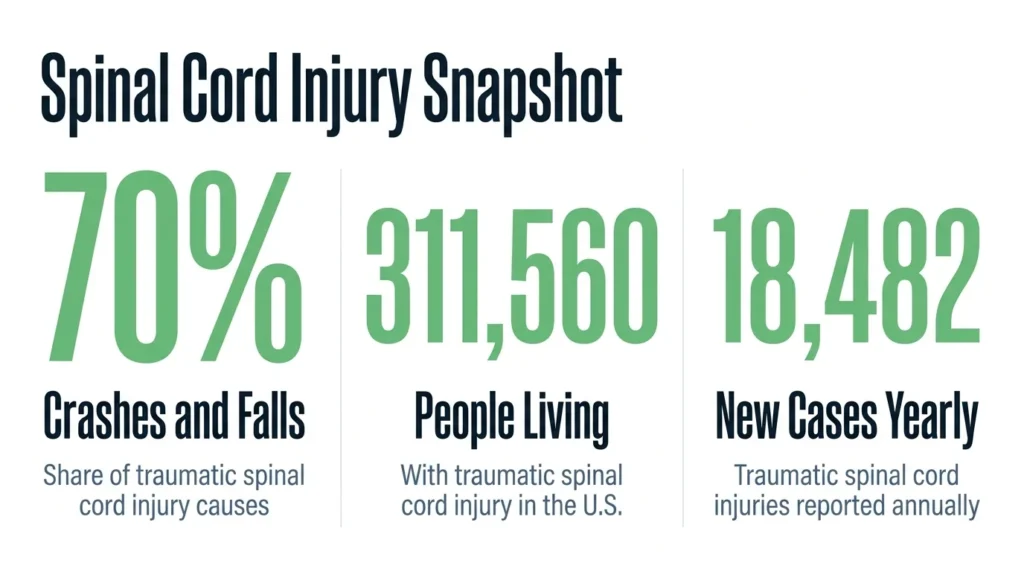
Motor vehicle crashes are among the leading causes of traumatic spinal cord injury nationwide. No published data breaks out spinal cord injuries by Texas crash statistics specifically, so the Texas relevance here comes from the venue and the Texas evidentiary rules covered above, not from a Texas-specific medical number:
- Motor vehicle crashes and falls together account for almost 70% of recent traumatic spinal cord injury cases nationally. Violence, mostly gunshot wounds, and sports or recreation account for about 23% combined. Vehicle crashes remain the most recent leading cause, closely followed by falls.
- The force involved in high-speed collisions, including truck accidents and motorcycle accidents, makes these crashes especially likely to cause the kind of high-energy trauma that damages the spinal cord.
- About 311,560 people were living with a traumatic spinal cord injury in the United States as of the most recent data, with roughly 18,482 new cases every year.
- Since 2015, incomplete tetraplegia has been the single most common category of traumatic spinal cord injury, at about 47.7%. Incomplete and complete paraplegia occur at roughly similar, much lower rates. Complete tetraplegia is the least common of the four categories, at about 11.8%. Full neurological recovery by hospital discharge is rare, at about 0.4%.
Talk to a Lawyer About Your Case
The classification your medical team documents today, whether that’s paraplegia or quadriplegia, complete or incomplete, will shape the life care plan your claim depends on. Early, thorough documentation makes a real difference later.
Angel Reyes & Associates has guided injured Texans through situations like this for over 30 years. If you or someone you love is facing a spinal cord injury after a Texas car accident, contact Angel Reyes & Associates for a free consultation to talk through your options.
Past results do not guarantee future outcomes.
Paraplegia vs. Quadriplegia FAQs
What is the difference between quadriplegia and hemiplegia?
Quadriplegia causes paralysis of all limbs, while hemiplegia causes paralysis on one side of the body only. Hemiplegia is usually caused by a traumatic brain injury or stroke rather than a spinal cord injury.
What does life look like after a spinal cord injury?
Daily life typically involves use of mobility aids, such as power or manual wheelchairs, vehicle and home modifications, assistive technology, ongoing medical care and physical therapy, and emotional and mental health support, such as counseling.
Can you collect punitive damages after a traumatic spinal cord injury?
Punitive damages are for instances of gross negligence or intentional harmful acts only. If either of these apply to your case, your lawyer may be able to request punitive damages.
About the Authors

Angel Reyes
Writer
Angel L. Reyes, III is the Founder and Managing Partner of Angel Reyes & Associates. A nationally recognized trial attorney and business leader, Angel has helped over 70,000 injury victims recover more than $1 billion since founding the firm in 1993. Named to the Texas Super Lawyers list annually since 2008, Angel brings Wall Street experience, Ivy League education, and a deep commitment to client advocacy. He is a frequent legal commentator and published author with extensive contributions to legal scholarship, trial strategy, and consumer protection.

Graham Griffin
Editor
Graham Griffin is the Web & Content Manager at Angel Reyes & Associates, where he oversees content strategy, AI-powered workflows, a...

Angel Reyes
Reviewer
Angel L. Reyes, III is the Founder and Managing Partner of Angel Reyes & Associates. A nationally recognized trial attorney and business...