Dealing With an Allstate Auto Accident Claim


Every article on this site is researched by our internal team, reviewed for legal accuracy against current Texas law, and held to State Bar of Texas advertising standards before publication. We do not publish content that overstates outcomes or makes promises about results.
Learn more about our
editorial standards .
Key Takeaways
- Delaying your claim or missing documentation can hurt your payout
- Don’t accept Allstate’s first settlement offer without legal review
- Know your policy and avoid giving statements without attorney guidance

You’re driving home along I-35 in Austin when another car runs a red light and slams into your passenger door. The other driver carries Allstate. Within 48 hours, an adjuster calls with a friendly tone and a settlement number that sounds reasonable on the surface.
Before you say yes, you need to understand how that number was built and how an Allstate auto accident claim works.
Allstate’s Colossus Software Settlement System
Allstate calculates many bodily injury offers using a software program called Colossus, which produces formulaic settlement values based on a narrow set of data inputs. The result is often a number that looks objective but undervalues what your claim is actually worth.
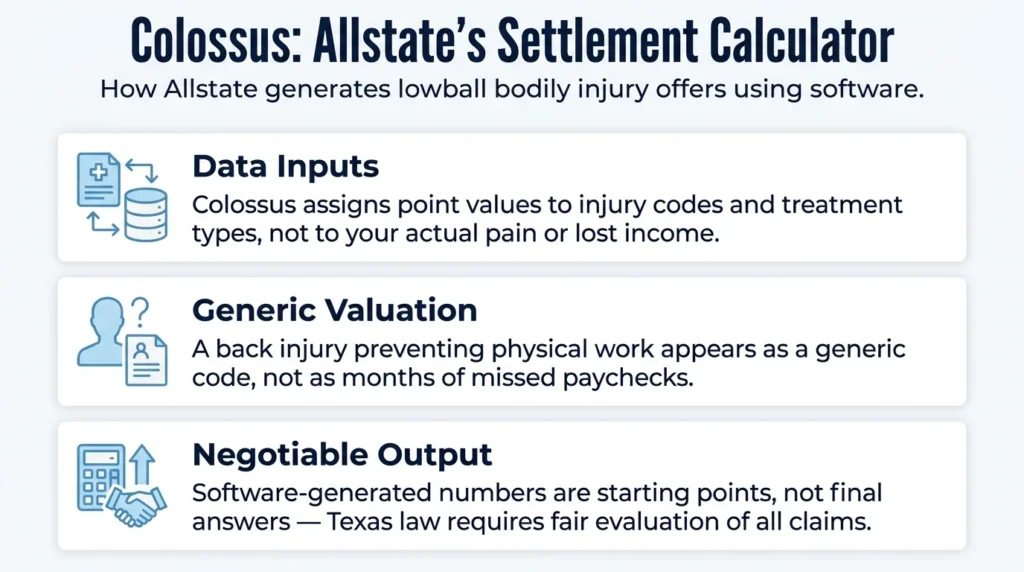
Colossus assigns point values to specific injury codes, treatment types, and recovery timelines. It struggles to account for the full picture of pain, lost income, or how an injury disrupts your daily life. A back injury that prevents you from doing physical work shows up in the system as a generic code, not as the months of missed paychecks you’re facing.
Adjusters frequently present these software-generated numbers as if they are fixed determinations. They are not. The Texas Department of Insurance claim settlement guidelines make clear that insurers must evaluate claims fairly, and software outputs are starting points, not final answers. Knowing that adjusters use these insurance company tactics after a car accident helps you push back with confidence.
Recorded Statement Requests & Your Rights
If Allstate insures the at-fault driver, you are not required under Texas law to give them a recorded statement. Allstate adjusters often request one within days of the crash, framing it as a routine step. It is not routine for you. It is a tool that helps them.

Early statements happen before you know the full extent of your injuries. A simple “I feel okay” said in the first week can be replayed later to dispute symptoms that emerge as soft tissue damage develops. Anything ambiguous you say can be used to question your credibility or reduce the value of your claim.
The Texas Insurance Code § 541.060 prohibits unfair settlement practices, including misrepresenting facts or policy provisions to claimants. That protection is crucial when adjusters imply a recorded statement is mandatory. Before agreeing to anything, review what your rights are around[recorded statements after car accidents and consider speaking with a car accident attorney first.
Common Allstate Settlement Tactics
Allstate adjusters use a predictable set of moves to keep payouts low. Recognizing them early helps you avoid accepting an offer that won’t cover your actual costs.
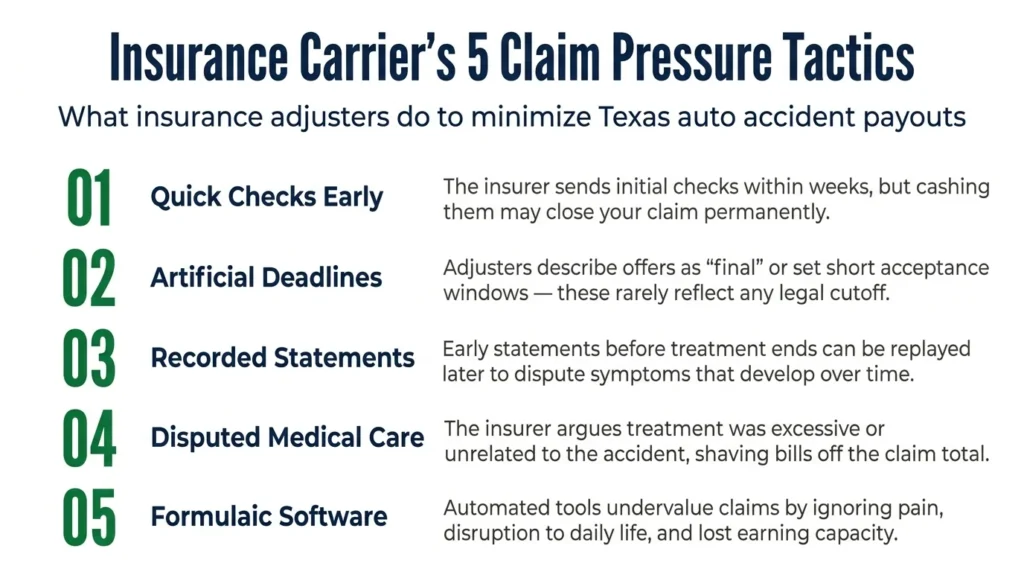
Quick offers before treatment ends. Allstate often sends an initial check within weeks of the crash. Cashing it may close your claim, even if you later need surgery or extended therapy.
Artificial deadlines. Adjusters describe offers as “final” or set short windows for acceptance. These pressure tactics rarely reflect any legal cutoff. Your real deadline is the Texas statute of limitations for personal injury, which gives you two years from the crash date.
Disputing medical care. Allstate may argue that your treatment was excessive, unnecessary, or unrelated to the accident. They use this to shave bills off the claim total and reduce pain-and-suffering calculations.
When these tactics cross into bad faith, Texas law provides remedies. Under Texas Civil Practice and Remedies Code § 41.003, exemplary damages may apply when a claimant proves by clear and convincing evidence that harm resulted from fraud, malice, or gross negligence. Our insurance bad faith work focuses on holding insurers accountable when they cross that line.
Protecting Your Interests in Texas
The strongest position you can take with Allstate is built on documentation and patience. Keep written records of every call, email, and offer. Save voicemails. Write down the date, name, and substance of every adjuster contact.
Do not settle until your doctor has released you or given a clear long-term prognosis. Settling early locks in a number that cannot grow if your condition worsens. Medical evaluations are the backbone of any fair settlement, because they translate your injuries into the evidence Allstate’s system actually responds to.
Texas law protects you against unfair settlement practices, and the state maintains official crash records through TxDOT that can support your version of events. Our firm’s case results show what’s possible when claims are built carefully and pushed hard against insurer resistance.
Work with an Attorney for Your Claim
Angel Reyes & Associates has extensive experience challenging insurance company tactics and securing fair compensation for Texas accident victims. With no fee unless we win and more than $1 billion recovered for clients, our team understands how to counter Allstate’s software-driven settlement calculations and pressure tactics. Contact us today to protect your rights and maximize your recovery.
Past results do not guarantee future success.
Allstate Auto Accident Claim FAQs
Can I negotiate with Allstate if they say their settlement offer is final?
Yes, settlement offers are almost always negotiable despite adjuster claims of finality. These “final offer” statements are pressure tactics rather than legal limitations.
What happens if I already gave Allstate a recorded statement?
The statement becomes part of your claim file and may be used to challenge later testimony or medical claims. However, it does not automatically disqualify you from fair compensation.
How long does Allstate typically take to process accident claims in Texas?
Simple property damage claims often resolve within 30-60 days, while bodily injury claims can take several months to over a year depending on medical treatment duration and dispute complexity.
Does Allstate have to pay for a rental car while my vehicle is being repaired?
If the Allstate policyholder caused your accident, their liability coverage should include reasonable rental expenses while your car is being repaired or until total loss settlement.
Can Allstate access my medical records from before the accident?
Allstate may request pre-existing medical records to argue that current injuries were not caused by the accident. You have the right to limit which records are released and should consult an attorney before signing broad medical releases.
About the Authors

Angel Reyes
Writer
Angel L. Reyes, III is the Founder and Managing Partner of Angel Reyes & Associates. A nationally recognized trial attorney and business leader, Angel has helped over 70,000 injury victims recover more than $1 billion since founding the firm in 1993. Named to the Texas Super Lawyers list annually since 2008, Angel brings Wall Street experience, Ivy League education, and a deep commitment to client advocacy. He is a frequent legal commentator and published author with extensive contributions to legal scholarship, trial strategy, and consumer protection.

Kyle Nicolas
Editor
Kyle Nicolas is the Web Content & SEO Manager at Angel Reyes & Associates. He has more than 10 years of experience as a marketing co...

Spencer Browne
Reviewer
Spencer Browne is a partner at Angel Reyes & Associates and a Board Certified personal injury trial lawyer with nearly 100 jury trials a...