What’s the Difference Between a Herniated & a Bulging Disc?


Every article on this site is researched by our internal team, reviewed for legal accuracy against current Texas law, and held to State Bar of Texas advertising standards before publication. We do not publish content that overstates outcomes or makes promises about results.
Learn more about our
editorial standards .
Key Takeaways
- A bulge is broad and degenerative; a herniation is focal and can tear the annulus.
- Disc bulges appear in most pain-free adults, which fuels the wear-and-tear defense.
- Texas law needs a treating doctor's causation opinion, not just crash timing.

The MRI report comes back after your crash and one word inside it starts shaping your whole claim. One radiologist writes “bulge.” Another, looking at similar anatomy, writes “herniation.”
Here is the short answer. A bulging disc is a broad, wraparound displacement of disc material past the edges of the vertebral bones, with the tough outer wall of the disc still intact. A herniated disc is a focal displacement, meaning the material pushes out at one spot, and it can involve a tear in that outer wall.
They are two different findings, not two grades of the same injury. That distinction is where an insurance adjuster will start building a reason to pay you less.
How a Bulging Disc & a Herniated Disc Differ on an MRI
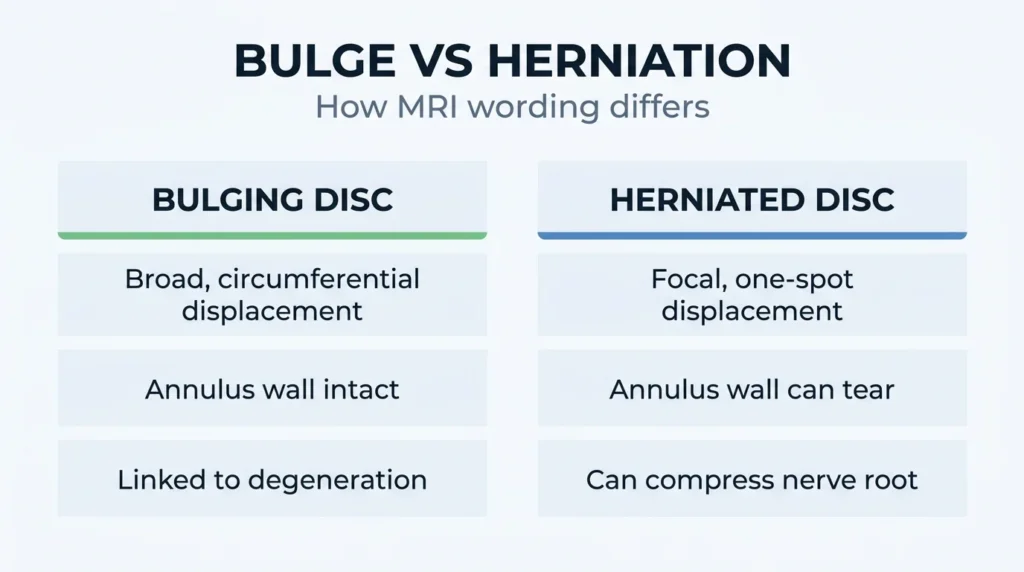
Radiologists work from a shared naming standard, the lumbar disc nomenclature adopted by the North American Spine Society and the spine radiology societies, and that standard treats a bulge and a herniation as separate categories rather than two points on one severity scale.
A bulge is disc tissue extending beyond the vertebral margins in a broad, circumferential pattern, with the annulus (the disc’s outer wall) grossly intact. It is the finding most often attributed to ordinary disc degeneration.
A herniation is focal. Only part of the disc’s circumference is involved, and the nomenclature divides herniations into two forms.
A protrusion stays contained. The displaced material is narrower than the base it comes from, so the outer wall still holds it in place.
An extrusion is uncontained. In at least one plane the displaced material is wider than its base, or it has lost continuity with the disc it came from. Extrusions are generally treated as more serious because they are more likely to compress a nerve root and to irritate that nerve chemically when inner disc material reaches neural tissue.
A bulge is not a mild herniation. Under this nomenclature it is a different category of finding altogether.
Why the Radiology Report’s Wording Matters More Than Your Symptoms
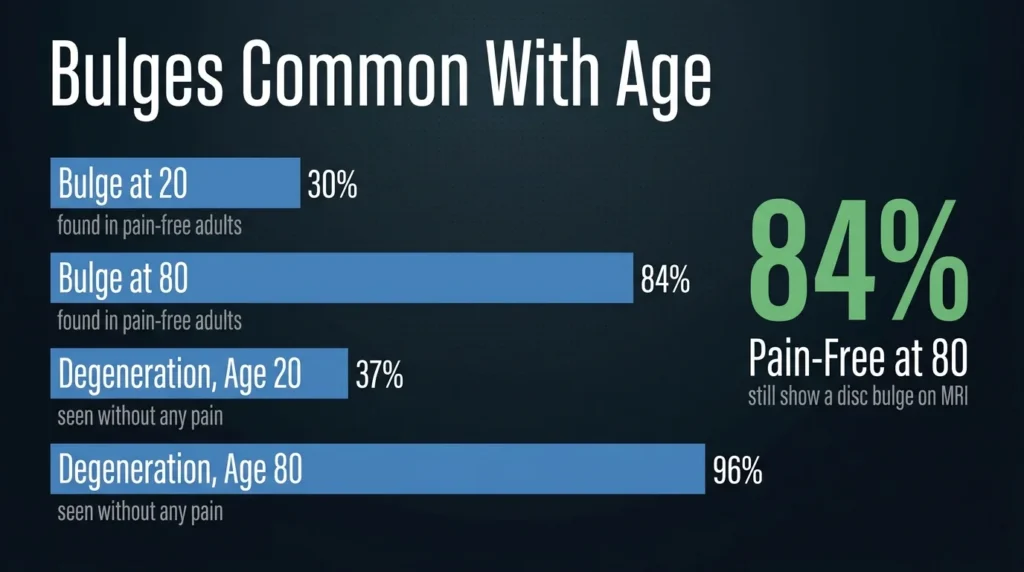
Disc bulges are so common in people who feel perfectly fine that the word alone hands the defense an argument. A systematic review of spine imaging in people with no back pain found disc bulges in roughly 30% of 20-year-olds, rising to roughly 84% of 80-year-olds. Disc degeneration ran from about 37% to about 96% across the same age span.
Consider those numbers in claims terms. If most pain-free adults your age already show a bulge on film, an adjuster can argue that yours predates the collision and has nothing to do with it.
A focal herniation or extrusion does not invite that argument the same way, particularly when the finding lines up with documented nerve symptoms such as radiating leg pain, numbness, or weakness.
That is why the term the radiologist dictated can influence how a herniated disc claim gets valued in a Texas car accident more than your pain level does. None of this predicts what any individual claim is worth. It tells you where the argument begins.
How Texas Insurers Argue a Disc Injury Is Degenerative Rather Than Traumatic
The defense playbook comes straight out of the imaging vocabulary. A bulge gets characterized as age-related wear that was always there.
A herniation or extrusion gets treated as the only finding a collision could plausibly cause. Anything else becomes something you brought to the wreck with you.
Texas law answers that argument directly. A defendant who aggravates a pre-existing condition remains responsible for the aggravation, including when quiet degenerative changes in your spine never caused pain until the crash.
Jurors hear this in the court’s charge. The Texas Pattern Jury Charges for general negligence include separate instructions for a pre-existing condition that was not aggravated, one that was already symptomatic and then made worse, and one that was asymptomatic before the occurrence, the eggshell plaintiff situation.
The doctrine only helps you when proof stands behind it. No jury reaches the aggravation instruction unless the evidence connects your current condition to the collision, and assembling that evidence is the core work of a Texas car accident injury claim.
Building the Evidence That Ties a Disc Finding to Your Crash
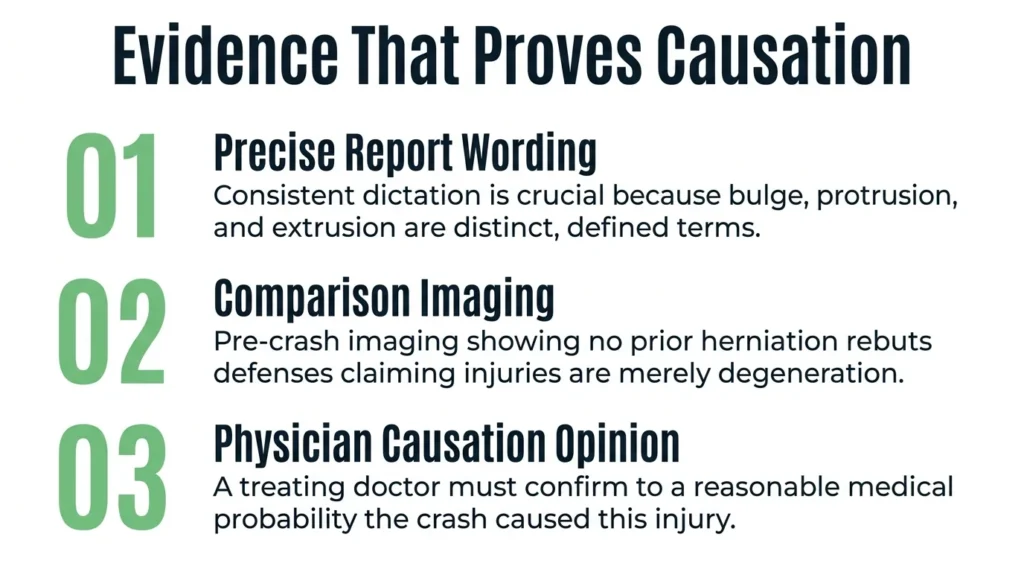
Three pieces of evidence turn an imaging finding into a provable injury claim:
- Precise, consistent report wording. Bulge, protrusion, and extrusion are defined terms with different meanings, so loose or inconsistent dictation is itself a risk to your claim. The same underlying anatomy can read very differently depending on which word appears in the report.
- Comparison imaging. A pre-crash image or report showing no herniation, set against post-crash imaging showing a new focal herniation or extrusion, is the most direct rebuttal to a degeneration defense.
- A treating physician’s causation opinion. In Guevara v. Ferrer, 247 S.W.3d 662 (Tex. 2007), the Texas Supreme Court held that lay testimony can establish medical causation only in limited circumstances where general experience and common sense allow a layperson to evaluate the link. More complex conditions require expert evidence stated to a reasonable degree of medical probability.
A disc herniation, especially alongside degenerative changes, is not something a jury can causally connect on its own. That makes your doctor’s opinion tying the finding to the crash mechanism a legal necessity rather than a helpful extra.
Timing by itself will not carry it. The fact that your pain started after the collision is not, standing alone, proof the collision caused the injury.
Building this record early is much of the work behind maximizing a herniated disc injury claim in Texas. Figures you find online, including general overviews of average settlements for herniated discs, describe other people’s records. Yours will be decided on the evidence in your own file.
Talk to an Attorney About Your Disc Injury Claim
Whether your MRI reads bulge or herniation, you should not have to translate radiology language or push back on a wear-and-tear defense by yourself.
Angel Reyes & Associates has guided injured Texans through claims like this for more than 30 years, and you can reach the firm 24/7. Our team can review your imaging, your treatment records, and the causation evidence your claim will need.
Request a free consultation to go over where your case stands.
Past results do not guarantee future outcomes.
Herniated vs. Bulging Disc FAQs
Can a bulging disc still qualify for compensation in a Texas personal injury claim, or only a herniation?
Yes, a bulging disc can support a compensable claim; Texas law requires no specific radiology label, only proof the crash caused or aggravated the finding. Because bulges are common in pain-free people, insurers often argue a bulge predates the crash, so documented medical causation matters.
If I had a bulging disc before my accident, can I still recover for a new or worsened injury?
Yes. Texas recognizes the aggravation doctrine, so a defendant who worsens a pre-existing condition, including an asymptomatic degenerative bulge, remains responsible for that aggravation, provided the evidence connects the worsening to the collision.
Do I need a doctor's opinion connecting my disc injury to the crash, or is the MRI report enough by itself?
The MRI report by itself is not enough under Texas law. Under Guevara v. Ferrer, the Texas Supreme Court held that a disc injury’s cause is outside common lay knowledge, so a treating or retained physician must state to a reasonable degree of medical probability that the crash caused or aggravated the finding.
About the Authors

Angel Reyes
Writer
Angel L. Reyes, III is the Founder and Managing Partner of Angel Reyes & Associates. A nationally recognized trial attorney and business leader, Angel has helped over 70,000 injury victims recover more than $1 billion since founding the firm in 1993. Named to the Texas Super Lawyers list annually since 2008, Angel brings Wall Street experience, Ivy League education, and a deep commitment to client advocacy. He is a frequent legal commentator and published author with extensive contributions to legal scholarship, trial strategy, and consumer protection.

Graham Griffin
Editor
Graham Griffin is the Web & Content Manager at Angel Reyes & Associates, where he oversees content strategy, AI-powered workflows, a...

Angel Reyes
Reviewer
Angel L. Reyes, III is the Founder and Managing Partner of Angel Reyes & Associates. A nationally recognized trial attorney and business...