Do I Need to Replace My Motorcycle Helmet After a Crash?


Every article on this site is researched by our internal team, reviewed for legal accuracy against current Texas law, and held to State Bar of Texas advertising standards before publication. We do not publish content that overstates outcomes or makes promises about results.
Learn more about our
editorial standards .
Key Takeaways
- A motorcycle helmet's EPS liner is designed for a single impact; it cannot reliably protect you in a second crash even when the outer shell looks undamaged.
- Replace a motorcycle helmet immediately after any crash where it contacts pavement, and consider replacement after significant drops onto hard surfaces.
- A crashed helmet is physical evidence: preserve it with photographs before replacement, especially if you plan to file an injury claim.
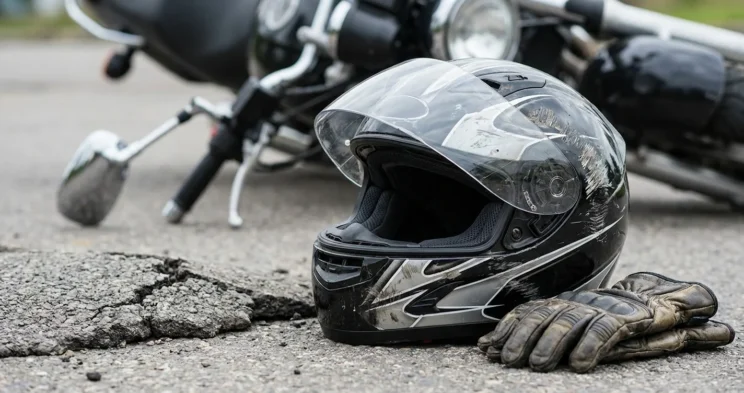
You walked away from the crash, and your helmet looks fine from the outside. No cracks, no scuffs, nothing. But despite how it looks, the hard truth most riders don’t want to hear is simple: you need to replace it.
Helmets Are Designed for One Impact Only
A motorcycle helmet has two jobs. The hard outer shell spreads out the force of a crash, while the expanded polystyrene (EPS) foam inner liner crushes to absorb the rest. That foam liner is what saves your life – and it only works once.
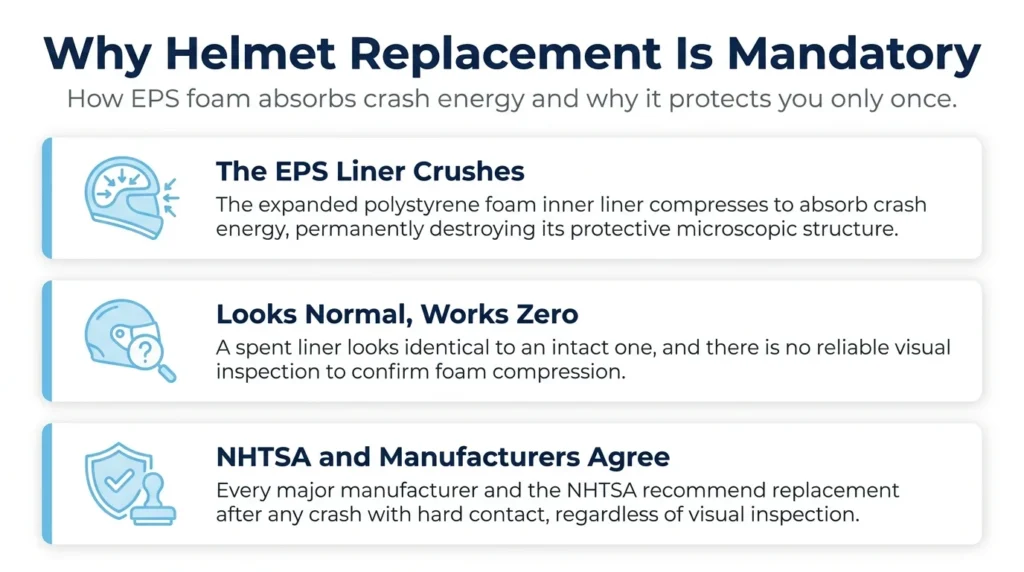
EPS foam is a single-use material by design. When the liner compresses to absorb energy during a crash, it does not spring back. The microscopic structure that gave it protective capacity is gone. The foam may look the same. The helmet may look the same. But the liner has already done its work, and it will not do it again in a second impact.
This is why the National Highway Traffic Safety Administration (NHTSA) and every major helmet manufacturer recommend replacement after any crash in which the helmet made contact with a hard surface. Passing a visual inspection is not a substitute for that replacement. There is no way to confirm whether the liner has been spent by looking at it. The only reliable test would destroy the helmet in a laboratory.
Any rider who wears a helmet on the road after being involved in a motorcycle accident is taking a huge risk that can have devastating consequences. Common motorcycle accident injuries include traumatic brain injuries, which proper helmet function is specifically designed to prevent.
When Should a Helmet Be Replaced?
The replacement rule applies to any incident in which the helmet makes contact with pavement, another vehicle, or a fixed object with any real force.
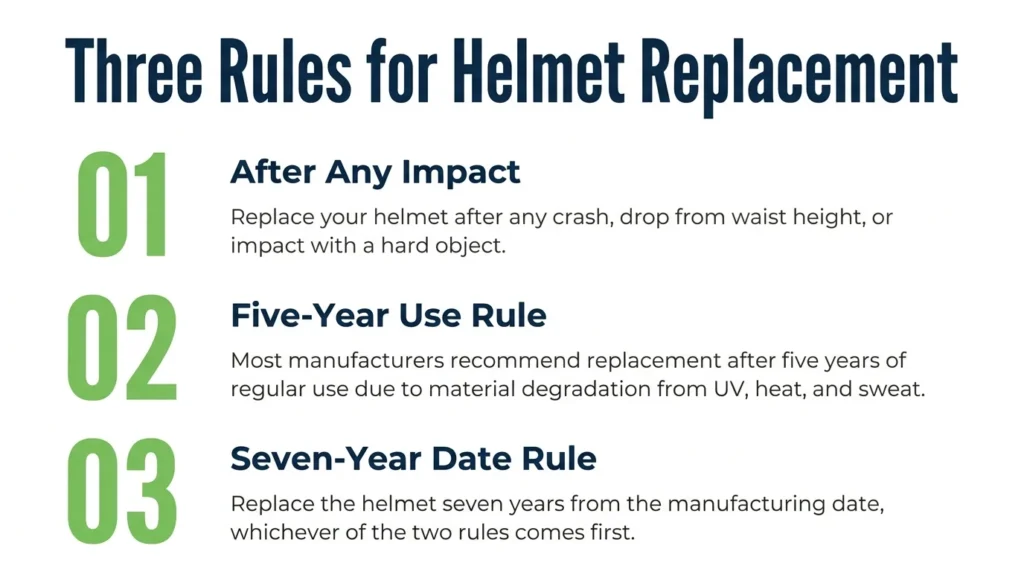
Even helmets that are dropped or involved in low-speed accidents should be replaced. A helmet that falls from your handlebars onto a hard floor at rest is obviously at less risk than one that hits asphalt at 45 mph, but this type of incident can still cause irreversible damage. If the helmet drops onto pavement from more than waist height, it should be replaced.
Since you cannot determine if the EPS liner was damaged by looking at it, the conservative answer, and the one all major safety organizations support, is to replace your helmet after any significant drop or crash event.
The Five-Year Rule
The adhesives that bond the liner to the shell, the padding that cushions your head, and the EPS liner itself can all degrade with exposure to UV light, heat cycles, sweat, and hair products. This gives helmets something of an expiration date.
Most helmet manufacturers recommend replacing a motorcycle helmet after either five years of use or seven years after the manufacturing date, whichever comes first. That manufacturing date is printed on a label inside the helmet, typically under the padding near the chin strap attachment.
A helmet used regularly outdoors in Texas summers ages faster than one kept in a climate-controlled garage.
According to Texas Transportation Code (TTC) § 661.003, helmets worn on Texas roads must meet DOT safety standards. While a police officer won’t ticket you solely for wearing an expired helmet, doing so carries massive legal risk during an injury claim. If an insurance adjuster proves your helmet was past its five-year serviceable life, they will argue you knowingly wore compromised safety gear, using it to shift comparative fault onto you for your head injuries.
Why Your Damaged Helmet Matters in a Texas Injury Claim
Your damaged helmet is physical evidence of the force involved in your accident. If you plan to file an insurance claim or pursue a personal injury case, your attorney or an accident investigator may need to examine it. Discarding or cleaning the helmet before that examination happens can weaken your case.
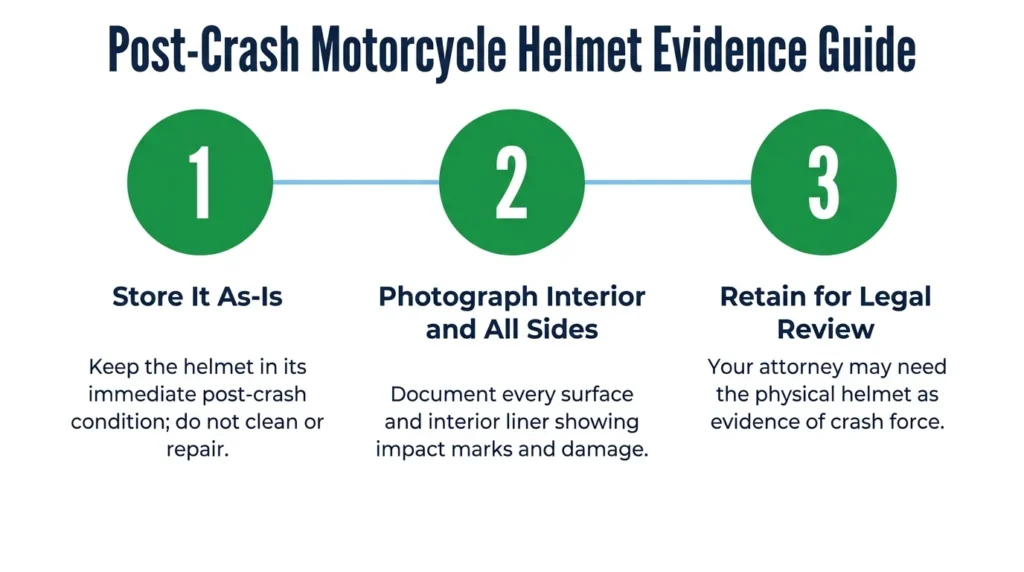
Here’s what you should do with your damaged helmet after a crash:
- Store the helmet as it was after the crash.
- Do not clean the damaged areas.
- Do not attempt repairs.
- Photograph all sides, including the interior liner, before you put it away.
- Document the chin strap condition and any exterior marks or scuffs that show contact points.
Talk to an Attorney About Your Accident
If a crash left you with injuries and a damaged helmet, the decisions you make in the days afterward matter. Angel Reyes & Associates represents injured Texas riders and handles motorcycle accident cases across the state with no fees unless we win. Our case results reflect our record of success, including handling serious and catastrophic injury cases.
Do not discard your helmet before speaking with an attorney. Contact us to discuss your case and receive compassionate guidance. We offer free consultations and 24/7 assistance.
Motorcycle Helmets Replacement FAQs
Does not wearing a helmet affect my motorcycle accident claim in Texas?
Not wearing a helmet can give the defense a basis to argue you contributed to the severity of your head injuries, which may reduce your compensation under Texas proportionate fault rules. If your injuries are unrelated to head trauma, such as broken bones or spinal damage, the helmet argument carries less weight.
Can I make an insurance claim for my damaged motorcycle helmet?
A damaged helmet is typically treated as property damage in a motorcycle accident claim. If the at-fault driver caused the crash, their liability coverage may cover replacement cost. Your own motorcycle policy’s collision or property damage coverage may also apply, depending on your specific policy terms.
Does Texas require all motorcycle riders to wear a helmet?
Texas Transportation Code § 661.003 requires a DOT-compliant helmet for all riders, with a major exception: riders 21 and older may legally ride without a helmet if they have completed an approved motorcycle safety course OR carry a health insurance plan providing at least $10,000 in medical benefits for motorcycle-related injuries.
What should I look for when buying a replacement motorcycle helmet?
Choosing the right helmet is crucial. Look for the DOT certification label on the back of the helmet, which confirms federal safety compliance. Helmets that also carry Snell or ECE 22.06 certification have passed independent testing with stricter standards. Make sure the helmet fits snugly without pressure points, as proper fit is part of how the EPS liner protects you during an impact.
About the Authors

Angel Reyes
Writer
Angel L. Reyes, III is the Founder and Managing Partner of Angel Reyes & Associates. A nationally recognized trial attorney and business leader, Angel has helped over 70,000 injury victims recover more than $1 billion since founding the firm in 1993. Named to the Texas Super Lawyers list annually since 2008, Angel brings Wall Street experience, Ivy League education, and a deep commitment to client advocacy. He is a frequent legal commentator and published author with extensive contributions to legal scholarship, trial strategy, and consumer protection.

Kyle Nicolas
Editor
Kyle Nicolas is the Web Content & SEO Manager at Angel Reyes & Associates. He has more than 10 years of experience as a marketing co...

Angel Reyes
Reviewer
Angel L. Reyes, III is the Founder and Managing Partner of Angel Reyes & Associates. A nationally recognized trial attorney and business...