Do You Need a License for an Electric Motorcycle?


Every article on this site is researched by our internal team, reviewed for legal accuracy against current Texas law, and held to State Bar of Texas advertising standards before publication. We do not publish content that overstates outcomes or makes promises about results.
Learn more about our
editorial standards .
Key Takeaways
- Texas classifies electric vehicles by motor power and speed, not by what a seller calls them.
- Electric motorcycles exceeding 750 watts or 28 mph require a Texas Class M license to ride legally.
- Riding without a required license can reduce your personal injury recovery after a crash.
How Texas Law Classifies Electric Vehicles
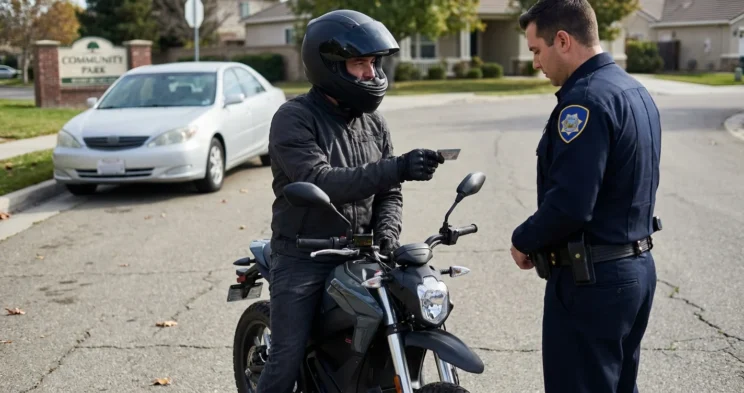
Texas law uses four classifications for electric two-wheelers: electric bicycle, moped, motorcycle, and off-highway vehicle. Each classification carries its own set of requirements. The one your vehicle falls into is determined by motor power and top speed, not by what a manufacturer printed on the box.
Electric Bicycle
Under Texas Transportation Code Chapter 664, an electric bicycle is a vehicle with fully operable pedals, a motor under 750 watts, and a top assisted speed of 28 mph or less. Texas recognizes three classes within this definition. Class 1 bikes provide pedal assist only, and they go up to 20 mph. Class 2 bikes can use the motor without pedaling, and go up to 20 mph. Class 3 bikes assist while pedaling, and go up to 28 mph.
If your vehicle is a Class 1, 2, or 3 bike, you do not need a license, registration, or insurance to ride it on Texas roads. The law treats it the same as a conventional bicycle.
Moped vs. Motorcycle
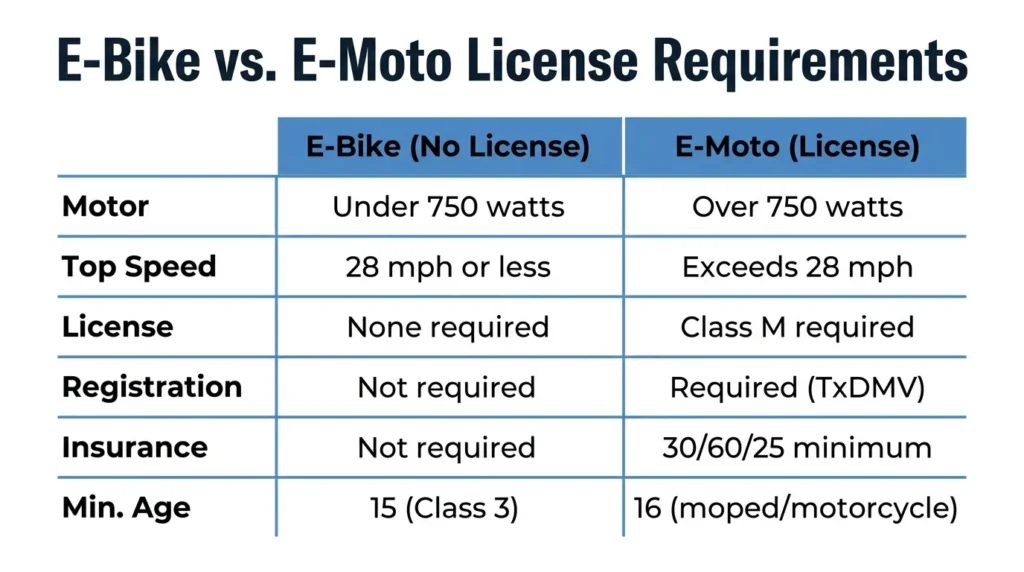
Once a vehicle exceeds e-bike thresholds, it becomes a motor vehicle under Texas law. Texas Transportation Code § 541.201 defines a moped as a motor vehicle with a rider’s saddle that cannot exceed 30 mph, cannot produce more than 5 brake horsepower, and runs on an internal combustion engine of 50 cubic centimeters or less. Texas requires a Class M license with a P36 (moped) restriction for moped riders. The P36 restriction limits you to mopeds only and does not require a motorcycle skills test, only a written knowledge exam. The vehicle must be registered, inspected, and insured at the Texas minimum liability limits.
A motorcycle is any motor vehicle with a rider’s saddle designed for not more than three wheels on the ground, without the speed or power limits that cap a moped.
Most electric vehicles marketed as “e-motos” are not mopeds. If your e-moto motor exceeds 5 brake horsepower or its top speed exceeds 30 mph, it is considered a motorcycle. Under Texas Transportation Code § 521.084, a Class M license is required to operate a motorcycle on public roads. Riders must complete a Texas Department of Public Safety-approved motorcycle operator training course as part of the licensing process. The vehicle must be titled, registered, inspected, and insured at Texas minimums.
Do I Need a License for Surrons & Talarias?
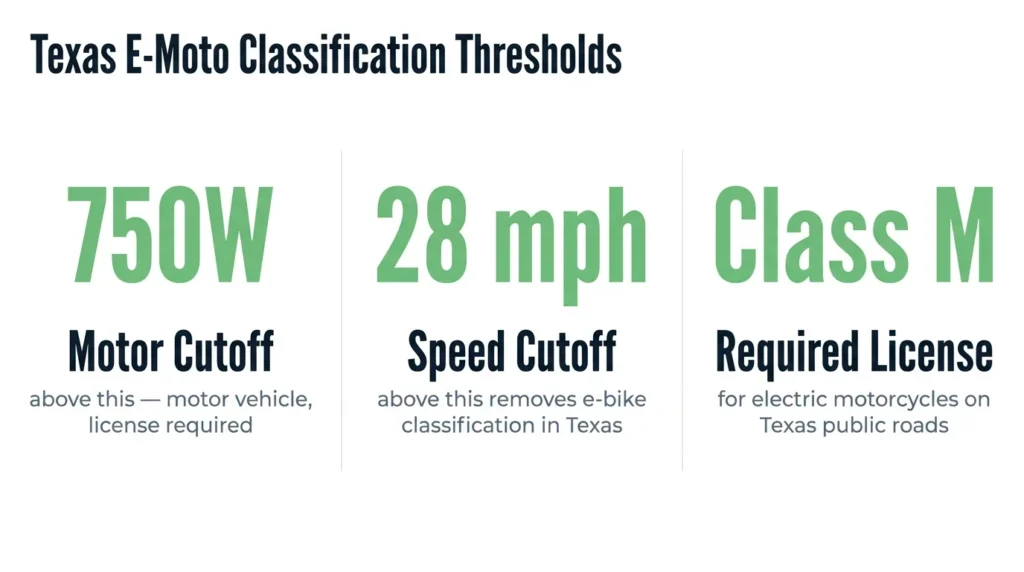
Surron and Talaria models generate far more than 750 watts of power and can reach speeds well past 28 mph. That rules out the electric bicycle classification. Whether they qualify as mopeds or motorcycles depends on their specific specs, but most configurations are considered motorcycles.
Off-Road Use
For off-road use on private land or at Texas Parks and Wildlife OHV areas, no Class M license is required. A Texas OHV decal is required for use on public off-highway vehicle lands. The Texas Parks and Wildlife Department runs the OHV program and sets the requirements for where these vehicles can operate legally.
Street Use
These bikes were not manufactured to meet Federal Motor Vehicle Safety Standards, which are the federal baseline required before a vehicle can be titled and registered for public road use in Texas. Riders attempting to make a Surron street-legal typically face significant modification costs and a complicated registration process.
Crashing an E-Bike Without a License
According to Texas Transportation Code § 521.021, riders need a valid driver’s license to operate any motor vehicle on a Texas public road. Riding an electric motorcycle that exceeds moped or e-bike thresholds without a Class M license is a violation of the law.
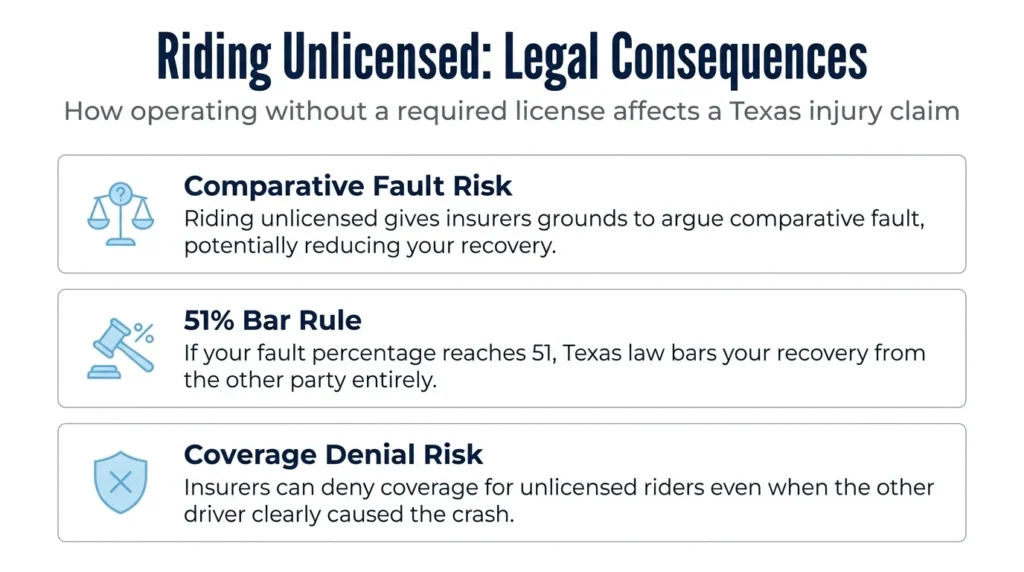
If you are involved in a crash while driving without a license, this violation does not automatically make you responsible for a crash caused by someone else. But it does make it easier for the other side to form a claim against you. Texas uses a proportionate responsibility system under Texas Civil to determine fault. Your recovery is reduced by your share of fault, and that number can be impacted by driving without a license.
An insurance company or opposing attorney will argue that riding without a required license contributed to the crash or its outcome. They do not need to prove you caused the accident. They need to push enough fault onto you to reduce what they owe. If the fault assigned to you reaches 51 percent, you recover nothing.
Being involved in a motorcycle accident without a license can also impact your own personal insurance. Most personal auto and motorcycle policies include a clause allowing the insurer to deny claims when the insured was engaged in an illegal act at the time of the loss. An unlicensed rider can face denial of coverage for medical bills and property damage even when the other driver was clearly at fault.
If you were in a crash while riding an electric vehicle whose classification and licensing requirements were unclear, talking through your situation with a personal injury attorney can clarify what you are actually dealing with before the insurer closes your file. You may also find our uninsured motorist accident guide helpful.
Talk to Angel Reyes & Associates About Your Situation
Licensing questions can get complicated when a crash is involved. Classification disputes, insurance denials, and comparative fault arguments can all turn a straightforward personal injury claim into a contested fight.
Angel Reyes & Associates has guided injured Texans through motorcycle and e-mobility cases for over 30 years. We offer free consultations and work on a contingency basis, meaning you pay no fees unless we win.
If you were involved in a crash on an electric motorcycle, e-moto, or high-powered e-bike and have questions about how your licensing status affects your options, contact us to review your situation. We are available 24/7 to discuss your case.
Past results do not guarantee future outcomes.
E-Moto FAQs
Can a 15-year-old ride an electric motorcycle in Texas?
A 15-year-old may ride a Class 1 or Class 2 electric bicycle in Texas without a license. Class 3 e-bikes require the rider to be at least 16. For mopeds, a 15-year-old can obtain a Class M license with a P36 restriction after passing a written knowledge exam.
What happens to the other driver's liability if I was riding without a license?
The other driver can still be held liable for the crash if they caused it. However, your lack of a required license gives their insurer grounds to argue comparative fault, and any fault percentage assigned to you reduces your recovery under Texas law.
Can I register a Surron or Talaria for street use in Texas?
Most factory-stock Surron and Talaria models cannot be registered for Texas street use because they were not manufactured to meet Federal Motor Vehicle Safety Standards. Some riders attempt to modify these bikes to meet FMVSS requirements before pursuing registration, but the process is complex and not guaranteed to succeed.
Is riding an electric motorcycle without a license a criminal offense in Texas?
Operating a motor vehicle on a Texas public road without a required license is a misdemeanor offense under Texas law. The charge does not depend on whether an accident occurred.
About the Authors

Angel Reyes
Writer
Angel L. Reyes, III is the Founder and Managing Partner of Angel Reyes & Associates. A nationally recognized trial attorney and business leader, Angel has helped over 70,000 injury victims recover more than $1 billion since founding the firm in 1993. Named to the Texas Super Lawyers list annually since 2008, Angel brings Wall Street experience, Ivy League education, and a deep commitment to client advocacy. He is a frequent legal commentator and published author with extensive contributions to legal scholarship, trial strategy, and consumer protection.

Kyle Nicolas
Editor
Kyle Nicolas is the Web Content & SEO Manager at Angel Reyes & Associates. He has more than 10 years of experience as a marketing co...

Angel Reyes
Reviewer
Angel L. Reyes, III is the Founder and Managing Partner of Angel Reyes & Associates. A nationally recognized trial attorney and business...