Who Is at Fault for Motorcycle Accidents in Parking Lots?


Every article on this site is researched by our internal team, reviewed for legal accuracy against current Texas law, and held to State Bar of Texas advertising standards before publication. We do not publish content that overstates outcomes or makes promises about results.
Learn more about our
editorial standards .
Key Takeaways
- In Texas, motorcycles have full right-of-way in parking lot travel lanes just like on the road.
- Property owners can share fault when poor lighting or sightline hazards contributed to your crash.
- Soft tissue injuries after a parking lot crash often appear 24 to 72 hours after the impact.
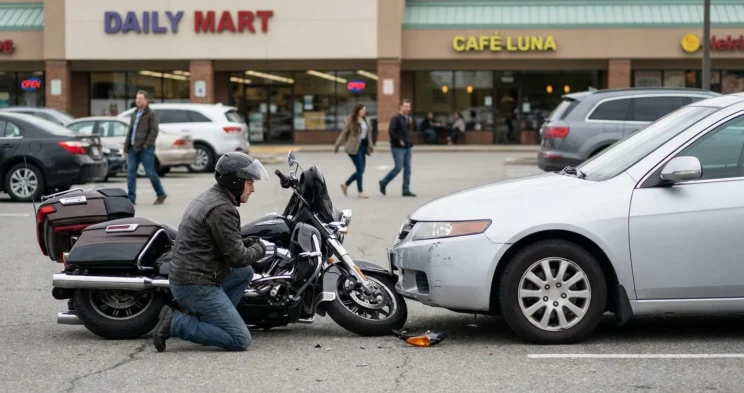
You were heading into the parking lot off Westheimer Road when a sedan reversed out of a space without checking its mirrors and clipped the front of your bike. The impact knocked you down, but you were able to stand up. The driver apologized. You both exchanged numbers and went your way.
Three days later, your neck hurts. Your shoulder aches when you lift your arm.
The insurance adjuster for the other driver’s policy is calling, and their compensation offer is low. Now you are wondering whether a slow-speed parking lot crash can actually support a real injury claim.
It can, and that means you should act quickly to pursue your claim.
Right-of-Way Rules in a Parking Lot
Parking lots are private property, but Texas traffic rules still apply to every vehicle traveling through them, including motorcycles. Texas Transportation Code Chapter 545 governs vehicle operation in Texas, and courts apply its general rules of the road to private lots when determining fault.
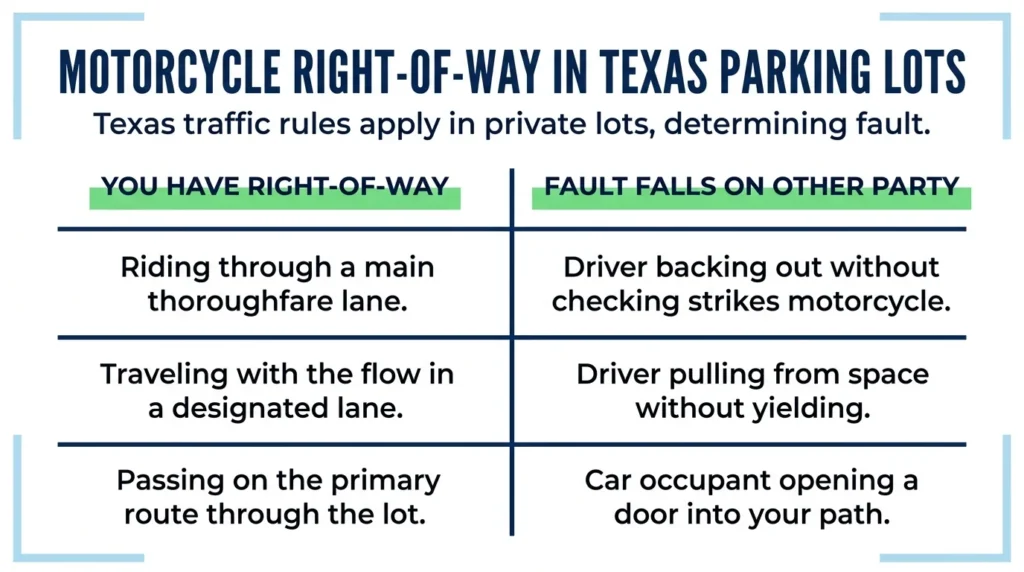
Drivers crossing from a public road into a parking lot must stop before entering under § 545.423, and the same right-of-way rules that govern public roads guide how courts determine fault inside a lot.
Most parking lots share the same basic structure: thoroughfare lanes cut through the lot and carry the right of way, while feeder lanes running along parking rows are secondary. A motorcycle traveling through a main thoroughfare lane has the right of way over a vehicle pulling out of a spot. A driver who reverses without checking their mirrors and strikes a passing motorcycle has violated that right of way.
When a driver backs out of a space, they bear the lower-priority duty in almost every scenario. Failure to check blind spots or mirrors before reversing is a common fault source in these crashes. Two vehicles backing out at the same time is a split-fault situation where neither has clear priority, and comparative responsibility applies to both.
One scenario that affects motorcycles specifically is dooring. When a parked car occupant swings their door open into a motorcycle’s path, the door occupant carries the fault in most circumstances.
When the Property Owner Shares Liability
The at-fault driver is not always the only party responsible for your crash. Property owners in Texas owe a duty of reasonable care to everyone on their premises, including motorcyclists. When a dangerous lot condition contributed to the crash, the owner can share liability alongside the driver.
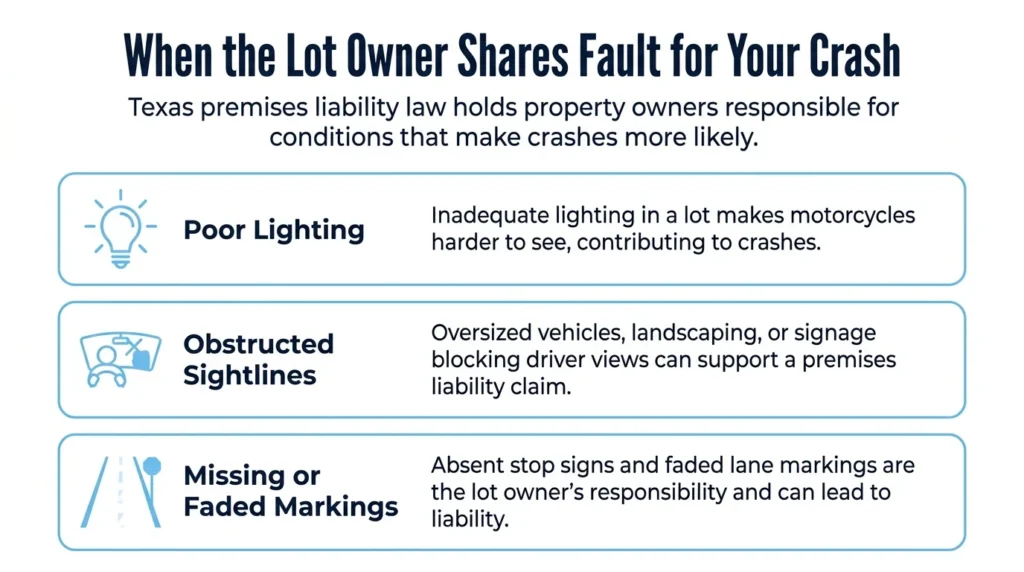
Poor lighting is the most common property condition in these cases. A motorcycle moving through a dimly lit lot is harder for other drivers to see. If inadequate lighting made the motorcycle less visible and contributed to the collision, that is a condition the owner knew or should have known about.
Overgrown landscaping, badly placed signage, structural columns, or oversized vehicles allowed to park in ways that block sightlines are all conditions that can result in a premises liability claim.
Faded lane markings, missing stop signs, and confusing lot traffic patterns also fall on the owner’s responsibility. The owner cannot deflect blame onto the at-fault driver alone when the lot’s physical conditions created the environment for a crash.
How fault gets divided between a driver and a property owner is part of what a careful review of both the driver’s actions and the lot’s condition will sort out. Riders who suspect property conditions contributed to their crash often benefit from a legal review before settling.
Understanding how fault is determined in Texas injury cases can help you see how these multiple-party scenarios work under state law.
Why Low-Speed Crashes Get Contested on Fault
Low crash speed does not reduce negligence. A driver who rolls forward at 5 mph without checking mirrors and strikes a passing motorcycle is still negligent. But the slow speed gives insurers an argument they use aggressively.
Texas uses proportionate responsibility under Texas Civil Practice and Remedies Code (CPRC) Chapter 33. If you are found 51% or more at fault, you receive no compensation. If you are found 30% at fault, your compensation, or recovery, is reduced by 30%.
Insurance adjusters in low-speed parking lot crashes know that many riders accept partial blame to move past what feels like a minor incident. Accepting a high fault assignment at the claim stage can eliminate or drastically reduce your recovery.
The evidence in parking lot crashes is time-sensitive. Surveillance footage from the business is often deleted within days or weeks. Photos of the vehicle positions at the scene, witness contact information, and any business security reports become critical once that footage is gone. The more complete your documentation at the scene, the harder it is for an insurer to blame most of the accident on you.
See how Texas comparative negligence affects your claim for a deeper look at how the 51% bar works and what it means for your recovery.
Why “Minor” Injuries Often Are Not
The way you feel immediately after a parking lot crash is not a reliable measure of your injuries. Soft tissue injuries, whiplash, and spinal strain routinely do not produce noticeable pain until 24 to 72 hours after impact. Your body releases adrenaline during and after a traumatic event, and that response can mask pain for hours.
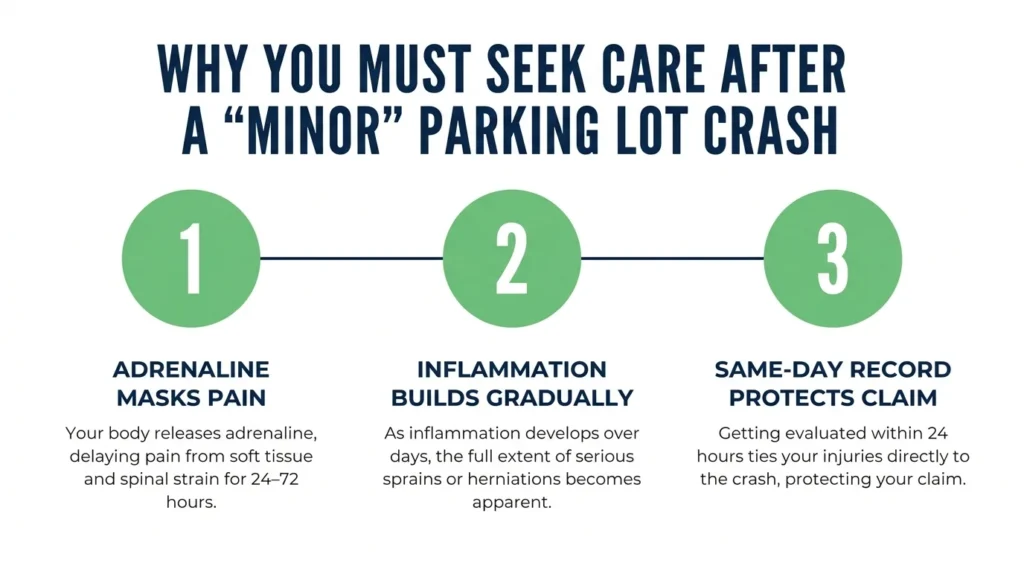
As inflammation builds in the hours and days that follow, pain and stiffness become apparent.
A rider who declines medical evaluation at the scene because they feel “fine” faces a real problem. If you see a doctor three days later when symptoms emerge, the insurer will argue the gap between the crash and treatment means your injuries came from something else. That argument is much harder to make when you have a medical record from the day of the crash, or within 24 hours, that documents your condition and ties it directly to the collision.
Texas’s two-year filing deadline under Texas Civil Practice and Remedies Code § 16.003 gives you time to bring a lawsuit. But waiting to seek medical care does not preserve your claim. It weakens it.
Getting evaluated promptly builds the documentation chain the insurer cannot easily dispute.
You can learn more about legal strategies after a motorcycle accident in Texas affect how evidence and medical documentation interact at the claim stage.
Speak with an Attorney About Your Claim
Parking lot crashes involving motorcycles come with layers of liability that are easy to miss when the crash feels routine. Fault can be shared between a driver and a property owner. The insurer may push a high fault percentage to reduce or eliminate your claim. Injuries that seem minor at the scene may take days to surface.
Angel Reyes & Associates has represented injured motorcycle riders across Texas for over 30 years. We handle cases where fault is disputed, where property owners share liability, and where insurers are pressing for a quick settlement before injuries are fully understood.
Initial consultations are free, and we work on a contingency basis, meaning you pay no fee unless we win. Reach out to review your situation with our motorcycle accident legal team.
Past results do not guarantee future outcomes.
Parking Lot Motorcycle Accident FAQs
Do you need a police report after a motorcycle parking lot crash in Texas?
You can file an insurance claim without a police report, though you will need to build your own documentation. Gather photos, the other driver’s insurance information, and witness contact details at the scene, since police often decline to respond to minor crashes on private property.
Do traffic laws apply to motorcycles in a private parking lot?
Yes. Texas Transportation Code Chapter 545 applies to vehicles operated on private property that is open to the public, including commercial parking lots. Motorcycles must follow the same right-of-way rules as other vehicles.
What if the other driver who hit my motorcycle in the parking lot has no insurance?
You may be able to file a claim under your own uninsured motorist coverage if you carry it. Texas insurers must offer uninsured and underinsured motorist coverage when you purchase a policy, and that coverage can pay for injuries and damages when the at-fault driver has none.
About the Authors

Angel Reyes
Writer
Angel L. Reyes, III is the Founder and Managing Partner of Angel Reyes & Associates. A nationally recognized trial attorney and business leader, Angel has helped over 70,000 injury victims recover more than $1 billion since founding the firm in 1993. Named to the Texas Super Lawyers list annually since 2008, Angel brings Wall Street experience, Ivy League education, and a deep commitment to client advocacy. He is a frequent legal commentator and published author with extensive contributions to legal scholarship, trial strategy, and consumer protection.

Kyle Nicolas
Editor
Kyle Nicolas is the Web Content & SEO Manager at Angel Reyes & Associates. He has more than 10 years of experience as a marketing co...

Angel Reyes
Reviewer
Angel L. Reyes, III is the Founder and Managing Partner of Angel Reyes & Associates. A nationally recognized trial attorney and business...