Who Is at Fault in a Parking Lot Accident in Texas?


Every article on this site is researched by our internal team, reviewed for legal accuracy against current Texas law, and held to State Bar of Texas advertising standards before publication. We do not publish content that overstates outcomes or makes promises about results.
Learn more about our
editorial standards .
Key Takeaways
- Texas Transportation Code Chapter 550 covers many private business parking lots too.
- You can still recover damages if you are found 50% or less at fault for a crash.
- Photograph the scene and exchange driver, witness, and property manager details right away.
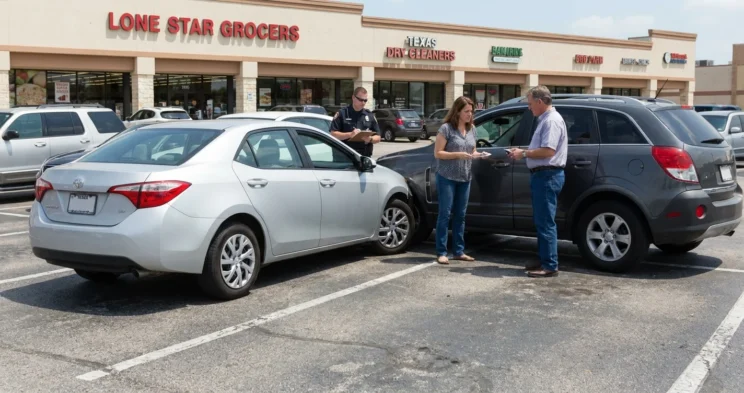
You were exiting your favorite retail store’s parking lot when another driver hit you. Now you’re dealing with medical bills, stress from the accident, and insurance adjuster calls.
Most drivers assume parking lot accidents work like any other crash. Then they discover police won’t file reports, insurance companies point fingers, and property owners deny responsibility.
Texas parking lots operate under a complex mix of private property rules and selective traffic law applications that leave accident victims confused about their rights and struggling to prove fault.
Why Parking Lot Accidents Are More Legally Complicated Than You Think
The moment your accident occurs on private property rather than a public road, the entire legal landscape shifts in ways that catch even experienced drivers off guard.
Most parking lots are private property where police have limited authority, creating situations where officers refuse to issue citations or file official reports unless serious injuries or criminal offenses occur.
This enforcement gap leaves victims scrambling to document fault themselves while insurance companies exploit the confusion to push “50/50” fault determinations that unfairly reduce compensation.
Understanding these complexities requires guidance from experienced car accident attorneys who know how to navigate private property liability rules.
Do Texas Traffic Laws Apply in Parking Lots?
The question of which laws apply in parking lots creates confusion that insurance companies eagerly exploit to minimize claims.
Understanding the legal framework helps protect your rights when accidents occur on private property where traditional traffic enforcement doesn’t reach.
What the Texas Transportation Code Says
Texas Transportation Code Chapter 550 applies to accidents occurring in public places and private property “used for vehicular traffic,” creating a gray area many parking lots fall into.
While criminal violations like DUI and reckless driving remain enforceable anywhere, civil traffic violations often go unenforced in private lots, leaving fault determination to insurance companies and courts.
When Police Will (and Won’t) File a Report
Officers typically refuse to issue citations for running stop signs, speeding, or failure to yield in private parking lots unless criminal behavior is involved.
This creates a liability gap where victims must build their own cases through witness statements, security footage, and photographic evidence. Documentation becomes crucial when determining fault in Texas without official police reports.
Who Is at Fault in a Texas Parking Lot Accident?
Parking lot fault determination involves unique considerations that differ significantly from standard roadway accidents.
Each scenario requires careful analysis of movement patterns, visibility, and the often-unclear right-of-way rules that govern private property crashes.
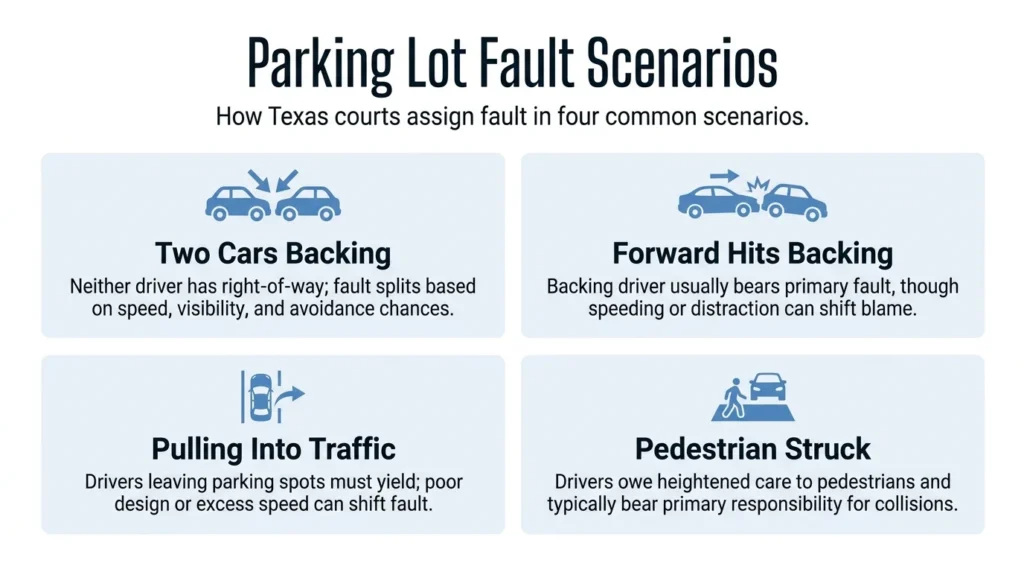
Scenario 1 – Two Cars Backing Out at the Same Time
When two vehicles simultaneously reverse from parking spaces and collide, neither driver holds superior right-of-way unless clear signage establishes priority.
Texas’s comparative negligence laws typically assign shared fault based on factors like speed, visibility checks, and whether either driver could have reasonably avoided the collision.
Scenario 2 – One Driver Pulling Forward Hits a Backing Vehicle
Generally, the backing driver bears primary fault since forward-moving vehicles have right-of-way, but context dramatically affects liability determinations.
If the forward-moving driver was speeding through the parking lot or distracted, comparative fault principles may reduce their recovery or shift significant blame their way. This is especially important when filing a claim if you are partially at fault.
Scenario 3 – Driver Pulls Into Path of Moving Vehicle From Parking Spot
Drivers entering traffic lanes from parking spaces must yield to vehicles already in motion, following the general principle that thoroughfares take precedence over feeder lanes.
However, poor lot design, obstructed views, or excessive speed by the moving vehicle can shift fault percentages in ways that significantly impact compensation.
Scenario 4 – Pedestrian Struck in Crosswalk or Lot
Drivers owe heightened duties of care to pedestrians in parking lots, where foot traffic is expected and visibility often limited.
While pedestrian behavior, like darting between cars, affects comparative fault calculations, drivers typically bear primary responsibility. Similar principles apply in pedestrian car accident claims generally.
When Property Owners Can Be Liable for Parking Lot Crashes
Unlike public roads maintained by government entities, parking lot owners have direct liability exposure when dangerous conditions contribute to accidents.
This premises liability angle creates additional recovery avenues that many accident victims never realize exist.
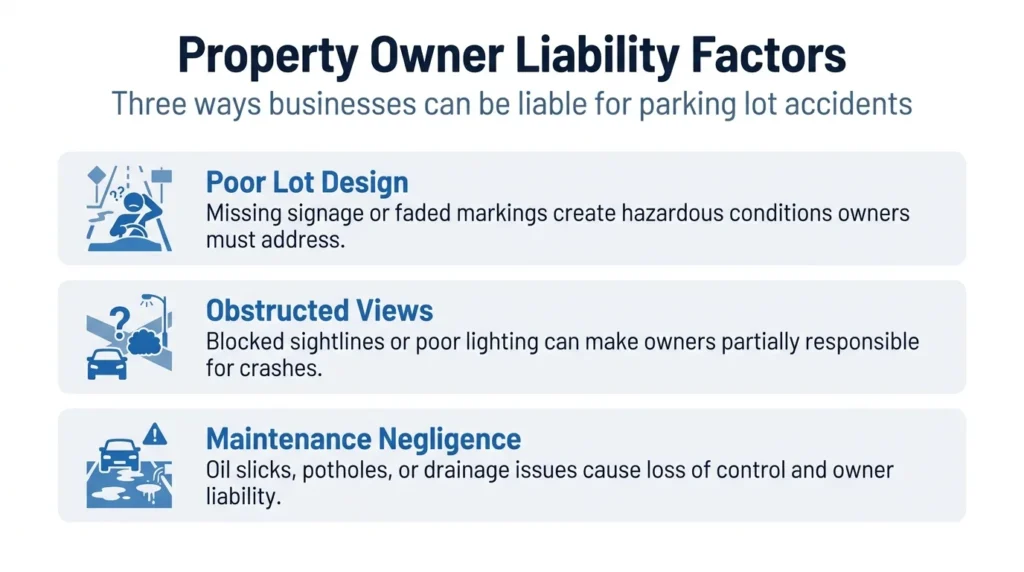
Poor Lot Design or Lack of Signage
Missing stop signs, faded lane markings, and confusing traffic patterns create hazardous conditions that property owners must address through reasonable maintenance and design.
When poor lot configuration contributes to accidents, businesses face liability for their role in creating dangerous conditions that lead to collisions.
Obstructed Views or Lighting Issues
Overgrown landscaping, poorly placed promotional signs, or structural elements that block driver sightlines can make property owners partially responsible for resulting accidents.
Similarly, inadequate lighting that obscures pedestrians or other vehicles at night creates liability exposure when darkness contributes to crashes.
Maintenance Negligence (e.g., oil slicks, potholes)
Property owners who allow oil accumulations, fail to repair potholes, or ignore drainage problems that create slick surfaces bear responsibility when these conditions cause vehicles to lose control.
This maintenance negligence creates premises liability claims separate from driver fault, potentially providing additional compensation sources for injured victims.
What to Do Immediately After a Parking Lot Accident in Texas
Taking the right steps immediately after a parking lot crash protects your legal rights when police involvement is limited. Following this proven process helps overcome the unique challenges private property accidents create:
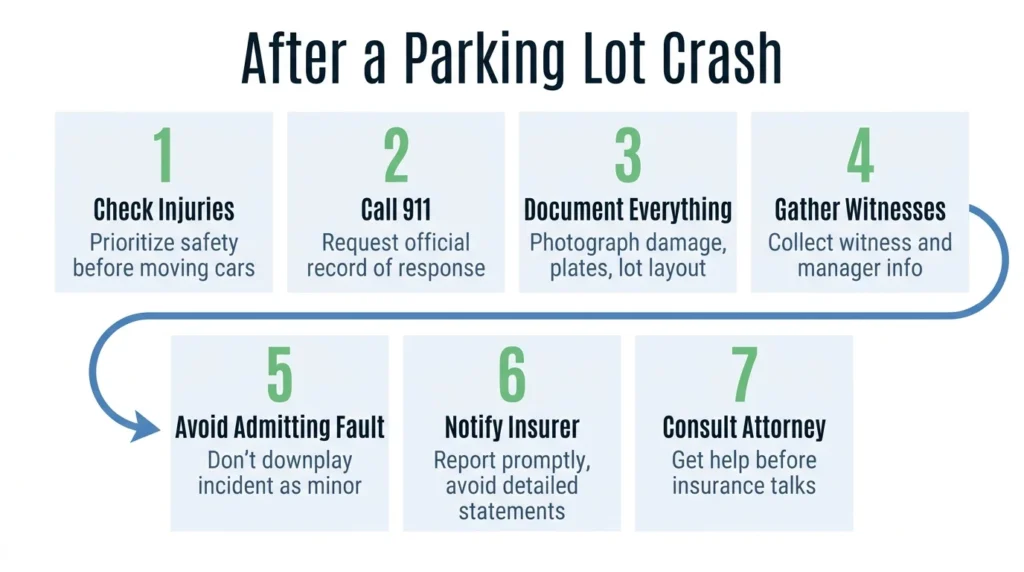
- First, stay calm and check for injuries before moving vehicles, as safety always takes priority over property damage concerns.
- Call 911 even if police won’t file reports, as having an official record of the call and any response helps establish the accident’s severity and timeline.
- Document everything thoroughly by photographing vehicle damage, license plates, the overall lot layout, and any contributing factors like missing signs or poor lighting.
- Gather contact information from witnesses and the property owner or manager, as their statements often become crucial when police reports aren’t available.
- Never admit fault or minimize the incident as “just a fender bender,” as these statements will be used against you during insurance negotiations.
- Report the accident to your insurance company promptly but avoid detailed statements until consulting an attorney who understands parking lot liability complexities.
Most importantly, consult a Texas parking lot accident lawyer if any disputes arise about fault, damages, or insurance coverage.
Early legal intervention prevents costly mistakes and ensures you receive fair compensation despite the unique challenges these accidents present. Critical guidance about what to do after a car accident applies even more strongly in complicated parking lot situations.
Documenting a Parking Lot Crash When No Officer Responds
When no officer responds to a parking lot crash at all, you can still protect your claim by documenting the scene yourself and understanding your reporting options under Texas law.
Before anyone moves a vehicle, take photos that show:
- Where each vehicle stopped and the angle of impact
- Damage to both vehicles, including close-ups
- License plates and the position of each vehicle
- Lighting, signage, and any lot conditions that may have contributed
In addition to exchanging contact information with the other driver, collect the same information from any witnesses and from the property manager on duty, and ask whether the lot has surveillance footage.
If the crash was not investigated by police and involved injury, death, or at least $1,000 in damage, Texas law still gives you a documentation option.
Since a 2017 change under Senate Bill 312 of the 85th Legislature, TxDOT no longer accepts or retains driver-filed CR-2 reports, so keep your completed copy for your own records rather than expecting to file it with the department.
Once you notify your insurer, Texas Insurance Code Chapter 542 requires the company to acknowledge your claim and begin its investigation within 15 days of receiving notice, whether or not a police report exists.
Why Parking Lot Accidents Require Legal Guidance in Texas
Angel Reyes & Associates has helped countless parking lot accident victims overcome these unique claim challenges by gathering evidence insurance companies can’t ignore.
We understand exactly which Texas laws still apply on private property and how to hold negligent drivers and property owners fully accountable for the damages they cause. The intersection of private property rules, limited police involvement, and aggressive insurance tactics creates a perfect storm where parking lot accident victims often receive far less than they deserve.
Schedule a free consultation with our Texas legal team to evaluate your parking lot accident and protect your rights against insurance companies seeking to exploit private property complexities.
Past results do not guarantee future outcomes.
Parking Lot Accident Claim FAQs
Is fault always 50/50 in parking lot accidents?
No, fault depends on specific circumstances including vehicle movements, visibility conditions, signage, and each driver’s actions before impact. Texas’s comparative negligence laws assign fault percentages based on evidence, not arbitrary assumptions about private property accidents.
Can I sue a business for a parking lot accident?
Yes, if poor maintenance, inadequate lighting, or dangerous design contributed to the accident, the property owner may share liability. Proving premises liability requires showing the owner knew or should have known about the hazardous condition and failed to address it reasonably.
Who pays for my damages if both drivers are partially at fault?
Under Texas’s modified comparative fault rule, compensation is reduced by the driver’s percentage of fault as long as they are less than 51% responsible. This makes accurate fault determination crucial, since being assigned majority blame eliminates the right to any compensation.
About the Authors

Angel Reyes
Writer
Angel L. Reyes, III is the Founder and Managing Partner of Angel Reyes & Associates. A nationally recognized trial attorney and business leader, Angel has helped over 70,000 injury victims recover more than $1 billion since founding the firm in 1993. Named to the Texas Super Lawyers list annually since 2008, Angel brings Wall Street experience, Ivy League education, and a deep commitment to client advocacy. He is a frequent legal commentator and published author with extensive contributions to legal scholarship, trial strategy, and consumer protection.

Graham Griffin
Editor
Graham Griffin is the Web & Content Manager at Angel Reyes & Associates, where he oversees content strategy, AI-powered workflows, a...

Angel Reyes
Reviewer
Angel L. Reyes, III is the Founder and Managing Partner of Angel Reyes & Associates. A nationally recognized trial attorney and business...