Should You Accept the First Settlement Offer After a Motorcycle Accident?


Every article on this site is researched by our internal team, reviewed for legal accuracy against current Texas law, and held to State Bar of Texas advertising standards before publication. We do not publish content that overstates outcomes or makes promises about results.
Learn more about our
editorial standards .
Key Takeaways
- First settlement offers are designed to close claims before you know your full injury costs.
- Insurers inflate fault percentages in motorcycle cases to reduce or eliminate recovery.
- Texas law gives you two years to file, so you do not have to decide in the first weeks.
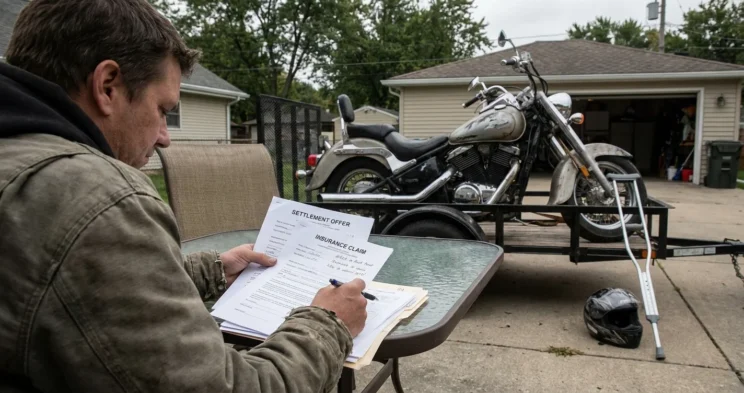
You were riding home on I-35 when another driver cut across your lane without signaling. The crash left you with a fractured collarbone, road rash down your left arm, and weeks of missed work stacking up.
Now the other driver’s insurance company is calling, and they’re offering you money! It sounds like a lot of money, too. But, is it enough to cover your current bills? It might not be, and it might not be anywhere near the full value of your injury when you factor in both short and long-term expenses associated with your accident.
Why First Offers Almost Always Fall Short
The first settlement offer you receive is rarely an honest assessment of what you’re owed. The initial offers are usually a meticulously calculated, strategic attempt to close your file before you understand the full cost of your injuries.
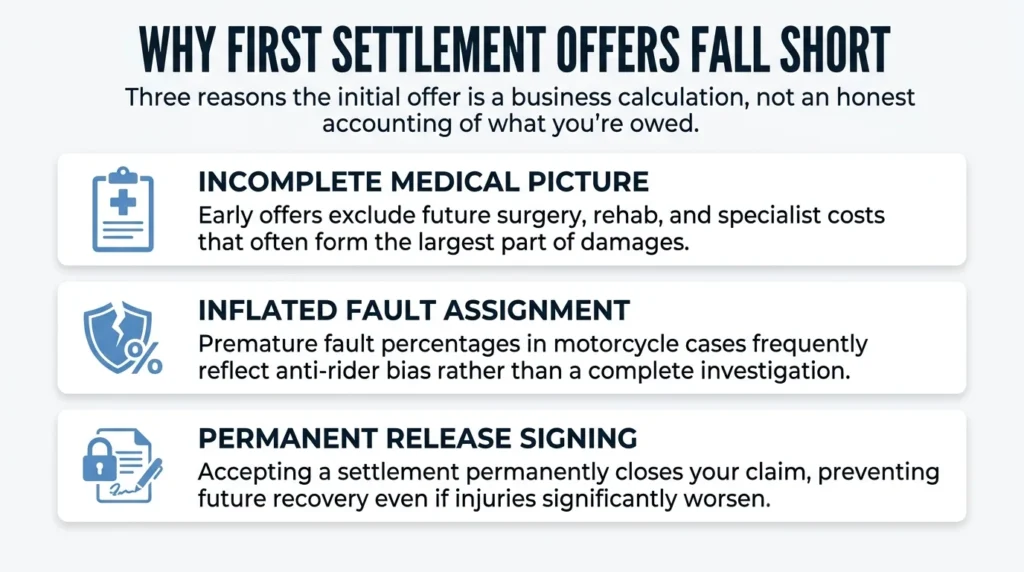
Insurers know that the weeks right after a crash are when financial pressure is highest. Medical bills start coming in, and you may be missing shifts at work while recovering from your injuries. Not only is savings starting to dwindle from keeping up with your daily expenses, but now you also have a mountain of additional bills to cover.
That pressure is exactly what insurers are hoping you’re feeling when they send you a first offer. Their goal is to convince you to make a permanent decision before you fully understand the nature of your losses.
The first offer may be, say, $10,000. That sounds like a lot of cash! But here’s the truth: $10,000 doesn’t go very far when you consider medical expenses. According to data compiled by Health Bill Central, the average cost of a ground ambulance trip in Texas is slightly over $1,500 without insurance.
Then you have the cost of dealing with each of your injuries, which can can surge into the thousands quickly. That broken collar bone? According to Sidecar Health, if that injury requires outpatient surgery to properly heal, total costs without insurance in Texas exceed $11,800. If you need to stay in the hospital, add another $2,500 to $4,000 per day, according to Becker’s Hospital Review.
Suddenly, that $10,000 doesn’t seem like all that much. And that doesn’t even consider your lost income from missed work, pain and suffering, and the cost to fix or replace your bike that is almost certainly badly damaged.
But insurance companies are hoping you aren’t aware of this and that you’re willing to sign on the dotted line and close the file for them. Accepting a settlement releases all future claims. If your injuries worsen, if complications develop, if you need a second surgery, you have no legal recourse once you sign.
Understanding how motorcycle accident settlements work before any negotiation begins is the single most useful thing you can do.
Motorcycle-Specific Tactics Insurers Use
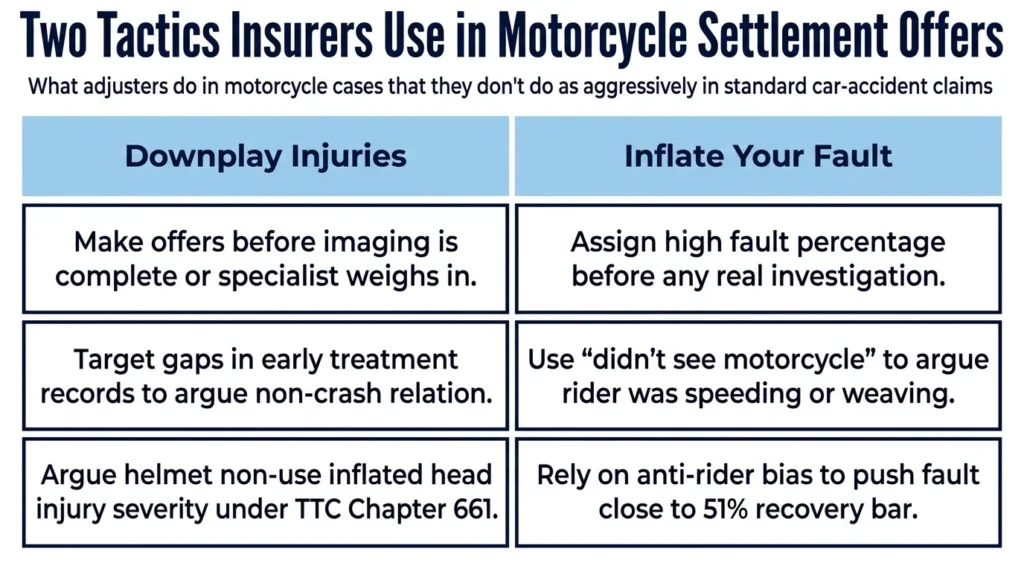
In motorcycle claims, insurers often use two specific tactics you will not encounter in most standard car accident claims. Both are designed to make a low offer appear more reasonable than it is.
Downplaying the Severity of Your Injuries
An offer made before your imaging is complete, before a specialist has weighed in, or before your treatment plan is set is not based on complete medical information. Insurers take advantage of that gap.
Adjusters look for early gaps in your treatment record and use them to argue that your injury was not caused by the crash or is less severe than you report. Soft-tissue injuries and neurological damage often don’t appear clearly on early imaging, making them easy targets for minimization.
Helmet use is another pressure point. Under Texas Transportation Code Chapter 661, riders who meet specific age and insurance requirements may legally ride without a helmet. Even so, insurers often argue that riding helmetless contributed to head and neck injuries, raising your comparative fault percentage and reducing the offer accordingly.
Overstating the Rider’s Comparative Fault
Texas uses a proportionate responsibility system. Under Texas Civil Practice and Remedies Code Section 33.001, if you’re found more than 50% responsible for the crash, you recover nothing. If found 30% responsible, your recovery is reduced by 30%. That math gives insurers a powerful reason to push your fault percentage as high as possible.
Anti-rider bias makes this tactic particularly aggressive in motorcycle claims. Adjusters often rely on the other driver’s statement that they “didn’t see” the motorcycle to argue the rider was speeding, weaving, or otherwise at fault. Lack of brightly colored gear becomes an argument that you contributed to being struck. These fault assignments appear in early offers before any investigation has been done.
Reviewing how Texas comparative negligence rules affect a personal injury claim helps you see why the fault percentage in an early offer matters so much more than the dollar amount itself.
Your Injury Trajectory Before Any Settlement Discussion
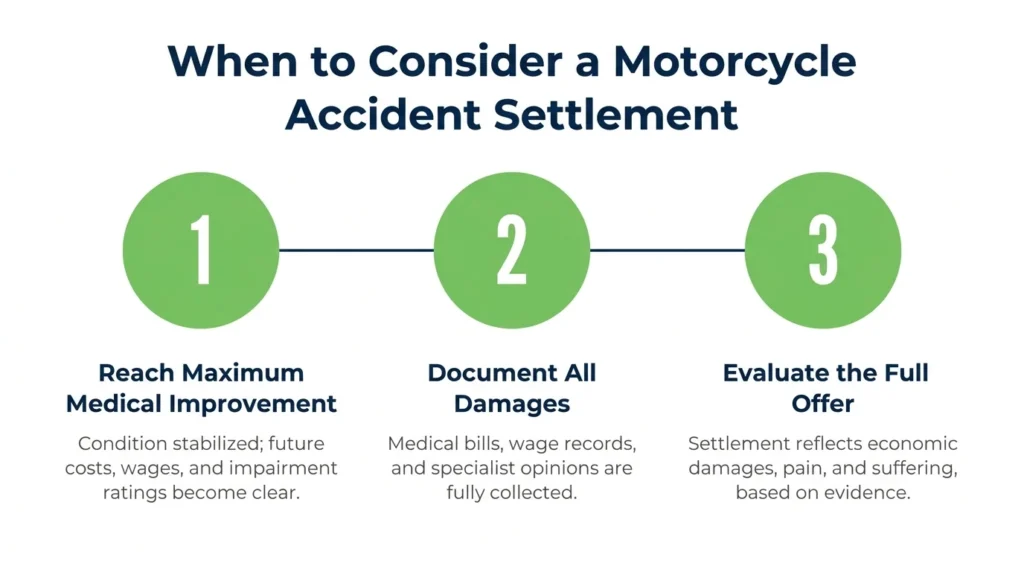
No insurer can offer you a reliable total damages figure until your medical condition has stabilized. The legal term for that point is maximum medical improvement (MMI). Settling before MMI means agreeing to a number before anyone, including your doctors, knows what your recovery will actually cost.
Motorcycle crashes frequently cause orthopedic injuries:
- Fractures
- Joint damage
- Road rash requiring skin grafting
These injuries often involve multiple procedures with recovery timelines measured in months. A settlement made in week three does not include the surgery scheduled for month four.
Early offers almost never account for future medical expenses, future lost wages, or long-term pain and suffering. Those categories represent a large share of total damages in serious injury cases. If they’re not in the number, the number is not complete.
What Rejecting the Offer Means
Saying no to a first offer doesn’t end your claim or cost you the opportunity. Rejecting a first offer is a normal, expected step in the claims process. Insurers build negotiating room into their opening number precisely because they expect pushback.
Pressure language like “this offer expires Friday” is a tactic. Insurance companies cannot legally force you to accept on their timeline, and offers don’t evaporate because you ask for time.
When you decline and provide documentation, the insurer returns with a revised number. Updated medical records, specialist opinions, a letter from your employer documenting missed wages, and a clear treatment plan all give the adjuster a basis to increase the offer.
You also have more time than the insurer’s pressure suggests. Under Texas Civil Practice and Remedies Code Section 16.003, you have two years from the date of the accident to file a personal injury lawsuit.
Talk to an Attorney Before You Decide
Motorcycle accident claims involve more moving parts than most riders expect, and the first offer is almost never the right stopping point.
Angel Reyes & Associates has spent over 30 years helping injured Texans through situations exactly like this. Our team of attorneys can review your offer, assess what your full damages picture looks like, and explain your options. We offer free consultations, and you pay nothing unless we win your case.
If you have received a first settlement offer and you are not certain it reflects what you are actually owed, contact us before you decide.
Motorcycle Accident Settlement FAQs
Can I still negotiate after I reject a first settlement offer?
Yes. Saying no to a first offer opens negotiation. The insurer will typically return with a revised offer when you provide documentation supporting a higher number.
Does the fault percentage in a settlement offer reflect what actually happened?
Not necessarily. In motorcycle cases, initial fault assignments often reflect adjuster assumptions rather than a full investigation. Disputing an inflated fault percentage with evidence, witness statements, and crash reconstruction can change that number.
What happens if my injuries get worse after I accept a settlement?
Once you sign a release, your claim is closed. You cannot reopen it to seek more compensation, even if your condition worsens or new complications develop. That finality is the core reason to wait until your medical picture is stable before accepting anything.
How long does a motorcycle accident settlement typically take in Texas?
Cases with minor injuries and clear fault may resolve in a few months. Cases involving serious injuries, disputed liability, or surgery often take one to two years or more, especially if the parties do not reach an agreement before a lawsuit is filed.
Does the insurer have to honor its settlement offer if I decide to accept later?
Settlement offers are generally not binding on either side until both parties sign a release. An offer can be withdrawn or modified before acceptance, which is another reason to evaluate offers carefully rather than waiting without a clear plan.
About the Authors

Angel Reyes
Writer
Angel L. Reyes, III is the Founder and Managing Partner of Angel Reyes & Associates. A nationally recognized trial attorney and business leader, Angel has helped over 70,000 injury victims recover more than $1 billion since founding the firm in 1993. Named to the Texas Super Lawyers list annually since 2008, Angel brings Wall Street experience, Ivy League education, and a deep commitment to client advocacy. He is a frequent legal commentator and published author with extensive contributions to legal scholarship, trial strategy, and consumer protection.

Kyle Nicolas
Editor
Kyle Nicolas is the Web Content & SEO Manager at Angel Reyes & Associates. He has more than 10 years of experience as a marketing co...

Angel Reyes
Reviewer
Angel L. Reyes, III is the Founder and Managing Partner of Angel Reyes & Associates. A nationally recognized trial attorney and business...