Group Ride Motorcycle Accident Liability in Texas


Every article on this site is researched by our internal team, reviewed for legal accuracy against current Texas law, and held to State Bar of Texas advertising standards before publication. We do not publish content that overstates outcomes or makes promises about results.
Learn more about our
editorial standards .
Key Takeaways
- Texas splits fault across all riders involved; your share must be 50% or less to recover.
- Lead riders can be assigned fault for decisions that contributed to the crash.
- Claims against fellow riders go to their liability insurance, not their personal funds.
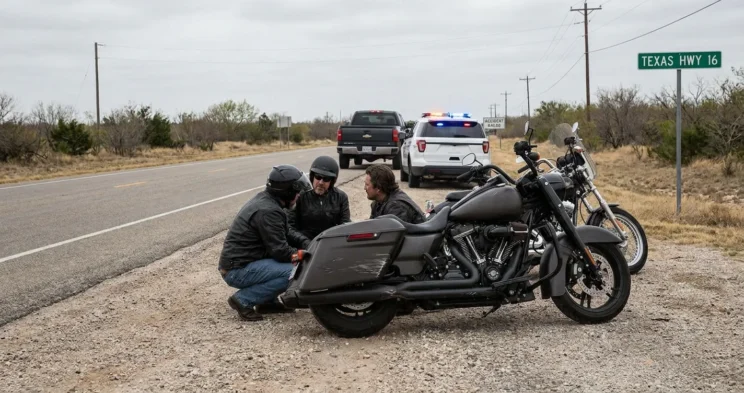
You were riding with a group on the weekend and everything was going fine, then one rider made a sudden move that set off a chain reaction. Now you’re dealing with injuries, a wrecked bike, and a question that feels more complicated than a typical crash: can you actually file a claim when the person who caused the wreck was riding right beside you?
The answer is yes. But how that claim works in Texas depends on rules most riders have never had to think about before the crash happened.
How Fault Works Differently in a Group Ride Crash
In a standard two-vehicle collision, fault usually points in one direction. In a group ride crash, it can point at several riders at once, an outside driver, and in some cases, the person who organized or led the ride.
Texas is not a no-fault state. Compensation in the Lone Star State requires proving that someone was negligent, meaning they failed to act the way a reasonable person would under the same conditions. In a group ride, every rider on the road owes that duty of care to every other rider around them, the same as any driver owes it to other vehicles on the highway.
You can learn more about how Texas motorcycle accident claims approach fault in general, but group crashes add layers that standard collisions do not.
Reckless maneuvers, following too closely within the formation, sudden braking without warning, or failing to signal a lane change can all be considered negligence in a group ride context. The fact that these riders were traveling together does not reduce the legal duty they owe each other.
What Texas Law Says About Shared Fault
Texas distributes fault across multiple parties under a framework called proportionate responsibility. The Texas Civil Practice and Remedies Code (CPRC) Chapter 33 sets the rule: a claimant who is more than 50% responsible for a crash recovers nothing. If your share of fault is 50% or less, your compensation is reduced by your fault percentage.
For example, if your damages total $60,000 and a jury finds you 25% at fault, you collect $45,000. If they find you 51% at fault, you collect no money.
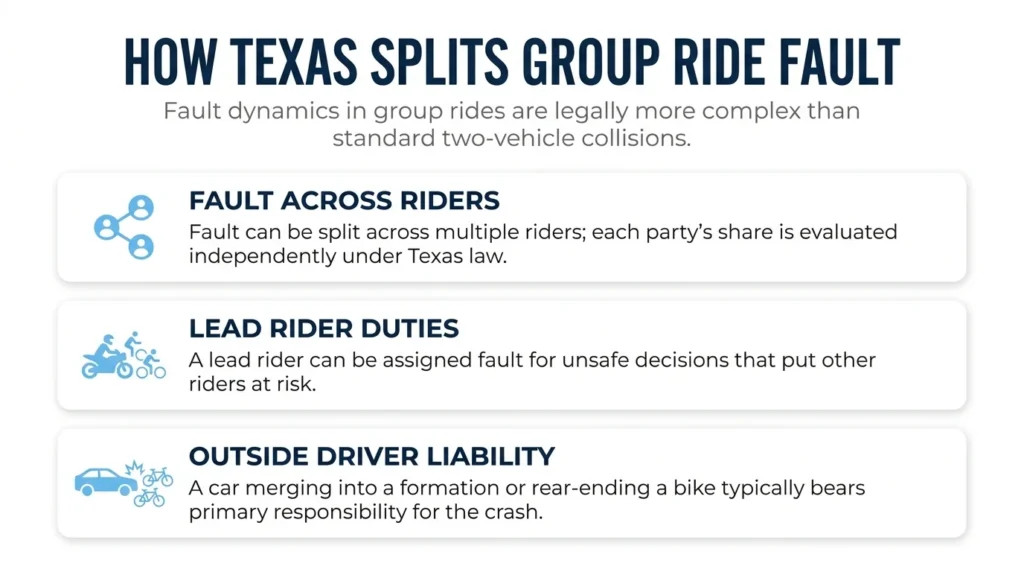
In a group ride crash, fault can be split across three, four, or more parties at the same time. One rider may be assigned 40%, another 30%, and an outside driver the remaining 30%. Each party’s percentage is evaluated independently. Your ability to receive compensation depends on where your own number lands.
Understanding how Texas comparative negligence works in practice before you accept any offer from an insurer can make the difference between a fair outcome and a permanently closed claim.
Texas also sets a hard deadline for filing. Under Texas Civil Practice and Remedies Code § 16.003, you have two years from the date of the crash to file a personal injury lawsuit. Miss that window and a Texas court will almost certainly dismiss the case regardless of how strong your facts are.
Knowing where your fault percentage lands is more important than most injured riders expect. An attorney can help you understand how the numbers affect your claim before you accept any offer.
The Lead Rider’s Role in a Group Crash
The lead rider is not automatically responsible for a crash. But the role carries specific duties that can affect fault assignment if they make decisions that put others at risk.
Before the ride starts, a lead rider typically sets the route, communicates the formation, establishes pace, and takes responsibility for managing the group through traffic. Those decisions are evaluated for reasonableness after a crash occurs.
If the lead rider called a sudden lane change without signaling, set a pace that was too fast for the road conditions that day, or failed to warn riders of a hazard visible ahead, those choices can be part of the negligence analysis directed at them.
The legal standard is not perfect. Courts and adjusters look at whether the lead rider’s conduct fell below what a reasonable, experienced rider would do in the same situation. Understanding how fault is determined in Texas injury cases applies the same framework here.
Outside drivers remain the most common at-fault party in group ride crashes. A car merging into a formation without checking for the full group, cutting off the lead rider, or rear-ending the last bike can bear primary responsibility while the internal dynamics of the ride play a supporting role in the fault calculation.
Staggered Formation & How Riding Conduct Affects Your Claim
How your group was riding at the moment of the crash is not just a safety question. It becomes evidence in the liability analysis.

The Motorcycle Safety Foundation’s group riding standards recommend a staggered formation where the lead rider takes the left third of the lane, the second rider takes the right third at least one second behind, and riders continue the pattern. A two-second gap between riders in the same lane position is the standard spacing. When the road narrows or turns twisty, groups shift to single file to allow proper lean clearance.
If riders in your group were following those standards, that documented evidence works in your favor. If they were not, an opposing insurer will use it to argue negligence. Here is what formation conduct looks like in the post-crash liability picture:
- Formation compliance can support your claim. Evidence that you maintained proper spacing and position, supported by statements from other riders or dashcam footage, can counter arguments that your own riding contributed to the crash.
- Formation violations can increase a rider’s fault percentage. A rider who was tailgating within the formation, weaving between positions, or riding two-abreast in a staggered slot may see a higher fault percentage assigned to them.
- Single-file deviations matter when conditions require it. If the group was on a curving road and remained in staggered formation instead of shifting to single file, that choice can be cited in the fault analysis if a rider lost control trying to lean around another bike.
Documenting how the group was riding at the time of the crash, including witness statements from other riders, can make a significant difference in how fault is assigned.
Filing a Claim Against a Fellow Rider in Texas
Filing a claim against someone you were riding with can feel uncomfortable. The legal process is designed to make it less so.
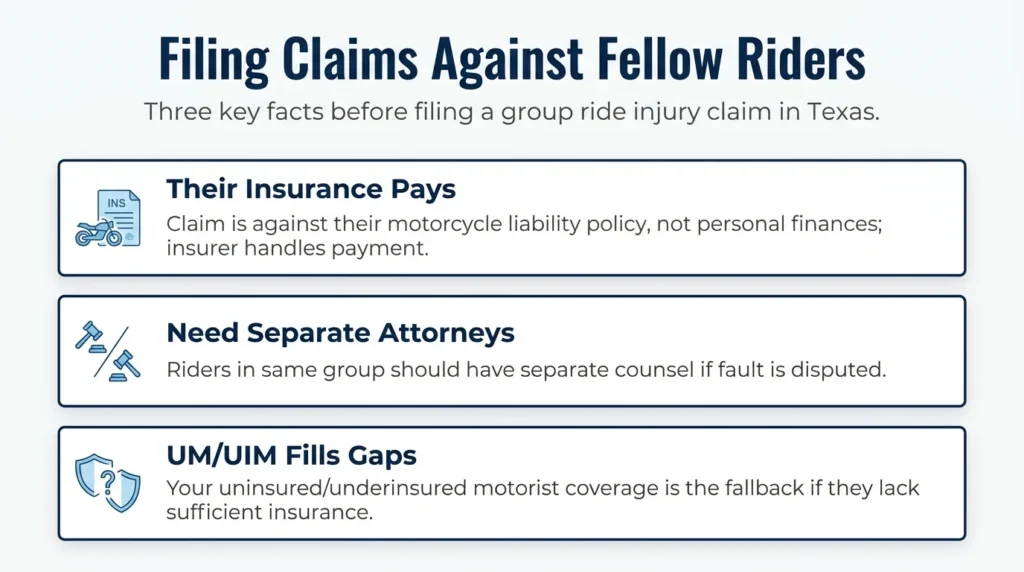
When you file against a fellow rider’s negligence, the claim goes to their motorcycle liability insurance policy, not to their personal finances. Texas requires all motorcycle operators to carry minimum liability coverage. The minimum is $30,000 per injured person, up to $60,000 per accident, with $25,000 for property damage.
You can verify current Texas motorcycle insurance requirements through the Texas Department of Insurance. The process mirrors any motorcycle accident claim: document the crash, gather witness statements, preserve physical evidence, and file with the at-fault rider’s insurer.
If the at-fault rider carries no insurance or not enough to cover your damages, your own uninsured/underinsured motorist (UM/UIM) coverage becomes the fallback. UM/UIM coverage is optional in Texas, but it is one of the most practical forms of protection for a rider who regularly rides in groups.
Understanding how settlements work in Texas motorcycle cases and how policy limits affect what you can actually recover helps set realistic expectations before the process begins.
One practical note: riders in the same group should not share the same attorney if there is any possibility that fault will be disputed between them. Separate counsel protects each rider’s independent interests in the fault allocation.
Get Help with a Complex Group Ride Claim
Multi-rider crashes involve multiple insurance companies, competing fault arguments, and injured parties who may all know each other. That combination creates pressure to settle fast and settle low.
Angel Reyes & Associates has guided Texans through motorcycle accident claims for over 30 years, including cases where fault was contested across several parties. Our team offers free consultations so you can understand what your claim is worth before any insurer tells you otherwise. We work on contingency, meaning no fee unless we win.
Contact us today to talk through your situation.
Past results do not guarantee future outcomes.
Group Ride Motorcycle Accident Liability FAQs
Can a liability waiver signed before a group ride prevent me from filing a claim?
It depends on the waiver’s language and how it was presented. Texas courts enforce liability waivers that meet specific requirements, but waivers that cover gross negligence are generally not enforceable under Texas public policy.
Will filing a claim against a fellow rider affect my relationship with the group or the rider personally?
The claim goes to the rider’s insurance company, not to the rider directly. Their insurer handles the defense and pays any settlement or judgment within policy limits, so the financial burden does not come out of the other rider’s pocket.
Does it matter whether the crash happened on a private road or a public highway?
Texas traffic laws and the proportionate responsibility framework apply on public roads. Crashes on private property involve different legal considerations, and the duty-of-care analysis can shift depending on who owned or controlled the property.
About the Authors

Angel Reyes
Writer
Angel L. Reyes, III is the Founder and Managing Partner of Angel Reyes & Associates. A nationally recognized trial attorney and business leader, Angel has helped over 70,000 injury victims recover more than $1 billion since founding the firm in 1993. Named to the Texas Super Lawyers list annually since 2008, Angel brings Wall Street experience, Ivy League education, and a deep commitment to client advocacy. He is a frequent legal commentator and published author with extensive contributions to legal scholarship, trial strategy, and consumer protection.

Kyle Nicolas
Editor
Kyle Nicolas is the Web Content & SEO Manager at Angel Reyes & Associates. He has more than 10 years of experience as a marketing co...

Angel Reyes
Reviewer
Angel L. Reyes, III is the Founder and Managing Partner of Angel Reyes & Associates. A nationally recognized trial attorney and business...