Leading Causes of Motorcycle Accidents in Texas


Every article on this site is researched by our internal team, reviewed for legal accuracy against current Texas law, and held to State Bar of Texas advertising standards before publication. We do not publish content that overstates outcomes or makes promises about results.
Learn more about our
editorial standards .
Key Takeaways
- Left-turn driver violations are the leading cause of serious Texas motorcycle crashes.
- About 30% of Texas motorcycle deaths happen at intersections under TxDOT 2025 data.
- Riders over 50% at fault recover nothing under Texas Civil Practice & Remedies Code Ch. 33.
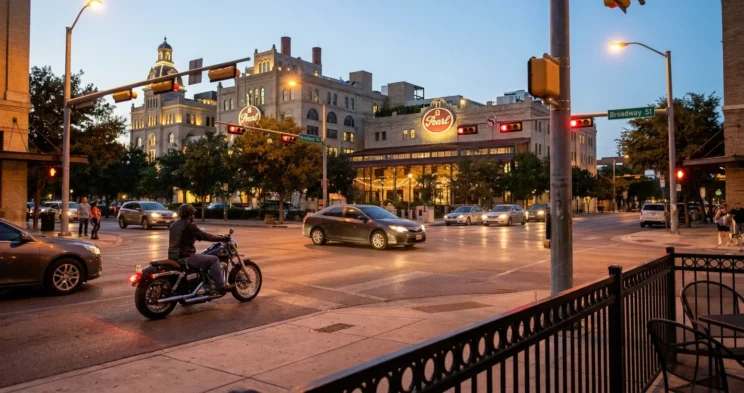
You finished work in San Antonio and pointed your bike toward home along Broadway Street, easing through evening traffic near the Pearl. A driver in the oncoming lane started a left turn across your path, eyes locked on something else, and never registered your headlight closing the gap.
One second of misjudgment by another driver can change everything for a rider. That’s the reason why other traffic is actually one of the leading causes of motorcycle accidents in Texas.
Left-Turn Crashes: Texas’s No. 1 Motorcycle Hazard
Left-turn violations by other drivers are the most common serious-crash scenario for Texas motorcyclists. State data reported 581 motorcyclist deaths and 2,534 serious injuries in 2024, with intersection collisions making up a large share. The mechanism is consistent: a driver turns across oncoming traffic and fails to see the approaching bike.
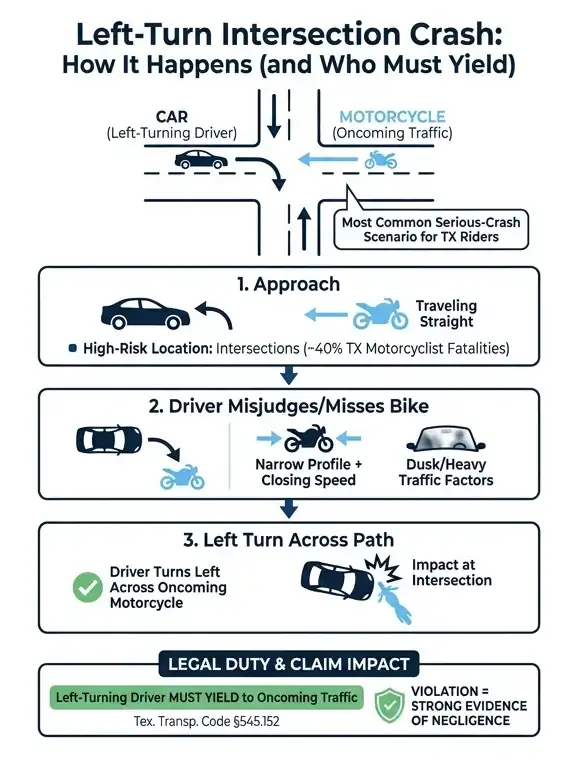
Motorcycles are easy to under-perceive. Their narrow profile and closing speed cause drivers to misjudge distance, especially in dusk light or heavy traffic. Roughly 30% of Texas motorcycle fatalities happen at intersections, according to TxDOT CRIS crash data for 2025 (167 of 562), which is why the left-turn scenario carries so much weight.
The law is clear about who must yield. Under Texas Transportation Code § 545.152, a driver turning left must yield the right-of-way to any oncoming vehicle that is already in the intersection or close enough to the intersection to be an immediate hazard. When a turning driver breaks this rule and strikes a rider, the violation itself is direct evidence of negligence in a motorcycle accident claim.
That single fact often shapes the entire case. Establishing the left-turn violation early can lock in fault before the insurer’s adjusters reframe the story.
Other Driver Behaviors That Cause Motorcycle Crashes
Beyond left-turn crashes, a handful of driver behaviors keep showing up in Texas motorcycle injury cases. Each one points to the other driver’s negligence rather than the rider’s. Knowing the pattern helps you describe what happened in a way that matches how fault is actually proven.
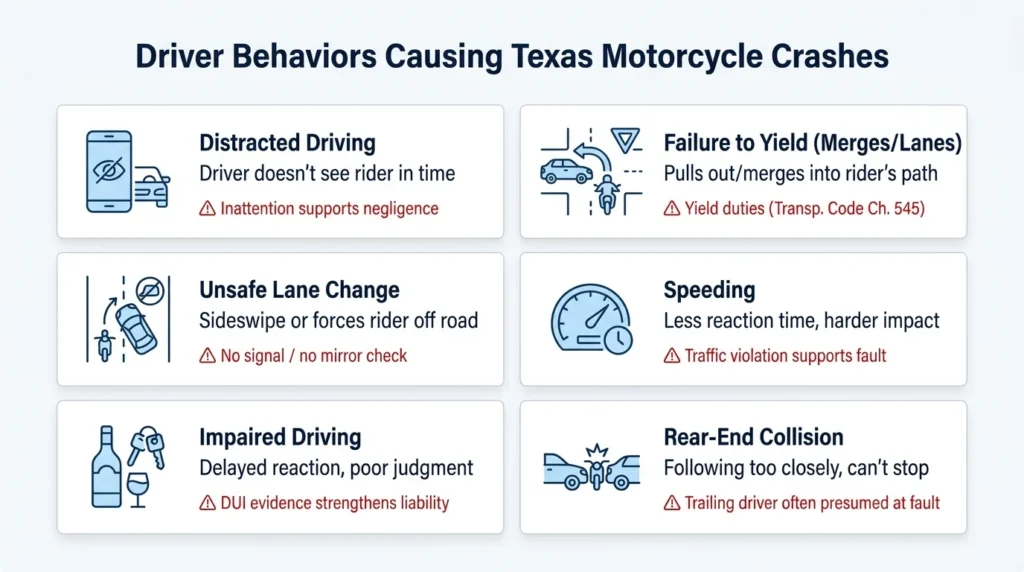
Distracted driving. A driver glancing at a phone or touchscreen often fails to see a motorcycle until it is too late to brake or yield. The inattention itself supports a negligence finding.
Failure to yield in other contexts. Drivers merge onto highways, pull out of driveways, or change lanes without checking mirrors. Drivers who merge onto highways, pull out of driveways, or change lanes without checking mirrors may violate separate yielding duties under Texas Transportation Code Chapter 545, including § 545.154 for highway feeder roads and § 545.155 for vehicles entering from private roads or driveways.
Unsafe lane changes. Sideswipes and forced-off-road crashes are common when a driver moves over without signaling or looking. This pattern often appears alongside illegal lane splitting, which raises its own legal questions.
Speeding. A speeding driver has less time to react and hits with more force. Speeding is a per se traffic violation that helps prove negligence.
Impaired driving. Alcohol and drugs continue to show up as contributing factors in fatal Texas motorcycle crashes. National figures from NHTSA motorcycle safety reporting put the scale of the problem in context.
Rear-end collisions. A driver following too closely fails to stop when the rider brakes. The trailing driver is presumed at fault under standard negligence analysis. If you recognize one of these behaviors in your own crash, it is worth understanding how fault is determined in Texas before you talk to any insurer.
Single-Vehicle Causes & Road Hazards
Not every motorcycle crash involves another driver. Some involve rider conduct, road defects, or weather. These cases still carry legal options, but the analysis depends on what actually caused the loss of control.
Speed and inexperience drive many single-vehicle crashes. Riders lose control on curves, brake too late, or overcorrect. A crash like this does not automatically end a legal claim, especially if a road defect or another driver played a role.
Road hazards factor in more than people think. Potholes, missing signs, debris, and uneven pavement edges can cause a rider to go down. When a government entity failed to maintain the road, it may share liability under Texas premises and governmental liability rules.
Weather and visibility add another layer. Rain, fog, sun glare, and night riding cut reaction time for everyone on the road. Even in a single-vehicle crash, investigation sometimes reveals that another driver ran the rider off the road or that a defect went unrepaired for months.
Texas uses a fault-sharing system that affects what you can recover. The Texas Civil Practice and Remedies Code (CPRC) Chapter 33 reduces your damages by your percentage of fault. A rider found more than 50 percent at fault recovers nothing. That rule is why cause documentation is so important, even when the crash looks like a solo wreck. The same proportionate logic shapes auto cases too, as outlined in this look at the leading causes of car accidents in Texas.
What Crash Cause Means for Your Texas Injury Claim
Identifying the cause is the foundation of any motorcycle injury claim. Liability flows from what the other party did wrong, and the evidence that proves it disappears fast. The earlier you preserve cause evidence, the stronger your claim.
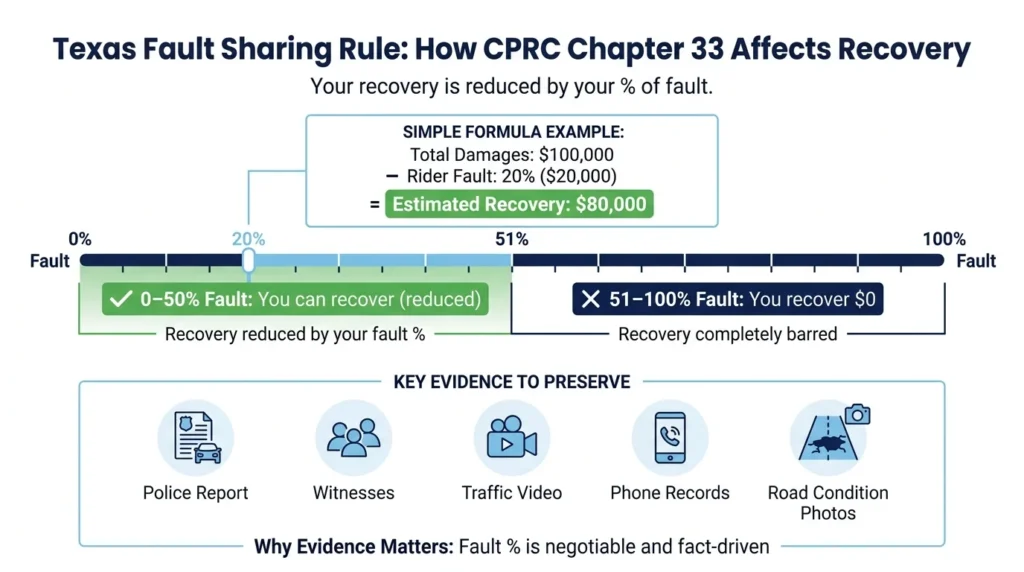
Police reports, witness statements, traffic camera footage, and phone records each capture different pieces of the picture. A driver’s statutory violation is direct evidence of negligence under Texas law. Cause identification is the first step in a claim, not an afterthought.
Cause also shapes damages. Riders typically recover medical expenses, lost wages, and pain and suffering, and the severity of the common injuries in motorcycle accidents often tracks the violence of the crash. For families who lost a loved one in an intersection or left-turn crash, wrongful death claims depend on the same cause analysis.
Building the case takes more than a single document. Reviewing legal strategies after a Texas motorcycle accident can help you see what an organized claim looks like from start to finish. Past motorcycle and auto accident case results show how cause evidence shapes outcomes in real Texas claims.
Talk to an Attorney About Your Motorcycle Accident
Angel Reyes & Associates has represented injured Texas motorcyclists and their families for decades, and have recovered more than $1 billion for clients. We work on contingency, so there is no fee unless we win, and consultations are free.
If another driver’s left turn, distraction, or failure to yield caused your crash, the cause is crucial and the evidence has a short shelf life. Contact us today to talk through what happened and what your claim could look like.
Past results do not guarantee future outcomes.
Motorcycle Accident Causes FAQs
Can a motorcyclist's family file a wrongful death claim if the rider had no helmet?
Texas does not require adult motorcycle riders to wear helmets if they meet certain insurance or training exemptions, and the absence of a helmet does not automatically bar a wrongful death claim. However, the defense may argue that it contributed to the severity of injuries, which could affect the family’s damages under Texas proportionate responsibility rules.
Does Texas require motorcyclists to carry uninsured motorist coverage?
Texas law requires insurers to offer uninsured and underinsured motorist coverage, but riders can reject it in writing. If a hit-and-run driver or an uninsured driver caused the crash, having that coverage in place can be the only way to recover compensation.
How long does a motorcycle accident victim have to file a personal injury lawsuit in Texas?
Texas sets a two-year statute of limitations for personal injury claims under Civil Practice and Remedies Code § 16.003, meaning the lawsuit must be filed within two years of the crash date. Claims against a government entity for a road defect follow different notice deadlines that can be much shorter.
What happens to a Texas motorcycle accident claim if the at-fault driver has minimum-limits insurance?
Texas requires drivers to carry at least $30,000 per person in bodily injury liability coverage, but that amount often falls short of what serious motorcycle injuries cost. A rider’s own underinsured motorist policy, if purchased, can cover the gap between the at-fault driver’s policy limit and the actual damages.
Does lane splitting affect fault in a Texas motorcycle accident?
Lane splitting is not legal in Texas, so a rider who was splitting lanes at the time of a crash may be assigned a share of fault under the state’s proportionate responsibility system. How much fault depends on the specific facts, including whether the other driver’s conduct also contributed to the collision.
About the Authors

Alex Ivanov
Writer
Alex Ivanov is a personal injury attorney at Angel Reyes & Associates, focused on car, truck, and motorcycle accident cases. Licensed in Texas and multiple federal districts, Alex brings international legal experience and a global education to his practice. He earned his LL.M. from Texas A&M University School of Law after graduating from Belarussian State University in 2016. Alex is fluent in Russian, English, Ukrainian, and Belarussian, and is recognized by multiple national trial lawyer associations for his results and leadership under 40.

Kyle Nicolas
Editor
Kyle Nicolas is the Web Content & SEO Manager at Angel Reyes & Associates. He has more than 10 years of experience as a marketing co...

Angel Reyes
Reviewer
Angel L. Reyes, III is the Founder and Managing Partner of Angel Reyes & Associates. A nationally recognized trial attorney and business...