How Bus Accident Settlements Are Split Among Victims


Every article on this site is researched by our internal team, reviewed for legal accuracy against current Texas law, and held to State Bar of Texas advertising standards before publication. We do not publish content that overstates outcomes or makes promises about results.
Learn more about our
editorial standards .
Key Takeaways
- Government-operated bus claims are capped at $500,000 per crash for state and city buses or $300,000 per crash for county and school district buses, to be shared by all victims.
- Privately operated bus carriers pay only up to their policy limit, to be divided among all claimants.
- Government-operated bus claims require written notice within six months, or your right to recovery is dismissed.
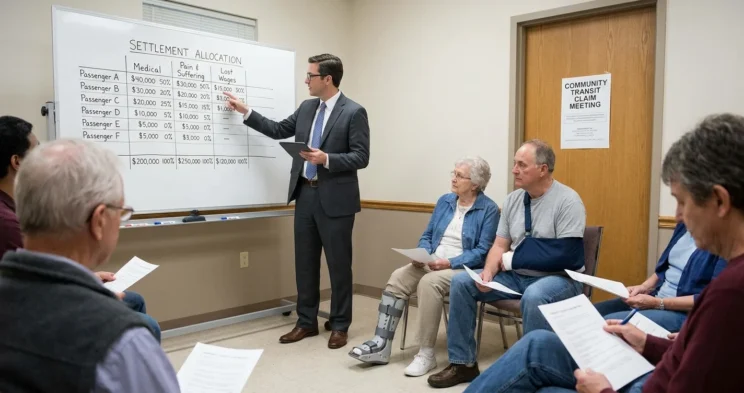
You were riding the bus home through downtown Dallas when the driver ran a red light and slammed into oncoming traffic. A dozen people around you were hurt, some far worse than you. Now, everyone is filing a claim, and you are worried there will not be enough money to go around.
So, how does the system decide who gets what?
How the Type of Bus Accident Affects Your Claim
The kind of bus you were on decides everything about how the money gets divided. A government-operated bus and a privately operated bus follow two completely different sets of funding rules, and you need to know which one applies before pursuing your claim.
- City transit buses, school district buses, and state agency shuttles are government-operated. Claims against them fall under the Texas Tort Claims Act. Sovereign immunity protects government agencies by placing a legal limit on how much compensation you can recover.
- Charter buses, commercial carriers, and intercity coach lines are privately operated. These types of vehicles carry private insurance instead. There is no legal limit on damages, but the carrier’s policy limit decides the maximum amount available to be shared between all injured passengers.
Determining who owned and operated the bus controls how the available money gets split when several people are injured at once. For more information, see how we handle Texas bus accident claims of both types.
Texas Tort Claims Act Limits for Government-Operated Bus Crashes
When you are injured in a crash involving a government-operated bus, your recovery is capped at a fixed dollar amount, no matter how serious your injuries are. How much money you can recover depends on which type of government unit was operating the bus.
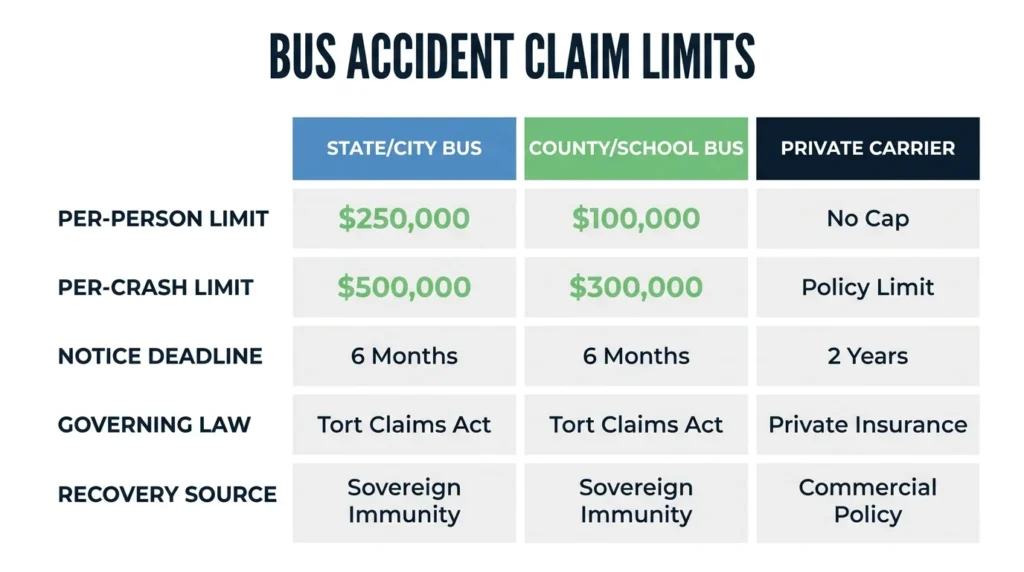
For claims against the state or a city, the Texas Civil Practice and Remedies Code (CPRC) § 101.023 sets the limit at $250,000 per person and $500,000 per crash for bodily injury or death. The per-crash limit can become the biggest issue in a crash with many injured passengers.
Claims against other local government units (such as counties and school districts) have even lower limits. In this case, the per-person limit drops to $100,000, and the per-crash limit is $300,000. So, if your child was hurt on a school bus, the recovery pool is smaller than it would be after a city transit crash.
The per-crash limit is important because if many passengers are injured in a single crash, the per-crash limit applies to the combined total of every claim filed from all passengers. For example, if four passengers each hold a valid claim worth $200,000, their losses total $800,000, but the $500,000 limit ensures that each passenger could only be paid a maximum of $125,000.
To make matters worse, wrongful death claims do not have their own separate recovery pool. Families pursuing a wrongful death claim under the Texas wrongful death statute, CPRC Chapter 71, must still abide by the same per-crash limit as all injured passengers, and must therefore claim recovery from the same pool.
If you are unsure which limit applies to your crash, our guide on Texas Tort Claims Act bus accident limits can shed some light on the situation.
Private Bus Insurance Minimums & Policy Limits
When you are injured in a crash involving a privately owned bus carrier, there is no legal limit on damages. Instead, the carrier’s insurance policy limit determines the maximum amount available for every claimant to share.
The Texas Transportation Code Chapter 643 requires commercial bus companies that operate only within Texas to carry minimum liability coverage. This minimum coverage creates the recovery pool available for private carriers that operate within Texas.
Federal rules require higher insurance limits for carriers that cross state lines. Under FMCSA financial responsibility regulations, interstate for-hire carriers must carry $5 million in coverage for buses built to seat 16 or more passengers, and $1.5 million for vehicles built to seat 15 or fewer.
When the total value of all passenger claims surpasses the carrier’s policy limit, the insurer won’t pay more than the limit. The money has to be shared among all injured passengers, no matter if the policy provides $500,000 or $5 million. To see what a typical recovery looks like, check out the average bus accident settlement in Texas.
How Funds Are Divided When Claims Exceed the Limit
When the combined claims are worth more than the available insurance coverage, you will almost never collect the full value of your individual claim. The money gets split among all injured passengers who file a claim, and the following four methods are used to decide how much each claimant receives:

- Pro-rata allocation: In this case, each claimant recovers a proportionate share of the available insurance money based on how big each passenger’s claim is. For example, if your claim is worth 20% of all the claims combined, then you will receive 20% of the total available coverage.
- Interpleader: In this case, a government agency or insurer can pay the maximum amount to the court and ask a judge to distribute it. This protects the payer from facing multiple lawsuits that would exceed the legal limit when combined.
- Injury severity: In this case, a passenger with catastrophic injuries (such as spinal cord damage or a traumatic brain injury) is usually awarded a larger proportionate share than someone with soft-tissue injuries. The money is split based on the value of each individual claim, rather than being divided equally.
- First-to-settle risk: In this case, settling quickly for less than your full claim frees up money for the other claimants, but it can shortchange you. On the other hand, holding out for more money is also risky, as other claimants’ early settlements may drain the available funds before you can get paid.
Knowing how this allocation works before you sign anything can protect the full value of your claim. Our guide to who is liable in a bus accident in Texas explains how fault affects your share of recovery.
Notice Deadlines for Bus Accident Claims
Acting fast is not just about meeting a deadline. When a limited pool of money is shared, every day you wait means other claimants get paid first, which can reduce the amount of money that is left to pay out your claim.
Privately operated bus claims follow the general two-year deadline under CPRC § 16.003. Two years may sound generous, but waiting too long is risky when you’re dealing with a fixed amount of money that may run out quickly.
For a government-operated bus claim, the CPRC § 101.101 requires written notice within six months of the crash. If you miss that deadline, your right to recover anything disappears.
In a multi-victim government-operated bus crash, claimants who file and settle early may use up the available per-crash insurance pool before claimants who file late can be paid. The six-month notice window is not a safe grace period when other people are already collecting from the fund. Our step-by-step on how to file a bus accident claim in Texas explains this process in detail.
Get Legal Help for Your Bus Accident Claim
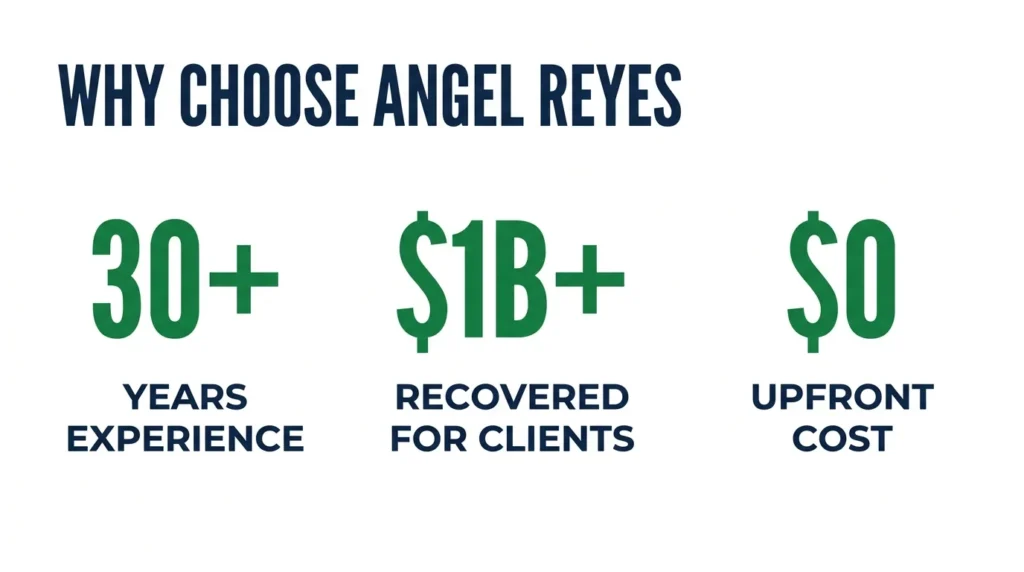
A shared limited pool rewards the people who move first and understand the rules. Angel Reyes & Associates has guided injured Texans through bus accident claims for over 30 years, with more than $1 billion recovered for clients across the state.
We work on contingency, so there are no upfront costs, and you pay no fee unless we win. Your initial consultation is free, and we can act quickly to protect your share before the six-month notice deadline passes or the limited pool runs dry.
Schedule a free consultation to discuss your options before time (and money) runs out.
Past results do not guarantee future outcomes.
Multi-Victim Bus Accident Settlement FAQs
Can a bus accident victim also file a claim against someone other than the bus operator?
Yes, if another driver, a road maintenance agency, or a vehicle manufacturer contributed to the crash, you can pursue compensation from that party separately. A third-party claim draws from a different coverage pool and does not reduce your share of the bus operator’s available funds.
Does Texas comparative fault apply to bus passengers, and can it reduce their payout?
Texas uses proportionate responsibility, which means your recovery is reduced by your percentage of fault. As a passenger, it is rare to be found at fault, but if a court assigns you any share of the blame, then your compensation will be reduced by the same percentage.
Can bus passengers use their own auto insurance after a crash?
If you carry uninsured or underinsured motorist coverage on your personal auto policy, that coverage may apply if the bus operator’s insurance is insufficient to cover your losses. Coverage terms vary by policy, so review your declarations page or ask your insurer directly for more details.
Who can file a wrongful death claim after a fatal bus accident in Texas?
Under Texas law, the surviving spouse, children, and parents of the deceased have the right to pursue a wrongful death claim. The executor of the estate may also file if no eligible family member does so within three months of the death.
What evidence should bus accident victims collect to protect their claim?
Preserve photos of the scene and your injuries, keep records of every medical visit and bill, and get the names and contact information of witnesses as soon as possible. Official records (such as the police report and the bus operator’s incident report) are also worth requesting early, before they become harder to obtain.
About the Authors

Angel Reyes
Writer
Angel L. Reyes, III is the Founder and Managing Partner of Angel Reyes & Associates. A nationally recognized trial attorney and business leader, Angel has helped over 70,000 injury victims recover more than $1 billion since founding the firm in 1993. Named to the Texas Super Lawyers list annually since 2008, Angel brings Wall Street experience, Ivy League education, and a deep commitment to client advocacy. He is a frequent legal commentator and published author with extensive contributions to legal scholarship, trial strategy, and consumer protection.

Kyle Nicolas
Editor
Kyle Nicolas is the Web Content & SEO Manager at Angel Reyes & Associates. He has more than 10 years of experience as a marketing co...

Angel Reyes
Reviewer
Angel L. Reyes, III is the Founder and Managing Partner of Angel Reyes & Associates. A nationally recognized trial attorney and business...