How Bus Camera Footage Can Help Prove Your Accident Claim


Every article on this site is researched by our internal team, reviewed for legal accuracy against current Texas law, and held to State Bar of Texas advertising standards before publication. We do not publish content that overstates outcomes or makes promises about results.
Learn more about our
editorial standards .
Key Takeaways
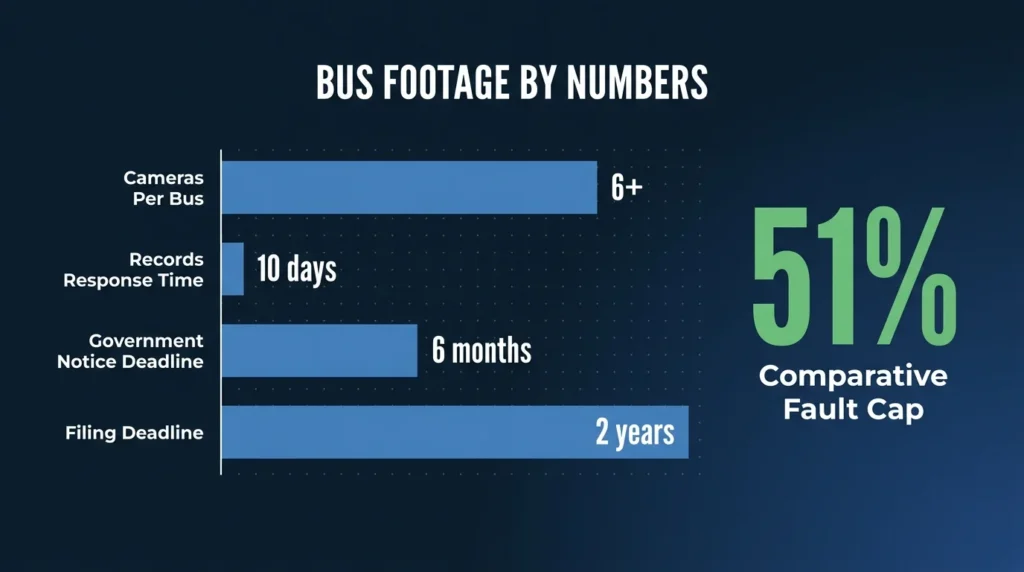
- Most transit buses carry multiple cameras (often six or more), recording a crash from several angles at once.
- Bus footage can be overwritten within days, so send a preservation demand fast.
- Government bus video comes via public records request; private carrier video needs a subpoena.
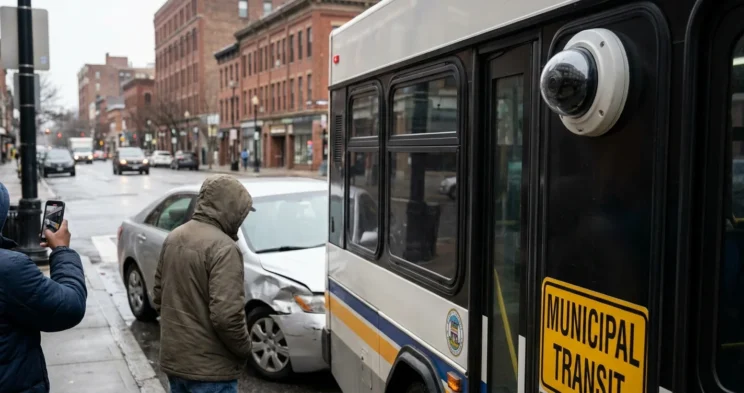
You were crossing Westheimer Road near the Galleria when a city bus pulled away from the stop and clipped you. The driver says you stepped into the lane. You know that is not what happened, and the bus was recording the whole time.
That footage could be the strongest proof you have. The problem is how fast it can vanish.
What Bus Cameras Capture in a Crash
Most transit buses carry multiple cameras (often six or more), so a single crash is recorded from several angles. Forward, rear, side-door, driver cab, and passenger cabin views all run together. Commercial charter buses use a similar setup.
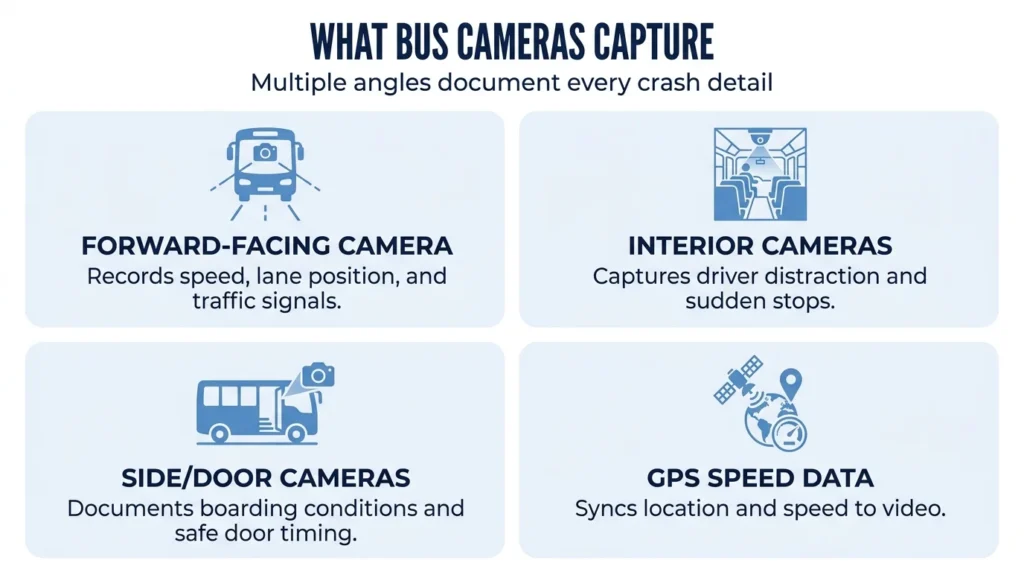
The forward-facing camera records the road ahead. It captures speed, lane position, traffic signals, and the seconds right before impact.
Interior cameras watch the driver and the cabin. They can show phone use, distraction, or a sudden stop with no warning to passengers.
Side and door cameras cover boarding and getting off. They document conditions at the stop and whether the driver opened the doors when it was not safe.
Many systems also log GPS-stamped speed and location data tied to the video. That synced record makes the footage harder to dispute than a plain visual clip.
Why Footage Disappears Faster Than You Expect
Bus video is often gone quickly. Government transit agencies like DART, Capital Metro, and VIA typically run rolling overwrite (delete) cycles that can erase routine trip footage within days. Policies vary by agency, but footage is rarely retained long without a specific hold request.
Private charter and intercity carriers set their own policies, and they vary widely. Without a legal hold demand, their footage can be overwritten within a few days, and sometimes sooner depending on storage capacity and the carrier’s policy.
The risk gets worse because buses go right back into service. They keep recording, and the new video automatically pushes the old footage out of storage.
Sending a litigation hold letter, also called a preservation demand, is the only reliable way to stop the clock. An attorney can send that demand the same day you hire one. Acting quickly is one reason it helps to speak with a bus accident attorney before the footage is gone.
Two Ways to Get Bus Camera Footage
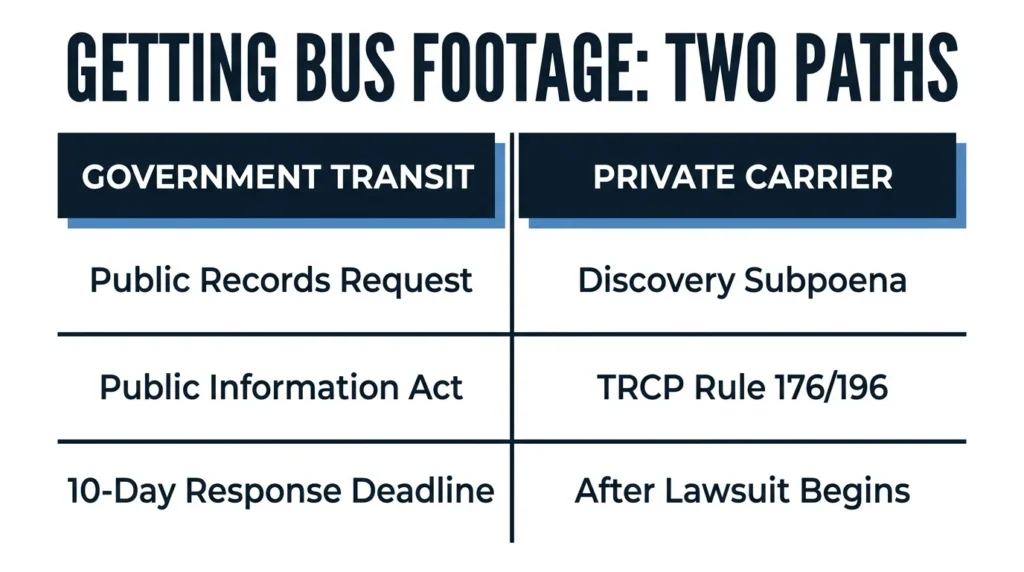
How you obtain the footage depends entirely on who owns the bus. Government transit footage comes through a public records request. Private carrier footage comes through a discovery subpoena after a lawsuit begins. The two tracks follow different laws and different timelines.
Public Records Requests for Government Transit Agencies
If a public agency runs the bus, you request the video through the open records process. A written request under the Texas Government Code Chapter 552 (Texas Public Information Act) starts a 10-business-day response deadline. The agency must then provide the records, ask for more time, or seek an Attorney General opinion to withhold them.
Make your request specific. Include the date, time, route number, direction of travel, and a short description of the crash so the agency can find the right recording.
Agencies sometimes claim an exception for footage tied to an active law enforcement investigation. Knowing how to answer or challenge that denial is part of what an attorney handles for you.
A records request alone does not guarantee the video survives. A preservation demand sent before or with the request adds a layer of legal protection. The same dual-track logic shapes how to file a bus accident claim in Texas.
Discovery Subpoenas for Private Bus Carriers
Private carriers are not covered by the Public Information Act, so you cannot simply request their video. You need either a voluntary preservation agreement or a formal subpoena issued after a lawsuit begins.
Document production from a party defendant comes through Texas Rules of Civil Procedure Rule 196, while compelling a nonparty to produce records requires a subpoena under Texas Rules of Civil Procedure Rule 176.
A pre-suit hold letter can establish notice and trigger preservation duties, but it does not force the carrier to hand anything over. The carrier can still refuse to release footage on its own.
If the carrier destroys video after receiving a written preservation demand, Texas courts may consider a spoliation remedy at trial, including, in cases of intentional destruction or severe prejudice, an instruction telling the jury it may assume the missing footage would have hurt the carrier’s defense.
The strength of that remedy depends on the circumstances, which is one more reason to get a preservation demand in writing as early as possible.
You also have a clock on filing. Texas Civil Practice and Remedies Code (CPRC) § 16.003 sets a two-year deadline for personal injury claims, and that window starts on the date of the crash. Knowing who is liable in a bus accident helps you decide whom to name before that deadline runs.
How Bus Footage Proves Fault in Texas
Once you have the video, it can show exactly what the driver did. Footage can capture the bus running a red light, failing to yield, making an unsafe lane change, or driving while distracted. Each of those points directly to operator negligence.
Texas uses a fault-sharing system called proportionate responsibility. Under Texas Civil Practice and Remedies Code Chapter 33 (Proportionate Responsibility), each party gets a percentage of the blame. Video that shows the driver was mostly at fault strengthens your recovery.
The synced GPS and speed data does more work here. It can refute an insurer’s claim that you exaggerated the speed or the force of the impact.
Interior footage matters too. A clip of a passenger thrown forward by a sudden, unexplained stop can back up your injury claim when the cause is in dispute. Because these caps and fault rules get complicated fast, it is worth understanding how the Texas Tort Claims Act limits recovery before you accept any offer.
Admitting Bus Footage as Evidence in Texas
Having the footage is not the same as getting it in front of a jury. The Texas Rule of Evidence 901 requires that video be authenticated first. You must show enough proof that the footage is what you say it is and has not been altered.
That usually means testimony from a records custodian or a bus system technician. They confirm how the video was captured, stored, and retrieved, and that your copy is accurate.
Chain of custody is the deciding factor. Footage pulled through a records request or subpoena, with proper paperwork, is far easier to confirm than a clip shared informally.
Defense attorneys routinely attack authentication when footage was not obtained through a formal legal process. Getting the video through counsel, with a documented chain of custody from day one, closes that gap.
Talk to an Experienced Attorney About Your Case
Bus camera footage is often the single best proof of what really happened, but only if someone moves fast to preserve it. Angel Reyes & Associates has represented bus accident victims across Texas for over 30 years. We handle preservation demands, public records requests, and discovery subpoenas so you do not lose critical video.
With more than $1 billion recovered for clients, no fee unless we win, and free consultations available 24/7, there is no financial risk to getting help right away.
Reach out to us for a free consultation to talk through your claim. You can also read what our clients say about working with us.
Past results do not guarantee future outcomes.
Bus Camera Footage & Accident Claim FAQs
Does the two-year deadline still apply if a city transit bus hit me?
No. When a government agency operates the bus, the Texas Tort Claims Act requires you to file a written notice of claim within six months of the accident, not two years. Some city charters, including Houston’s, shorten that window to 90 days, so the notice deadline can arrive long before most injured people realize it.
What happens if the bus footage shows I was partly to blame?
You can still recover under Texas’s modified comparative fault rules as long as your share of the blame is less than 51 percent. Your final award is reduced by your percentage of fault, so footage that places most of the responsibility on the bus driver still supports a meaningful recovery.
Does the same footage process apply if a school bus caused the crash?
School districts are government entities, so the Texas Tort Claims Act notice deadline applies just like it does for transit agencies. Footage showing other students may also be withheld under federal privacy rules, and obtaining it often requires a court order rather than a standard public records request.
What other bus records should be preserved alongside the camera footage?
Bus maintenance logs and driver qualification files can show whether the vehicle had unresolved defects or the driver had prior violations. For commercial carriers, federal regulations require those records to be kept on file, and they can establish a pattern of negligence that goes beyond what any single video clip shows.
What if the bus camera was not working at the time of the crash?
A malfunctioning or disabled camera does not end your claim. Nearby business surveillance footage, traffic cameras, witness statements, and physical evidence from the scene can fill the gap, and an accident reconstruction expert can use vehicle data and road conditions to show what happened.
About the Authors

Angel Reyes
Writer
Angel L. Reyes, III is the Founder and Managing Partner of Angel Reyes & Associates. A nationally recognized trial attorney and business leader, Angel has helped over 70,000 injury victims recover more than $1 billion since founding the firm in 1993. Named to the Texas Super Lawyers list annually since 2008, Angel brings Wall Street experience, Ivy League education, and a deep commitment to client advocacy. He is a frequent legal commentator and published author with extensive contributions to legal scholarship, trial strategy, and consumer protection.

Graham Griffin
Editor
Graham Griffin is the Web & Content Manager at Angel Reyes & Associates, where he oversees content strategy, AI-powered workflows, a...

Angel Reyes
Reviewer
Angel L. Reyes, III is the Founder and Managing Partner of Angel Reyes & Associates. A nationally recognized trial attorney and business...