How Do You Prove a Slip and Fall?


Every article on this site is researched by our internal team, reviewed for legal accuracy against current Texas law, and held to State Bar of Texas advertising standards before publication. We do not publish content that overstates outcomes or makes promises about results.
Learn more about our
editorial standards .
Key Takeaways
- Constructive notice requires timing evidence; a nearby employee alone is not enough.
- Preserve the footage and retention record, aisle sweep logs, incident report, and photos.
- Tracks or a log gap can be a clue to investigate, but neither proves the timeline alone.
To prove a Texas store slip-and-fall claim, you need evidence that the owner or operator knew or should have known of an unreasonably dangerous condition, failed to use reasonable care, and caused your injury. When the question is whether the store should have discovered a spill, you must establish how long it was there.
After a painful fall, gathering records can feel overwhelming. Start with the evidence that shows the condition, the store’s knowledge, and what happened to you.
What Must You Prove in a Texas Slip-and-Fall Case?
To prove negligence in a slip and fall, identify who controlled the area and show how the hazard, the store’s knowledge, and its failure to use reasonable care caused your injury. A fall alone does not prove negligence.
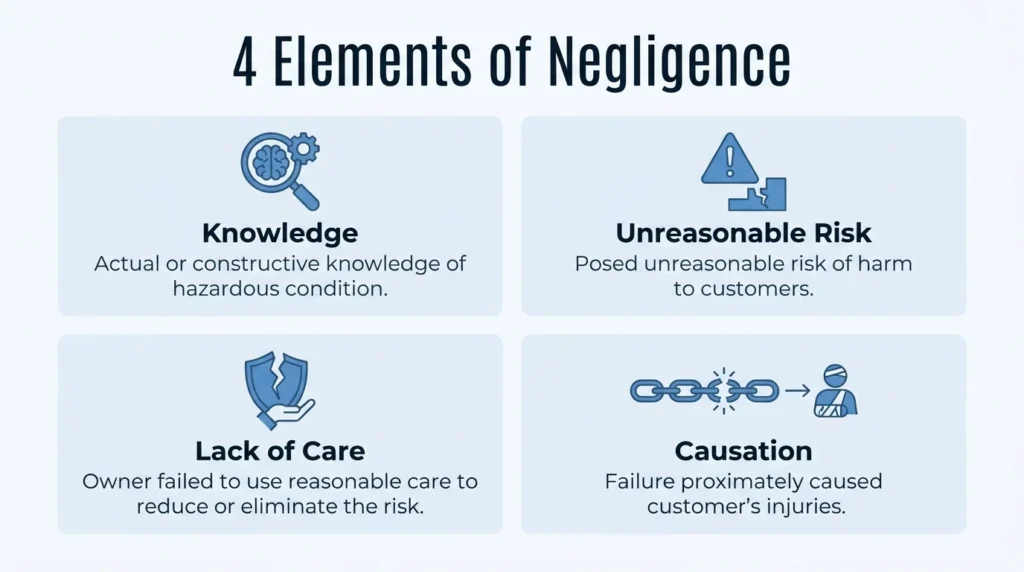
The Texas Supreme Court set out these elements in Wal-Mart Stores, Inc. v. Gonzalez. For a customer, who Texas law calls an invitee, the elements are:
- Knowledge: The owner or operator had actual or constructive knowledge of the condition.
- Unreasonable risk: The condition posed an unreasonable risk of harm.
- Lack of reasonable care: The owner or operator did not use reasonable care to reduce or eliminate the risk.
- Causation: That failure proximately caused your injuries.
Actual knowledge means the store was aware of the hazard. A manager saw the spill, or a customer reported it. Constructive knowledge means the store should have discovered it because it existed long enough that a reasonable inspection would have caught it.
Under Austin v. Kroger Texas, L.P., a store generally must make concealed hazards safe or adequately warn customers about hazards it knew of or reasonably should have discovered. A hazard that was open and obvious, or already known to you, can affect that duty. Texas recognizes exceptions, including a necessary-use exception, so an obvious hazard does not automatically end a claim.
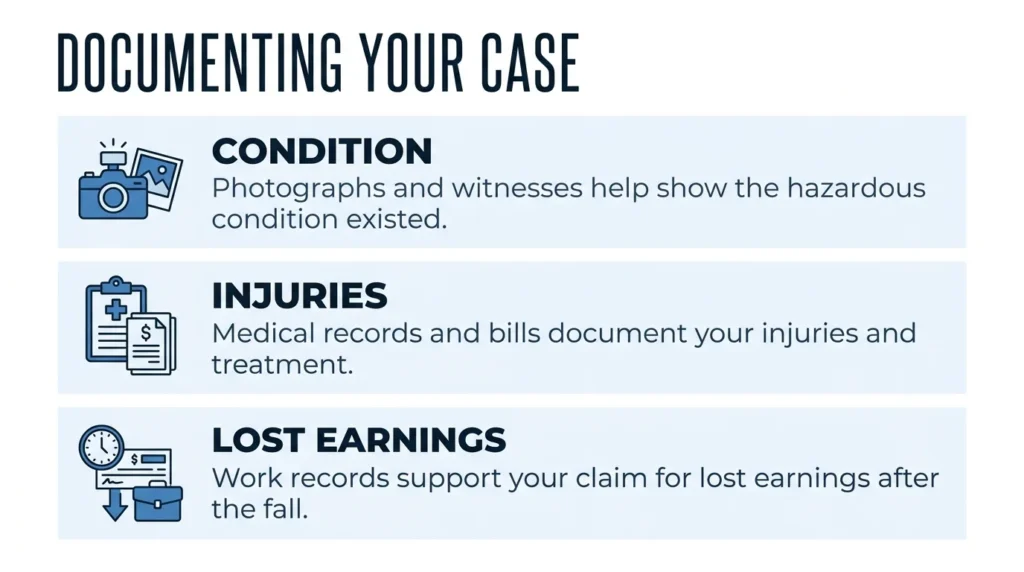
Each element calls for its own proof. Photographs and witnesses help show the condition. Medical records and bills document your injuries and treatment, while work records support lost earnings.
None of these elements proves notice or causation alone. This framework covers ordinary store customers; workplace falls, government property, and other visitors follow different rules. You can read more about Texas premises liability claims and how these cases fit together.
How Do You Show the Store Had Time to Discover the Hazard?
You show it with evidence of how long that specific hazard was on the floor before you fell. In Wal-Mart Stores, Inc. v. Reece, the Texas Supreme Court held that constructive notice requires proof the hazard existed long enough for the store to discover it. An employee’s mere proximity to the spill is not enough.
In Reece, an employee had been near the spill, but nothing showed how long the substance had been there. Without that timing evidence, the court rendered judgment that the injured customer was owed nothing. The court did not set a fixed number of minutes for how long a hazard needs to be present, but factors like visibility, how close employees were over time, and other circumstances all matter.
A witness who told an employee about the spill before your fall raises a question of actual knowledge. A witness who only saw an employee nearby does not prove the employee noticed anything. If an employee may have caused the spill, that possibility needs investigation rather than an assumption based on where the employee stood.
The Court reaffirmed Reece in H-E-B, LP v. Peterson, decided in April 2026. Prior roof leaks elsewhere in the store, the timing of rain, the size of the puddle, and the store’s inspection protocol did not establish how long that puddle existed.
Evidence That May Help Prove the Hazard
When nobody saw the spill happen, investigate the following clues without assuming they establish a timeline.
Tracks and footprints through the substance are worth photographing, but they do not prove duration on their own. Gonzalez rejected the argument that dirt and tracks showed food had been on the floor a while, because the contamination could have happened quickly. Peterson repeated that caution about cart tracks, footprints, and dirt.
Dried edges are a clue to photograph before cleanup if you can do so safely. However, the existence of dried edges alone does not establish a reliable number of minutes or prove how long the spill existed.
Sweep and inspection logs for that aisle can show who checked the floor, when, and what they saw. Compare each entry against video and testimony. A written inspection policy is not proof that anyone inspected, and a gap between recorded checks does not prove the spill sat there for the entire gap.
Surveillance video can help establish when the hazard was present. Footage of a visibly clean floor sets a possible starting boundary, though it does not prove the spill appeared right after.
Footage that clearly shows the hazard already present before your fall can establish a minimum duration. A clip showing only the fall, or a camera angle that hides the floor, may leave the notice question unanswered.
Which Records Should You Preserve After the Fall?
If safe, document the condition before anyone cleans up the hazard, then identify the exact time and place of your fall so you can request the right records. Focus on these four records:
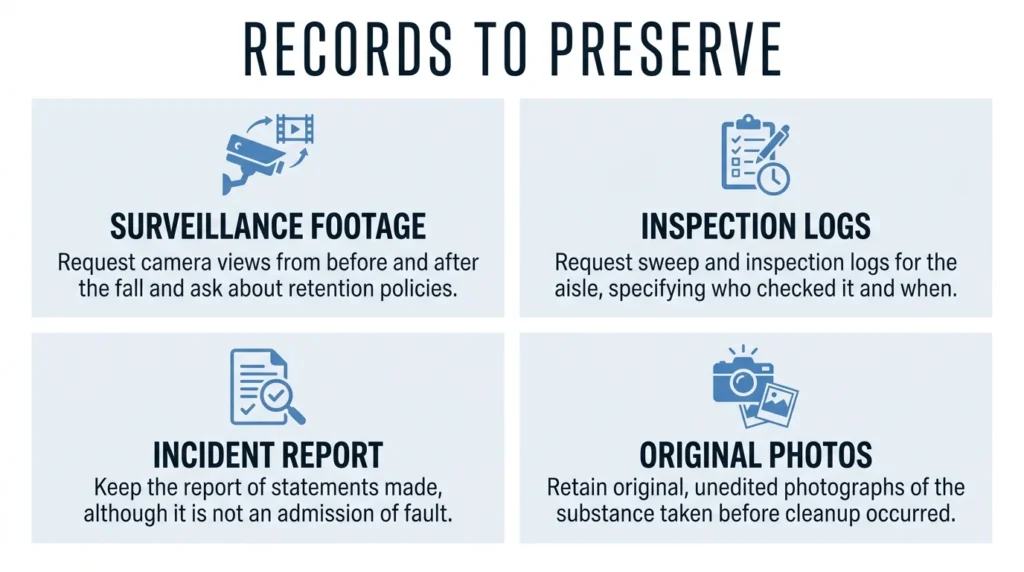
- Surveillance footage and its retention record. Ask for relevant camera views from before and after the fall. Ask which segment the store saved, who saved it, and when other footage may be overwritten.
- Sweep and inspection logs for that aisle. Request entries for the relevant period, including who performed each check and what each person recorded.
- The incident report. It records what people reported at the time. It is not necessarily an admission that the store was negligent.
- Original photographs of the substance taken before cleanup. Keep the original files, not just edited or cropped copies.
Write down the date, the approximate time, and the exact location, including the aisle and any nearby display. Collect witness names and phone numbers and keep your medical records and bills. These support what happened and how you were hurt, though they do not replace proof of notice.
Keep copies of every preservation request you send and every response you receive. A request asks the store to keep evidence. It does not guarantee the store will hand anything over right away, and it does not prove fault.
Lost video creates its own legal question. In Brookshire Brothers, Ltd. v. Aldridge, a store kept only a short segment of footage, and additional video was lost. A duty to preserve depends on whether litigation was reasonably anticipated and whether the store had relevant, material evidence in its control.
The trial judge decides whether evidence was improperly lost and what remedy fits. Missing footage does not automatically prove negligence, and in Aldridge the Supreme Court reversed the severe sanction imposed.
How Does a Slip-and-Fall Case Work, and Why Can Proof Be Difficult?
A Texas slip-and-fall case works by building proof for each element, with the notice timeline often at the center. Slip-and-fall cases can be hard to win because a missing timeline can defeat a claim even when your fall and injury are well documented.
The process generally moves through these stages:
- Identify the responsible party. Determine who owned, operated, or controlled the area, and why you were there.
- Document the condition and your injuries. Gather photographs, witness information, medical records, and work records.
- Reconstruct the notice timeline. Compare video, logs, and testimony to determine whether the store knew or should have known about the hazard.
- Request records. Send early preservation requests, then use formal discovery if the claim goes to litigation.
Early requests and formal discovery serve different purposes. A preservation request asks the store to keep evidence. Once a lawsuit is filed, Texas Rule of Civil Procedure 196 lets parties request identified documents, tangible items, and electronic information within the scope of discovery, subject to objections and privileges.
Talk With Angel Reyes & Associates About Your Evidence
If you were hurt in a fall at a Texas store, you do not have to sort through notice rules and evidence requests alone. Angel Reyes & Associates has guided injured Texans for over 30 years, and the team includes investigators and board-certified attorneys who know what records to look for.
Before your free consultation, gather your photographs, the incident report or request details, witness contact information, medical records, and preservation correspondence. Our team can review your fall, the notice timeline, and available evidence, then walk you through your options. You can reach us 24/7, and we have more than 30 locations across Texas.
Contact Angel Reyes & Associates for a free consultation.
Past results do not guarantee future outcomes.
Slip-and-Fall Proof FAQs
Does a store employee standing near a spill prove the store knew about it?
No. In a Texas store-customer claim, an employee’s proximity alone does not show that the employee saw the spill or that it had been there long enough for the store to discover it. A report to an employee before the fall would raise a different question about actual knowledge.
Can footprints or dried edges show how long a spill was on the floor?
They are clues to photograph and investigate, but neither establishes the spill’s age on its own. Tracks can form quickly, and the appearance of dried edges does not provide a reliable number of minutes. Compare those observations with video, inspection records, and witness accounts.
What if the store's video shows the floor was clear before my fall?
A clearly visible, clean floor helps narrow the possible time window, but it does not show exactly when the spill appeared. Footage that clearly shows the hazard present before the fall may establish a minimum duration; a clip showing only the fall may leave that question unanswered.
What if surveillance footage was overwritten after my fall?
Overwritten footage does not automatically prove the store was negligent. Keep your preservation request and any response, including details about what footage was saved and the store’s retention practices. If litigation follows, a judge determines whether the loss calls for a remedy based on the circumstances.
About the Authors

Angel Reyes
Writer
Angel L. Reyes, III is the Founder and Managing Partner of Angel Reyes & Associates. A nationally recognized trial attorney and business leader, Angel founded the firm in 1993, which has gone on to help over 70,000 injury victims recover more than $1 billion. Named to the Texas Super Lawyers list annually since 2008, Angel brings Wall Street experience, Ivy League education, and a deep commitment to client advocacy. He is a frequent legal commentator and published author with extensive contributions to legal scholarship, trial strategy, and consumer protection.

Graham Griffin
Editor
Graham Griffin is the Web & Content Manager at Angel Reyes & Associates, where he oversees content strategy, AI-powered workflows, a...

Angel Reyes
Reviewer
Angel L. Reyes, III is the Founder and Managing Partner of Angel Reyes & Associates. A nationally recognized trial attorney and business...