What If Your Broken Bone Won’t Heal Right?


Every article on this site is researched by our internal team, reviewed for legal accuracy against current Texas law, and held to State Bar of Texas advertising standards before publication. We do not publish content that overstates outcomes or makes promises about results.
Learn more about our
editorial standards .
Key Takeaways
- A nonunion fracture fails to heal, while a malunion fracture heals in the wrong position.
- Texas future medical expenses must be reasonably probable and reasonable in cost.
- Serial imaging, surgeon's notes, and a revision plan help document added surgery.

If your broken bone isn’t healing correctly after an accident, your orthopedic surgeon needs to determine whether it has failed to heal or healed in the wrong position. A nonunion fracture fails to heal; a malunion fracture heals in an abnormal position. Either can require more treatment, sometimes another surgery, and a longer recovery.
That uncertainty can affect your work and your plans. In Texas, an injury claim can include future medical care when the evidence shows that injury-related care is reasonably probable and its cost is reasonable. Your imaging, surgeon’s notes, and treatment plan help explain what you may need next.
Is It a Nonunion Fracture or a Malunion Fracture?

A nonunion fracture has failed to unite. A malunion fracture has united, but in an abnormal position. Nonunions are a failure to heal, distinct from delayed union, which means the bone is healing more slowly than usual.
|
Fracture Condition |
What Happened |
What Imaging May Show |
|
Nonunion |
The bone failed to unite |
A persistent gap or no healing progress across repeated studies |
|
Malunion |
The bone united in an abnormal position |
Angulation, rotation, or shortening |
Repeated imaging means a lot because one X-ray shows a single moment. A series of dated studies lets your orthopedic surgeon assess healing progress and alignment over time.
A malunion can involve a bone that heals at an angle, twisted, or shortened. Malunion in the leg can affect walking and function, but some malunions do not require treatment.
Pain alone cannot tell you which problem you have, though tenderness, swelling, deep aching, and trouble using the injured area as symptoms of nonhealing fractures. If those signs persist, tell your doctor so they can evaluate the cause.
What Treatment Might Be Needed When a Bone Does Not Heal Correctly?
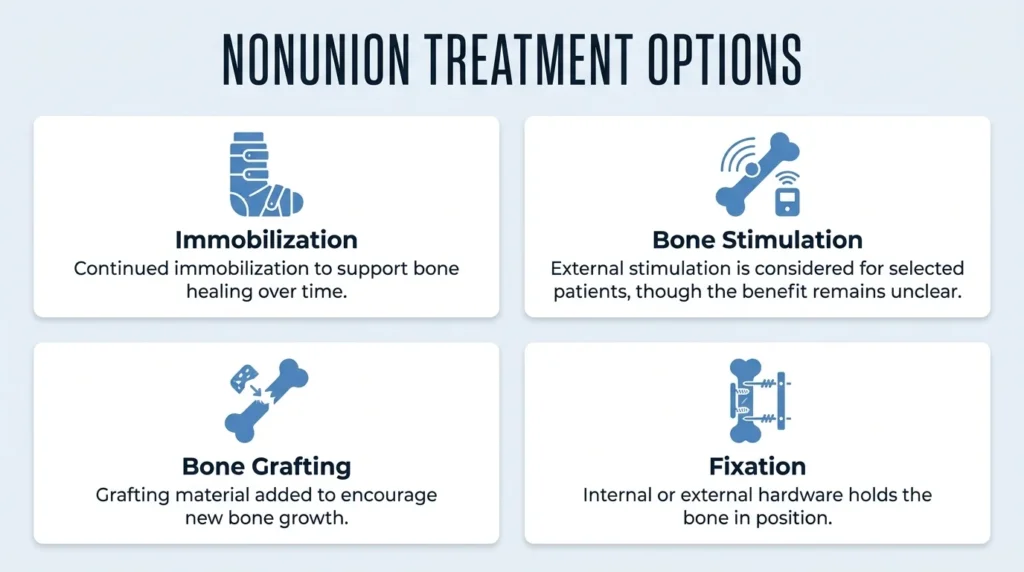
Treatment depends on the fracture, its alignment and stability, your symptoms, and your surgeon’s assessment. A nonunion and a malunion are different problems, so treatment must address the specific condition.
For a nonunion fracture, AAOS lists continued immobilization, external bone stimulation for selected patients, bone grafting, and internal or external fixation. Fixation uses hardware to hold the bone in position. If an earlier operation did not work, repeat surgery may be needed.
A surgeon may consider a bone stimulator for selected nonunions, but the Hospital for Special Surgery cautions that its proven benefit remains unclear and that mechanical stability is essential. Stimulation does not guarantee healing or avoidance of surgery.
For a malunion fracture, some cases need no treatment. When a malunion causes symptoms, a surgeon may perform an osteotomy, which means cutting the bone, realigning it, and holding it in place with hardware. Some lower limb cases can use a shoe lift or brace instead.
A stimulator does not straighten a bone that has already healed crooked. Your surgeon’s recommendation should explain whether the problem calls for improved healing, corrected alignment, or both.
Revision surgery may correct fixation, add stability, place a bone graft, or realign the bone, depending on your plan. HSS describes recovery as involving bone healing, muscle recovery, and rehabilitation, with activity restrictions that depend on the procedure.
Ask your surgeon what additional restrictions, therapy, and follow-up your procedure may require; there is no single recovery timeline for every patient.
Can a Texas Injury Claim Include Future Fracture Care?
Yes, when the evidence supports it. Texas law allows recovery of future medical expenses when injury-related care is reasonably probable and the expected costs are reasonable.
In Hulsey v. Attalla, a Texas collision case, the First Court of Appeals stated those requirements. It also explained that expert testimony is the preferred practice, though not always required. A jury can consider the nature of the injury, the medical care already received, and the person’s condition at trial.
The Texas Supreme Court confirmed in Gunn v. McCoy that future medical expenses require reasonable probability while recognizing their inherent uncertainty. You do not need to prove the future with certainty.
A diagnosis alone does not establish the need for a particular surgery or its cost. A surgery mentioned as one possibility among several options does not automatically count as probable care.
The evidence should connect your accident-related condition, a specific recommended procedure, and reasonable costs for that procedure.
The accident connection must rest on medical evidence, not assumption. In Hulsey, the court discussed how treatment history, physician testimony, and a surgical cost estimate worked together to support future surgery. That illustrates why a treatment recommendation and its supporting records count together.
If an adjuster questions whether another surgery is needed, your surgeon’s explanation can address why that procedure is recommended and whether alternatives remain appropriate.
How Can You Document Another Surgery & a Longer Recovery?

Dated imaging, orthopedic notes, and a specific revision plan form the core of your evidence. Together they can show what changed, why more care is recommended, and what recovery may involve. Cost estimates and work records address different parts of the claimed loss.
- Serial images and radiology reports. Keep dated images and their reports so your surgeon can explain stalled healing or malalignment over time. These records show what is happening to the bone; they do not establish treatment costs.
- Orthopedic notes. The notes should describe your diagnosis, prior treatment, symptoms, functional limits, and the medical reason for further treatment. Where the medical evidence supports it, they can also connect your condition to the accident.
- The revision plan. A useful plan names the proposed procedure and explains whether it is the probable course or only an alternative. It should also address expected restrictions, follow-up visits, and rehabilitation.
- Cost support. Reasonable estimates should match the recommended care. Relevant costs may include the surgeon, facility, anesthesia, therapy, and follow-up. An estimate should distinguish recommended services from other possible care.
- Recovery impact. Save physician restrictions, therapy records, and documentation of actual time missed from work. A personal calendar or journal can explain how the injury affects your daily life, but it cannot replace a medical prognosis or cost evidence.
The right attorney can review these records with you and help assemble the reports and estimates needed to explain the proposed care and added recovery time. No single record establishes the entire claim.
Talk With Angel Reyes & Associates About Your Fracture Claim
If you’re facing more treatment after an accident, request a free consultation with the team at Angel Reyes & Associates to discuss your injury, your surgeon’s recommendations, and your options under Texas law. Bring any imaging, orthopedic records, and proposed revision plan you have.
The firm has guided injured Texans for over 30 years.
Past results do not guarantee future outcomes.
Broken Bone Healing Issues FAQs
What factors can prevent a broken bone from healing properly?
Poor blood supply, infection, inadequate fracture stability, and certain health or lifestyle factors can interfere with bone healing. Your orthopedic surgeon can evaluate whether one or more of these factors may be contributing to the problem.
What happens if my doctor cannot determine whether I need another fracture surgery yet?
Your medical team may recommend continued monitoring, additional imaging, or conservative treatment before deciding whether surgery is necessary. For a Texas injury claim, a procedure that remains only a possible option may not satisfy the reasonable-probability standard for future medical expenses.
How does a broken bone that heals incorrectly affect nearby joints?
Abnormal bone alignment can change how weight and movement are distributed across nearby joints. Depending on the injury, this may contribute to stiffness, reduced range of motion, altered walking mechanics, or additional joint stress.
What if my fracture injury prevents me from returning to the same job in Texas?
You may be able to pursue compensation for diminished future earning capacity if medical evidence and employment-related evidence establish that your injury limits your ability to earn income. Relevant evidence may include permanent work restrictions, vocational assessments, and testimony about your prior and expected earnings.
About the Authors

Angel Reyes
Writer
Angel L. Reyes, III is the Founder and Managing Partner of Angel Reyes & Associates. A nationally recognized trial attorney and business leader, Angel founded the firm in 1993, which has gone on to help over 70,000 injury victims recover more than $1 billion. Named to the Texas Super Lawyers list annually since 2008, Angel brings Wall Street experience, Ivy League education, and a deep commitment to client advocacy. He is a frequent legal commentator and published author with extensive contributions to legal scholarship, trial strategy, and consumer protection.

Kyle Nicolas
Editor
Kyle Nicolas is the Web Content & SEO Manager at Angel Reyes & Associates. He has more than 10 years of experience as a marketing co...

Angel Reyes
Reviewer
Angel L. Reyes, III is the Founder and Managing Partner of Angel Reyes & Associates. A nationally recognized trial attorney and business...