How Road Construction Zones Lead to Bus Accidents in Texas


Every article on this site is researched by our internal team, reviewed for legal accuracy against current Texas law, and held to State Bar of Texas advertising standards before publication. We do not publish content that overstates outcomes or makes promises about results.
Learn more about our
editorial standards .
Key Takeaways
- Buses face higher work zone crash risk because narrowed lanes leave almost no room to correct.
- A bus driver, the contractor, and a government entity can all share fault for one crash.
- Private bus claims allow two years, but government bus claims can require notice in 45 to 90 days.
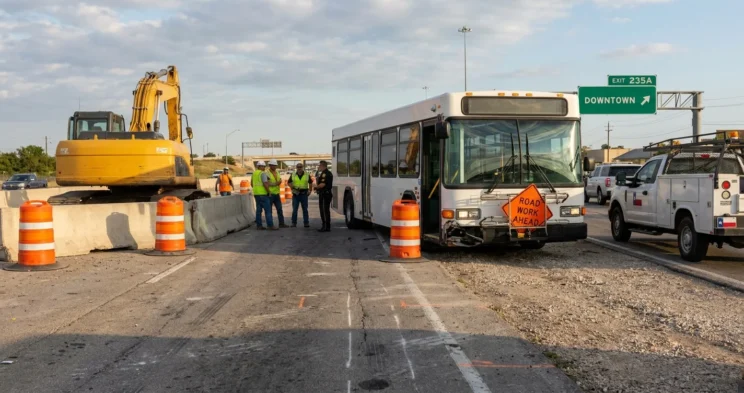
You were riding a bus through a narrowed stretch of I-10 near downtown Houston when the lane suddenly pinched down beside a row of concrete barriers. The bus drifted, clipped the edge, and lurched hard enough to throw passengers from their seats.
Now you are sore, shaken, and unsure who was even at fault.
Why Buses Are Especially Vulnerable in Work Zones
Buses run a higher crash risk in work zones because their size leaves almost no margin when lanes shrink. A bus body is wider than most vehicles, so a lane cut to half its normal width can put the bus within inches of a concrete barrier.
That tight fit removes the buffer a driver relies on to stay clear of barriers and equipment. There is simply no room left to correct a small drift before it becomes a crash.
Blind spots make the problem worse. A bus has large blind zones on all four sides, which can hide barriers, faded lane edges, and workers stepping into the travel lane.
Sudden detours add another layer of danger. An abrupt reroute can push a bus onto surface streets it was never built to handle at transit speed. Tight turns and narrow geometry raise the odds of a sideswipe or a clearance problem.
Rear-end crashes and sideswipes are the most common work zone crash types, according to federal work zone crash statistics. Both hit large vehicles harder, since a loaded bus needs far more distance to stop.
Construction Zone Hazards That Trigger Bus Crashes
Most work zone bus crashes trace back to a handful of site conditions that give a large vehicle no room to react. Federal data shows large trucks and buses are involved in roughly one-third of fatal work zone crashes, and the hazards below explain much of why.
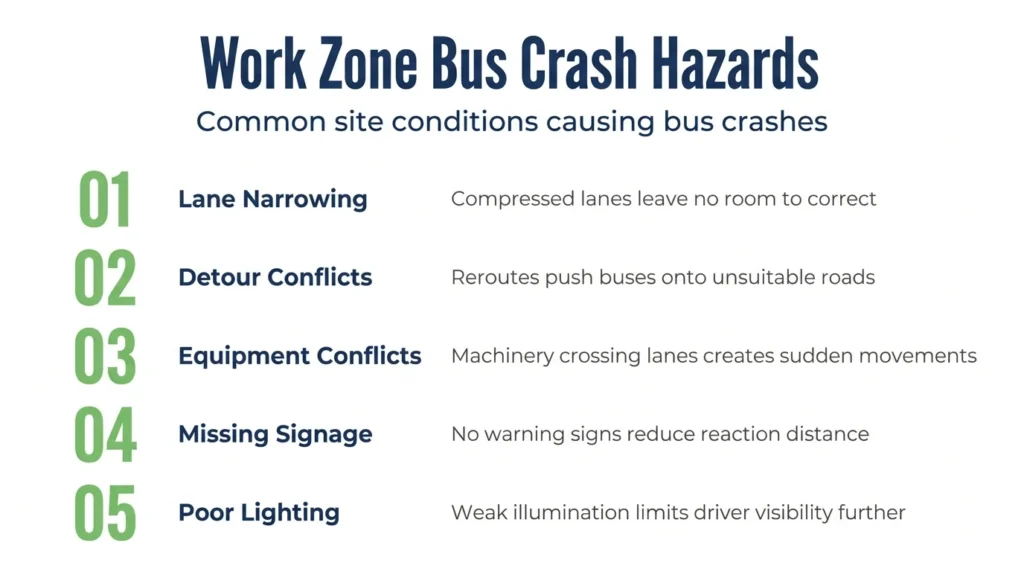
- Lane narrowing: Compressed lanes force a bus to thread between jersey barriers and equipment with no room to correct a drift.
- Detour conflicts: An abrupt reroute shifts a bus onto roads not built for its weight or turning radius, raising rollover and clearance risk.
- Equipment conflicts: Dump trucks, loaders, and excavators crossing into travel lanes create sudden movements a bus driver cannot anticipate at speed.
- Missing signage: When a contractor skips advance warning signs, a bus reaches a narrowed lane without enough distance to slow safely.
- Poor lighting: Night and early-morning zones with weak illumination add risk for a driver who already has limited visibility from the cab.
Any one of these can turn a routine drive into a serious crash. When two or more stack together, the danger climbs fast.
Who Bears Liability for a Bus Crash in a Work Zone?
Three parties can share fault for a work zone bus crash: the bus driver and operator, the construction contractor, and the government entity overseeing the project. Texas law lets you name all three in the same claim.
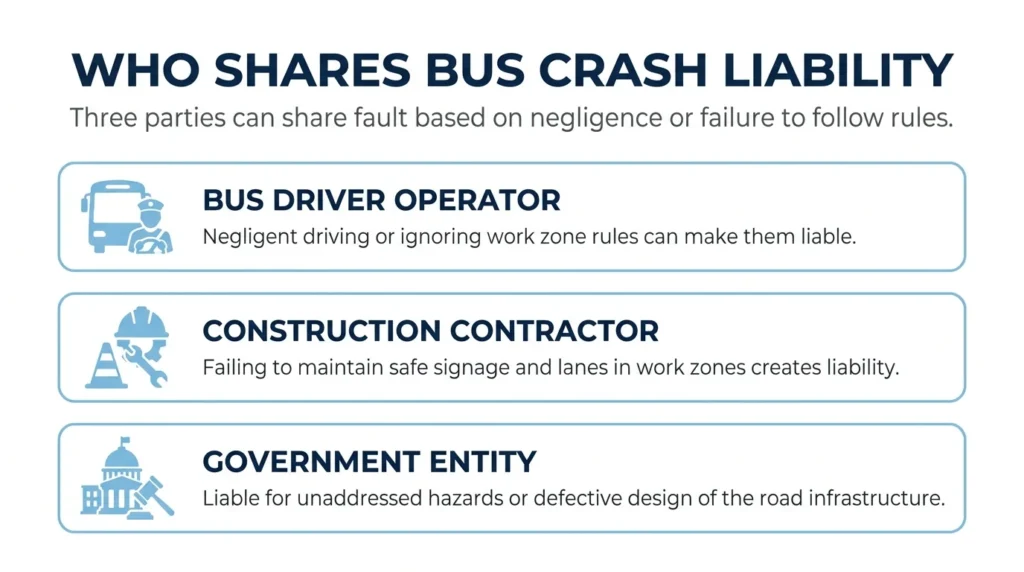
The bus driver is the first place fault often lands. A driver who ignores reduced speed limits, blows past warning signs, or fails to adjust for narrowed lanes can be found negligent. Drivers must obey work zone warning signs and barricades under Texas Transportation Code Section 472.022, which adds penalties when workers are present.
The operating company is on the hook too. Under Texas employer liability rules, the company answers for its driver’s conduct on the job.
Contractors carry their own duty. They must set up and maintain a safe work zone, including proper signage, lane markings, lighting, and equipment kept clear of travel lanes. When a contractor falls short and that failure helps cause a crash, you can bring a direct negligence claim.
Government entities can share fault as well. TxDOT and local agencies keep oversight duties even after they hand construction to a contractor. They can be liable under the Texas Tort Claims Act when a known hazard goes unaddressed or the work zone design itself was defective.
Texas sorts all of this through proportionate responsibility. Each party gets a separate fault percentage under Texas Civil Practice and Remedies Code Chapter 33, and you can still recover as long as your own share of fault stays at 50 percent or less.
If you are unsure which parties to name, speaking with an attorney experienced in multi-party bus accident claims before deadlines pass can protect your options.
Filing Deadlines That Can Limit Your Claim
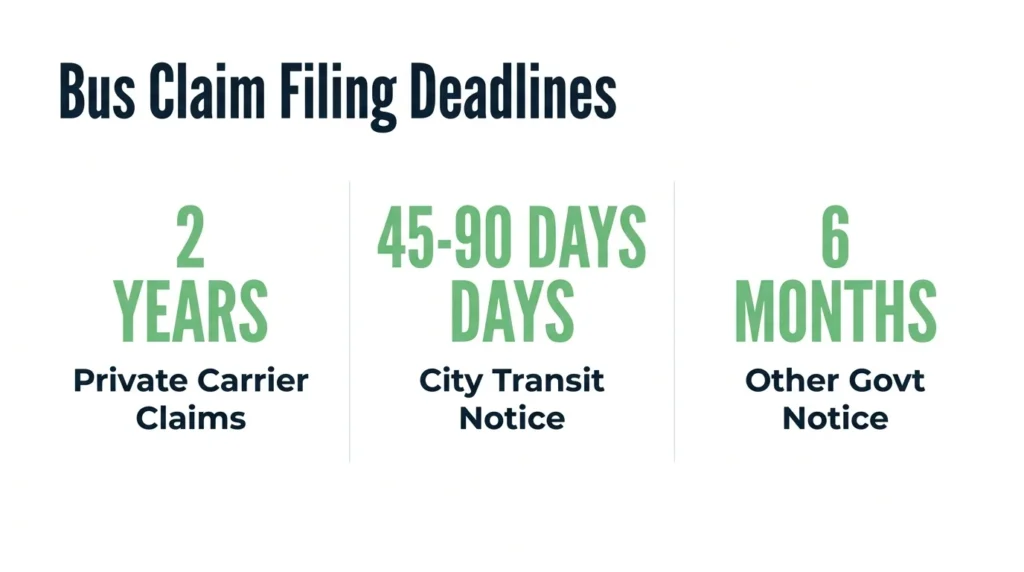
The deadline to file depends on who you are suing, and the gap between options is wide. A claim against a private bus carrier follows the standard two-year personal injury deadline under Texas Civil Practice and Remedies Code (CPRC) § 16.003. Miss that window and the claim is gone.
Government-operated bus claims work very differently. Under the Tort Claims Act, you must give written notice far sooner, sometimes within 45 to 90 days in certain Texas cities, and six months under state law for other entities.
That notice must describe the injury, the time and place of the crash, and what happened. Late or incomplete notices are routinely used to defeat claims that were otherwise solid.
Mixed cases are the hardest to manage. When a private contractor and a government transit authority are both named, you have to track two separate compensation clocks at once. If a government bus was involved, an attorney can confirm which deadline applies to your specific situation.
Talk to an Attorney About Your Accident
A work zone bus crash can leave you facing several insurers at once, each looking to pay as little as possible. Angel Reyes & Associates has represented Texas bus accident victims for more than 30 years, with more than $1 billion recovered for clients.
We work on contingency, which means no fee unless we win, and your first consultation is always free. You can review our past case results to see how we have handled claims like yours.
If you or a family member was hurt in a bus crash in a Texas construction zone, schedule a free consultation.
Past results do not guarantee future outcomes.
Road Construction Zones & Bus Accidents: FAQs
Does it matter which type of government bus was involved in the crash?
Yes. Under the Texas Tort Claims Act, the damages cap depends on who operated the bus. Claims against a city transit authority are capped at $250,000 per person, while claims against a school district or county are capped at $100,000 per person.
Can a bus passenger's own actions reduce what they recover?
Texas uses proportionate responsibility, so a passenger’s recovery shrinks by their share of fault. As long as the passenger’s share stays below 51 percent, they can still collect from the other parties.
What evidence should I try to preserve right after a work zone bus crash?
Ask for photos of the scene, the bus, and any construction signage before anything is moved. Bus companies and contractors are required to preserve electronic data like event recorder logs and dashcam footage, but that data can be deleted within days, so acting quickly matters.
Is there a cap on what I can recover if the contractor, not the bus company, was at fault?
No government cap applies to private contractors. If a construction company’s negligence caused or contributed to the crash, you can pursue full compensatory damages against that party without the limits that apply to government-operated buses.
About the Authors

Angel Reyes
Writer
Angel L. Reyes, III is the Founder and Managing Partner of Angel Reyes & Associates. A nationally recognized trial attorney and business leader, Angel has helped over 70,000 injury victims recover more than $1 billion since founding the firm in 1993. Named to the Texas Super Lawyers list annually since 2008, Angel brings Wall Street experience, Ivy League education, and a deep commitment to client advocacy. He is a frequent legal commentator and published author with extensive contributions to legal scholarship, trial strategy, and consumer protection.

Kyle Nicolas
Editor
Kyle Nicolas is the Web Content & SEO Manager at Angel Reyes & Associates. He has more than 10 years of experience as a marketing co...

Angel Reyes
Reviewer
Angel L. Reyes, III is the Founder and Managing Partner of Angel Reyes & Associates. A nationally recognized trial attorney and business...