How to File a Lyft Accident Claim in Texas


Every article on this site is researched by our internal team, reviewed for legal accuracy against current Texas law, and held to State Bar of Texas advertising standards before publication. We do not publish content that overstates outcomes or makes promises about results.
Learn more about our
editorial standards .
Key Takeaways
- Screenshot your active Lyft ride at the scene to prove which insurance period applies.
- Lyft carries $1 million in primary coverage once your driver accepts the ride.
- Texas gives you two years from the crash date to file a Lyft injury lawsuit.
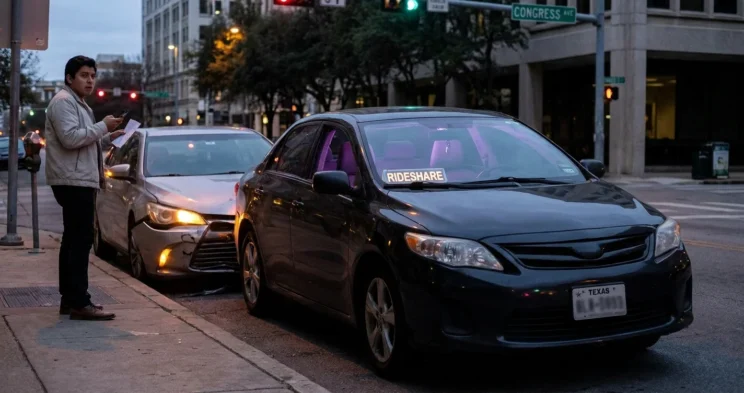
You were riding home from Deep Ellum late one night when your Lyft driver got T-boned at an intersection off Commerce Street. Your neck hurts, your phone is still open to the ride screen, and the drivers are already arguing about who ran the light. Now you are wondering who even pays for this, and how you start a claim without making a costly mistake.
Steps to Take After a Lyft Crash
What you do in the first hour shapes your entire claim, so protect your health and your evidence before anything else. These steps to take after a rideshare accident apply whether you were the passenger, the Lyft driver, or someone in another vehicle.
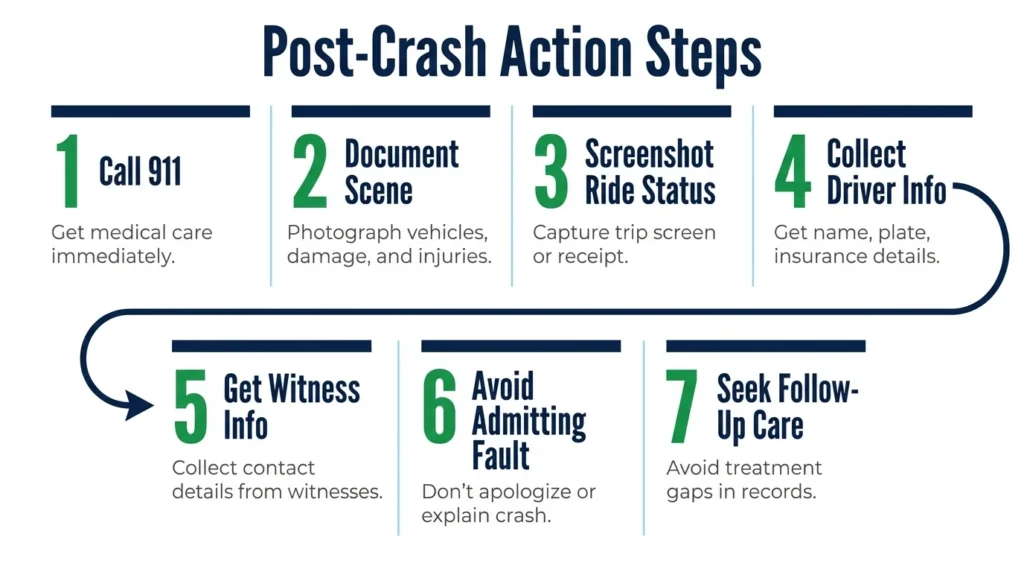
Call 911 and get medical attention, even if your injuries feel minor right now. A police report creates an official record that Lyft and its insurers will reference later, and adrenaline often masks real injuries.
Document the scene while it is fresh. Photograph the vehicle positions, the damage, the road conditions, and any visible injuries.
Take a screenshot of the active Lyft ride or your trip receipt in the app before you close it. This is really important. That screenshot helps establish the driver’s app status, which determines which insurance policy applies.
Collect the Lyft driver’s name, license plate, and insurance information. Get contact details from any witnesses too, since their accounts can settle a fault dispute weeks later.
Do not admit fault, apologize, or explain how the crash happened to anyone at the scene. A simple “I’m sorry” can be twisted into an admission during the rideshare accident claim process.
Finally, get follow-up medical care promptly. Gaps in treatment are one of the most common reasons insurers reduce or deny rideshare injury claims. Keep copies of your medical records, bills, and appointment history from the beginning because those documents often become some of the most important evidence in your claim.
Lyft Insurance Coverage Periods in Texas
The driver’s app status determines which insurance policy applies after a Lyft crash. Texas Insurance Code Chapter 1954 requires rideshare companies to carry different levels of coverage depending on where the driver was in the trip process when the collision occurred.
That distinction matters because the available coverage can change dramatically from one period to the next. A driver waiting for a ride request carries far less coverage than a driver actively transporting a passenger.
Lyft divides coverage into three periods, each with its own insurance requirements and coverage limits.
Period 1: App On, No Ride Accepted
Coverage is at its lowest when the driver has the app on but has not yet accepted a ride request. During Period 1, Lyft provides contingent liability coverage of $50,000 per person, $100,000 per accident, and $25,000 for property damage.
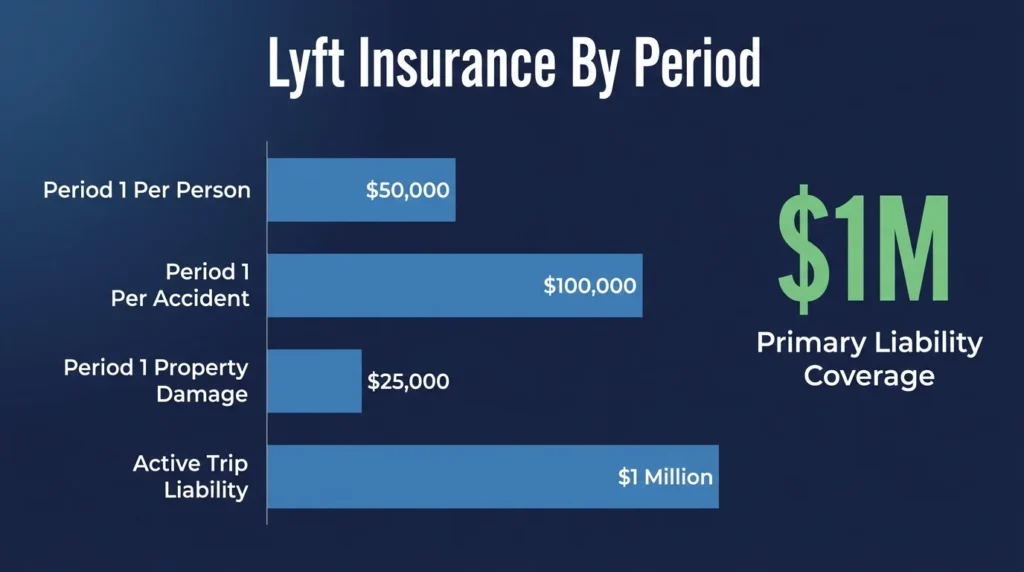
These limits often become the practical ceiling for Period 1 claims because many personal auto policies exclude rideshare activity. The practical problem is that most personal auto policies exclude commercial rideshare use, so the personal insurer will often deny the claim, and the $50,000/$100,000/$25,000 limits are the realistic ceiling for Period 1 injuries.
Periods 2 & 3: Ride Accepted Through Drop-Off
Coverage is strongest once the driver accepts your request and remains so until drop-off. This is the layer that best protects passengers.
From the moment the driver accepts the ride (Period 2) through the end of your trip (Period 3), Lyft maintains $1 million in primary liability coverage. Primary means Lyft’s policy pays first, no matter what the driver’s personal insurer says.
Lyft also carries uninsured and underinsured motorist coverage for active trips, plus contingent comprehensive and collision coverage subject to a deductible.
How to Report a Lyft Accident Claim
The Lyft claims process starts in the app, but it does not end there. Once you report the crash, you need to determine which insurance policy applies and begin compiling the documentation to support your claim.
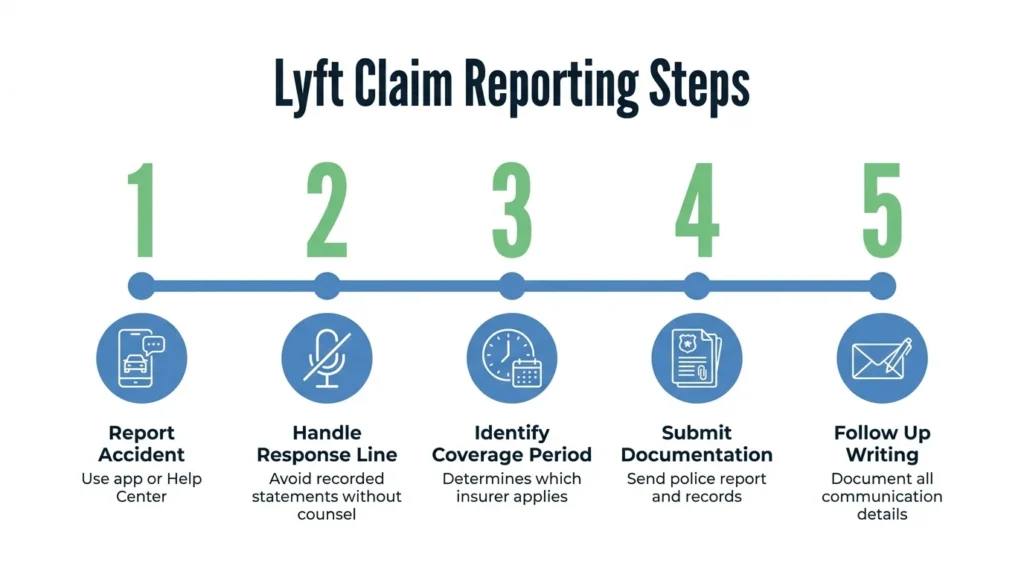
Step 1: Report the accident through the Lyft app or Help Center. Do this right after the crash using the “Report a Safety Incident” flow, or through Lyft’s accident reporting page. Quick reporting starts the clock on Lyft’s side.
Step 2: Be careful with the Critical Response Line. Lyft’s insurer, not Lyft itself, may call you after you report. That call is recorded, so avoid giving a recorded statement before you have legal guidance.
Step 3: Identify the applicable coverage period. This tells you which insurer to contact. For Period 2 and 3 claims, you deal with Lyft’s carrier. For Period 1 claims, you contact both Lyft and the driver’s personal insurer.
Step 4: Submit your documentation package. Send the relevant insurer your police report, medical records, a screenshot of the trip receipt, scene photographs, and witness contact information. A complete package moves a Lyft accident claim forward.
Step 5: Follow up in writing. Keep records of every communication with Lyft, the insurer, and any adjuster, including dates, names, and what was said.
Deadlines & Damages for Your Lyft Claim
Texas gives you two years from the date of the accident to file a personal injury lawsuit under the Texas Civil Practice and Remedies Code (CPRC) § 16.003. Miss that window, and you almost always lose the right to recover anything.
Texas also follows proportionate responsibility, a fault-sharing rule set out in Texas Civil Practice and Remedies Code Chapter 33. If you share some blame, your recovery drops by your percentage of fault. If you are found more than 50 percent at fault, you recover nothing.
So what can you actually recover? A Lyft accident claim can cover medical expenses, lost wages, future medical care, property damage, and pain and suffering. The size of any Lyft accident settlement mostly comes down to how severe your injuries are and how clearly fault falls on the other side.
One more wrinkle sets Lyft cases apart. Because Lyft treats its drivers as independent contractors, holding Lyft directly responsible depends on specific facts about driver control and hiring, not just the insurance structure. That is part of why these claims often look more like complex car accident cases than a simple fender bender.
Work with an Accident Attorney
A Lyft crash leaves you juggling insurance periods, app screenshots, and adjusters who do this every day while you do it once. You do not have to sort it out alone.
Angel Reyes & Associates has guided injured Texans through rideshare accident claims for over 30 years, and we serve the entire state. We offer free initial consultations and work on a contingency fee basis, which means no fee unless we win and no upfront cost to you. With more than $1 billion recovered for clients, we are available 24/7 to review your claim. You can read what our clients say about working with us, then reach out for a free consultation.
Past results do not guarantee future outcomes.
Lyft Accident Claim FAQs
Is filing a Lyft claim different from filing an Uber claim in Texas?
The process is similar because both companies use the same three-period insurance structure under Texas Insurance Code Chapter 1954 with the same coverage minimums. The main differences are the in-app reporting tools and internal claims teams, so the steps you take are nearly identical, but run through Lyft’s Help Center instead of Uber’s Safety Center.
Can a pedestrian or cyclist file a claim if a Lyft driver hits them?
Yes. Lyft’s liability coverage extends to anyone the driver injures, not just passengers. The same coverage period rules apply, so a pedestrian or cyclist hit during an active trip can claim against Lyft’s $1 million primary liability policy.
What if the other driver, not the Lyft driver, caused the crash?
You can file a liability claim against the at-fault driver’s insurance. If that driver has no insurance or not enough, Lyft’s uninsured and underinsured motorist coverage applies during Periods 2 and 3 to fill the gap.
What happens if the Lyft driver's personal auto insurer denies the Period 1 claim?
Personal auto insurers often deny Period 1 claims because many policies exclude rideshare activity. When that happens, Lyft’s contingent liability coverage may apply, subject to the coverage limits required by Texas law.
Can I use my own health insurance to pay medical bills while my Lyft claim is pending?
Yes, your health insurance can cover treatment costs while you wait for a settlement. Be aware that most health insurance contracts include a subrogation clause, which means your insurer may seek reimbursement from any settlement you receive later.
About the Authors

Angel Reyes
Writer
Angel L. Reyes, III is the Founder and Managing Partner of Angel Reyes & Associates. A nationally recognized trial attorney and business leader, Angel has helped over 70,000 injury victims recover more than $1 billion since founding the firm in 1993. Named to the Texas Super Lawyers list annually since 2008, Angel brings Wall Street experience, Ivy League education, and a deep commitment to client advocacy. He is a frequent legal commentator and published author with extensive contributions to legal scholarship, trial strategy, and consumer protection.

Kyle Nicolas
Editor
Kyle Nicolas is the Web Content & SEO Manager at Angel Reyes & Associates. He has more than 10 years of experience as a marketing co...

Angel Reyes
Reviewer
Angel L. Reyes, III is the Founder and Managing Partner of Angel Reyes & Associates. A nationally recognized trial attorney and business...