How to File a Wrongful Death Lawsuit in Texas


Every article on this site is researched by our internal team, reviewed for legal accuracy against current Texas law, and held to State Bar of Texas advertising standards before publication. We do not publish content that overstates outcomes or makes promises about results.
Learn more about our
editorial standards .
Key Takeaways
- Only a surviving spouse, children, or parents can file a Texas wrongful death lawsuit.
- Texas sets a two-year deadline from the date of the death to file a wrongful death claim.
- A survival action requires an open estate, so probate must begin before you file your claim.

In the middle of the night, you received a call from a state trooper standing on the shoulder of I-35W, telling you that your loved one died in a car accident because the other driver was careless. You haven’t even had time to process your grief, but insurers are asking you about lawyers and filing deadlines, and you need to know which step comes first.
Who Can File a Wrongful Death Lawsuit?
Texas allows the following three parties to file a wrongful death lawsuits:
- The surviving spouse
- The children of the deceased
- The parents of the deceased
One party can file on their own or together with the other qualifying parties under Texas Civil Practice and Remedies Code (CPRC) § 71.004. One lawsuit covers everyone in the eligible group, so each family member does not need to file a separate case.
If three months pass, and nobody in the qualifying group has filed, then the estate’s executor or administrator can file a claim. Alternatively, all the eligible family members together can ask the executor not to, which will keep the decision to file a claim within the family.
Siblings cannot file a claim. Neither can grandparents, cousins, or close friends. Courts dismiss a Texas wrongful death claim filed by someone outside these three parties, regardless of how clear the other driver’s negligence was. If stepchildren, legally adopted children, or estranged parents are involved, this can complicate things, so it’s important to understand who can sue after a wrongful death before a claim is filed.
Wrongful Death Statute of Limitations
You generally have two years from the date of the death to file a wrongful death lawsuit in Texas under CPRC § 16.003.
Courts strictly adhere to this deadline, so the entire process has to be handled beforehand. It takes time to confirm who can file the claim, open an estate, collect records, and draft the petition.
There are a few narrow exceptions to this rule, such as:
- The claimant is a minor
- The defendant is a city, county, or state agency
In these two specific cases, the wrongful death filing deadline works differently.
If your loved one had an open injury claim before they died, that claim follows the deadline for filing an injury lawsuit, which starts from the date of their injury, rather than the date of their death.
What Is a Survival Action in Texas?
A survival action seeks compensation for the losses that your loved one experienced before they died. It belongs to their estate, not to family members directly, and it is a separate claim that can be pursued alongside a wrongful death claim.
Under CPRC § 71.021, the estate can pursue compensation for medical bills, lost wages, and the physical pain your loved one experienced between their initial injury and their death.
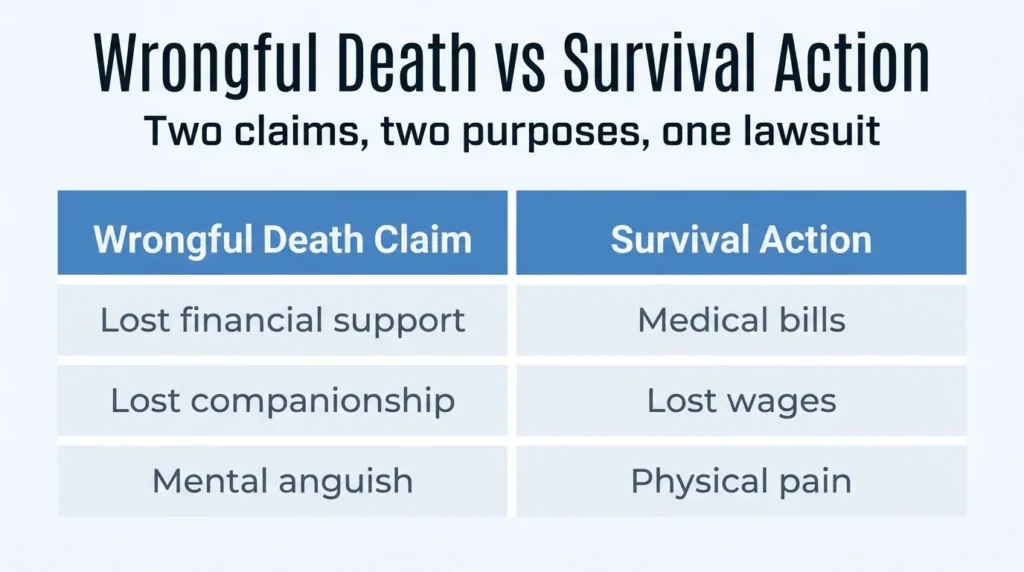
This is the difference:
- The wrongful death claim compensates your family’s losses (such as lost financial support, lost companionship, and mental anguish).
- The survival action compensates your deceased loved one’s losses (such as medical bills, lost wages, and physical pain).
Both claims are usually covered in the same lawsuit.
Under Texas Estates Code Chapter 301, a survival action requires someone with legal authority to speak for the estate. That means you must open a probate case and ask the court to appoint an executor or administrator. A probate attorney can move the estate application through court, while you stay focused on the wrongful death claim.
Steps to Preserve Evidence for Your Wrongful Death Claim
Be aware that evidence starts disappearing within days of the crash. Businesses overwrite their surveillance video, and shops repair or scrap the damaged vehicles involved in the accident.

If a traffic collision caused the death, the standard steps for documenting a crash apply. Ask a relative or a friend to help you handle them if you cannot.
- Step One: Document the scene of the crash. Photographs, a police report or incident report, witness names and phone numbers, and video footage from nearby cameras will be vital evidence later.
- Step Two: Collect the paperwork. Medical bills, funeral and burial invoices, paystubs, tax returns, and benefits statements will build the financial aspect of the case.
- Step Three: Collect case-specific evidence if needed. The circumstances of the death itself determine what other evidence may be needed. For example, if an 18-wheeler was involved, then driver logs, electronic control module data, and maintenance files are in the carrier’s possession, and you will need to send a preservation letter to the company before the data retention period is over.
Steps to File Your Wrongful Death Petition

You can file a wrongful death petition in four steps:
- Step 1: Choose the right county. You can generally file a claim in the county where the death occurred, the county where the defendant lives, or another county allowed by the Texas Civil Practice and Remedies Code Chapter 15. Filing in the wrong county will initiate a motion to transfer your case to the correct county, which can take months.
- Step 2: Draft the petition. The petition should name every eligible plaintiff, the defendant, the facts of the case, the damages you are requesting, and the estate representative if you are including a survival action. The Texas Rules of Civil Procedure govern what this document must contain.
- Step 3: File your petition with the clerk, then serve the defendant. The clerk’s stamp will record the date that your petition was filed, and that date will determine whether you filed your claim within the two-year deadline. The defendant must also be properly served under procedural rules, as improperly serving the defendant can create problems for your case.
- Step 4: Move into the discovery phase. In this phase, both sides will exchange documents, answer written questions, and take court depositions. Most cases resolve during or after the discovery phase.
An attorney who manages the filing and discovery steps can catch any procedural mistakes that may delay or weaken your case.
Work with an Attorney on Your Wrongful Death Case in Texas
No family should have to learn Texas civil procedure while they are grieving. Angel Reyes & Associates has guided Texans through wrongful death claims for over 30 years, with more than $1 billion recovered for clients.
We work on contingency, so you owe no attorney fee unless we win. We will also explain how court costs and case expenses will affect your recovery before you sign anything. Schedule a free consultation today, so we can get started on taking the first steps before your deadline approaches.
Past results do not guarantee future outcomes.
Frequently Asked Questions
Are wrongful death lawsuits handled differently if a doctor's negligence caused the death?
Yes. In this case, Texas requires an expert report on the standard of care within 120 days after a healthcare provider is sued. Missing that deadline can get your case thrown out.
Can you sue an employer for a wrongful death that happened on the job?
Usually no. In most cases, workers’ compensation is the only way to recover compensation from a covered employer. However, family members can still sue if the employer’s gross negligence or an intentional act caused the death.
Does a wrongful death settlement need court approval if children are involved?
Yes. A Texas court must approve the settlement and will often appoint a guardian ad litem (a person appointed by the court to protect a child’s interests) to make sure that each child’s share is handled fairly. Sometimes, this is handled through a trust or structured payments.
Do you have to wait for a criminal case to be resolved before filing a wrongful death lawsuit?
No. A civil wrongful death case has its own timeline, so it is not required or recommended to wait for the criminal case to be resolved before filing your claim.
Is money from a wrongful death settlement taxable?
Most of it is not taxable, since the IRS treats wrongful death compensation as payment related to a physical injury or death. However, punitive damages and any interest awarded can be taxed.
About the Authors

Angel Reyes
Writer
Angel L. Reyes, III is the Founder and Managing Partner of Angel Reyes & Associates. A nationally recognized trial attorney and business leader, Angel has helped over 70,000 injury victims recover more than $1 billion since founding the firm in 1993. Named to the Texas Super Lawyers list annually since 2008, Angel brings Wall Street experience, Ivy League education, and a deep commitment to client advocacy. He is a frequent legal commentator and published author with extensive contributions to legal scholarship, trial strategy, and consumer protection.

Kyle Nicolas
Editor
Kyle Nicolas is the Web Content & SEO Manager at Angel Reyes & Associates. He has more than 10 years of experience as a marketing co...

Angel Reyes
Reviewer
Angel L. Reyes, III is the Founder and Managing Partner of Angel Reyes & Associates. A nationally recognized trial attorney and business...