How to Report a Bus Accident in Texas


Every article on this site is researched by our internal team, reviewed for legal accuracy against current Texas law, and held to State Bar of Texas advertising standards before publication. We do not publish content that overstates outcomes or makes promises about results.
Learn more about our
editorial standards .
Key Takeaways
- Call 911 first after a bus crash, then notify the transit authority that ran the bus.
- A government bus claim needs written notice within six months under Texas tort claims law.
- A school bus crash means notifying the school district directly, on top of the police call.
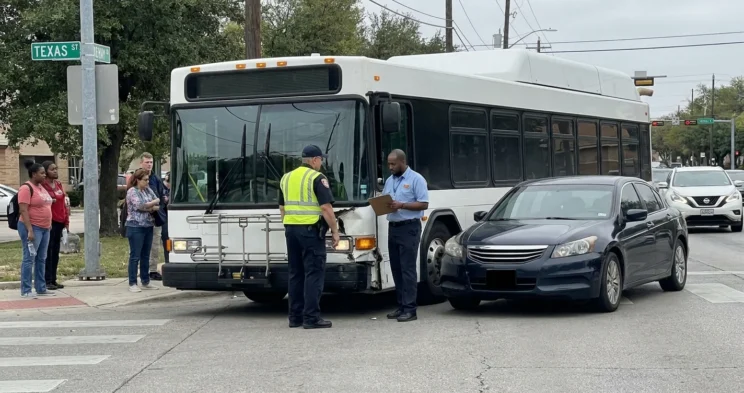
You were riding the bus home from work along Westheimer Road in Houston when the driver slammed the brakes and another vehicle clipped the side. Your shoulder hit the seat in front of you, and now people are shaken and asking what to do next.
You are not sure who you are supposed to call, or whether you even have to call anyone at all.
Do You Have to Report a Bus Accident?
The driver of any vehicle in a crash that causes injury, death, or vehicle damage must immediately notify police or the county sheriff under Texas Transportation Code § 550.026. As a passenger, you have no parallel legal duty to make that call yourself.
That does not mean you can sit back. The bus driver’s report and the police record protect you later.
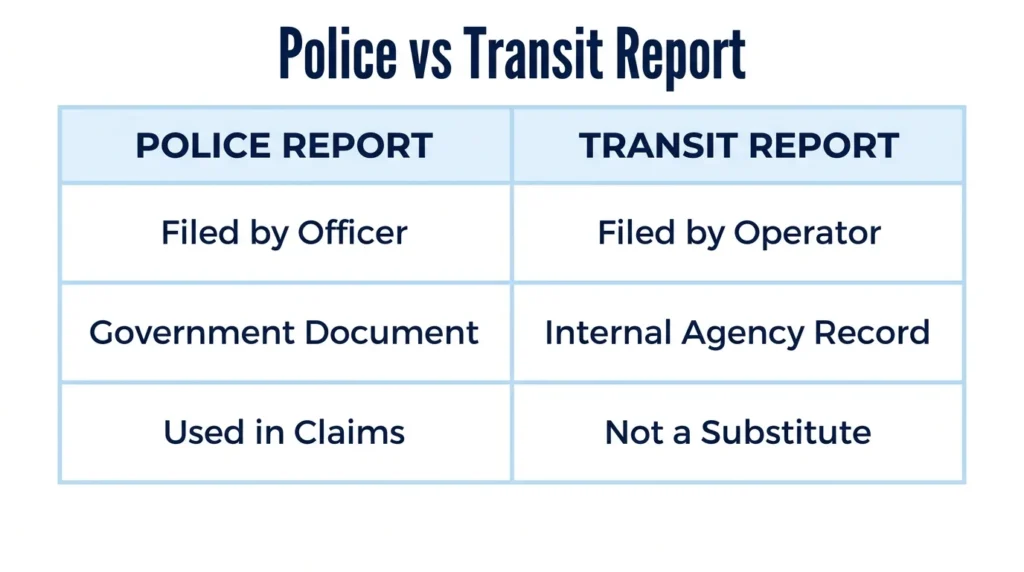
A documented crash report is key evidence in any injury claim you might bring. Without it, the only record of what happened may sit in the transit company’s internal files, where you cannot easily reach it. A police report carries weight that an internal company memo never will, which is one reason a crash report matters for insurance claims.
Do not assume a report was filed just because officers showed up. Ask the responding officer to confirm a report is being generated, and get the report number before you leave.
Call 911 First, Then the Transit Authority
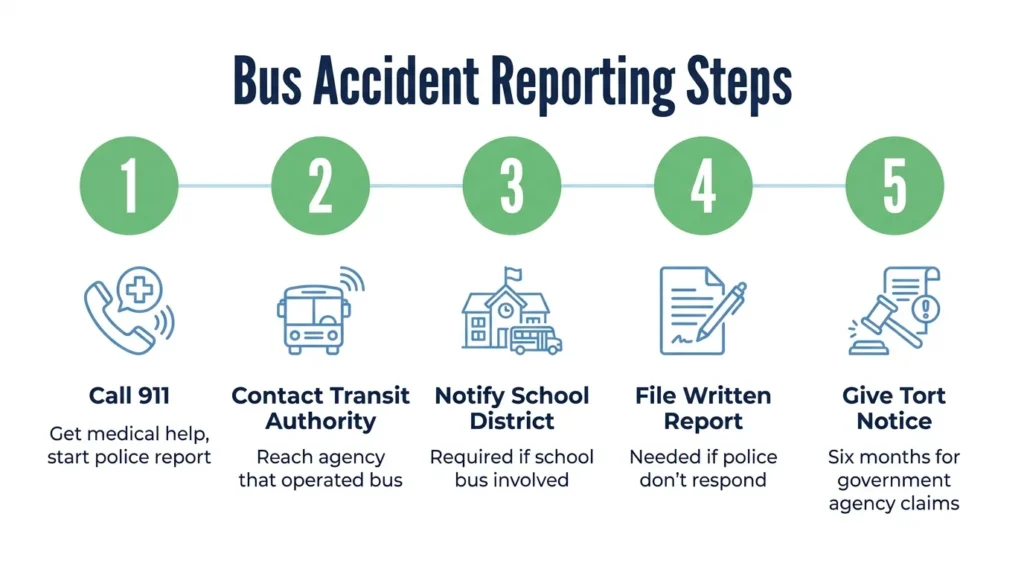
Make two notifications after a bus crash: call 911 right away, then contact the transit company that operated the bus. The 911 call brings medical help and triggers the police report you will need.
Call 911 immediately when anyone is hurt or a vehicle is damaged. The driver has a duty to notify police under § 550.026, but place the call yourself anyway. That way you know a report is started, and you create your own record of the time and place.
Next, find out which agency ran the bus and contact it directly. Major Texas transit systems operate as public authorities under the Texas Transportation Code, and each runs its own incident-reporting line:
- DART (Dallas) was created under Chapter 452; METRO (Houston) and Cap Metro (Austin) operate under Chapter 451. The specific enabling statute varies by agency, but the practical step is the same: identify who ran the bus and contact that agency directly.
- DART (Dallas Area Rapid Transit): Call customer service at 214-979-1111, DART Police non-emergency at 214-749-5900, or DART Police emergency at 214-928-6300. The agency lists these on its official website.
- VIA Metropolitan Transit, METRO, Cap Metro, and The T: These serve San Antonio, Houston, Austin, and Fort Worth. Ask the driver or agency staff for the reporting number, or call the agency’s main customer line to start an incident report.
Knowing which agency operated the bus is a real step, not a formality. It decides whose internal report gets written and which claim rules apply to you later, which is why who is liable in a Texas bus crash often turns on the operator’s identity.
School Bus Accidents Require a Separate Step
When a school bus is involved, you must notify the school district directly, on top of calling police. Contact the district’s transportation department or main administrative office. If your child was a student on the bus, make that call as soon as police have been reached.
The district carries its own reporting duty, but that duty is not yours. Under Texas Education Code § 34.015, the school district must report bus collisions to the Texas Education Agency each year. The Texas Education Agency explains this obligation. You do not file anything with the agency yourself.
Before you leave the scene, write down the driver’s name, employee ID if you can see it, the bus number, and the route. This information backs up your call to the district and any claim that follows.
When a school bus crash injures a student or passenger, talking with an attorney early can help protect your rights before deadlines past.
When You Need a Written Crash Report
A written report is required in two situations beyond the 911 call. The first applies when police never come to the scene.
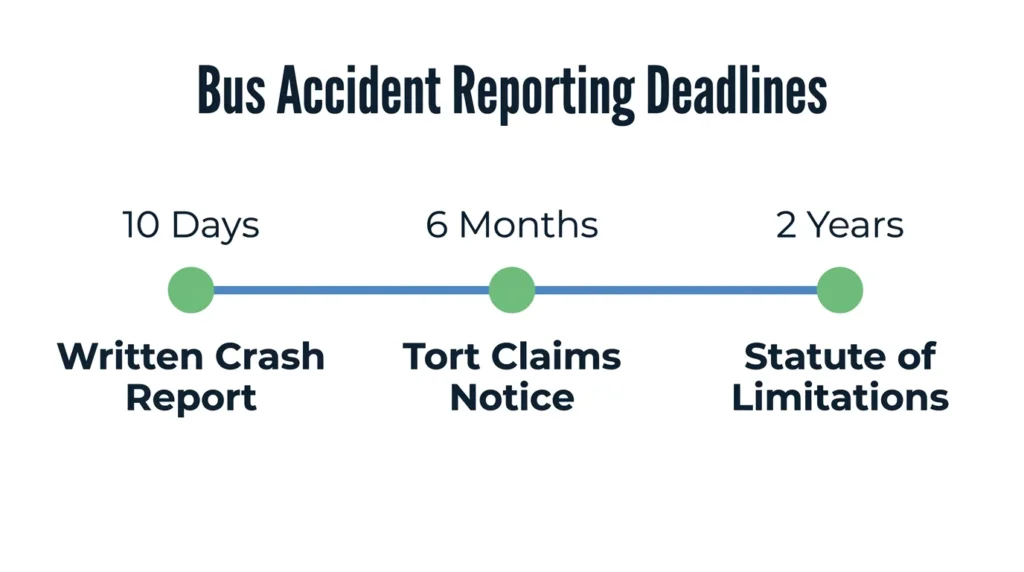
If no officer responds and the crash causes injury, death, or property damage over $1,000, Texas Transportation Code § 550.061 requires the involved driver to file a written report with TxDOT within 10 days. That duty falls on the driver, not on you as a passenger. Still, ask the bus operator whether the report will be filed and get confirmation.
When police do investigate, the officer files a Peace Officer’s Crash Report. You can request a copy through TxDOT crash records and reports once it is ready.
Keep one more deadline in mind if a government agency ran the bus. Under Texas Civil Practice and Remedies Code § 101.101, you must give that agency written notice of an injury claim within six months of the crash. This is not the same as today’s incident report, and missing it can halt your claim entirely.
That six-month window starts the day of the crash, so understanding Texas Tort Claims Act deadlines and damage limits early is worth your time.
What Happens After You Report
Save every record your notifications create. Keep the police report number, the transit company’s incident confirmation number, the names of officers and agency staff you spoke with, and any written acknowledgment from a school district.
Photos round out the official record. Take pictures of vehicle damage, road conditions, your injuries, and the bus number and route signage while you are still at the scene.
Those photos and reports work together to support a future claim, which is also true when a bus strikes your car rather than injuring you as a rider.
Once reporting is done, the next step is the claim itself. The rules shift depending on whether a government agency or a private company operated the bus.
Talk to an Experienced Attorney Today
Finishing these notification steps is a real act of self-protection, and it puts you in a stronger position than most crash victims. The next questions, about who pays and how much, are harder to answer alone.
Angel Reyes & Associates has guided injured Texans for over 30 years, and we handle bus accident cases across the state. We work on contingency, so there is no fee unless we win your case.
With more than $1 billion recovered for clients, our record speaks to that work, and you can review our case results to see the kinds of outcomes we have reached.
Schedule a free consultation and we will walk you through your options.
Past results do not guarantee future outcomes.
How to Report a Bus Accident FAQs
What is the difference between a police report and a transit authority incident report?
The police report (CR-3) is a government document filed by the responding officer and is used in insurance claims and litigation. The transit authority’s incident report is an internal agency record created from the operator’s perspective; it is not a substitute for the official crash report and carries less weight in any legal proceeding.
Does reporting the accident to police start the injury claim process?
No. Reporting to police and the transit authority creates an official record of what happened, but it does not open a claim. Filing a formal injury claim is a separate process with its own deadlines and steps.
What if the bus was a charter bus or private tour bus, not a city transit vehicle?
Charter and private tour buses are not government entities, so the Texas Tort Claims Act deadlines and damage caps do not apply. Standard Texas negligence rules govern those claims, and you generally have two years from the crash date to file a lawsuit under the state’s personal injury statute of limitations.
How much does it cost to get a copy of the Texas bus accident police report?
TxDOT charges $6 for a standard copy of the CR-3 Peace Officer’s Crash Report and $8 for a certified copy, which is the version typically required for legal proceedings. You can order either through TxDOT’s crash reports and records portal.
Should I still report a bus crash if no one appeared to be hurt at the scene?
Yes. Some injuries, such as soft-tissue damage and concussions, do not show symptoms immediately, and a report filed the same day creates a dated record linking the crash to any injuries that surface later. Without that record, connecting your medical treatment to the incident becomes harder.
About the Authors

Angel Reyes
Writer
Angel L. Reyes, III is the Founder and Managing Partner of Angel Reyes & Associates. A nationally recognized trial attorney and business leader, Angel has helped over 70,000 injury victims recover more than $1 billion since founding the firm in 1993. Named to the Texas Super Lawyers list annually since 2008, Angel brings Wall Street experience, Ivy League education, and a deep commitment to client advocacy. He is a frequent legal commentator and published author with extensive contributions to legal scholarship, trial strategy, and consumer protection.

Kyle Nicolas
Editor
Kyle Nicolas is the Web Content & SEO Manager at Angel Reyes & Associates. He has more than 10 years of experience as a marketing co...

Angel Reyes
Reviewer
Angel L. Reyes, III is the Founder and Managing Partner of Angel Reyes & Associates. A nationally recognized trial attorney and business...