How Uber’s $1 Million Insurance Policy Works


Every article on this site is researched by our internal team, reviewed for legal accuracy against current Texas law, and held to State Bar of Texas advertising standards before publication. We do not publish content that overstates outcomes or makes promises about results.
Learn more about our
editorial standards .
Key Takeaways
- Uber's $1 million policy activates only when a trip is accepted or a passenger is onboard.
- Period 1 coverage is much lower: $50,000 per person and $100,000 per accident.
- Both passengers and third-party drivers can file claims against the $1 million policy during Periods 2 and 3.
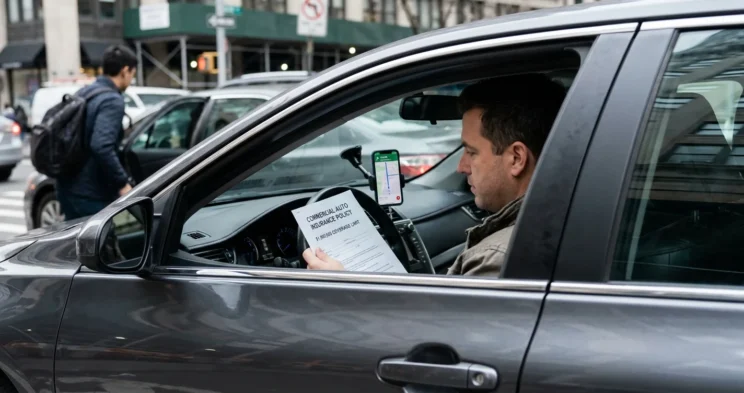
You heard that Uber carries a $1 million insurance policy, and after your crash on the US-290 corridor outside Austin, you want to know if it applies to you. The answer is not as simple as yes or no. Whether that coverage is available depends on one thing: what the driver was doing in the app at the exact moment of impact.
The $1 Million Policy Does Not Always Apply
Uber’s $1 million insurance policy is not active any time an Uber driver is on the road. It activates only under specific conditions set by Texas law, not by Uber’s preferences or marketing language.
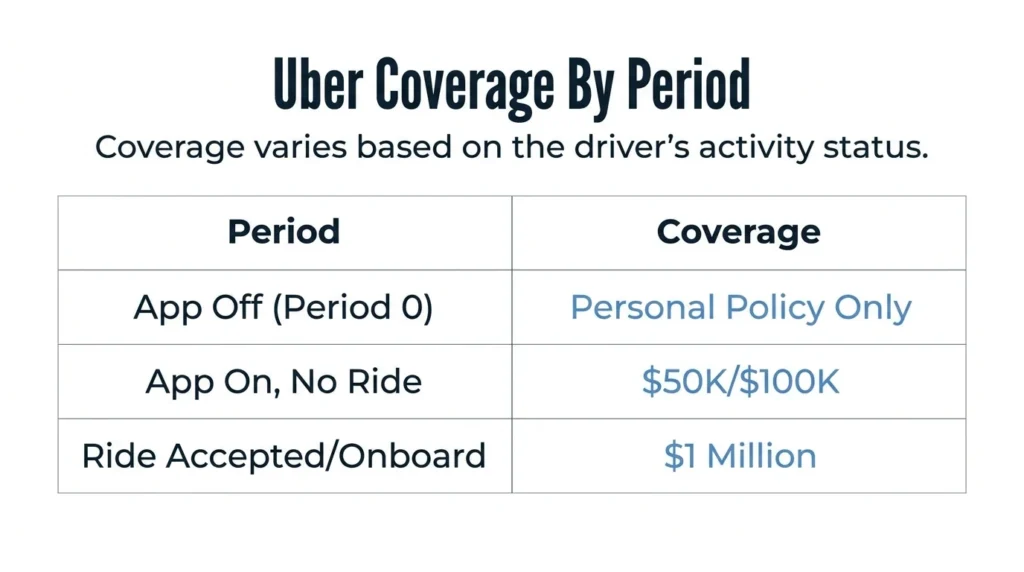
Texas regulates rideshare companies as Transportation Network Companies under the Texas Insurance Code Chapter 1954. That statute defines three coverage periods and assigns mandatory minimum coverage amounts to each. The period that was active at the moment of your crash controls which policy pays.
- Period 0: When the Uber app is off, Uber owes nothing. The driver’s personal auto policy is the only coverage available, and that policy may or may not be adequate.
- Period 1: When the app is on but the driver has not yet accepted a ride request (Period 1), coverage rises to a minimum of $50,000 per person and $100,000 per accident. That is far below the $1 million threshold most people associate with Uber.
- Periods 2 & 3: When the driver has accepted a ride request (Period 2) or when a passenger is in the car, and the trip is in progress (Period 3), coverage rises to at least $1,000,000.
For a broader look at how all three coverage periods work across both Uber and Lyft, the breakdown in Uber and Lyft’s insurance coverage periods explained walks through the full framework. This article focuses specifically on when and how the $1 million policy activates and what it actually covers.
When Does the $1 Million Coverage Activate?
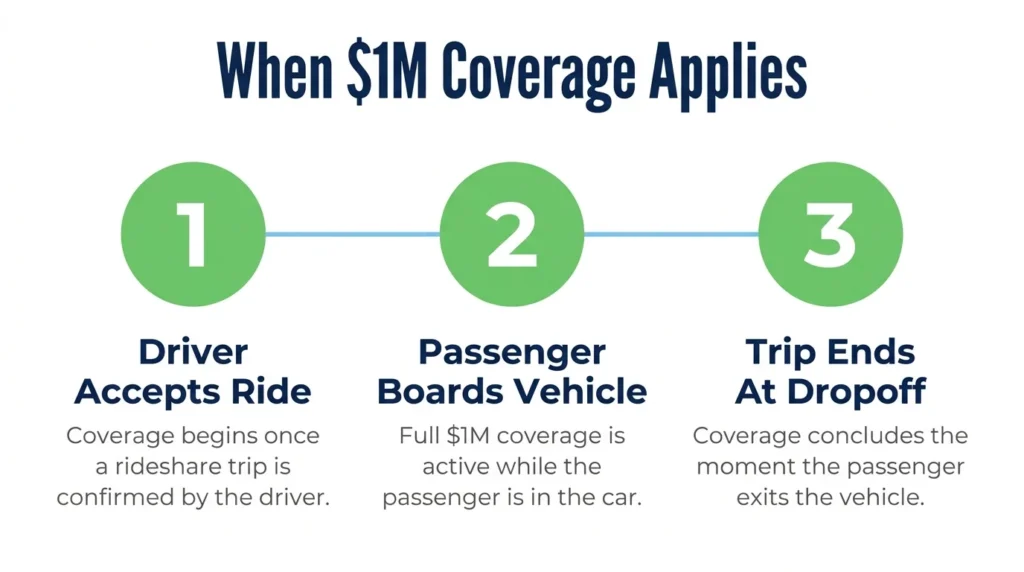
The $1 million liability coverage becomes available once a driver accepts a trip and stays active through the passenger’s drop-off. Texas law and Uber’s own commercial policy together govern two distinct periods where this amount applies.
Period 2: Ride Accepted, Driver En Route
Period 2 begins the moment the driver taps “Accept” on a ride request. At this point, Uber’s commercial policy provides $1 million in liability coverage, even though no passenger has entered the vehicle yet.
Texas Insurance Code § 1954.052 sets. Uber’s own commercial policy exceeds the minimum of $50,000 per person and $100,000 per accident when a driver is en route but has not yet picked up a passenger and provides $1 million in coverage during this window, but the higher amount comes from Uber’s voluntary policy choice, not from the statutory minimum.
This matters for third parties. If the Uber driver is traveling to pick up a passenger and rear-ends another vehicle on I-35, the injured driver in the other car can file against Uber’s $1 million commercial policy. The coverage is active even before anyone boards the vehicle.
Period 3: Passenger Onboard Through Drop-Off
Period 3 begins when the passenger enters the vehicle. The $1 million liability coverage continues uninterrupted through the entire trip until the passenger is dropped off.
Uber also carries $1 million in uninsured and underinsured motorist (UM/UIM) coverage during Periods 2 and 3. This is a separate layer of protection. If a third-party driver with no insurance, or not enough insurance, causes a crash while you are in an Uber, this UM/UIM coverage can compensate you for injuries the at-fault driver cannot pay.
If you were a passenger or another driver injured during an active Uber trip, understanding which period was active at the time can determine whether substantial coverage is available for your claim.
Three Myths About Uber’s $1 Million Policy
Several misunderstandings circulate about when and how this policy works. Here is what the law and Uber’s actual policy say.
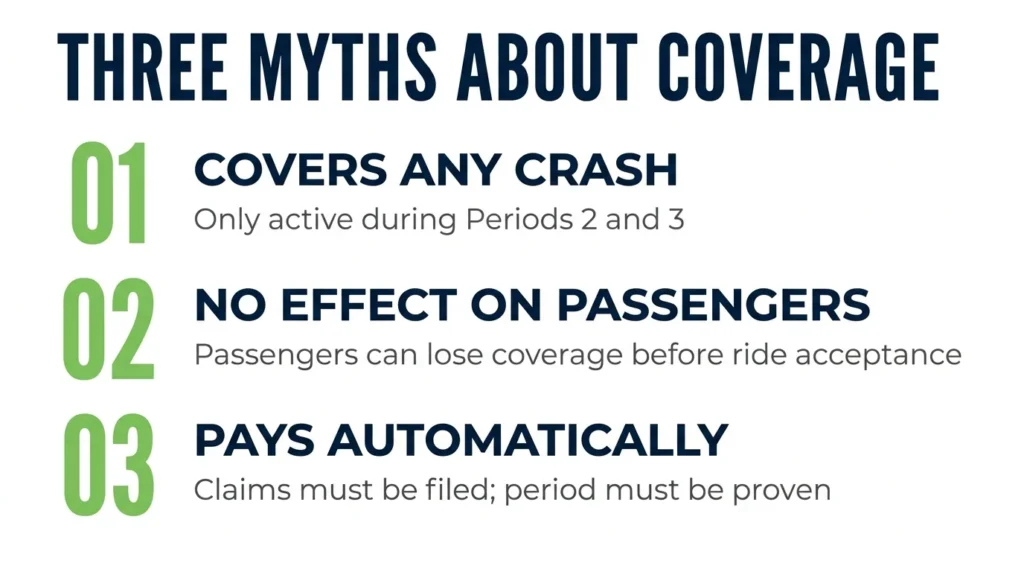
Myth 1: The $1 million policy covers any crash involving an Uber driver. It does not, as the policy only applies during Periods 2 and 3. A crash that happens while the app is entirely off means Uber has no coverage obligation at all, whereas a crash while the driver has the app on but no ride accepted triggers the much lower Period 1 limits of $50,000 per person and $100,000 per accident.
Myth 2: Uber’s coverage gap does not affect passengers. While the gap most affects third parties during Period 1, passengers are not immune. If you get into an Uber before the driver has accepted your specific ride request in the app, you may not be in Period 3 at all, because the period is determined by what the app shows, not by what the driver tells you.
Myth 3: The $1 million policy pays automatically. It does not, meaning you or your attorney must file a claim, and the period must be established. Because Uber can dispute which period the driver was in at the time of the crash, questions about whether Uber can be sued directly often arise when coverage periods are in dispute.
Who Is Covered by the $1 Million Policy?
The $1 million liability policy is not limited to passengers. Multiple parties can file against it during Periods 2 and 3.
If an Uber driver causes a crash while en route to a pickup or while transporting a passenger, any injured third party (for example, another driver, a pedestrian, or a cyclist) can file against Uber’s $1 million commercial liability coverage. The injured party does not need to have been in the Uber to access this policy.
Passengers are also covered under the liability policy if the Uber driver is at fault. The UM/UIM layer adds protection if a separate driver caused the crash and lacked adequate insurance.
These are two distinct pools of coverage, and each applies to different crash scenarios. For a full look at how rideshare claims develop in Texas, our rideshare accident practice area page explains the claims process and what injured parties can pursue.
After any rideshare crash, the steps you take in the first hours matter. The guide on what to do after a rideshare accident in Texas covers how to preserve your claim from the scene forward.
Get Legal Help After a Rideshare Crash
Rideshare insurance claims are more complicated than standard auto claims. The coverage period, the type of injury, and which policy applies can all affect your recovery.
Angel Reyes & Associates has helped injured Texans through situations like this for over 30 years. As a statewide firm with more than 30 office locations and more than $1 billion recovered for our clients, we have the resources to handle complex corporate claims. Our team is fully available in English and Spanish, and because we work on contingency, you pay nothing unless we recover compensation for you.
Reach out to us for a free consultation; we will review your crash details, confirm which coverage period applied, and help you pursue the right claim against the right policy.
Past results do not guarantee future outcomes.
How Uber's $1M Insurance Policy Works
Does Uber's $1 million policy cover the Uber driver's own injuries?
No. The $1 million policy is a third-party liability policy, so it covers other people’s injuries and property damage, not the driver’s own medical costs. Uber drivers who want injury protection for themselves typically need a separate occupational accident policy or rideshare endorsement on their personal auto coverage.
What happens if the at-fault driver in my Uber crash has no insurance?
Uber carries $1 million in uninsured and underinsured motorist (UM/UIM) coverage during Periods 2 and 3. If another driver caused your crash and has little or no insurance, you can file against this UM/UIM layer for compensation.
How do I find out which coverage period was active during my crash?
Uber’s app and trip records document the exact timestamps of when a ride was accepted and when a trip ended. You can request this data directly from Uber, or an attorney can obtain it through a formal discovery request or pre-suit evidence demand.
Can the driver's personal insurance still be involved after a rideshare crash?
During Periods 2 and 3, Uber’s commercial policy is primary, and the driver’s personal policy generally does not need to be involved. During Period 1, both may apply, and Texas Insurance Code § 1954.055 prohibits requiring the driver’s personal insurer to deny a claim before Uber’s coverage responds.
Does the $1 million policy cover crashes caused by a third party, not the Uber driver?
The $1 million liability policy covers situations where the Uber driver is at fault. If a third-party driver caused the crash, their auto policy is the primary source of recovery. The UM/UIM layer kicks in when that third party lacks adequate insurance.
About the Authors

Angel Reyes
Writer
Angel L. Reyes, III is the Founder and Managing Partner of Angel Reyes & Associates. A nationally recognized trial attorney and business leader, Angel has helped over 70,000 injury victims recover more than $1 billion since founding the firm in 1993. Named to the Texas Super Lawyers list annually since 2008, Angel brings Wall Street experience, Ivy League education, and a deep commitment to client advocacy. He is a frequent legal commentator and published author with extensive contributions to legal scholarship, trial strategy, and consumer protection.

Kyle Nicolas
Editor
Kyle Nicolas is the Web Content & SEO Manager at Angel Reyes & Associates. He has more than 10 years of experience as a marketing co...

Angel Reyes
Reviewer
Angel L. Reyes, III is the Founder and Managing Partner of Angel Reyes & Associates. A nationally recognized trial attorney and business...