Injured as an Uber or Lyft Driver in Texas?


Every article on this site is researched by our internal team, reviewed for legal accuracy against current Texas law, and held to State Bar of Texas advertising standards before publication. We do not publish content that overstates outcomes or makes promises about results.
Learn more about our
editorial standards .
Key Takeaways
- Uber and Lyft drivers are independent contractors, so workers' comp does not apply.
- Texas gives injured rideshare drivers two years from the crash date to file suit.
- A personal policy often denies app-on crashes, but platform TNC coverage may apply.
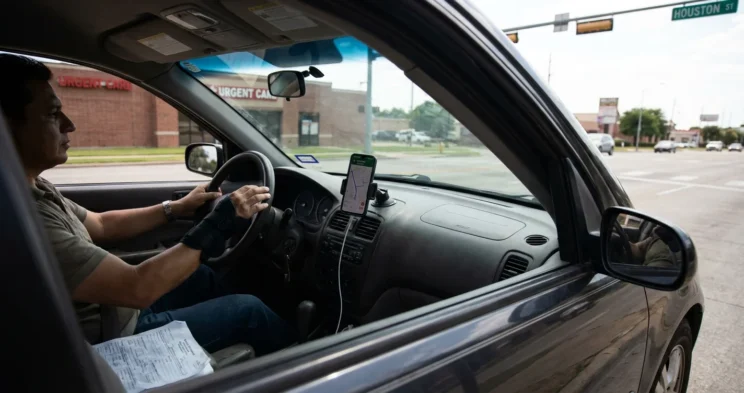
You were finishing a fare near the Galleria when another driver ran a light on Westheimer and slammed into your door. Now you are staring at an ER bill, you cannot drive, and your own insurer just told you the claim is denied because you were working. You did nothing wrong, so where does that leave you?
Rideshare Drivers Are Independent Contractors
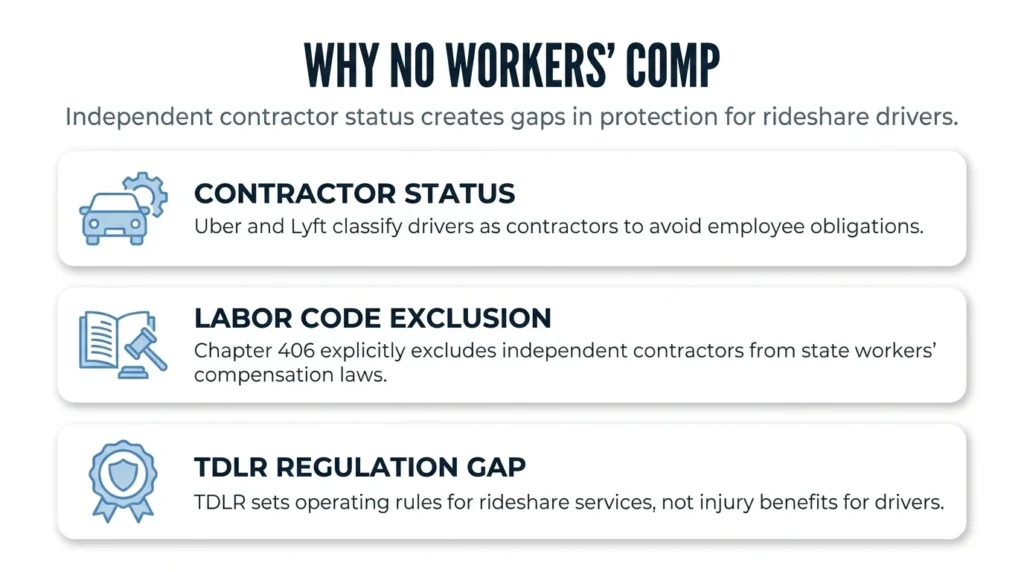
Uber and Lyft classify you as an independent contractor, not an employee. That single fact is why neither platform carries workers’ compensation coverage for you in Texas.
The Texas Labor Code Chapter 406 excludes independent contractors from mandatory workers’ compensation. In plain terms, you cannot file a work injury claim against Uber or Lyft the way a delivery employee might against their employer.
For a driver staring at medical bills and lost income, that feels like a dead end. It is not.
The Texas Department of Licensing and Regulation regulates rideshare drivers and sets the rules platforms must follow. Those rules cover how you operate, but they do not include injury benefits for you.
This gap is not a loophole or a mistake you made by signing up. It is the intended legal framework, and you need to understand it before you weigh any coverage or claim path. Understanding this gap is the first step toward finding which compensation paths are actually open to you, and an attorney who handles rideshare injury cases can map those paths for you.
Your Personal Auto Policy & the Coverage Gap
Your standard personal auto policy almost certainly will not cover you for a crash that happened while you were logged into the app. Most policies exclude commercial use, and your insurer can deny the claim even during Period 1, when no passenger is in your car.
This is the rideshare driver coverage gap, and it surprises most people the day they need their policy most. The moment you turned the app on, you stepped outside what your personal coverage was written to protect.
Some Texas insurers let you add a rideshare endorsement, sometimes called a TNC endorsement, to your personal policy. It extends coverage into the periods when you are driving for the platform and closes part of the gap your standard policy leaves open.
The catch is that many drivers never add one. It costs extra, and most people do not learn it exists until after a denied claim. If you want to understand how these two policy types differ, our breakdown of commercial versus personal auto coverage walks through what each one does.
If you had no endorsement and your carrier denied the claim, you still have options. The question simply shifts to whether the platform’s own insurance applies, which is the next piece to understand.
For a fuller look at how the three app-status periods interact with both policies, our guide to Uber and Lyft coverage periods lays out the overview.
What TNC Insurance Covers for Injured Drivers
The Texas Insurance Code Chapter 1954 requires Uber and Lyft to carry minimum coverage during each of the three app-status periods. What those tiers mean from your seat depends entirely on when the crash happened.
Period 1 is the app on with no ride accepted, and it is your most exposed window. Platform liability coverage drops to minimal limits here, while your personal policy exclusions kick in at the same time.
In that period, the platform’s required contingent liability coverage sits at $50,000 per person for injury, $100,000 per accident, and $25,000 for property damage. Those limits protect people you might hurt, not you.
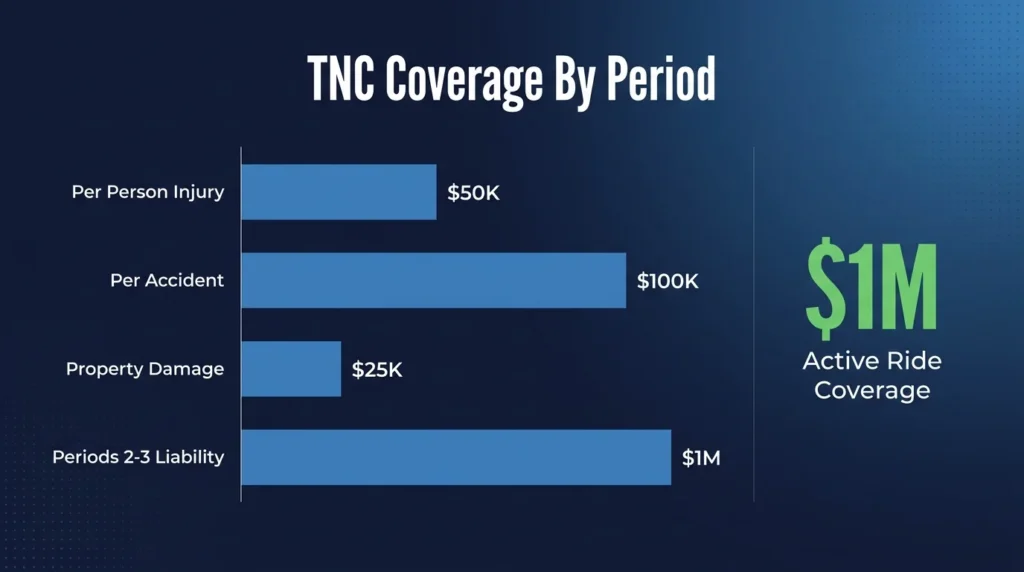
Periods 2 and 3 cover the stretch from accepting a ride through dropping the passenger off. Platform coverage jumps to a $1 million liability policy during these windows.
That higher limit still points outward. It pays third parties you injure, so your own claim against an at-fault driver remains a separate analysis from the platform’s liability coverage.
Uber also offers an Optional Injury Protection product to Texas drivers. The Uber injury protection plan pays medical costs, disability benefits, and survivor benefits regardless of who caused the crash.
You fund it through a small per-mile deduction while you drive. Whether it is worth it comes down to how much you drive and what other coverage you already carry. If you want the practical next steps after a wreck, our guide on what to do after a rideshare accident covers the immediate moves.
Compensation Paths After a Driver Injury
Two legal tracks are usually open to an injured rideshare driver, and people often confuse them. One is a claim against the at-fault driver. The other is an uninsured or underinsured motorist claim when that driver lacks enough coverage.
Third-Party Claims Against the At-Fault Driver
If another motorist caused your crash, you have the same personal injury claim any driver would. You can pursue that driver’s liability insurance for your medical bills, your lost income, and your pain and suffering.
The Texas Civil Practice and Remedies Code Chapter 33 governs how fault affects what you recover. You can still recover as long as you are not more than 50% at fault, though your damages drop in proportion to any share of blame you carry.
Don’t forget about the clock. Under the Texas Civil Practice and Remedies Code (CPRC) § 16.003, you have two years from the date of the accident to file. Miss that window and your right to sue almost always disappears.
The income you cannot earn from the platform while you recover counts as economic damages. That lost rideshare income is a real, claimable loss, and our guide on claiming lost wages after a crash explains how to document it.
UM/UIM Claims When the At-Fault Driver Is Uninsured
When the at-fault driver has no insurance or too little, the platform’s policy may step in. Uber’s and Lyft’s coverage during Periods 2 and 3 includes uninsured and underinsured motorist protection that can reach you as the injured driver.
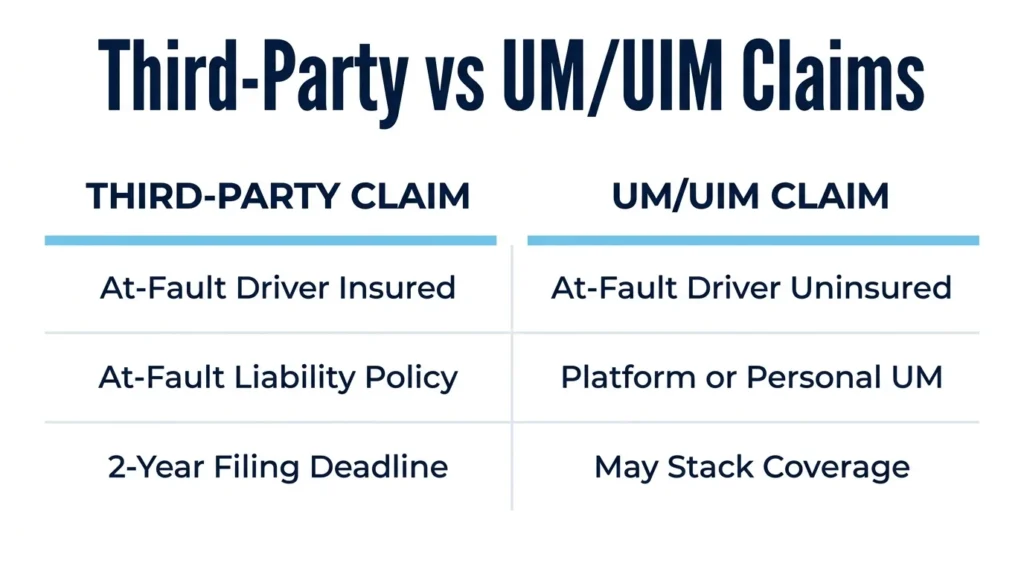
The two terms describe different problems. Uninsured motorist coverage applies when the other driver carries no policy at all. Underinsured motorist coverage applies when their limits exist but fall short of covering your full loss.
Your own personal auto policy’s UM/UIM coverage adds another layer. Depending on the exact terms, it may stack with the platform’s coverage or be excluded by it, so each policy needs a line-by-line read. Sorting out UM/UIM claims against a platform’s insurer is complex, and injured drivers often recover more when they have legal representation from the start.
Work with a Texas Rideshare Injury Attorney
Untangling insurance gaps, platform policies, and third-party claims is hard to do alone while you are hurt and out of work. Angel Reyes & Associates has spent over 30 years helping injured Texans sort out exactly this kind of layered coverage problem. We work on contingency, so there is no fee unless we win, and your first consultation is free.
We have recovered more than $1 billion for clients across Texas, and you can read what those clients say in our client reviews or learn about the attorneys who would handle your case. When you are ready, schedule a free consultation and we will walk you through every path open to you.
Past results do not guarantee future outcomes.
Injured Uber/Lyft Driver FAQs
Does Lyft offer injury protection for drivers in Texas like Uber does?
Not currently. Lyft provides occupational accident insurance to drivers in California, Massachusetts, and Minnesota, but that coverage is not available in Texas as of 2026. Texas Lyft drivers must look to their own auto policy endorsements or Uber-style optional products if they want first-party injury coverage tied to platform work.
What happens to my Uber or Lyft account after I report an accident?
Both platforms typically suspend a driver’s account while they investigate the crash, with no fixed timeline for reinstatement. Reporting promptly through the app is important because waiting too long can itself trigger permanent deactivation, regardless of who caused the accident.
If I kept PIP on my personal auto policy, can it help pay my bills after a rideshare crash?
Texas requires insurers to offer personal injury protection, and if you did not reject it in writing, your PIP coverage pays a portion of medical bills and up to 80 percent of lost wages regardless of fault. That benefit can provide faster access to funds while other claims are still being sorted out.
How do I prove lost rideshare income if I do not have a traditional pay stub?
Federal tax returns with Schedule C, 1099 forms from the platform, and your in-app earnings history are the primary documents insurers and courts accept for gig workers. An attorney can use those records to calculate an average weekly income and project what you would have earned during your recovery period.
Does the platform's insurance apply if I was hit while the app was completely off?
No. When the app is off, neither Uber’s nor Lyft’s insurance has any role in the claim. Your personal auto policy is the only platform-related coverage in play, and the claim proceeds as a standard auto accident against the at-fault driver’s liability insurance.
About the Authors

Angel Reyes
Writer
Angel L. Reyes, III is the Founder and Managing Partner of Angel Reyes & Associates. A nationally recognized trial attorney and business leader, Angel has helped over 70,000 injury victims recover more than $1 billion since founding the firm in 1993. Named to the Texas Super Lawyers list annually since 2008, Angel brings Wall Street experience, Ivy League education, and a deep commitment to client advocacy. He is a frequent legal commentator and published author with extensive contributions to legal scholarship, trial strategy, and consumer protection.

Kyle Nicolas
Editor
Kyle Nicolas is the Web Content & SEO Manager at Angel Reyes & Associates. He has more than 10 years of experience as a marketing co...

Angel Reyes
Reviewer
Angel L. Reyes, III is the Founder and Managing Partner of Angel Reyes & Associates. A nationally recognized trial attorney and business...