Truck Accident Lawsuits Against Major Carriers in Texas


Every article on this site is researched by our internal team, reviewed for legal accuracy against current Texas law, and held to State Bar of Texas advertising standards before publication. We do not publish content that overstates outcomes or makes promises about results.
Learn more about our
editorial standards .
Key Takeaways
- A freight broker, driver, and carrier can each face separate liability claims.
- Federal leasing rules under 49 CFR Part 376 can shift who answers for a driver.
- Texas bars recovery once your share of fault reaches 51 percent under Section 33.001.
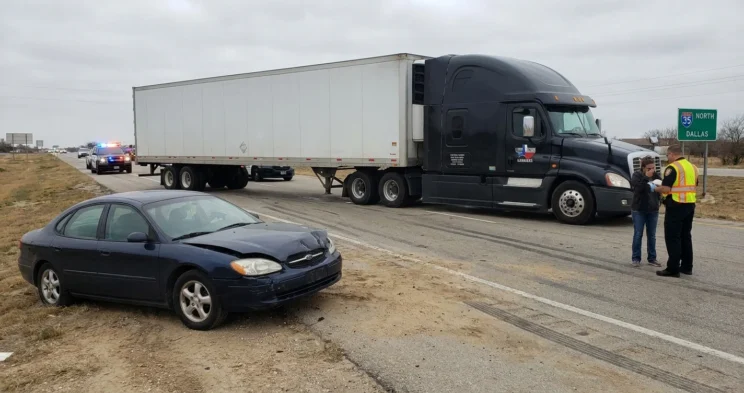
You are stopped in traffic on the Gulf Freeway in Houston when an 18-wheeler rear-ends the line of cars ahead of you. The name painted on the trailer belongs to a company with in-house lawyers and a rapid-response team already moving.
You start to wonder who actually owns that truck, and who is legally responsible for what just happened. The answer is rarely as simple as the driver’s name on the police report.
Who Is Liable for a Truck Accident?
A truck accident claim can name more than one party. You are not limited to suing the driver. Texas law also lets you sue the trucking company directly when its own conduct contributed to the crash.
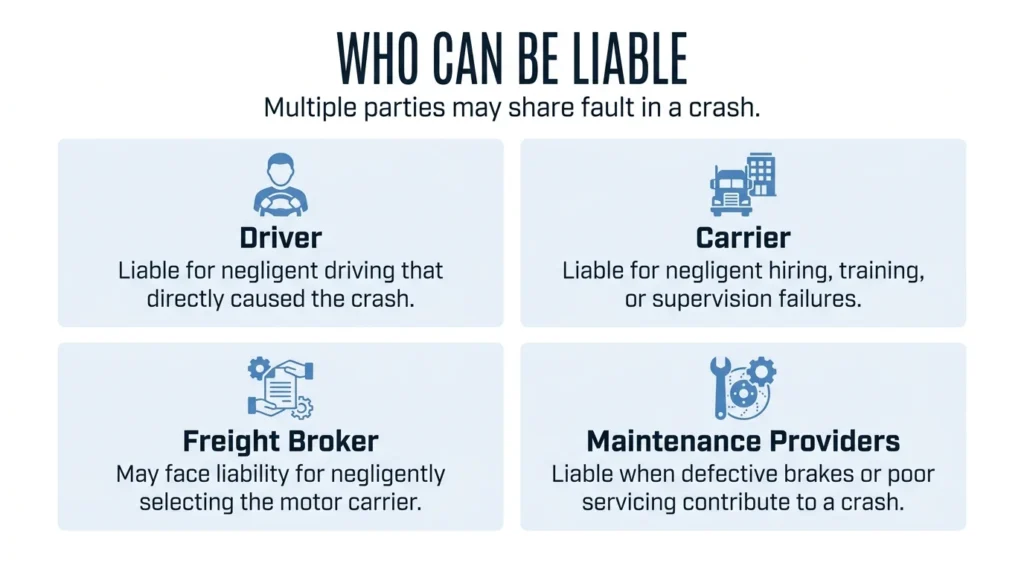
Negligent hiring, training, and supervision give you a second route to the company itself. The carrier may have hired an unqualified driver, skipped required training, or ignored warning signs. That kind of failure can support a direct negligence claim, separate from vicarious liability for the driver’s conduct.
How these claims play out differs, as each case turns on its own facts. Maintenance providers and parts manufacturers may also share responsibility when a defective brake system or a poorly serviced trailer contributes to the crash.
With a major carrier, though, even naming the right company is not always straightforward.
Identifying the Correct Defendant
With a major carrier, the truck you saw on the road may not tell you who is actually responsible. The driver, the tractor, the trailer, and the freight can each belong to a different company. Settling on the right defendant is often the first real fight in the case.
Large carriers sometimes operate through self-insured programs rather than a traditional policy. Others route coverage through shell insurance entities that hold minimal assets, adding another layer between you and the money owed on your claim.
Two recent Texas-relevant rulings show how contested this question can become. In re: Home Depot U.S.A., Inc., the Texas Supreme Court addressed a passive shipper’s duty of care. It held that the shipper owed no duty when it did not control the carrier’s operations.
In Montgomery v. Caribe Transport II, LLC, a court let a negligent-hiring claim proceed against the freight broker that selected the motor carrier.
Neither ruling reflects a typical outcome; each turned on its own specific facts.
Separate Entities Behind a Truck
The name on the truck’s door does not always tell you who employs the driver or who owns the trailer and freight. Ownership of each part of the rig can sit with a different company entirely.
A freight broker who selected the motor carrier can carry its own negligent-hiring exposure, separate from the carrier’s. This matters most in overloaded or unsecured cargo cases, where the freight owner’s packing decisions, not just the driver’s, may have caused the crash.
Leasing & Owner-Operator Arrangements
Federal rules decide when a carrier is treated as controlling a driver who is technically an independent owner-operator. That distinction can shift who answers for the crash.
Under 49 CFR Part 376, a carrier that uses leased equipment must sign a written lease with the equipment’s owner. The rule exists to fix responsibility for a leased truck, not to obscure it.
49 CFR 376.12 requires the authorized carrier-lessee to hold exclusive possession, control, and use of the leased equipment for the lease term. Carriers point to this same provision both to establish responsibility for a leased driver and, in some cases, to try to disclaim it.
You may be unsure whether the driver was a company employee or an independent owner-operator. How leasing arrangements affect insurance coverage helps determine responsibility.
Federal & State Trucking Laws
Federal safety rules set the baseline for what a truck driver and carrier must do. Texas law then decides how fault and damages play out once a case reaches court.
The Federal Motor Carrier Safety Regulations apply to commercial carriers and drivers operating vehicles over a set weight or hauling certain cargo. These rules cover everything from who can hold a commercial license to how long a driver may stay on the road.
Driver qualification standards, hours-of-service limits, and vehicle inspection and maintenance duties are the three FMCSR categories most often at issue in a lawsuit. A violation of any of these can support a negligence claim against the carrier. For example, a driver who logged more hours behind the wheel than federal rules allow may point to fault.
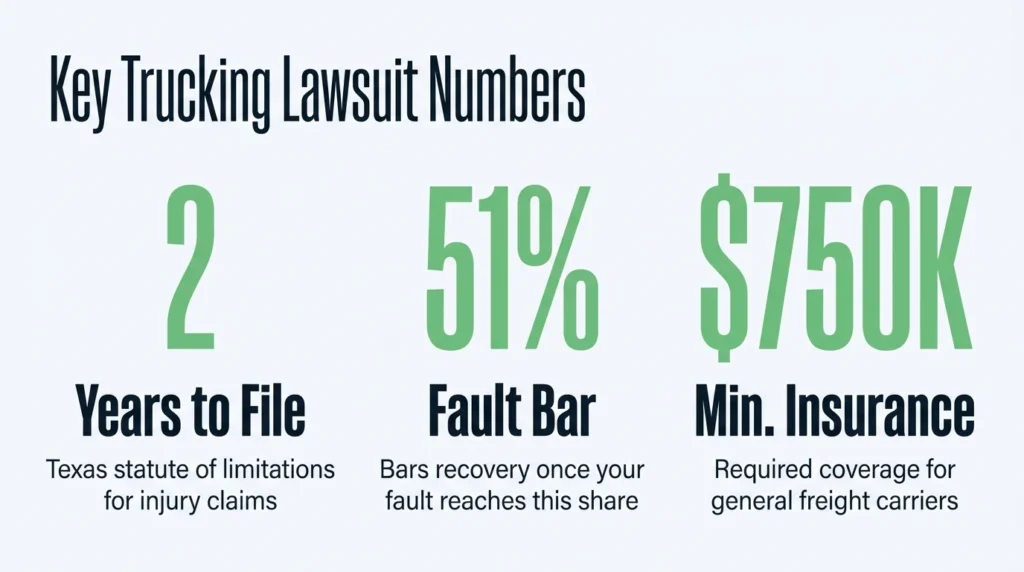
Texas Civil Practice and Remedies Code § 33.001 sets the state’s comparative negligence rule. If your share of fault for the crash reaches 51 percent or more, you cannot recover damages.
House Bill 19, passed in 2021, added Chapter 72, Subchapter B to the Texas Civil Practice and Remedies Code.
It requires certain commercial motor vehicle cases to be tried in two phases. Compensatory damages come first, then exemplary damages only if the jury finds a basis for them.
How Major Carriers Defend Claims
A major carrier’s defense often begins before you have even called a lawyer. In-house counsel gets involved the moment the company learns a crash was serious.
That legal team’s first priority is protecting the company, not resolving your claim quickly. Retaining your own attorney early puts someone on your side while the carrier’s team is already at work.
Within hours of a serious crash, a rapid-response investigation team may already be documenting the scene, downloading electronic logging device data, and interviewing witnesses. That evidence can shape the company’s position before you have received any medical treatment.
A small, local trucking operation rarely has this kind of infrastructure. Because a major carrier moves this fast, your own evidence needs to be preserved just as quickly. That includes skid marks, debris, or dashcam footage.
Steps in Filing a Trucking Lawsuit
Filing a lawsuit against a major carrier generally follows three stages: investigation, filing and discovery, and trial or settlement.
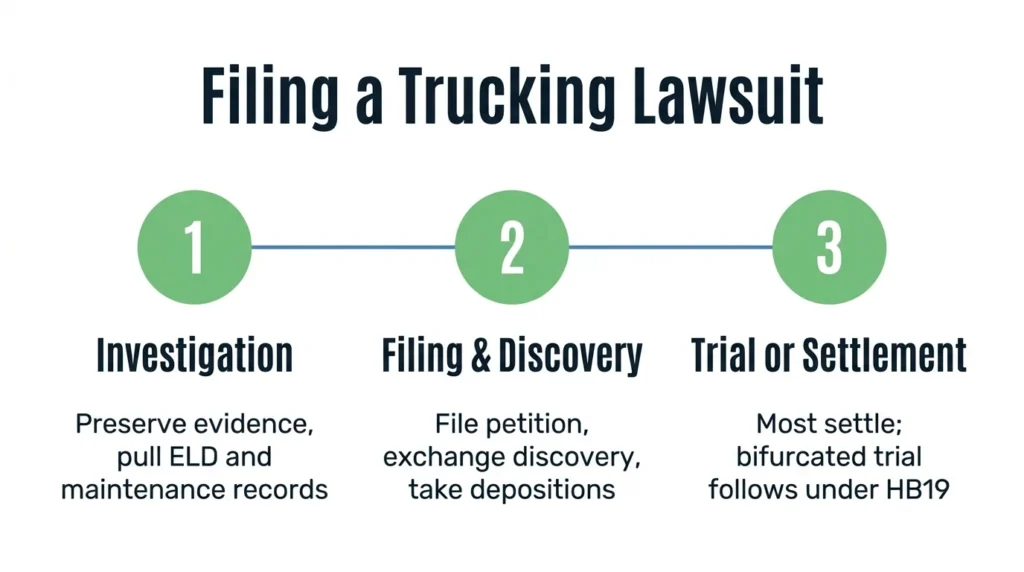
Investigation. This stage typically includes:
- Preserving crash-scene evidence before it disappears.
- Pulling electronic logging devices and maintenance records.
- Collecting witness statements while memories are fresh.
Filing and discovery. Your attorney files the petition. Both sides then exchange discovery requests and take depositions of company representatives and, where relevant, the driver.
Trial or settlement. Most cases resolve before trial. Cases that do proceed under HB19’s bifurcated framework follow the same two-phase order described above. Compensatory damages come first, then exemplary damages only if the jury finds a basis for them.
Work with an Experienced Attorney
A lawsuit against a major trucking company moves fast, and you should not have to face it alone.
Angel Reyes & Associates represents injured Texans in truck accident cases against carriers of every size. We work on a contingency fee basis, so you owe no fee unless we win your case. We have more than $1 billion recovered for clients, and our team is ready to investigate a major carrier’s conduct from day one.
Contact us today for a free consultation to talk about what happened.
Past results do not guarantee future outcomes.
Major Carrier Lawsuit FAQs
How long do I have to file a lawsuit against a trucking company in Texas?
Texas law generally gives you two years from the date of the crash to file a personal injury lawsuit, under Texas Civil Practice and Remedies Code Section 16.003. Missing that deadline usually means losing the right to sue, so it helps to start building your case well before it arrives.
What is the minimum insurance a trucking company is required to carry?
Federal rules require most large trucks hauling general freight to carry at least $750,000 in liability insurance. Carriers hauling hazardous materials must carry more, from $1 million up to $5 million depending on the cargo.
Do I still have a case if the truck driver was not given a ticket after the crash?
Yes. A citation is not required to sue, because a company can be held responsible for a driver’s negligence under the legal doctrine of respondeat superior, and other evidence such as driver logs and maintenance records can establish fault even without a police citation.
Can I sue an out of state trucking company in a Texas court?
Yes. Texas’s long arm statute lets Texas courts hear claims against out of state carriers when the crash happened in Texas, though serving a company based in another state can take longer than serving a local one.
About the Authors

Alex Ivanov
Writer
Alex Ivanov is a personal injury attorney at Angel Reyes & Associates, focused on car, truck, and motorcycle accident cases. Licensed in Texas and multiple federal districts, Alex brings international legal experience and a global education to his practice. He earned his LL.M. from Texas A&M University School of Law after graduating from Belarussian State University in 2016. Alex is fluent in Russian, English, Ukrainian, and Belarussian, and is recognized by multiple national trial lawyer associations for his results and leadership under 40.

Kyle Nicolas
Editor
Kyle Nicolas is the Web Content & SEO Manager at Angel Reyes & Associates. He has more than 10 years of experience as a marketing co...

Angel Reyes
Reviewer
Angel L. Reyes, III is the Founder and Managing Partner of Angel Reyes & Associates. A nationally recognized trial attorney and business...