What Happens If You Leave the Scene of a Motorcycle Accident in Texas?


Every article on this site is researched by our internal team, reviewed for legal accuracy against current Texas law, and held to State Bar of Texas advertising standards before publication. We do not publish content that overstates outcomes or makes promises about results.
Learn more about our
editorial standards .
Key Takeaways
- Leaving the scene of a motorcycle accident in Texas is a criminal offense regardless of fault, with penalties ranging from a misdemeanor fine to a second-degree felony.
- Victims of motorcycle hit-and-runs can recover compensation through their own UM coverage when the at-fault driver flees and is never identified.
- Fleeing the scene does not eliminate civil liability and can support punitive damage claims in addition to medical bills and lost wages.
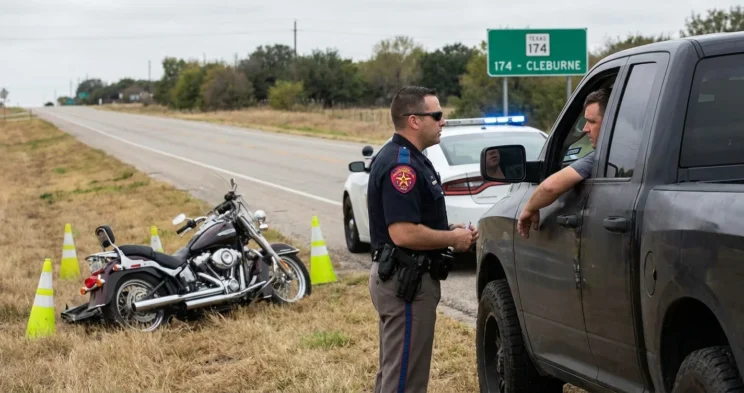
No matter what brings a driver to leave the scene of a motorcycle accident in Texas, the legal consequences are swift and serious. Texas law has zero tolerance for drivers who flee, and both the injured rider and the runner face strict legal timelines after the dust settles.
What Texas Law Requires at Every Accident Scene
According to Texas Transportation Code (TTC) § 550.021, every driver involved in a crash causing an injury or death must remain at the scene and comply with the requirements of TTC § 550.023.
Under this section, drivers involved in accidents must:
- Assist injured individuals.
- Making arrangements for emergency transportation, if necessary.
- Provide their names, addresses, registration, insurance, and driver’s license (if requested).
Leaving before fulfilling these obligations can escalate the accident to a hit-and-run, which carries steep consequences.
Criminal Penalties for Leaving the Scene in Texas
Texas determines hit-and-run charges based on the severity of the crash. Property damage triggers misdemeanor charges, while injury or death triggers serious felony charges.
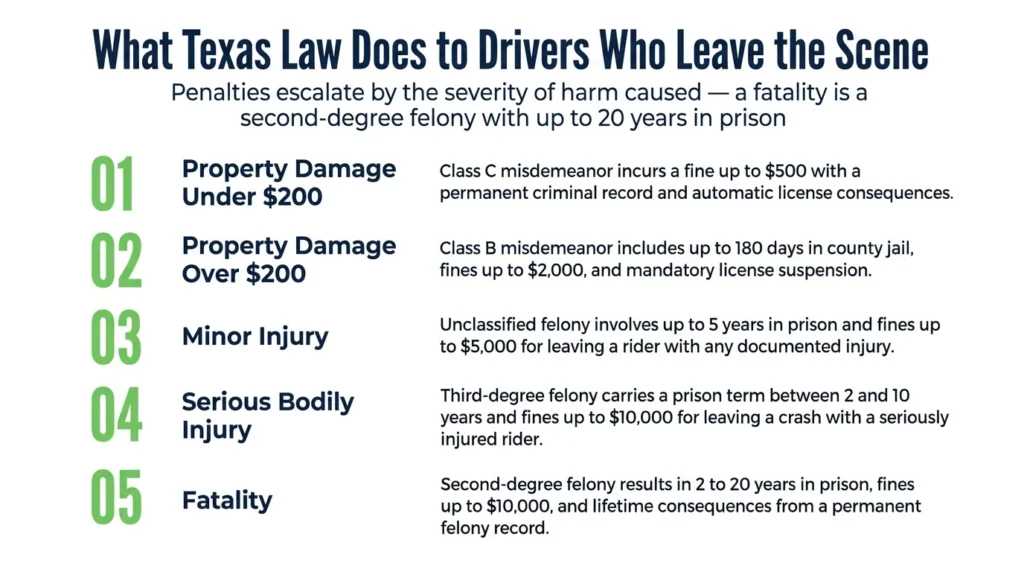
Penalties for a hit-and-run include:
- Property damage under $200 (class C misdemeanor): No jail time and a fine of up to $500.
- Property damage over $200 (class B misdemeanor): Up to 180 days in county jail and fines up to $2,000.
- Minor injury (unclassified felony): Up to 5 years in prison (or up to 1 year in county jail) and fines up to $5,000.
- Serious bodily injury (third-degree felony): Between 2 and 10 years in prison and fines up to $10,000.
- Fatality (second-degree felony): From 2 to 20 years in prison and fines up to $10,000.
Criminal charges are only the beginning. Texas automatically suspends the driver’s license of anyone convicted of failing to stop and render aid. A permanent felony record will also follow the driver for life, increasing insurance rates and impacting future job and housing opportunities.
Civil Liability on Top of Criminal Charges
A driver who leaves an accident scene is still responsible under Texas civil law for the rider’s medical bills, lost income, pain and suffering, and property damage. Fleeing does not reduce that financial obligation. In practice, it often increases it.
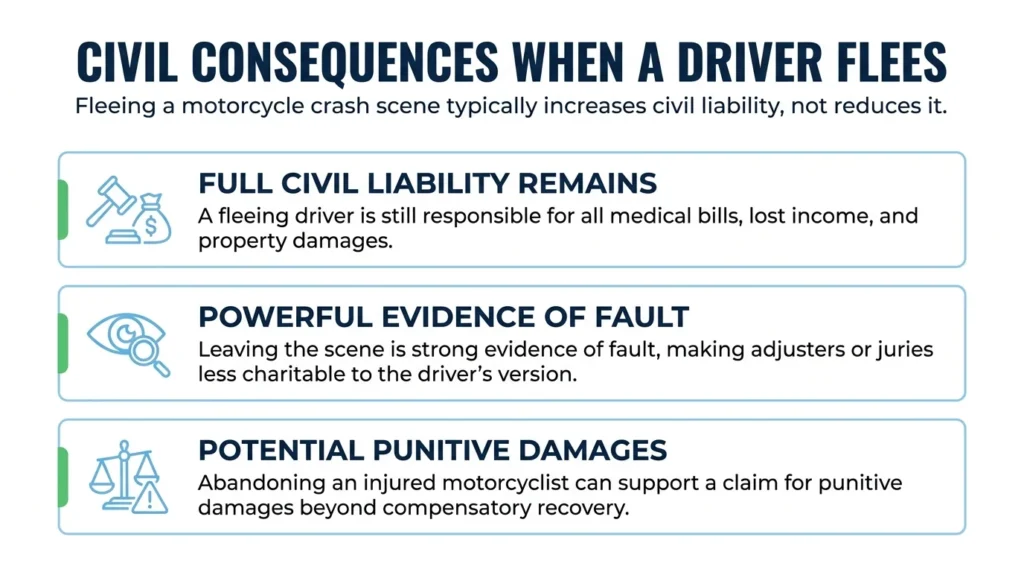
In all motorcycle accidents, Texas proportionate responsibility rules apply, meaning each party’s share of fault is assessed individually. But leaving the scene is powerful evidence of fault in a civil case. A jury or insurance adjuster who learns the at-fault driver fled is unlikely to view that driver charitably.
Leaving the scene can also support a claim for punitive damages (extra fees a judge or jury orders a wrongdoer to pay as a punishment for extreme or reckless behavior, rather than to cover actual bills or losses). A driver who abandons an injured motorcyclist and speeds away is likely to be held responsible for punitive damages as well, depending on the specific facts of the case.
How Victims of Motorcycle Hit-&-Runs Can Recover Compensation
If the driver who caused your accident left and has not been identified, you still have a path to compensation. Your own uninsured motorist (UM) coverage is designed for exactly this situation.
UM coverage applies when the at-fault driver is unidentified or carries no insurance. It can cover your medical expenses, lost wages, and pain and suffering up to your policy limits.
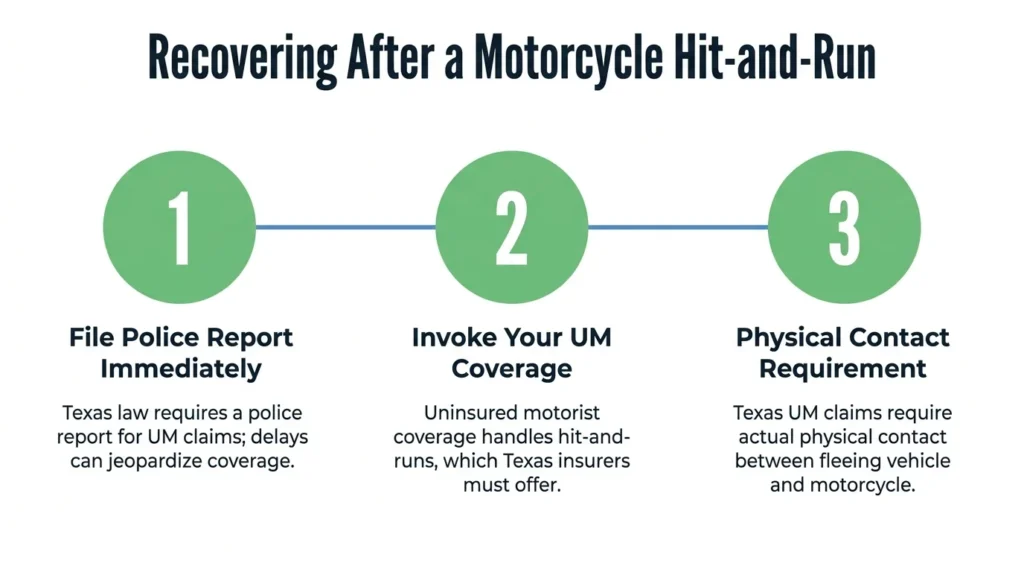
Texas law requires insurers to offer UM and UIM coverage to every policyholder. If you did not decline it in writing, you likely have it. Additionally, even if the driver is later identified, a direct civil claim against them is an additional path that does not require you to give up your UM claim.
Filing a UM claim after a motorcycle hit-and-run requires prompt police reporting. Texas law requires actual physical contact between the fleeing vehicle and your motorcycle to trigger a hit-and-run UM claim. If a “phantom driver” forces you off the road but doesn’t actually strike your bike, your insurer may deny a UM claim unless an independent witness can verify the other vehicle’s actions. Delays in reporting can jeopardize the claim. Our uninsured motorist accident guide outlines how to build and document this type of claim.
Speak with an Attorney About Your Options
Motorcycle hit-and-run cases involve overlapping criminal, civil, and insurance claim processes. Missing a step in any of them can limit your recovery options.
With over 20 office locations, Angel Reyes & Associates has spent 30+ years assisting victims of motorcycle hit-and-run accidents across the state of Texas. We work on a contingency basis (meaning you don’t pay unless we win), and we are available 24/7 to discuss your case. Reach out to our personal injury lawyers today for a free consultation.
Motorcycle Hit-&-Run FAQs
How long does a motorcycle hit-and-run victim have to file a civil lawsuit in Texas?
Texas Civil Practice and Remedies Code § 16.003 gives injury victims two years from the date of the accident to file a personal injury lawsuit. Missing this deadline generally bars the claim entirely, regardless of how clear the other driver’s fault is.
Does PIP coverage apply to a motorcycle hit-and-run in Texas?
PIP coverage can be added to a motorcycle insurance policy and pays for medical expenses and a portion of lost wages regardless of fault or whether the other driver is identified. Unlike UM coverage, PIP does not require a police report naming the at-fault vehicle, so it can provide faster access to funds after a hit-and-run.
Can a criminal conviction for leaving the scene be used against the driver in a civil lawsuit?
A criminal conviction is a separate proceeding from a civil case, but the facts that support the conviction, including evidence that the driver fled the scene, can be introduced in a civil trial as evidence of fault. Fleeing behavior is generally treated as an admission that the driver knew something went wrong.
Should I repair or sell my motorcycle before the insurance claim is settled?
Do not repair, alter, or dispose of your motorcycle until your insurance claim is fully resolved. Your insurer will likely need to inspect the damage, and making changes to the bike before that inspection can complicate your property damage claim and reduce your recovery.
About the Authors

Angel Reyes
Writer
Angel L. Reyes, III is the Founder and Managing Partner of Angel Reyes & Associates. A nationally recognized trial attorney and business leader, Angel has helped over 70,000 injury victims recover more than $1 billion since founding the firm in 1993. Named to the Texas Super Lawyers list annually since 2008, Angel brings Wall Street experience, Ivy League education, and a deep commitment to client advocacy. He is a frequent legal commentator and published author with extensive contributions to legal scholarship, trial strategy, and consumer protection.

Kyle Nicolas
Editor
Kyle Nicolas is the Web Content & SEO Manager at Angel Reyes & Associates. He has more than 10 years of experience as a marketing co...

Angel Reyes
Reviewer
Angel L. Reyes, III is the Founder and Managing Partner of Angel Reyes & Associates. A nationally recognized trial attorney and business...