Lyft Passenger Accident Rights in Texas


Every article on this site is researched by our internal team, reviewed for legal accuracy against current Texas law, and held to State Bar of Texas advertising standards before publication. We do not publish content that overstates outcomes or makes promises about results.
Learn more about our
editorial standards .
Key Takeaways
- As a no-fault Lyft passenger, you can recover full damages under Texas law.
- During an active ride, Lyft's $1 million liability policy covers your injuries.
- Texas gives you two years from the crash date to file a Lyft injury claim.
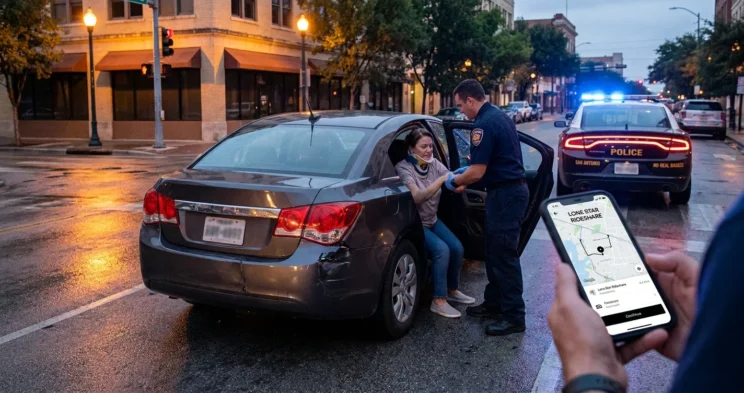
You were riding home from a late dinner near the Pearl in San Antonio when another car ran a light on Broadway and slammed into your Lyft. You did nothing wrong, yet now your neck hurts and your phone is filling up with insurance numbers you do not recognize.
Who pays for your medical bills, and where do you even start?
Lyft Passenger Rights After a Texas Crash
As a Lyft passenger, you carry no fault in the crash. That makes you a third-party claimant with a strong legal position from the moment you file.
You did not choose the route, the speed, or the lane. Because of that, you start any claim with a clean slate that the at-fault parties have to answer to.
Texas uses a fault-sharing system called proportionate responsibility. Under Texas Civil Practice and Remedies Code Chapter 33, a person who shares no blame can recover full damages, or compensation, from any responsible party.
That rule almost never works against a passenger. You were simply sitting in the back seat.
Lyft drivers are independent contractors, so Lyft’s direct liability has limits. Even so, you keep the right to file against the driver, a third-party driver, or both at once.
The path you take depends on who caused the crash and what coverage was active that day. Texas law gives you access to several layers of insurance, and the right one depends on the trip stage when the crash happened.
Lyft’s Insurance Coverage Periods in Texas
Lyft’s coverage changes based on what the driver was doing in the app when the accident occurred. Texas Insurance Code Chapter 1954 sets these tiers for rideshare companies, and your Lyft accident passenger compensation in Texas depends on which one applies.
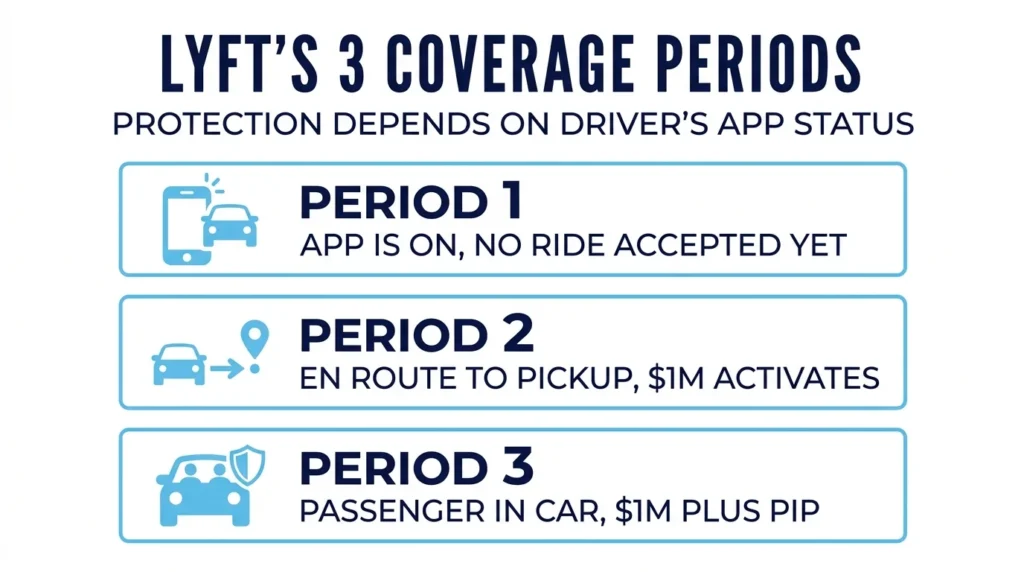
There are three coverage periods. Each one carries a different level of protection.
Period 1 starts when the driver is logged in but has not accepted a ride. Lower contingent limits apply here, at $50,000 per person, $100,000 per accident, and $25,000 for property damage under Texas Insurance Code § 1954.052, and Lyft’s policy only steps in if the driver’s personal policy denies the claim.
Period 2 begins when the driver accepts a ride and heads to pick someone up. At that point the $1 million aggregate liability policy turns on under Texas Insurance Code § 1954.053.
Period 3 covers the time you are actually in the car. The $1 million policy stays in full force, and your Lyft passenger injury claim falls squarely inside it. Section 1954.053 also requires uninsured and underinsured motorist coverage plus personal injury protection during this stretch.
What happens if the at-fault driver has no insurance, or not enough? You can reach the uninsured and underinsured motorist coverage layer required under Texas Insurance Code § 1952.101. You may also file against your own auto policy if it carries that coverage.
Sorting out which period applies is rarely simple, but will help you see where your crash fits.
Who Can Be Liable for Your Injuries
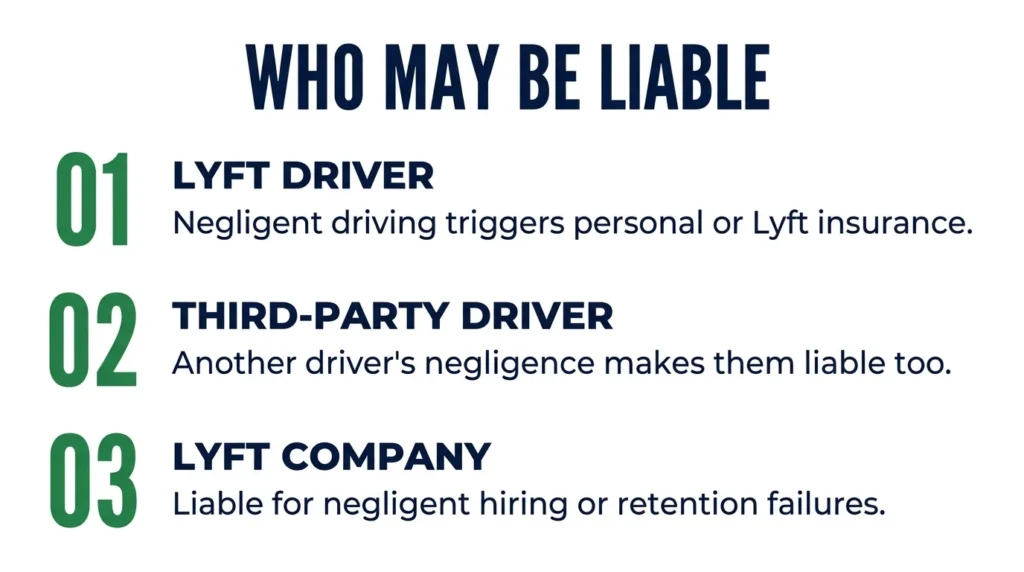
More than one party can owe you money after a Lyft crash. Often, several do.
The Lyft driver has direct liability when driver negligence caused the wreck. Speeding, distraction, or running a red light all qualify. Depending on the coverage period, the driver’s personal insurer or Lyft’s policy responds.
A third-party driver who caused or contributed to the crash can also be held liable. You reach that driver through their personal auto insurance or, if needed, through a lawsuit.
So what happens if the Lyft driver causes the accident but Lyft tries to step away? Lyft itself can face direct liability under negligent hiring, negligent retention, or negligent entrustment.
These claims apply when Lyft failed to screen a driver properly or kept one with a known dangerous history.
The Texas Department of Licensing and Regulation oversees rideshare compliance and sets baseline screening rules Lyft must meet. Proof that Lyft ignored those rules can support a direct claim against the company.
You can name more than one party in a single claim. That gives you the widest possible path to full compensation.
Steps to Take After a Lyft Accident in Texas
The strongest passenger claims are built in the first hours and days after the crash. The steps below protect both your health and your right to compensation:
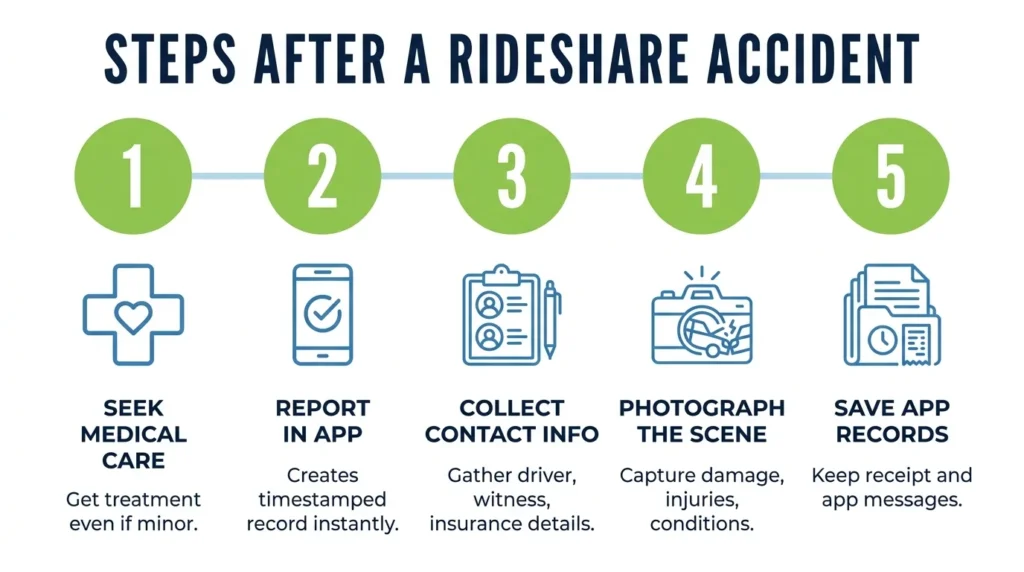
- Step 1: Seek medical attention immediately. Do this even when your injuries feel minor. A medical record from the day of the crash is one of the most powerful pieces of evidence you can have.
- Step 2: Report the crash in the Lyft app before you close it. The in-app report creates a timestamped record of the ride and the event that you cannot rebuild later.
- Step 3: Collect contact and insurance details. Get the names, phone numbers, and insurance information for every driver involved, plus the names of any witnesses.
- Step 4: Photograph everything at the scene. Capture vehicle damage, the crash location, your visible injuries, and any road or traffic conditions that played a part.
- Step 5: Save your Lyft receipt and in-app messages. This data confirms the driver’s app status and the trip phase when the crash happened.
You also have a hard deadline. Texas Civil Practice and Remedies Code (CPRC) § 16.003 gives you two years from the crash date to file a personal injury claim. That is a strict legal limit, not a suggestion.
An attorney can help you document and preserve the exact evidence insurers scrutinize most.
What Your Claim May Be Worth
What your claim is worth depends on your injuries, your documented losses, and the coverage available. No one can promise a number, but Texas law lets you recover money across several categories.
Economic damages cover your hard costs. That includes current and future medical expenses, lost wages, and out-of-pocket costs tied to the injury, all calculated from your records.
Non-economic damages cover the human toll. Pain and suffering, mental anguish, and loss of enjoyment of life are all recoverable, though these amounts vary more with the facts of each case.
Texas does not cap compensatory damages in standard personal injury cases. Your compensation depends on what you can prove.
The coverage available shapes the compensation limit too. A Period 3 claim reaches the $1 million Lyft policy, a far larger pool than a Period 1 claim offers.
Talk to an Experienced Attorney About Your Accident
A Lyft passenger crash can pull in several insurers and more than one at-fault party, and sorting that out alone is hard while you are trying to heal. That is where we come in.
Angel Reyes & Associates has spent more than 30 years helping injured Texans, with more than $1 billion recovered for clients. Our team of attorneys handles rideshare passenger injury claims on a no-fee-unless-we-win basis, and your first consultation is free.
The two-year filing deadline makes early action important, so the sooner you reach out, the more options you keep. Schedule a free consultation with us today and protect your right to compensation.
Past results do not guarantee future outcomes.
Lyft Passenger Accident Rights FAQs
Does not wearing a seatbelt affect my claim as a Lyft passenger?
Texas allows a jury to consider seatbelt non-use when deciding how much your injuries were your own fault, which can reduce the damages you recover. Because you bear no fault for the crash itself, any reduction would typically apply to injury severity rather than to who caused the accident.
Does Lyft's personal injury protection pay out regardless of who caused the crash?
Yes. Personal injury protection (PIP) is a no-fault coverage, so it pays for your medical bills and a portion of lost wages without requiring proof that anyone else was at fault. During an active ride, Texas law requires Lyft’s policy to include PIP as part of the Period 3 coverage package.
What if I waited a few days before seeing a doctor after my Lyft accident?
A gap in care gives insurers grounds to argue that your injuries were not caused by the crash or were not serious. Seeing a doctor as soon as possible, even if a few days have passed, still strengthens your claim far more than not going at all.
Do I need a lawyer to file a Lyft passenger injury claim in Texas?
You are not legally required to hire an attorney, but these claims typically involve multiple insurers and disputes over which coverage period applies, which are hard to navigate on your own. Most Texas personal injury attorneys take rideshare cases on a contingency basis, meaning no upfront cost to you.
What if I don't own a car or carry personal auto insurance?
You can still recover. During an active ride, Lyft’s commercial policy provides $1 million in liability coverage and mandatory uninsured and underinsured motorist protection under Texas Insurance Code Section 1954.053, with no requirement that you personally carry auto insurance.
About the Authors

Angel Reyes
Writer
Angel L. Reyes, III is the Founder and Managing Partner of Angel Reyes & Associates. A nationally recognized trial attorney and business leader, Angel has helped over 70,000 injury victims recover more than $1 billion since founding the firm in 1993. Named to the Texas Super Lawyers list annually since 2008, Angel brings Wall Street experience, Ivy League education, and a deep commitment to client advocacy. He is a frequent legal commentator and published author with extensive contributions to legal scholarship, trial strategy, and consumer protection.

Graham Griffin
Editor
Graham Griffin is the Web & Content Manager at Angel Reyes & Associates, where he oversees content strategy, AI-powered workflows, a...

Angel Reyes
Reviewer
Angel L. Reyes, III is the Founder and Managing Partner of Angel Reyes & Associates. A nationally recognized trial attorney and business...