Megabus & Intercity Bus Accident Claims in Texas


Every article on this site is researched by our internal team, reviewed for legal accuracy against current Texas law, and held to State Bar of Texas advertising standards before publication. We do not publish content that overstates outcomes or makes promises about results.
Learn more about our
editorial standards .
Key Takeaways
- Private intercity bus carriers owe passengers the highest degree of care under Texas law.
- You have two years from your injury date to file a claim against a private bus carrier.
- Large coaches must carry at least $5 million in coverage under federal safety rules.
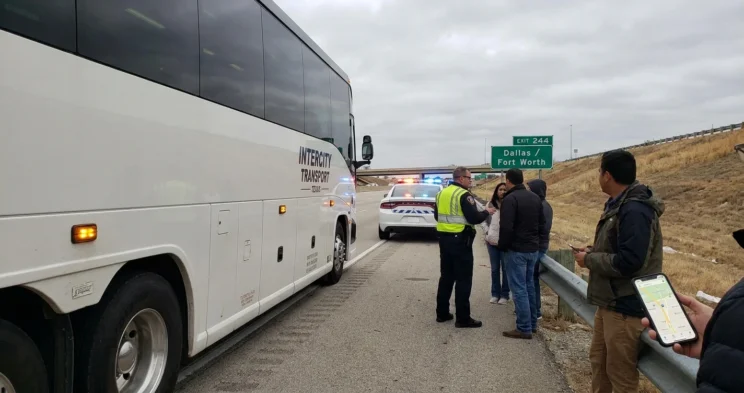
You boarded a budget coach in downtown Dallas, heading south on I-35 to save money on a trip you needed to take. Somewhere past the city, the bus slammed into stopped traffic, and now you are facing medical bills you never planned for. You are wondering whether you can even take on a company this large, and whether it is worth trying.
Private Carriers Owe You the Highest Duty of Care
A private intercity bus company owes you the highest degree of care the law allows, far more than an ordinary driver owes. Companies like Megabus, which operated as a Coach USA brand, are for-hire commercial carriers, not government agencies. That means none of the notice deadlines or damage caps that protect public transit apply to your claim against them.
This is a real advantage for you. When you sue a city or county transit system, you face short notice windows and strict limits on what compensation you can recover. A private carrier gives you the full reach of Texas civil law instead.
Texas law treats these companies as common carriers. They must use the highest degree of care to protect passengers from harm they could foresee. That standard covers how they maintain their buses, who they hire to drive, how they supervise those drivers, and how they run their routes.
Intercity carriers cross state lines under federal authority. Even so, Texas civil law governs your right to damages and who is liable, while federal safety rules can separately help prove the company was negligent.
FMCSA Rules & Your Injury Claim
Federal safety rules can do a lot of the heavy lifting in your claim. Any intercity carrier running large coaches in interstate commerce, including double-decker buses designed to transport 16 or more passengers including the driver, must register with the Federal Motor Carrier Safety Administration and follow its rules.
Those rules cover how long a driver can stay behind the wheel, who qualifies to drive, and how the bus must be maintained.
You can see the agency’s own summary of these requirements through the FMCSA passenger carrier safety rules.
Federal regulations under 49 C.F.R. Part 390 set the safety standards for commercial passenger buses on interstate routes. If the carrier broke one of these rules, that violation can support a negligence per se claim. In plain terms, the broken rule can prove the company failed its duty without a fight over what a careful carrier should have done.
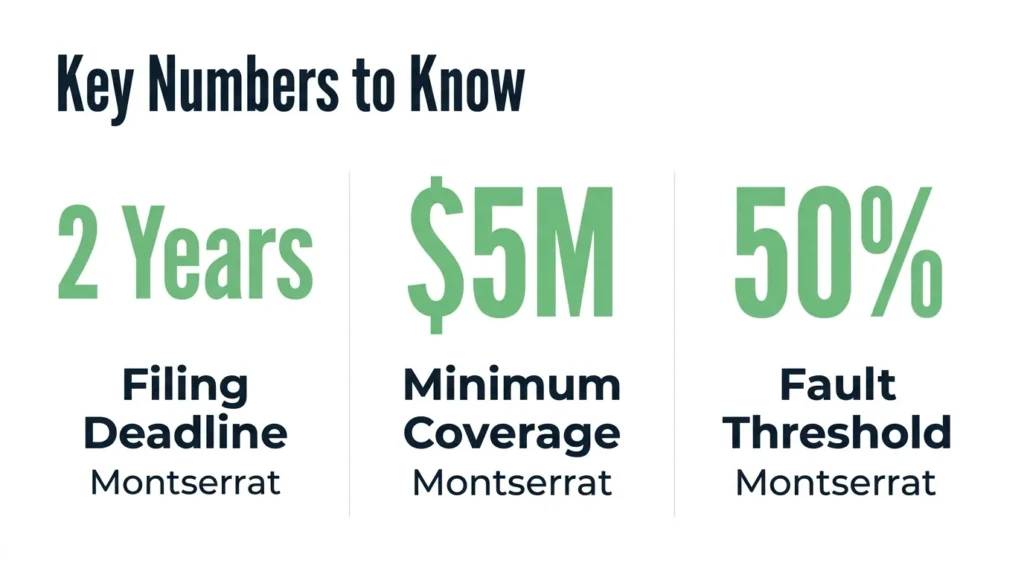
There is another reason these federal rules help you. Carriers running large coaches must keep at least $5 million in coverage under 49 C.F.R. Part 387. That is far more than a typical driver carries, which means the company that injured you can actually pay a fair recovery.
A serious injury can quickly outgrow what a smaller policy would cover, so it helps to understand how bus accident settlement value is calculated before you talk numbers with anyone.
Who Is Liable in an Intercity Bus Crash?
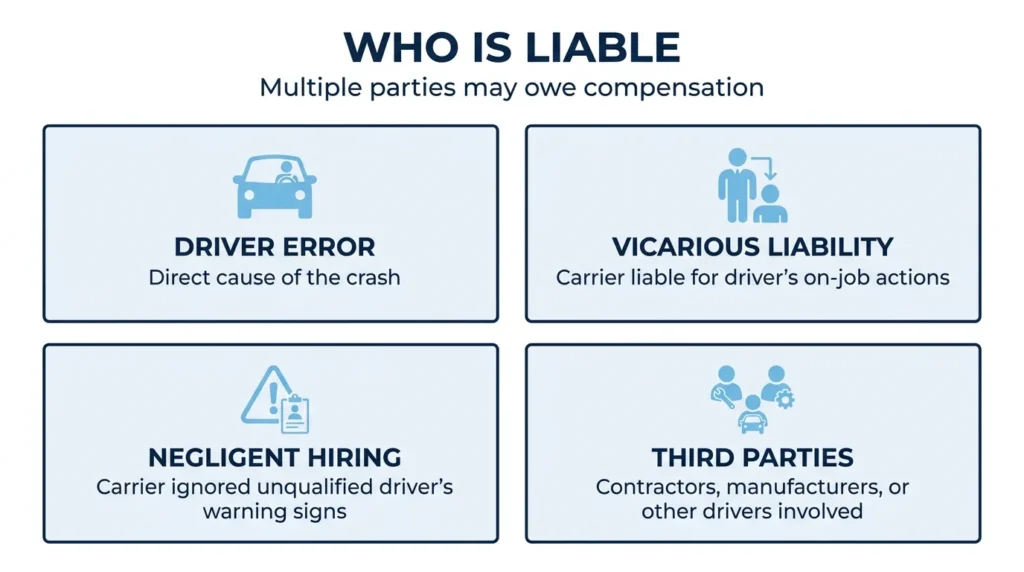
More than one party may owe you money after an intercity bus crash. The driver is the most direct one when their error caused the wreck. Because these drivers work for the carrier, the company is also on the hook for what its driver did on the job, a rule the law calls vicarious liability.
The carrier can be liable on its own, too. If it put an unqualified driver behind the wheel, or ignored warning signs in that driver’s federal safety record, you may have a claim for negligent hiring or supervision.
Other parties can be pulled in as well. A maintenance contractor that did shoddy work, a manufacturer that built a defective part, or another driver who helped cause a multi-vehicle pileup can all be named. Texas sorts out fault among everyone involved under Texas Civil Practice and Remedies Code (CPRC) Chapter 33, which divides responsibility by percentage.
Finding the right company to sue can get complicated. Coach USA, the parent behind the Megabus brand, filed for Chapter 11 bankruptcy in June 2024 and completed its sale to affiliates of The Renco Group on October 31, 2024. Megabus also ended its Texas routes in August 2024.
If your crash happened before that, your claim may still involve Coach USA as a bankrupt entity. Identifying the correct defendant takes a careful look at the corporate history and the bankruptcy record. The same care that goes into large commercial vehicle and truck accident claims applies here.
Filing an Intercity Bus Lawsuit in Texas
You have two years from the date of your injury to file a personal injury claim against a private carrier. That deadline comes from Texas Civil Practice and Remedies Code (CPRC) § 16.003. Unlike a claim against public transit, there is no short notice period to beat first, and the clock usually starts the day you are hurt.
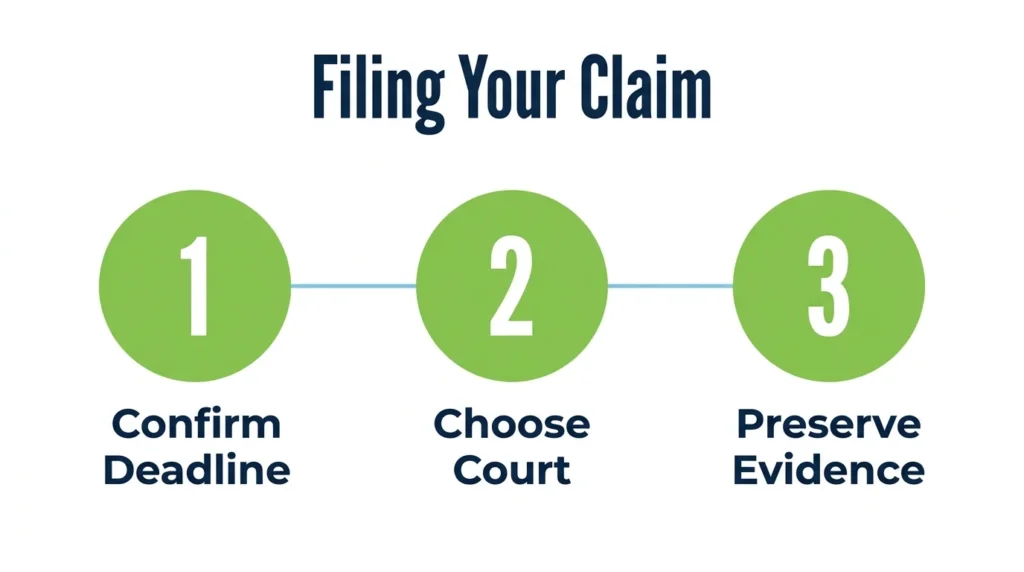
Here is what the path to a claim generally looks like:
Step 1: Confirm your filing deadline. Two years is the rule under § 16.003, but the date your clock started can depend on your specific injury, so pin it down early.
Step 2: Decide where the case belongs. Because Megabus and its parent companies are incorporated outside Texas, your case may belong in federal court under 28 U.S.C. § 1332 if your damages exceed $75,000. Your attorney will weigh local rules, the likely jury, and the facts of your case before choosing.
Step 3: Lock down the evidence fast. Federal inspection records, driver logbooks, maintenance logs, dashcam footage, and the bus’s electronic control module data can all prove what happened. An attorney can move to preserve these through litigation holds before the company deletes them.
If a crash takes a life, surviving family members can bring a wrongful death claim under Texas Civil Practice and Remedies Code Chapter 71. These claims carry the same two-year deadline and face none of the government limits that reduce compensation against public transit.
Talk to an Experienced Attorney About Your Accident
Taking on a national bus company while you are hurt and worried about money feels like an uneven fight. It does not have to be. Angel Reyes & Associates has spent over 30 years helping injured Texans hold large carriers accountable, including in commercial vehicle and bus crash cases.
We work on a contingency fee basis, so you pay no attorney fee unless we win, and your first consultation is always free. We serve clients across Texas, offer service in Spanish, and have more than $1 billion recovered for clients.
You can review what past clients say about working with us, meet the team that would handle your case, or find one of our offices across Texas.
When you are ready, schedule a free consultation and we will review your options together.
Past results do not guarantee future outcomes.
Megabus & Intercity Bus Accident Claim FAQs
Do intercity buses have to have seat belts?
Federal rules require seat belts on motorcoaches built after 2016, so many coaches are equipped with them. Texas law does not require passengers to wear them, but whether you used a seat belt could still come up as a factor in how your injuries are evaluated.
What if I was partly at fault for my own injuries?
Texas uses a modified comparative fault rule: you can still recover as long as you are found 50% or less at fault, and your award is reduced by your share of responsibility. If you are found more than 50% at fault, you will not receive any compensation.
What happens to a claim if the crash happened before Megabus left Texas and Coach USA is now in bankruptcy?
Coach USA’s Chapter 11 case converted to Chapter 7 in December 2024, and a bankruptcy trustee was appointed to manage remaining assets. If you have a pre-August 2024 injury claim, you may need to file a proof of claim in the bankruptcy proceeding to protect your rights.
What if the Megabus crash happened outside Texas on a route that started in Texas?
The law of the state where the crash occurred typically governs your claim, not Texas law. Which state’s statutes apply, including deadlines and damage rules, depends on where the accident actually took place.
Can a driver or pedestrian hurt by a Megabus file a claim?
Yes. A motorist or pedestrian struck by an intercity bus can file a negligence claim against the carrier and driver. The standard is ordinary reasonable care, not the heightened duty that applies specifically to the carrier’s paying passengers.
About the Authors

Angel Reyes
Writer
Angel L. Reyes, III is the Founder and Managing Partner of Angel Reyes & Associates. A nationally recognized trial attorney and business leader, Angel has helped over 70,000 injury victims recover more than $1 billion since founding the firm in 1993. Named to the Texas Super Lawyers list annually since 2008, Angel brings Wall Street experience, Ivy League education, and a deep commitment to client advocacy. He is a frequent legal commentator and published author with extensive contributions to legal scholarship, trial strategy, and consumer protection.

Graham Griffin
Editor
Graham Griffin is the Web & Content Manager at Angel Reyes & Associates, where he oversees content strategy, AI-powered workflows, a...

Angel Reyes
Reviewer
Angel L. Reyes, III is the Founder and Managing Partner of Angel Reyes & Associates. A nationally recognized trial attorney and business...