What Damages Can You Recover After a Motorcycle Accident in Texas?


Every article on this site is researched by our internal team, reviewed for legal accuracy against current Texas law, and held to State Bar of Texas advertising standards before publication. We do not publish content that overstates outcomes or makes promises about results.
Learn more about our
editorial standards .
Key Takeaways
- Texas sorts crash compensation into economic, non-economic, and exemplary damage categories.
- Texas does not cap pain and suffering damages in standard motorcycle accident claims.
- A rider found 51% or more at fault for the crash recovers nothing under Texas law.
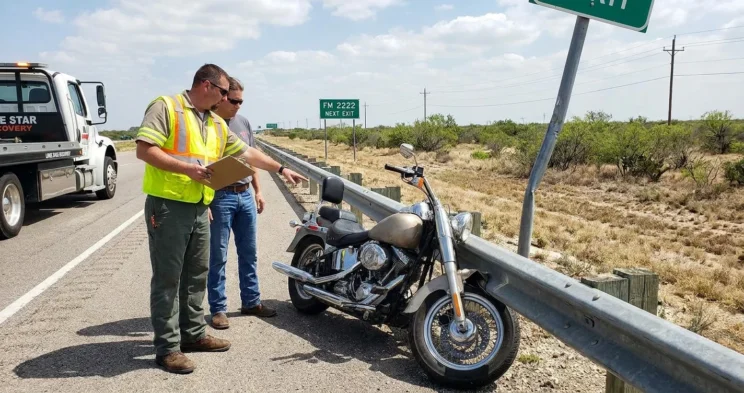
You were riding home through Deep Ellum when a driver turned left across your lane and put you on the pavement. Now the medical bills are stacking up, you have missed work, and the other driver’s insurance is already floating a number. Is that number close to what your case is actually worth, or is it leaving real money on the table?
Three Types of Damages in Texas Injury Claims
Texas law sorts the compensation you can recover into three categories: economic, non-economic, and exemplary (also called punitive). Each runs on different legal rules and a different standard of proof, defined under Texas Civil Practice and Remedies Code (CPRC) § 41.001.
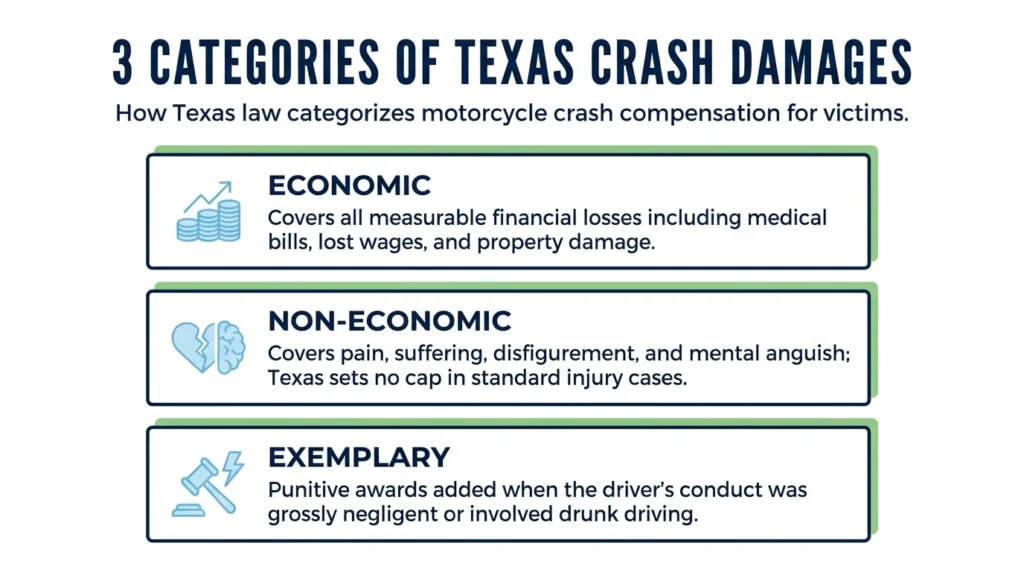
Most riders recover economic and non-economic damages. Exemplary damages are different. They require meeting a much higher legal standard.
Knowing these categories is important because insurance adjusters build their offers mostly around your economic losses. A rider who does not understand the non-economic categories can accept a quick offer and sign away compensation he never knew he could claim.
Economic Damages: Your Measurable Financial Losses
Economic damages are your concrete, documented financial losses from the crash. They are the easiest part of your claim to prove because bills, pay records, and medical reports back them up.
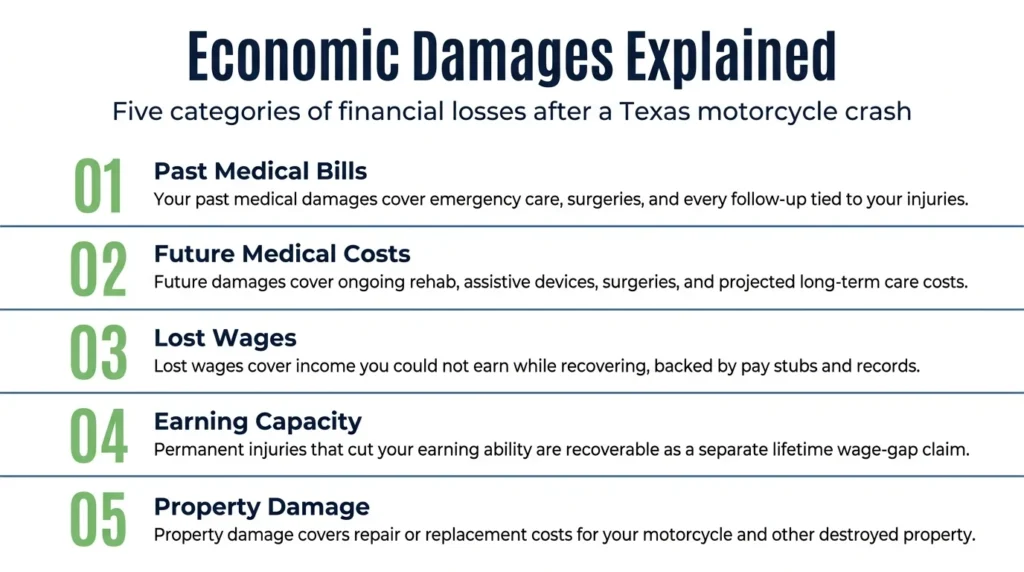
Here is what typically falls into this category after a motorcycle crash.
- Past medical expenses. This covers emergency care, hospitalization, surgeries, imaging, physical therapy, and every follow-up appointment tied to your crash injuries.
- Future medical costs. When your injuries need ongoing care, you can recover those projected costs too. That includes future surgeries, long-term rehabilitation, assistive devices, and home health care.
- Lost wages. You can recover the income you could not earn while you recovered. Pay stubs and a letter from your employer support this part of the claim.
- Diminished earning capacity. If a permanent injury keeps you from earning at your old level, the gap in your lifetime earning potential is recoverable as its own line item.
- Property damage. This covers the cost to repair or replace your motorcycle and any other property the crash destroyed.
The strength of your paperwork directly impacts your claim’s financial value. Solid documentation is the difference between a number the adjuster accepts and one they fight.
Non-Economic Damages: What Texas Law Says About Caps
Texas does not cap, or limit, non-economic damages in standard personal injury cases, and that includes motorcycle crashes. Many riders believe a limit applies to every claim. It does not.
Caps do exist in medical malpractice cases and in certain claims against government entities. A standard crash claim against a private driver has no statutory limit on what you can financially recover for non-economic damages.
That gap between what people assume and what the law allows is exactly where low offers thrive.
Knowing the law on caps is one thing. Knowing how a settlement gets calculated is another.
Pain & Suffering
Pain and suffering covers both the physical pain of your injuries and the ongoing discomfort of recovery and any permanent conditions left behind. Texas juries have a lot of room to assign the dollar value here. There is no formula and no limit in a standard injury case.
Physical pain includes both the immediate agony after the crash and chronic pain that becomes permanent. A back injury that flares for the rest of your life belongs in this category.
Loss of enjoyment of life is a recognized part of this damage type. If you can no longer ride, play sports, or do the physical work you once did, that loss counts.
Your spouse may also have a separate claim for loss of consortium. That covers the companionship, support, and relationship impact your injuries take from your marriage.
Disfigurement & Mental Anguish
Disfigurement and mental anguish are their own non-economic categories in Texas, not footnotes under pain and suffering. Each can add real value to your claim, and each is frequently undervalued in early offers.
Disfigurement covers permanent scarring, road rash, amputations, and other visible or physical changes to your body. Adjusters routinely lowball these injuries, which is why riders with serious scarring often see their first offer fall far short.
Mental anguish asks more of you than general upset. Courts look for direct evidence of the nature, duration, and seriousness of the emotional harm, including proof that it caused a substantial disruption in your daily routine. Conditions like post-traumatic stress disorder, severe anxiety, or depression that trace back to the crash or your injuries can meet that standard.
Exemplary Damages in Motorcycle Crash Cases
Exemplary damages are not available in every case. You must prove by clear and convincing evidence that the at-fault driver acted with gross negligence, malice, or fraud, under Texas Civil Practice and Remedies Code (CPRC) § 41.003. Ordinary carelessness does not clear that bar.
Drunk driving is one of the most common pathways to these damages in motorcycle cases. Texas courts have found that driving while intoxicated can support a gross negligence finding, which opens the door to exemplary damages in DWI-related crashes.
Other conduct can support a gross negligence finding too. Street racing, distracted driving with extreme disregard for safety, or a commercial driver with a known violation history who keeps operating anyway can all qualify.
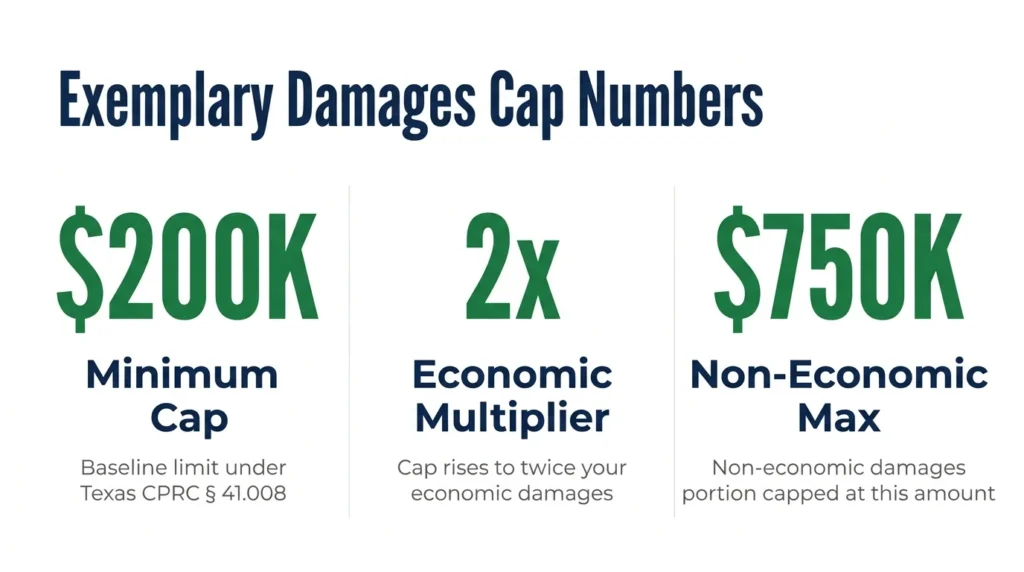
Texas does cap these awards. Under Texas Civil Practice and Remedies Code (CPRC) § 41.008, the limit is the greater of $200,000, or two times your economic damages plus up to $750,000 of your non-economic damages. The cap does not apply in cases involving certain felony conduct listed in the statute.
These damages are separate from and on top of your economic and non-economic recovery. A court awards them to punish the driver, not to repay your actual losses.
How Fault Affects Your Total Recovery
Everything above describes the most you could recover. Texas then adjusts that figure based on how much fault lands on you. The state follows a modified comparative fault rule under Chapter 33 of the Texas Civil Practice and Remedies Code.
The rule works in two parts. If you are found 51% or more at fault for the crash, you recover nothing. If you are 50% or less at fault, you still recover, but the court reduces your damages by your share of the blame.
Insurance adjusters know this rule well, and they use it. They will argue you were speeding, lane-splitting, or not wearing a helmet to push more fault onto you and shrink the payout. None of those arguments automatically prevents you from recovering financial losses, but each can move the fault percentage.
This is why evidence drives everything. Crash scene photos, witness statements, and traffic camera footage all shape how fault gets divided. The Texas comparative negligence rules explain how that split is decided.
Talk to an Experienced Attorney
Before you accept any offer, an attorney can review the facts and explain how fault is likely to affect your total recovery.
A motorcycle crash can leave you with losses in all three categories at once, and sorting out what you are owed is hard to do while you are still healing. That is where we come in. Angel Reyes & Associates has represented injured Texas riders for over 30 years, and we work on contingency, which means no attorney fee unless we win your case. Court costs and case expenses may still apply.
We have more than $1 billion recovered for clients, and every case starts with a free consultation. To talk through what your claim may be worth, reach out to us today. You can also learn more about our team and track record.
Past results do not guarantee future outcomes.
Motorcycle Accident Damages FAQ
How long do I have to file a motorcycle accident damages claim in Texas?
Texas gives you two years from the date of the crash to file a personal injury lawsuit. Missing that deadline typically ends your right to sue, regardless of how strong your case is.
What happens if the driver who hit me had no insurance?
You can turn to your own uninsured motorist (UM) coverage to recover medical costs, lost wages, and pain and suffering up to your policy limits. If your coverage falls short of your total losses, you may still have a claim against the at-fault driver personally, though collecting from an uninsured driver can be difficult.
Can my family recover damages if I was killed in a motorcycle crash in Texas?
Yes. Under Texas wrongful death law, a surviving spouse, children, and parents can file a claim for losses such as lost future income, mental anguish, and loss of companionship. Siblings and other relatives generally do not have standing to file a wrongful death claim under the Texas statute.
Does not wearing a helmet reduce what I can recover in Texas?
Possibly. If you were legally required to wear a helmet and did not, an insurer can argue that your head injuries were made worse by your choice, which could reduce your damages under the comparative fault rule. Riders who meet Texas’s exemption requirements are on stronger footing, though insurers may still raise the argument.
About the Authors

Angel Reyes
Writer
Angel L. Reyes, III is the Founder and Managing Partner of Angel Reyes & Associates. A nationally recognized trial attorney and business leader, Angel has helped over 70,000 injury victims recover more than $1 billion since founding the firm in 1993. Named to the Texas Super Lawyers list annually since 2008, Angel brings Wall Street experience, Ivy League education, and a deep commitment to client advocacy. He is a frequent legal commentator and published author with extensive contributions to legal scholarship, trial strategy, and consumer protection.

Kyle Nicolas
Editor
Kyle Nicolas is the Web Content & SEO Manager at Angel Reyes & Associates. He has more than 10 years of experience as a marketing co...

Angel Reyes
Reviewer
Angel L. Reyes, III is the Founder and Managing Partner of Angel Reyes & Associates. A nationally recognized trial attorney and business...