Motorcycle Accident Fractures & Broken Bone Injuries


Every article on this site is researched by our internal team, reviewed for legal accuracy against current Texas law, and held to State Bar of Texas advertising standards before publication. We do not publish content that overstates outcomes or makes promises about results.
Learn more about our
editorial standards .
Key Takeaways
- Fracture type and surgical complexity directly determine how much your claim is worth in Texas.
- Insurers routinely dispute future orthopedic costs before you reach maximum medical improvement.
- Texas law gives you two years to file, and waiting weakens your evidence and your leverage.
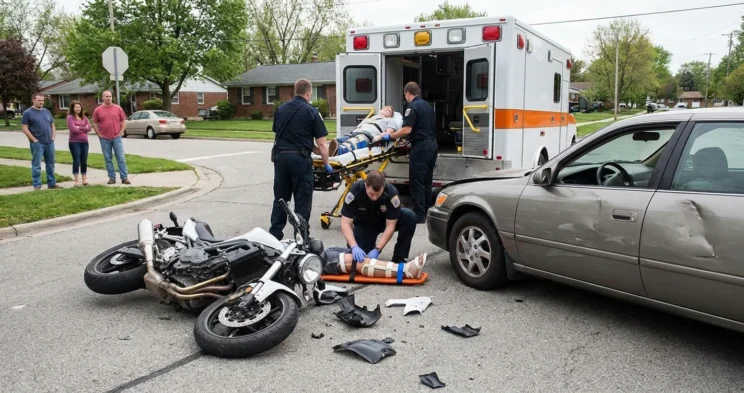
You were heading home on I-35 after a long shift when a driver cut across your lane and sent you off your bike. You hit the pavement hard. At the ER, they told you the bone was broken.
Now you’re home with a cast, a stack of bills, and an insurance adjuster calling to “check in” before you’ve even seen an orthopedic surgeon. What the adjuster offers you in these first weeks is almost certainly less than your fracture claim is worth.
Fracture Types & Claim Value in Motorcycle Crashes
Broken bones are some of the most common motorcycle accident injuries. However, not every broken bone is the same. The type of fracture you suffered has a direct effect on what your claim may be worth. In general, the more complex the fracture and the longer the recovery, the greater the potential damages.
Tibia, fibula, and femur fractures in the legs are among the most common in motorcycle crashes. Wrist and forearm fractures happen when riders instinctively throw out their hands during a fall.
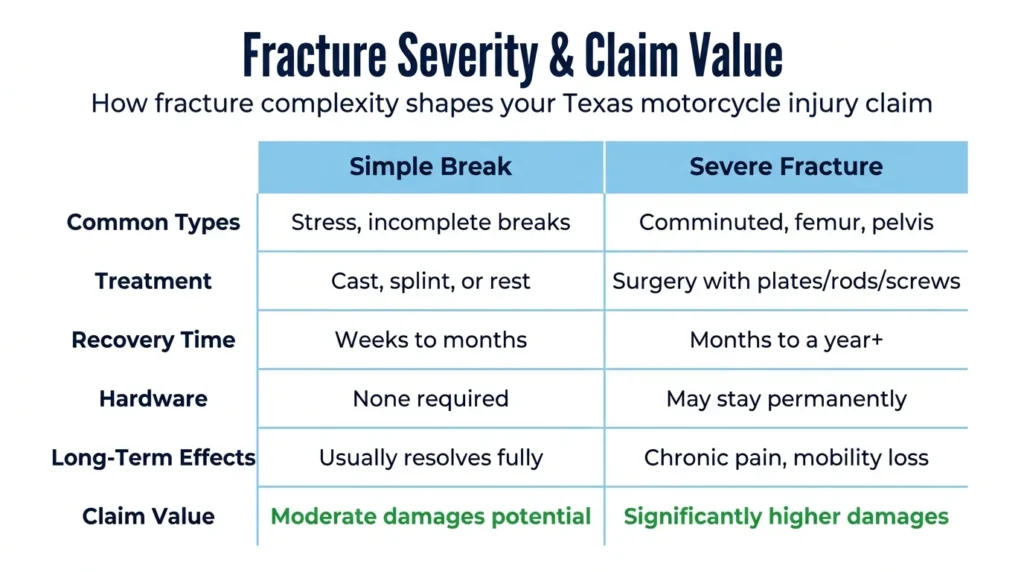
Simple fractures often heal with fewer complications and shorter recovery periods. More serious fractures can require surgery or months of rehabilitation. Some fractures create long-term problems even after the bone heals.
A comminuted fracture is one of the most severe types you can sustain from a motorcycle crash. The bone shatters into multiple pieces, which often requires surgeons to install plates, rods, or screws to hold the bone together while it heals. In some cases, the hardware stays in your body permanently.
An injury to a major weight-bearing bone, like the femur, can affect your mobility, future medical needs, and ability to work. These consequences often become a significant part of the claim.
Something to be aware of is insurers treating stress or incomplete fractures as minor injuries and making offers that reflect only short-term treatment costs. If a stress fracture goes undetected initially, its true cost often becomes clear only after weeks of recovery.
Clavicle, rib, and pelvic fractures carry their own complications. The National Highway Traffic Safety Administration documents how motorcycle riders face disproportionately higher injury rates compared to occupants inside an enclosed vehicle.
What Damages Can You Recover for a Broken Bone?
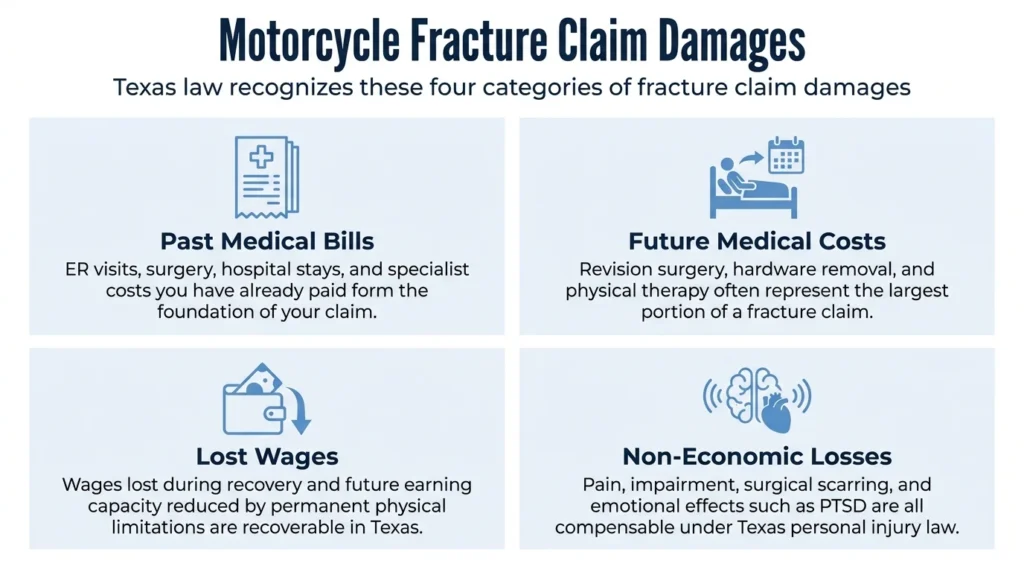
The Texas Civil Practice and Remedies Code (CPRC) Chapter 41 defines the full categories of damages available. In general, a motorcycle accident settlement amount is built from economic and non-economic damages.
Economic Damages
Economic damages cover your actual financial losses from the injury. Past medical expenses are usually the starting point. These include the emergency room visit, surgery, hospital stay, and orthopedic specialist visits you have already paid for.
Future medical expenses are where fracture claims often have the most value left on the table. If your fracture requires plates, rods, screws, or other hardware, you may need future imaging, revision surgery, hardware removal, or ongoing treatment for complications that develop later.
Serious fractures often require months of follow-up care. Physical therapy following orthopedic injuries can stretch on for months or years. Insurers routinely offer early settlements that account only for your current medical bills, which is a fraction of what you may be owed.
You may be able to recover lost wages during your recovery. If your fracture has affected your ability to do your job long-term, you may also have a claim for loss of future earning capacity. A broken leg that requires months off work could mean a higher recovery.
A comminuted femur fracture that leaves you with a permanent limp and limits your ability to perform physical labor could mean you can’t return to work, and your settlement should reflect that.
During an initial consultation, our team can break down how past and future medical costs factor into your claim. We can also discuss recovering lost wages after a motorcycle crash with you and walk through how to document these losses.
Non-Economic Damages
Not every loss shows up on a medical bill or pay stub. Non-economic damages compensate you for the personal impact a serious fracture can have on your life.
Pain and suffering are often a significant part of a fracture claim. Recovery from a broken bone can involve surgery, physical therapy, limited mobility, and months of discomfort. Some riders continue to experience pain long after the fracture has healed.
A serious fracture can also leave lasting physical limitations. Reduced strength, restricted range of motion, chronic pain, and mobility issues may affect your ability to work, exercise, enjoy hobbies, or perform everyday activities. Texas law allows injured riders to seek compensation for these types of impairments.
Disfigurement may be another component of the claim. Surgical scars, visible deformities, and other permanent physical changes caused by the fracture or its treatment can support a claim for damages. These losses are not limited to facial injuries, and Texas law recognizes both past and future disfigurement.
Many riders also experience emotional effects after a serious motorcycle crash. Anxiety, depression, sleep disturbances, and symptoms associated with post-traumatic stress can all become part of the recovery process. When those conditions stem from the accident and resulting injuries, they may also be considered as part of a claim for damages.
Our team will be able to explain how these non-economic damages are calculated and documented.
Why Insurers Dispute Injury Claims
Insurance companies move quickly after motorcycle crashes, and with purpose. The earlier they can get you to settle, the less they pay.
One common tactic is making a settlement offer before you reach maximum medical improvement (MMI). MMI is the point at which your doctor determines that your condition has stabilized and further recovery is unlikely. Settling before that point can be risky because no one knows the full cost of your injury, future treatment needs, or any permanent limitations.
Insurers also dispute future surgery costs. If your treating surgeon says you will likely need hardware removed or a revision procedure in the future, the insurer will argue the procedure is not reasonably certain, is elective, or can be avoided through less expensive alternatives. They will often request an independent medical exam (IME) conducted by a physician they choose and pay, whose conclusion frequently conflicts with your treating surgeon’s prognosis.
Insurers also frequently challenge future medical expenses. If your surgeon believes you may need additional procedures, hardware removal, or ongoing treatment, the insurance company may argue those costs are speculative or unlikely to occur. In some cases, the insurer will request an independent medical examination (IME) from a physician.
Disfigurement and physical impairment are often disputed as well. An insurer may characterize surgical scars as minor, argue that hardware successfully resolved the injury, or claim that your physical limitations are less significant than your medical providers believe.
Comparative fault is another common defense. Under Texas Civil Practice and Remedies Code Chapter 33, your compensation can be reduced by your percentage of fault. If the insurer convinces a jury that you were more than 50% responsible for the crash, you cannot recover damages.
Evidence That Protects Your Fracture Claim
Your medical records are often the most important evidence. Emergency room records, surgical reports, imaging studies, physical therapy notes, and follow-up appointments create a timeline that connects the motorcycle crash to your injury and documents the treatment you needed.
Your treating orthopedic surgeon’s opinions can also carry significant weight. A surgeon who has followed your recovery over time is often in the best position to explain your prognosis, future treatment needs, and any permanent limitations caused by the injury.
When future medical expenses are substantial, additional expert evidence may be necessary. In some cases, life care planners and other specialists help estimate the cost of future surgeries, rehabilitation, assistive devices, and long-term care needs.
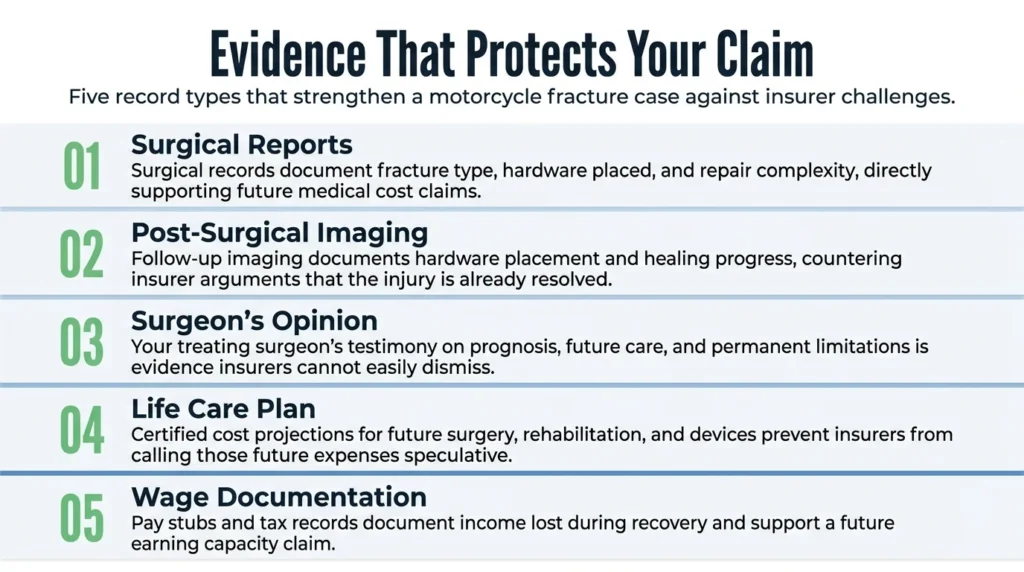
Evidence commonly used to support a fracture claim includes:
- Surgical and operative reports establishing the fracture type, hardware placed, and repair complexity
- Post-surgical imaging showing hardware placement and healing progress at each follow-up
- Treating orthopedic surgeon statements on prognosis, expected future care, and permanent limitations
- A certified life care plan detailing future medical needs and associated costs
- Wage documentation, including pay stubs, employer letters, and tax records, establishing income loss during recovery
The stronger the documentation, the harder it becomes for an insurer to argue that the fracture was minor, fully resolved, or unlikely to create future expenses.
An attorney can help you identify and preserve the records most likely to be challenged before they become harder to obtain, and can connect you with the expert witnesses whose testimony the insurer cannot easily dismiss.
Texas Filing Deadlines for Fracture Claims
Texas gives you two years from the date of your motorcycle accident to file a personal injury lawsuit for your fracture injuries. The Texas Civil Practice and Remedies Code section 16.003 sets this deadline, and missing it almost always ends your right to compensation regardless of how serious your injuries are.
Waiting can make it harder to build a strong claim. Medical records, surgical reports, imaging studies, and other evidence are generally easier to gather while treatment is ongoing. Witness memories fade, records become harder to obtain, and important evidence can become more difficult to preserve over time.
The right time to consult an attorney is before you settle, before you give a recorded statement to the adjuster, and well before the two-year window closes. Our attorneys page gives you a sense of who handles these cases and what that representation looks like.
Speak with an Accident Attorney
A fracture from a motorcycle crash can affect your ability to work, move, and live normally for months or years. The insurance company handling your claim knows this. Their goal is to close your file for as little as possible before you understand the full extent of what you can recover.
Angel Reyes & Associates has guided injured Texans through motorcycle accident claims, including complex fracture and orthopedic injury cases, for over 30 years. Our consultations are free, and we work on a contingency basis, which means there is no fee unless we win. If you are dealing with a fracture claim and an adjuster has already made contact, reach out to us before you respond.
Past results do not guarantee future outcomes.
Fracture Injury FAQs
Does not wearing a helmet or protective gear affect my broken bone claim in Texas?
Not wearing gear does not bar you from filing a claim, but the insurer may argue it contributed to your injuries and seek to reduce your payout under Texas’s fault-sharing rules. For fractures to the legs, wrists, or ribs, the connection between missing gear and the injury is often weak, which limits how much that argument can reduce your recovery.
What if my fracture healed incorrectly, leaving permanent deformity or limited movement?
A malunion (bone healed in the wrong position) or nonunion (bone that failed to heal) can require additional surgery and may cause lasting functional loss, which increases the value of your claim. These complications support claims for future medical expenses, physical impairment, and, in some cases, disfigurement.
How long does a motorcycle fracture claim typically take to settle in Texas?
Simple fractures with clean recoveries may settle in a few months, while complex fractures requiring surgery, hardware, or additional procedures can take a year or more, especially if the insurer disputes future treatment costs. Waiting until you reach maximum medical improvement before settling generally leads to a more accurate and complete recovery.
What can I recover if the driver who caused my crash had no insurance?
If the at-fault driver was uninsured, you may be able to file a claim under your own uninsured motorist coverage if you carry it. Without that coverage, you could pursue the driver directly through a lawsuit, though collecting on a judgment against someone with no insurance can be difficult in practice.
Can I file a fracture claim if I was partly at fault for the motorcycle crash?
Yes, as long as your share of fault does not exceed 50 percent under Texas law. If you were 30 percent at fault, for example, your total recovery is reduced by 30 percent. If your fault is found to be 51 percent or more, you cannot recover any damages.
About the Authors

Angel Reyes
Writer
Angel L. Reyes, III is the Founder and Managing Partner of Angel Reyes & Associates. A nationally recognized trial attorney and business leader, Angel has helped over 70,000 injury victims recover more than $1 billion since founding the firm in 1993. Named to the Texas Super Lawyers list annually since 2008, Angel brings Wall Street experience, Ivy League education, and a deep commitment to client advocacy. He is a frequent legal commentator and published author with extensive contributions to legal scholarship, trial strategy, and consumer protection.

Kyle Nicolas
Editor
Kyle Nicolas is the Web Content & SEO Manager at Angel Reyes & Associates. He has more than 10 years of experience as a marketing co...

Angel Reyes
Reviewer
Angel L. Reyes, III is the Founder and Managing Partner of Angel Reyes & Associates. A nationally recognized trial attorney and business...