Motorcycle Accident Medical Bills: Who Pays and How to Get Reimbursed


Every article on this site is researched by our internal team, reviewed for legal accuracy against current Texas law, and held to State Bar of Texas advertising standards before publication. We do not publish content that overstates outcomes or makes promises about results.
Learn more about our
editorial standards .
Key Takeaways
- Texas riders can reject PIP and MedPay in writing, leaving a common first-party coverage gap.
- Bills get paid in order: first-party coverage, then health insurance, then the at-fault driver.
- A rider found to be more than 50% at fault recovers nothing from the other driver under Texas law.
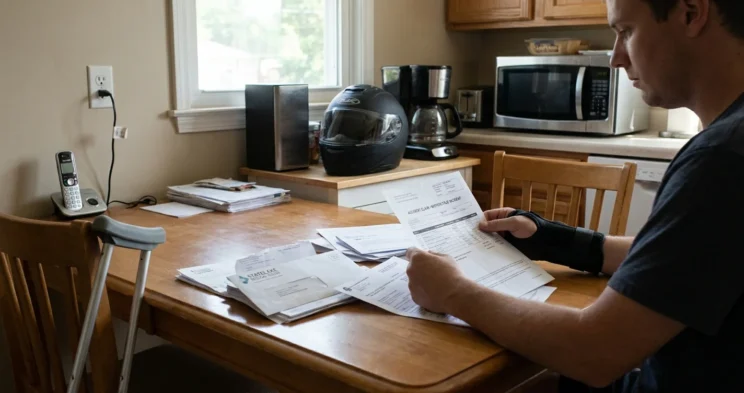
You were riding home on the I-35 corridor when a driver drifted into your lane and clipped your bike. Now you’re stacking hospital bills on the kitchen table, unable to work, and unsure which insurance is supposed to pay for any of it. The crash wasn’t your fault, yet the bills landed in your name.
Coverage Gaps Texas Motorcycle Riders Face
Texas riders carry a coverage gap that most car drivers never face. State law requires you to carry bodily injury liability coverage, but it doesn’t require the first-party medical coverage that pays your own bills right away.
That first-party coverage comes in two optional forms: Personal Injury Protection (PIP) and Medical Payments coverage (MedPay). Texas law requires insurers to offer PIP when selling a motorcycle liability policy, but you can decline it in writing, which many riders do.
MedPay is an optional add-on that insurers may, but are not required to, offer for motorcycle policies. Most riders end up without either policy.
Texas Insurance Code section 1952.152 lets you decline PIP in writing, but many riders never realize what they gave up until a crash. Without PIP or MedPay, you have no immediate source to pay hospital bills while fault is still being sorted out.
Liability limits create a second gap. Texas financial responsibility law sets minimum coverage at 30/60/25 under Texas Transportation Code section 601.072. These limits apply to motorcycles the same as cars, but they often fall far short of what a serious motorcycle injury actually costs.
If you did buy MedPay or PIP, you have a first-payer source that covers your initial bills no matter who caused the crash. If you skipped it, you need to route those bills somewhere else fast. In knowing how these coverages differ from uninsured motorist protection, we can help you understand what your policy actually does.
Motorcycle injuries also tend to be more severe than car occupants’ injuries. We share patterns in Texas motorcycle crash data to show why coverage adequacy matters more for riders than nearly anyone else on the road.
How Motorcycle Medical Bills Get Paid
Your medical bills get paid in a sequence, not all at once. Immediate sources cover early treatment, and the at-fault driver’s insurance reimburses the rest later at settlement. Walking through that order helps you see where your bills land and when.
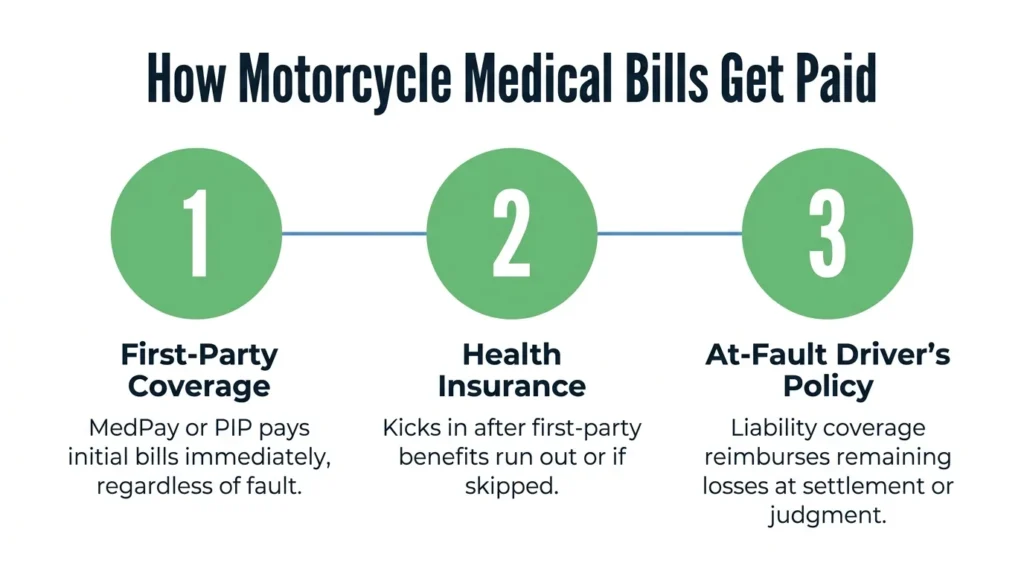
Step 1: First-party coverage pays first. If you carry MedPay or PIP, it pays your initial medical bills up to your policy limit, without regard to who caused the crash. While MedPay only covers medical bills, PIP covers medical bills and a portion of your lost wages.
Step 2: Health insurance pays next. For riders who carry health coverage, it kicks in after MedPay or PIP runs out, or right away if you skipped those add-ons. Your health insurer will attach a subrogation lien to any future settlement, meaning it expects to be repaid from your recovery.
Step 3: The at-fault driver’s liability coverage reimburses you last. This is the main source of repayment, but it arrives at settlement or judgment, not when the bills are due. You have two years from the crash date to pursue this recovery under the Texas Civil Practice and Remedies Code section 16.003.
One rule can shrink that recovery. Texas uses a fault-sharing system that reduces your payout by your share of the blame under CPRC section 33.001. If you’re found to be more than 50% at fault, you recover nothing from the other driver.
This is where it gets complicated to manage on your own. An attorney can document your medical costs, deal with insurers, and structure your claim so liens don’t eat your recovery before you see it.
MedPay vs PIP: What Each Covers
Riders confuse these two because both pay medical bills, but they differ on wage loss. MedPay only covers your medical expenses. It pays providers directly or reimburses you, and it carries no wage-loss component.

PIP goes further. It covers your medical expenses plus up to 80% of the income you lose while you recover. For a rider who can’t work after a crash, PIP is the broader and more useful of the two.
Health Insurance Liens & Hospital Liens Explained
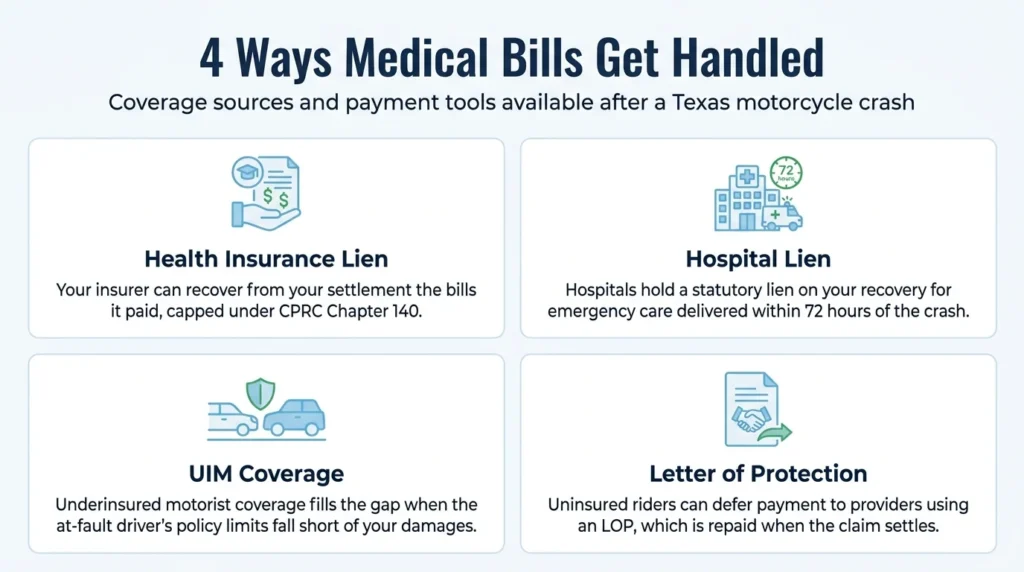
Using your health insurance after a crash comes with strings. When your health insurer pays your bills, it gains a subrogation right, which means it can recover what it paid out of your personal injury settlement. Texas law governs these contractual subrogation rights under Texas Civil Practice and Remedies Code Chapter 140, which limits what a health plan can recover from your settlement.
There’s a second layer for emergency care. Texas Property Code Chapter 55 gives hospitals and emergency providers a lien against your recovery for treatment delivered within 72 hours of the crash. That lien attaches to any settlement, judgment, or award you receive.
Both of these are often negotiable, especially when your total recovery is limited. An attorney typically negotiates health insurance subrogation and hospital liens at settlement, which increases the amount you actually take home.
Car accident billing follows a similar path, but riders carry no first-party coverage far more often than drivers do. That gap makes the lien and subrogation layers hit your net recovery harder. You can see how the rules compare in our breakdown of who pays medical bills after a car accident.
When Coverage Falls Short or Is Absent
Sometimes the standard sequence breaks down. The at-fault driver has no insurance, your coverage runs out, or no source covers your full bills. You still have options in each of these situations.
If the at-fault driver carries no insurance or too little, your own uninsured/underinsured motorist coverage becomes the primary fallback for unpaid bills, if you bought it. Many riders don’t know whether their policy includes it until they need it. Our guide on what to do after a crash with an uninsured driver walks through the next steps.
Riders without health insurance can still get treatment. A Letter of Protection (LOP) is a written agreement between your treating provider and attorney. The provider defers payment until your claim settles, then gets paid from the settlement proceeds.
An LOP lets you keep getting the care you need without paying upfront. It also preserves the medical records that prove the full extent of your injuries. If you have no insurance and don’t know how to get treatment after a crash, talking with a personal injury attorney early can open options you may not know exist.
Even when every source combined still falls short of your total damages, you’re not out of options. An attorney’s negotiation of your medical liens and bills at settlement can lower what you owe and improve what you keep.
Call an Attorney to Review Your Case
Sorting out who pays your medical bills after a crash is hard to do while you’re hurt and out of work. Angel Reyes & Associates has represented injured Texas riders for over 30 years, and we know how to sequence these payment sources so your recovery is not consumed by liens. We work on a contingency basis, which means there’s no fee unless we win.
We have recovered more than $1 billion for clients across Texas. If you’re facing mounting bills, unresolved insurance questions, or an uninsured at-fault driver, reach out to us for a free consultation, or read what our previous clients have to say about our firm.
Past results do not guarantee future outcomes.
Motorcycle Medical Bill Payment FAQs
Does every health insurance plan cover motorcycle accident injuries?
Not all plans do. Some health insurers classify motorcycle riding as a hazardous activity and exclude injuries from motorized vehicle crashes, so check your policy before assuming you have coverage.
If I was a passenger on the motorcycle, who pays my medical bills?
As a passenger, you can file a claim against the at-fault driver’s liability insurance. You may also be covered by the motorcycle rider’s MedPay or PIP if the rider purchased those add-ons.
Can I seek compensation for future medical treatment, not just my current bills?
Yes. A personal injury claim can include future costs, such as ongoing treatment, rehabilitation, and assistive devices. Waiting until your condition has stabilized gives you a more accurate picture of those future costs before you settle.
Does not wearing a helmet affect how much I can recover for my injuries?
It can. Texas’s fault-sharing rules allow an insurer to argue that helmet-preventable injuries, such as head or brain injuries, were partly your fault, which can reduce your recovery for those specific injuries.
What happens if the at-fault driver's policy limit isn't enough to cover my bills?
You can file a UIM claim with your own insurer if you carry underinsured motorist coverage. Depending on the facts, other parties, such as the driver’s employer or a vehicle owner, who permitted an unfit driver to use the vehicle may also share liability and carry separate coverage.
About the Authors

Angel Reyes
Writer
Angel L. Reyes, III is the Founder and Managing Partner of Angel Reyes & Associates. A nationally recognized trial attorney and business leader, Angel has helped over 70,000 injury victims recover more than $1 billion since founding the firm in 1993. Named to the Texas Super Lawyers list annually since 2008, Angel brings Wall Street experience, Ivy League education, and a deep commitment to client advocacy. He is a frequent legal commentator and published author with extensive contributions to legal scholarship, trial strategy, and consumer protection.

Kyle Nicolas
Editor
Kyle Nicolas is the Web Content & SEO Manager at Angel Reyes & Associates. He has more than 10 years of experience as a marketing co...

Angel Reyes
Reviewer
Angel L. Reyes, III is the Founder and Managing Partner of Angel Reyes & Associates. A nationally recognized trial attorney and business...