How Motorcycle Accident Negligence Is Proven in Texas Courts


Every article on this site is researched by our internal team, reviewed for legal accuracy against current Texas law, and held to State Bar of Texas advertising standards before publication. We do not publish content that overstates outcomes or makes promises about results.
Learn more about our
editorial standards .
Key Takeaways
- Proving negligence requires all four elements: duty, breach, causation, and damages.
- A rider found more than 50% at fault under Texas law recovers nothing at all.
- Crash reports, expert reconstruction, and medical records anchor a strong claim.
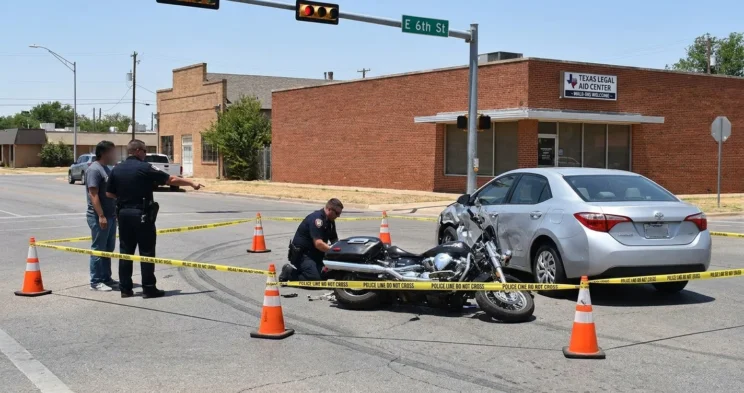
You were riding home through East Austin one evening when a driver turned left across your lane and clipped your front wheel. You know the crash was not your fault. Now the other driver’s insurance is hinting that you share the blame, and you are wondering whether your case is strong enough to hold up.
What does it actually take to prove the other driver was at fault?
What Is Motorcycle Accident Negligence?
Negligence is a specific legal standard, not just careless driving in the everyday sense. Texas courts use it to decide whether one party’s failure to act reasonably caused another person’s injury.
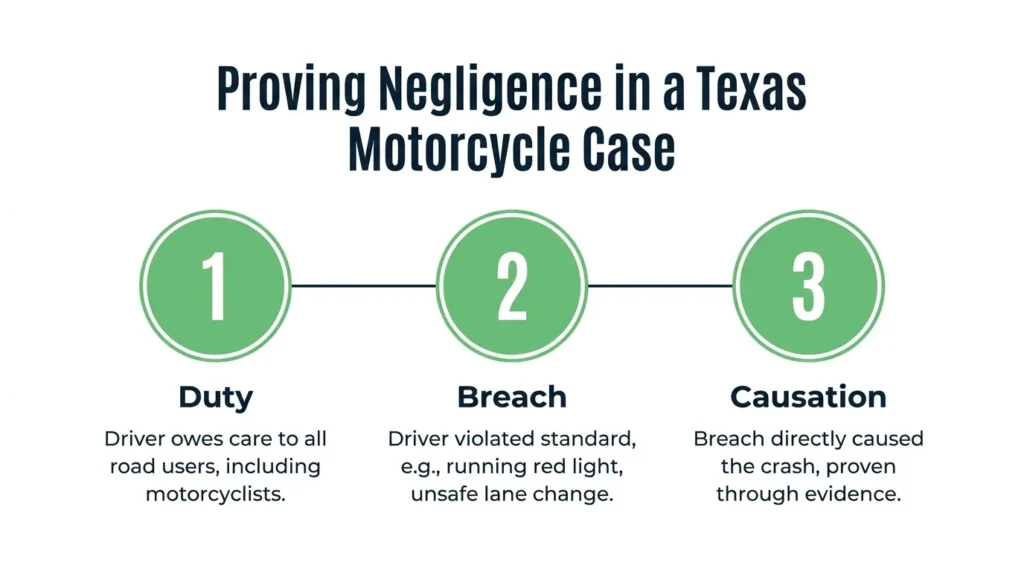
The standard jurors apply is “ordinary care,” which means the care a reasonably careful person would use in the same situation. Your claim has to show the other driver fell short of that mark.
To win, you must prove four elements: duty, breach of duty, causation, and damages. Fail to prove any single one, and you recover nothing, regardless of how serious your injuries are.
The good news is that the bar is lower than in a criminal case. You only have to prove your case by a “preponderance of the evidence,” meaning it is more likely than not that the driver was negligent. That still takes real proof, but it does not require certainty.
How well your evidence supports each element decides whether your case settles or heads to trial. The way Texas courts sort out fault depends heavily on the documentation behind each piece.
Duty and Breach: What the Other Driver Owed You
Every driver on a Texas road owes a duty of care to everyone else sharing it, and that includes you on your motorcycle. The duty is not lower or higher because you ride two wheels. All drivers must follow traffic laws and operate with ordinary care.

Breach means the driver failed to meet that standard. Common breaches in motorcycle crashes include failing to yield at an intersection, turning left without checking for oncoming riders, changing lanes without signaling, speeding, following too closely, and driving while impaired.
A traffic violation is some of the strongest breach evidence you can have. When a driver ran a red light, failed to yield, or made an unsafe lane change in violation of the Texas Transportation Code section 545.104, that violation is direct proof the driver broke the standard of care.
The crash report often records the responding officer’s findings about which traffic laws the driver broke. That report becomes a primary source of breach evidence, and knowing how to use it shapes your next steps after the wreck.
Anti-rider bias is a real problem. Adjusters and jurors sometimes assume you share fault simply because you were on a bike. Solid documentation of the driver’s specific violation pushes back hard against that assumption.
If you are unsure whether the crash report accurately reflects what happened, having someone review the documentation through a deeper look at motorcycle accident claims can help.
Causation: Connecting the Crash to Your Injuries
Causation is where many motorcycle cases get fought. The driver may admit they were careless but argue their actions did not cause your injuries, or that something you did was the real cause.
Actual Cause vs Proximate Cause
You have to establish two sub-elements here. Actual cause means the breach was the direct factual reason the crash happened. Proximate cause means your injury was a foreseeable result of that conduct.
Actual cause asks a simple question: if it were not for the driver’s actions, would the crash have happened? If the answer is no, actual cause is established.
Proximate cause adds a second layer. Your injury must have been a reasonably foreseeable result of the driver’s negligence, not some freak coincidence unrelated to the danger they created.
Evidence That Establishes Causation
Physical evidence, expert analysis, and witness accounts are the tools that connect the driver’s conduct to your injuries. When fault is disputed, this is what carries the weight.
Accident reconstruction experts analyze skid marks, debris fields, final vehicle positions, and black box data to rebuild how the crash happened. Their testimony can satisfy the causation element when the other side contests it.
Traffic camera footage, dashcam video, and security recordings can show the sequence of events in real time. That kind of record makes causation very hard to dispute.
Witness testimony from people who saw the crash gives independent accounts of what the driver did right before impact. Those accounts often fill gaps the cameras miss.
Your medical records connect the impact to your injuries. A treating doctor’s notes showing your injury pattern matches the mechanics of the crash support the chain from breach to injury, which ties directly into how fault is shared.
Damages: Proving What You Lost
Damages are the fourth element, and you cannot recover without them. Even if duty, breach, and causation are all proven, a court cannot award you anything unless you prove actual losses from the crash.
Economic vs Non-Economic Damages
These two categories are calculated differently and backed by different evidence. Knowing which is which helps you understand what your claim is worth.
Economic damages are your quantifiable financial losses. They cover medical bills, future treatment costs, lost wages, lost earning capacity, and motorcycle repair or replacement. You prove them with medical records, billing statements, pay stubs, and employer verification.
Non-economic damages cover losses that never come with a receipt. They include pain and suffering, emotional distress, disfigurement, and loss of enjoyment of life. Texas does not cap these in most injury cases, and you support them with your own testimony, family accounts, and provider notes about your limitations. The way courts weigh certain damage awards is worth understanding before you settle.
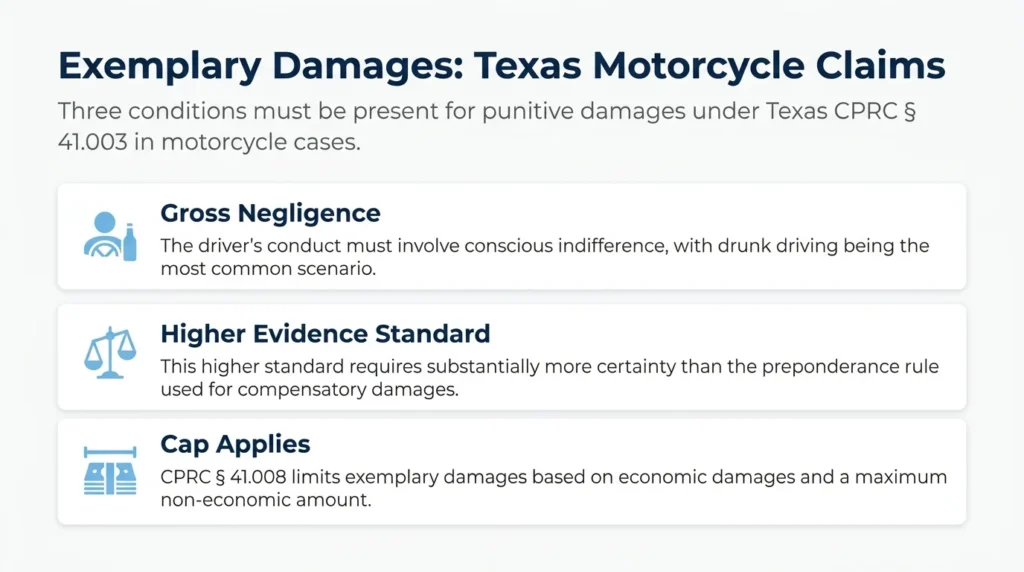
Gross negligence can open the door to exemplary damages, sometimes called punitive damages. The Texas Civil Practice and Remedies Code (CPRC) section 41.003 allows them when the driver’s conduct involved fraud, malice, or conscious indifference to your safety.
Drunk driving crashes are a common scenario where exemplary damages may apply. The proof bar is higher here. You must show “clear and convincing evidence,” which is a tougher standard than the preponderance rule used for your actual damages.
How Comparative Fault Affects Recovery
Texas follows modified comparative fault under the Texas Civil Practice and Remedies Code section 33.001. If more than one party shares blame, each gets a percentage of fault, and your recovery drops by your share.
The rule has a hard cutoff. A rider found more than 50% at fault cannot recover anything at all. Even a 30% fault finding cuts a $100,000 award down to $70,000.
Adjusters and defense attorneys routinely push to pin a bigger share on you. They argue you were speeding, that you were not wearing a helmet, or that you were riding in the driver’s blind spot. Helmet non-use does not bar recovery in Texas, but the defense may still raise it.
Keeping your fault percentage below 51% matters as much as proving the driver’s negligence. Evidence of your lawful speed, lane position, and gear use all factor into the final allocation, and understanding where partial fault comes from helps you prepare.
If you are worried that fault arguments could undercut your claim, having an attorney review the evidence behind the 51% rule before you accept any adjuster’s determination can protect your recovery.
Talk to an Attorney Today
Proving negligence in a motorcycle case takes coordinated evidence across all four elements, and the other side will work to chip away at each one. That is where experienced legal guidance changes the outcome.
Angel Reyes & Associates has guided injured Texans through motorcycle accident claims for over 30 years. Your consultation is free, and we work on contingency, so there is no fee unless we win and you owe nothing up front. We have a team of investigators and attorneys ready to review your case.
Our record includes more than $1 billion recovered for clients. Reach out to us for a free consultation so we can review your situation and walk you through your options.
Past results do not guarantee future outcomes.
Motorcycle Accident Negligence FAQs
How long do I have to file a motorcycle accident lawsuit in Texas?
Texas law gives you two years from the date of the crash to file a personal injury lawsuit, under Texas Civil Practice and Remedies Code Section 16.003. Missing that deadline typically ends your right to recover, regardless of how strong your case is.
What should I do at the crash scene to protect my negligence claim?
Call the police so a crash report is generated, photograph the scene, your injuries, and the other vehicle’s position before anything moves, and get contact information from any witnesses. That documentation becomes the foundation of your duty, breach, and causation evidence.
What if the at-fault driver was uninsured or underinsured?
Your own uninsured/underinsured motorist (UM/UIM) coverage may step in to cover damages the at-fault driver cannot pay. Texas does not require drivers to carry UM/UIM coverage, but insurers must offer it and you can purchase it when setting up your policy.
Can a passenger on a motorcycle file a negligence claim?
Yes. A passenger injured in a motorcycle crash can pursue a negligence claim against any at-fault party, including the car driver, the motorcycle operator, or both. Passengers are generally not considered at fault for a crash unless their actions directly contributed to it.
What if the crash report incorrectly assigns fault to the rider?
A crash report reflects the responding officer’s initial findings and is not a final legal determination of fault. Your attorney can gather additional evidence, such as witness statements, video footage, and accident reconstruction analysis, to challenge an inaccurate fault assessment.
About the Authors

Angel Reyes
Writer
Angel L. Reyes, III is the Founder and Managing Partner of Angel Reyes & Associates. A nationally recognized trial attorney and business leader, Angel has helped over 70,000 injury victims recover more than $1 billion since founding the firm in 1993. Named to the Texas Super Lawyers list annually since 2008, Angel brings Wall Street experience, Ivy League education, and a deep commitment to client advocacy. He is a frequent legal commentator and published author with extensive contributions to legal scholarship, trial strategy, and consumer protection.

Kyle Nicolas
Editor
Kyle Nicolas is the Web Content & SEO Manager at Angel Reyes & Associates. He has more than 10 years of experience as a marketing co...

Angel Reyes
Reviewer
Angel L. Reyes, III is the Founder and Managing Partner of Angel Reyes & Associates. A nationally recognized trial attorney and business...