Motorcycle Accidents Involving an Animal on the Road in Texas


Every article on this site is researched by our internal team, reviewed for legal accuracy against current Texas law, and held to State Bar of Texas advertising standards before publication. We do not publish content that overstates outcomes or makes promises about results.
Learn more about our
editorial standards .
Key Takeaways
- Open-range counties leave most livestock owners off the hook on farm-to-market roads in Texas.
- Texas Agriculture Code § 143.102 creates liability only if an owner knowingly permits livestock on highways.
- Personal injury claims must be filed within two years, and government claims require six-month notice.

You were riding home through Parker County on a two-lane farm-to-market road when a cow stepped out of the brush and stopped in your lane. You laid the bike down trying to avoid it, and now you’re looking at a broken collarbone, a totaled motorcycle, and a stack of medical bills.
Can anyone be held responsible? In Texas, the answer depends on the road, the county, and the animal.
How Often Animals Cause Texas Motorcycle Crashes
Animal collisions are one of the most dangerous hazards a Texas rider faces. You have no protective shell, like you would in a car, and almost no margin to react at highway speed. According to TxDOT crash data analysis, animal-related wrecks happen across every region of the state, fueled by rural road density and large wildlife and livestock populations.
Three animal categories cause most of these crashes:
- Wildlife (mostly white-tailed deer and feral hogs)
- Livestock such as cattle and horses
- Domestic dogs
The injuries are rarely minor. Road rash, fractures, traumatic brain injury, and spinal trauma are all common injuries in motorcycle accidents when a rider gets thrown after striking or swerving around an animal.
Open Range, Closed Range, & the Highway Exception for Livestock Liability
Whether you can sue a livestock owner depends on two things:
- The county where the crash happened
- The type of road you were on
Texas follows an open-range default, but counties can change it, and a separate statute overrides both rules on numbered highways.
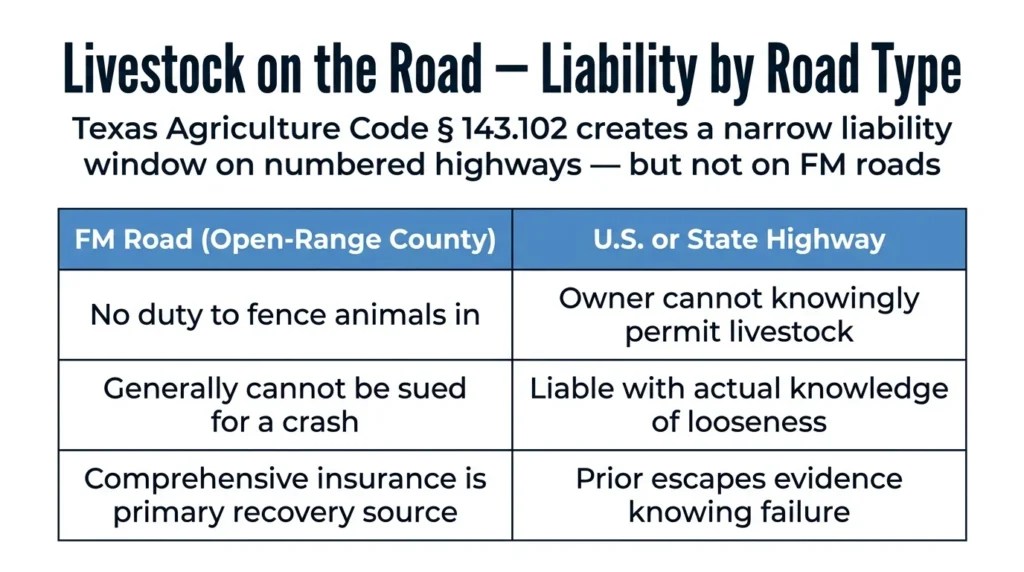
Open-Range Counties
The default common-law rule in Texas places no duty on a livestock owner to fence animals in. If your crash happened in an open-range county on a farm-to-market road, you generally can’t bring a negligence claim against the owner. The owner had no legal obligation to keep the cow off the road.
County stock laws change this default. When a county votes to adopt a closed-range stock law, the burden flips and owners must fence animals in. After a crash in a closed-range county, you often can file a standard negligence claim against the owner.
Stock-law status is not always intuitive or easy to find online. Verify it through the county clerk’s office before assuming you have or don’t have a claim. Riders pursuing Texas motorcycle accident claims often discover that county classification is the single fact that decides the case.
The Highway Exception Under Texas Agriculture Code § 143.102
Even in open-range counties, Texas Agriculture Code § 143.102 prohibits an owner from knowingly permitting livestock to run at large on a U.S. or state highway. This creates a narrow but real liability window.
“Knowingly permit” is the key phrase. The owner must have had actual knowledge that the animal was loose on the highway and failed to act. A one-time escape caused by a third party generally won’t meet the standard.
The definition of “highway” matters too. Texas Agriculture Code § 143.101 limits the exception to numbered U.S. and state highways. Farm-to-market (FM) roads are excluded. An FM-road crash in an open-range county falls outside § 143.102 entirely.
If your crash happened on a U.S. or state highway, document everything. Photographs, GPS confirmation of the road classification, and witness accounts of prior escapes by the same animal can all help you meet the “knowingly permit” standard.
Who Is Responsible for Wildlife & Domestic Pet Collisions?
Wildlife and domestic pets sit outside the livestock framework. Wildlife has no owner, so the analysis shifts to your own insurance. Domestic pets have owners, which opens a standard negligence path.
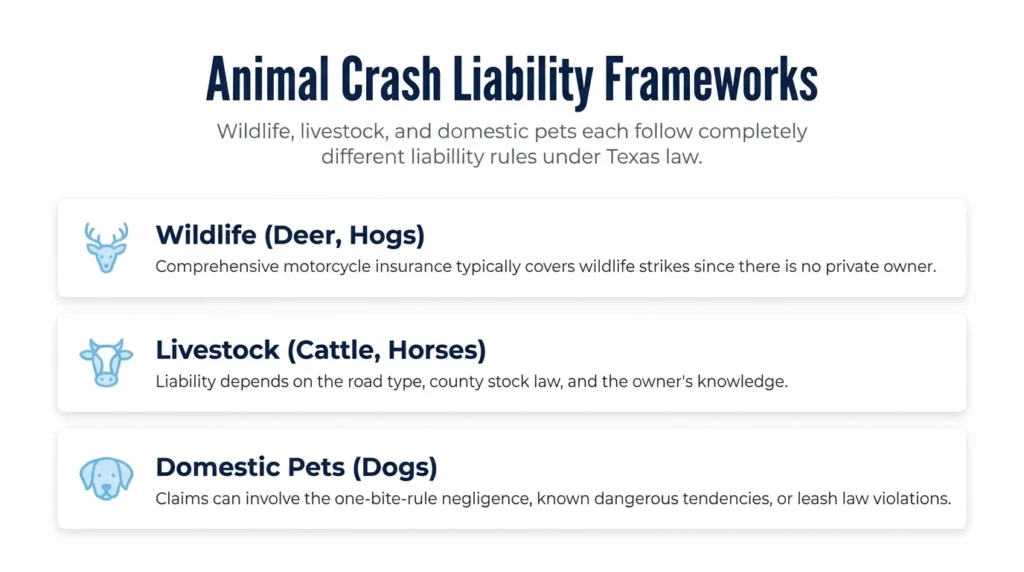
Wildlife Collisions
No private party owns a deer or a feral hog. After a wildlife crash, you likely can’t create a negligence claim against an individual defendant, no matter how severe your injuries are.
Comprehensive motorcycle insurance, not collision coverage, is what applies to a wildlife strike. If you have a liability-only policy, you usually must absorb the entire loss yourself. If you’ve been hit by a deer in Texas, the first step is pulling your declarations page to confirm which coverages you carry.
A government entity may bear some responsibility if a known wildlife-crossing hazard lacked adequate warning signs or fencing. Claims against government defendants come with their own procedural rules, covered below.
Domestic Pet Collisions
A dog or other domestic pet has an identifiable owner. That changes everything.
Texas follows a modified “one-bite rule”: an owner who knew or should have known the animal had dangerous tendencies can be held liable for resulting injuries. Allowing a pet to roam freely into a roadway can also support a failure-to-restrain negligence claim, independent of the animal’s history.
Local leash ordinances strengthen these claims. If the owner violated a local leash law and that violation caused your crash, you may have a negligence per se argument on top of the standard claim.
Government Entity Claims After an Animal Crash
A government entity may be liable when it knew of a recurring wildlife hazard and failed to install adequate warning signs or fencing on a road it maintains. These claims are harder to win than private-party claims and come with strict procedural rules.
Claims against Texas government entities fall under the Texas Civil Practice and Remedies Code (CPRC) Chapter 101, the Texas Tort Claims Act. Sovereign immunity is the default, and the Act creates only a limited waiver.
In these cases, notice rules are unforgiving. You generally must send formal written notice to the agency within six months of the incident. Missing this deadline can bar an otherwise valid claim before you ever file suit.
TxDOT and county road authorities are the most likely defendants in an animal-crash scenario. Identifying which entity owns and maintains the specific road segment is a threshold question that often requires investigation by trial attorneys before your claim can move forward.
Your Fault, Your Coverage, & Your Filing Deadline
Texas uses a proportionate responsibility system under Texas Civil Practice and Remedies Code § 33.001. Your own speed, attentiveness, and following distance can reduce or eliminate your recovery. To collect anything from a third-party defendant, you must be 50% or less at fault.
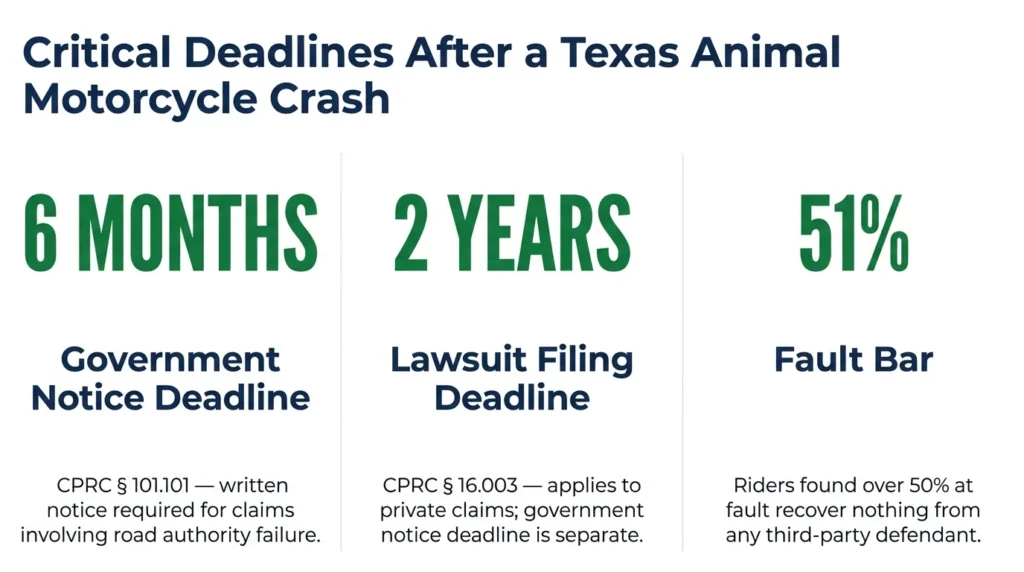
Defense counsel and insurance adjusters know this rule. They will scrutinize every detail of your riding after an animal crash, looking for ways to push your share of fault above the threshold. An attorney can review how comparative responsibility applies to your specific facts before you talk to an adjuster.
When no third-party path exists, your own policy may cover your damages. Comprehensive coverage handles wildlife strikes. Personal injury protection (PIP) pays medical expenses regardless of fault.
Under Texas Civil Practice and Remedies Code § 16.003, you have two years from the date of the crash to file a personal injury lawsuit. Government claims carry the separate six-month notice rule on top of that. The two-year clock does not stop while you wait for an insurance decision.
Talk to an Attorney About Your Case
Animal-caused motorcycle crashes sit at the intersection of multiple overlapping rules: open-range doctrine, the highway exception, Tort Claims Act notice requirements, and proportionate responsibility. Sorting out which path applies to your crash is not a do-it-yourself project, and the wrong assumption can cost you the case.
Angel Reyes & Associates has more than 30 years of experience handling Texas motorcycle claims, with more than $1 billion recovered for clients. We offer free consultations, work on contingency with no fee unless we win, and can handle most of your case remotely from anywhere in Texas. Contact us today to talk through your options.
Past results do not guarantee future outcomes.
Motorcycle Animal Accident FAQs
Does homeowner's or renter's insurance ever cover injuries from a dog that ran into the road and caused a motorcycle crash?
A dog owner’s homeowner’s or renter’s liability policy may cover bodily injury claims caused by the dog, even when the incident happens away from the home. Coverage depends on the specific policy language, so checking whether the owner carries such a policy is worth doing early in the claim process.
Can a livestock owner face criminal penalties in Texas for an animal that strays onto a highway?
Yes. Under Texas Agriculture Code § 143.102, knowingly permitting livestock to run at large on a U.S. or state highway is a Class C misdemeanor. A criminal citation or conviction can serve as evidence in a related civil claim.
If I was wearing full gear and still suffered serious injuries, does my protective equipment affect how fault is calculated?
Texas’s proportionate responsibility law focuses on the conduct that caused the crash, not on whether you wore protective gear. Gear use or non-use is generally not treated as a basis for reducing your recovery under Texas’s negligence doctrine.
What happens to my claim if the livestock owner has no insurance and few assets?
A judgment against an uninsured or judgment-proof defendant may be difficult to collect on, regardless of liability. Riders in this situation typically rely on their own PIP coverage for medical expenses and may have limited options beyond that unless the owner carries a farm or ranch liability policy.
Can I still recover compensation if the animal was never identified or found after the crash?
When the animal is never found and ownership cannot be established, a third-party negligence claim is generally not viable. Your own comprehensive or PIP coverage becomes the primary source of recovery in that situation.
About the Authors

Angel Reyes
Writer
Angel L. Reyes, III is the Founder and Managing Partner of Angel Reyes & Associates. A nationally recognized trial attorney and business leader, Angel has helped over 70,000 injury victims recover more than $1 billion since founding the firm in 1993. Named to the Texas Super Lawyers list annually since 2008, Angel brings Wall Street experience, Ivy League education, and a deep commitment to client advocacy. He is a frequent legal commentator and published author with extensive contributions to legal scholarship, trial strategy, and consumer protection.

Kyle Nicolas
Editor
Kyle Nicolas is the Web Content & SEO Manager at Angel Reyes & Associates. He has more than 10 years of experience as a marketing co...

Angel Reyes
Reviewer
Angel L. Reyes, III is the Founder and Managing Partner of Angel Reyes & Associates. A nationally recognized trial attorney and business...