What to Do If You Hit a Deer in Texas


Every article on this site is researched by our internal team, reviewed for legal accuracy against current Texas law, and held to State Bar of Texas advertising standards before publication. We do not publish content that overstates outcomes or makes promises about results.
Learn more about our
editorial standards .
Key Takeaways
- Deer are most active October-December during mating season in Texas Hill Country
- After hitting a deer, pull over safely, call authorities, and don’t approach injured animals
- Comprehensive insurance covers deer collisions but may increase premiums
How to Successfully Handle a Deer Accident in Texas and Protect Your Rights
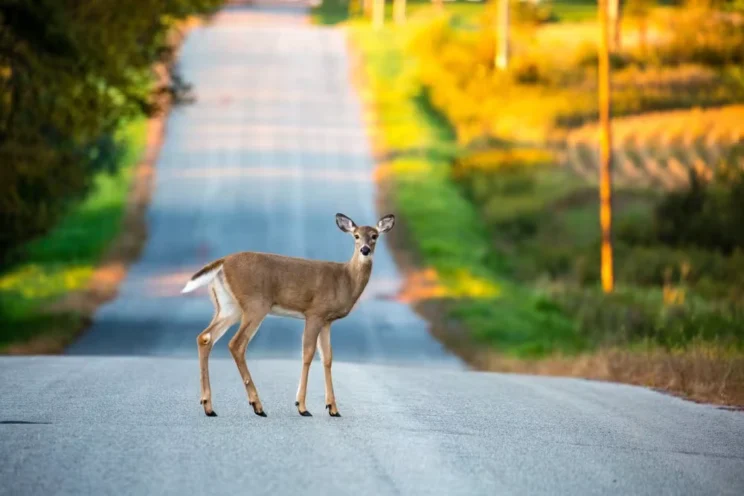
One thing that makes Texas beautiful is the abundance of wildlife roaming around. However, it also means that residents are more likely to be involved in a collision with a deer while driving. Deer may seem like harmless creatures, but they can cause immense damage to a car if you collide with one on the road.
Think about it: a large buck (male deer) can weigh up to 300 pounds. While that’s a lot less than an average car, it certainly could damage the car injure those inside it from the jolt. Combined with their tendency to freeze when scared, such as encountering a car coming toward them on the roads (becoming a literal deer-in-headlights), it should come as little surprise that animal collisions tend to increase at this time of year.
Understanding Deer Behavior and Migration Patterns
Deer are most active during late fall to early winter as this is their mating season, making their behavior much more erratic. The most dangerous months are October, November, and December.
The Texas Hill Country region is the most heavily populated area for deer. Since they travel in herds, spotting one of them means that there are usually more of them somewhere nearby. Because deer accidents can happen at any time, the Texas Parks and Wildlife Department advises driving carefully and making sure your headlights are in working order to reduce your chances of hitting a deer.
What to Do If You Hit a Wild Animal
Hitting a wild animal with your car can be frightening. But what do you do next? Do you have to stop? Do you have to report it? What can you do to help the deer?
Experts advise that you pull off to a safe location on the side of the road, if your car can still be driven. You should also turn on your hazard lights to indicate that you need assistance, and to make sure other drivers passing by can see you clearly.
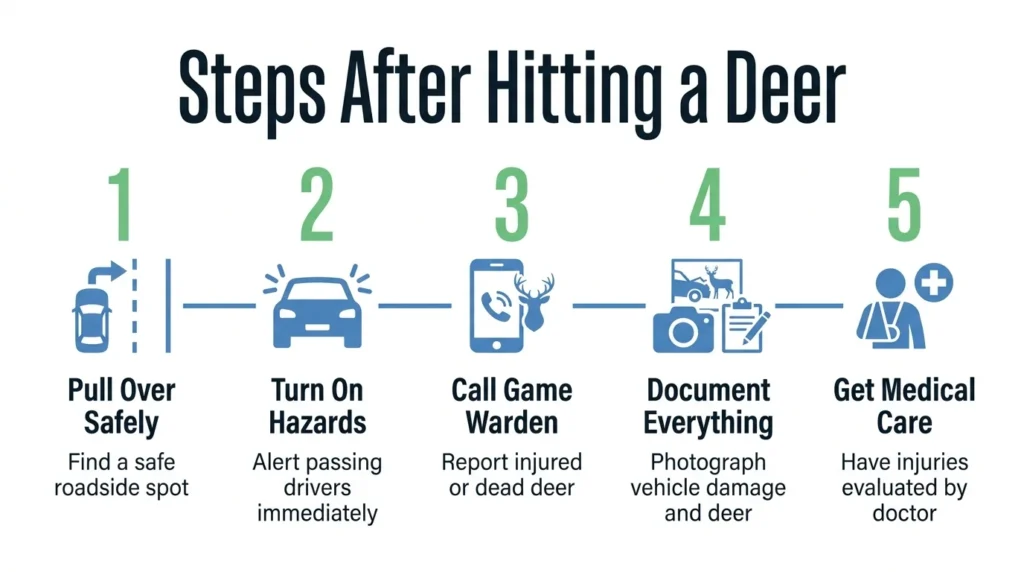
Next, reach out to your local game warden dispatcher if you think the animal is injured. You might not be certain if it’s still alive, though the warden will likely tell you if there’s a possibility that it’s still alive. Do not try to approach the deer. A deer that has been seriously wounded but is still alive may be frightened by your approach and flail to get away. This can happen suddenly, and it’s not hard to imagine how strong a 300-pound deer can be. One wrong move and that deer could badly injure you as well.
In Texas, it’s illegal to take a deer or any dead animal with you. If you’re planning on filing an insurance claim, take photos and videos for evidence, and call your car insurance company. You’ll additionally want to take photos and videos of the damage caused to your vehicle and of the deer itself if that’s possible. This will serve as evidence that can help with your insurance claim while providing an official record of the deer crash.
While you might be concerned about the harm done to this wild animal, don’t forget to get a medical evaluation. Crashing into a deer is a type of car accident, and you may have injuries that need treatment.
Deer Collision Reporting Requirements in Texas
Are you required to report hitting a deer to the authorities? That answer isn’t actually so simple. Texas Transportation Code § 550.026 requires you to report any collision that results in an injury, death, or damage to a vehicle that would prevent it from being driven further. To put it simply, if nobody in your car is hurt and you can drive your car away from the scene safely, you are not required to report the incident. However, if someone gets hurt, you are required to stop and report the incident.
If your vehicle is okay, we still recommend contacting the local game warden or law enforcement office to file an accident report for insurance purposes, and so that way someone can come out and collect the deer’s remains if they are blocking the road. The last thing anyone wants is another vehicle colliding with the same deer that’s now blocking a highway.
What to Do with a Dead Deer
If the collision kills the deer and you can safely confirm it is dead, you can remove it from the roadway if it’s blocking traffic to prevent another collision with other cars. However, as we mentioned previously, a deer that is badly wounded may still try to escape, resulting in unpredictable behavior like flailing or kicking.
We don’t recommend approaching a deer at all. However, if you can safely confirm the animal is dead, you can move it out of the way legally. However, we recommend wearing gloves when touching the animal carcass if you have them. Deer are often infested with ticks, fleas, and other pests.
Filing a Claim with Your Insurance Company
When an accident occurs with any form of wildlife, it can be incredibly upsetting. You may have been following the speed limit when it suddenly ran out right in front of your vehicle. Driving in Texas during the active months for deer herds is dangerous, especially on rural roads with a lot of tree cover. Even drivers who are prudent and aware of their surroundings often find themselves in these scary situations.
Does your insurance cover hitting a deer or other creature? If you have comprehensive coverage as part of your insurance coverage, it will most likely be covered. Insurance coverage can get confusing with property damage, especially if you collide with something else (like a tree or another vehicle) if you swerve to avoid hitting the deer.
Unfortunately, this may result in higher insurance premiums due to this collision, though it will depend on the collision coverage and your policy. Every driver should know what is and isn’t included in the terms of their auto insurance. We recommend reviewing this at the start of fall just to make sure you’re properly protected.
Tips to Avoid Running into a Deer on the Road
Animal collisions are common on rural Texas roads, and most of your protection comes from habits you control before a deer ever appears. Working headlights, strategic lane position, and undivided attention buy you the seconds you need to react. Some strikes are unavoidable, so report the crash, let paramedics check you out, and skip the apologies. An adjuster might still try to use a seemingly innocent statement as an admission of fault that lessens what they have to pay for your claim.
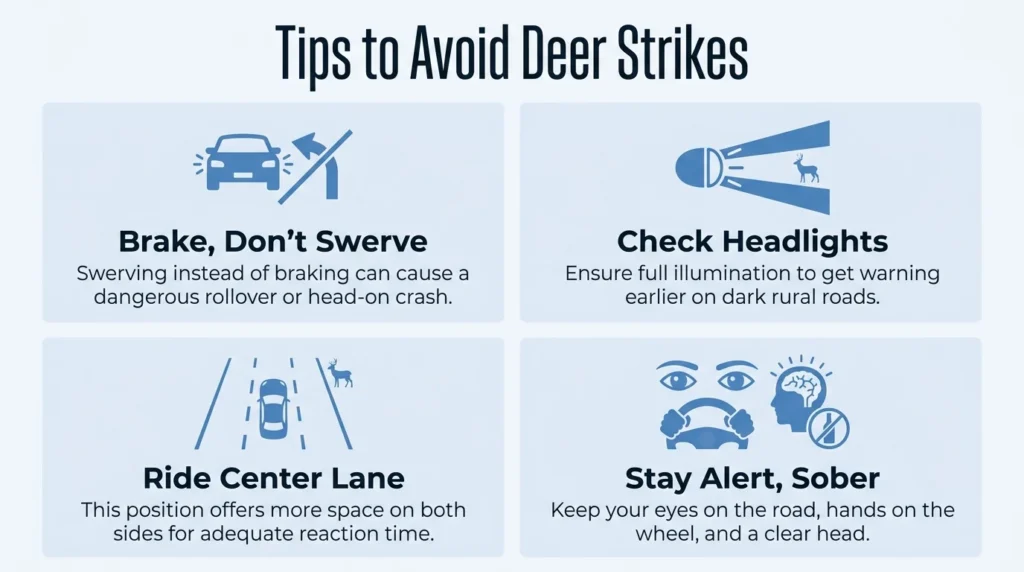
Here are some tips for avoiding running into a deer:
- Brake hard, do not swerve. Swerving hard could turn a deer strike for a rollover or a head-on collision.
- Check your headlights. Dark rural stretches give you almost no warning without full illumination.
- Ride the center lane when you can. More space on both sides means more time to spot movement and respond.
- Stay alert and sober. Eyes on the road, hands on the wheel, and a clear head are what make a reaction possible.
At Angel Reyes & Associates, we have spent over 30 years representing drivers hurt in Texas car accidents. With more than $1 billion recovered for clients, we have built a reputation as staunch defenders of your rights. We take each case on contingency, so you owe nothing unless we win, and we answer the phone 24/7 in English and Spanish. We proudly serve clients from more than 30 office locations across the state, including offices in Austin, Dallas, Fort Worth, and Houston.
Schedule a free consultation and we will handle the insurance company while you recover.
About the Authors

Spencer Browne
Writer
Spencer Browne is a partner at Angel Reyes & Associates and a Board Certified personal injury trial lawyer with nearly 100 jury trials across Texas. He focuses on car, truck, and wrongful death cases, with notable verdicts including a landmark win in the Choctaw Casino bus crash case. A recognized speaker and legal educator, Spencer is a member of the American Board of Trial Advocates and has been honored as a Texas Super Lawyer and one of D Magazine’s Best Lawyers in Dallas. He brings deep trial experience and relentless advocacy to every client he represents.

Kyle Nicolas
Editor
Kyle Nicolas is the Web Content & SEO Manager at Angel Reyes & Associates. He has more than 10 years of experience as a marketing co...

Angel Reyes
Reviewer
Angel L. Reyes, III is the Founder and Managing Partner of Angel Reyes & Associates. A nationally recognized trial attorney and business...