How Motorcycle Accidents Differ on Texas Highways vs. City Streets


Every article on this site is researched by our internal team, reviewed for legal accuracy against current Texas law, and held to State Bar of Texas advertising standards before publication. We do not publish content that overstates outcomes or makes promises about results.
Learn more about our
editorial standards .
Key Takeaways
- Highway crashes turn on lane changes; city crashes turn on intersection right-of-way.
- A rider found more than 50% at fault recovers nothing under Texas law.
- Texas gives you two years to file, but key crash footage vanishes within days.
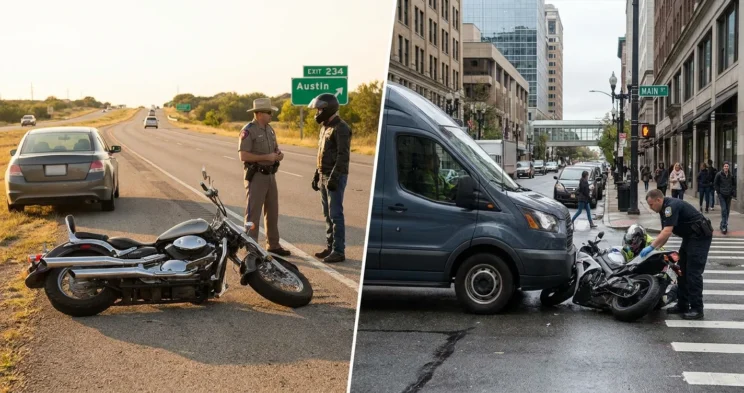
You were merging onto I-35 outside Austin when a driver drifted across the line and clipped your bike. Now you’re lying in a hospital bed, replaying the crash, and wondering whether it would have gone differently on a slower city street. The answer matters more than you might expect, because where your crash happened shapes who is at fault and what evidence you need.
Texas Motorcycle Crash Patterns: Highway vs. City
Highway and city street crashes injure riders in very different ways, and Texas crash data shows the split clearly. Highway wrecks tend to be high-speed, single-vehicle, or lane-change events. City street wrecks cluster at intersections and usually involve more than one vehicle.
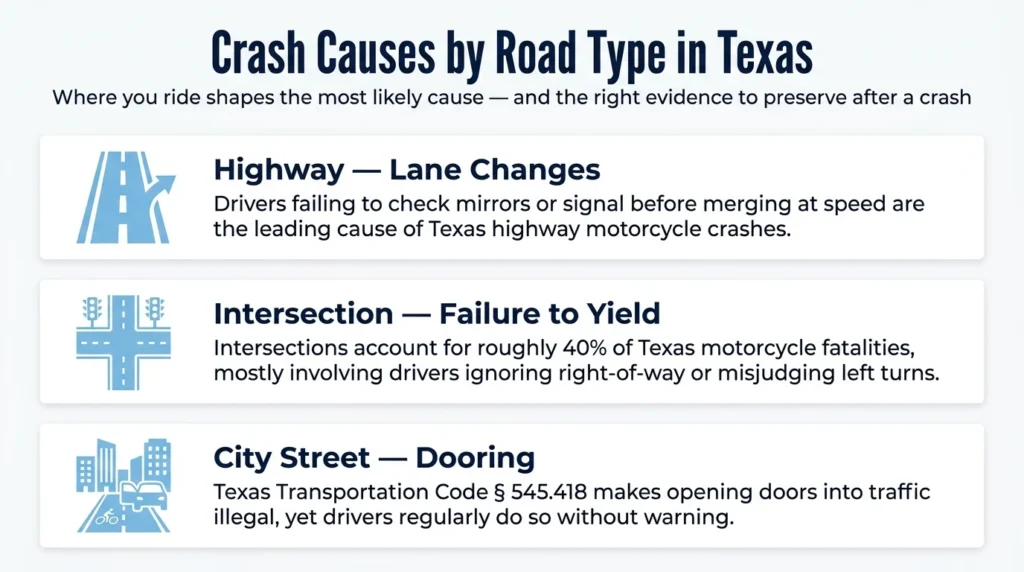
The cause of each crash tracks that pattern. On a highway, a driver who fails to check a mirror before merging can hit a rider at 70 miles per hour. On a city street, a driver who misjudges a left turn can cut directly across a rider’s path.
State data shows that intersections account for roughly 40% of motorcycle fatalities in Texas, making them a major danger zone for urban riders, and rising motorcyclist deaths across the state have drawn ongoing attention from TxDOT. Highway deaths more often trace to high-speed lane-change and merge events instead.
Why does this split matter to you as an injured rider? Because the environment shapes what caused your crash, who is at fault, and what proof survives long enough to help you.
Highway Crash Fault Determination in Texas
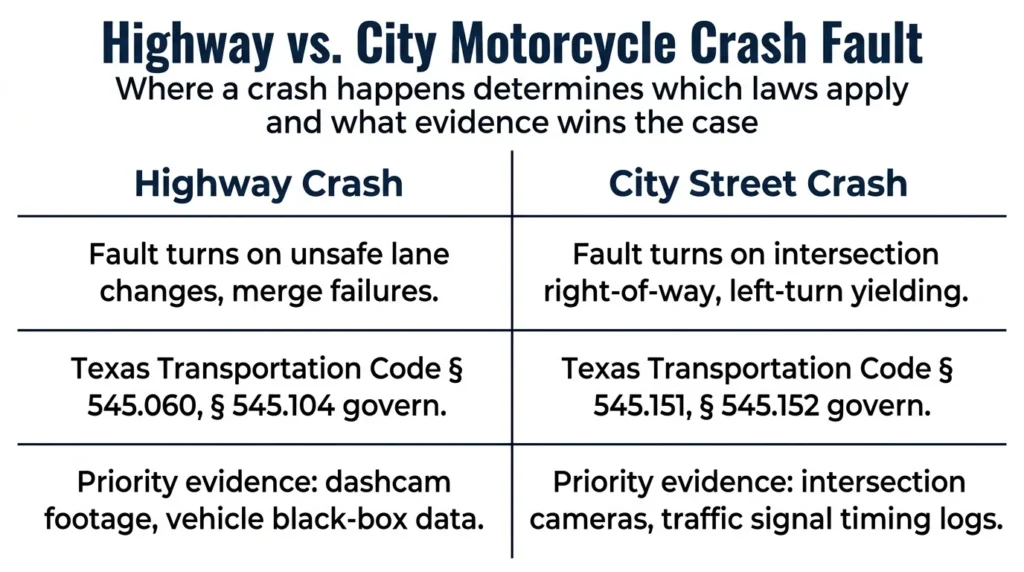
On a Texas highway, fault usually turns on lane-change failures, merge violations, and following too closely at speed. The driver who changed lanes without checking mirrors or signaling typically carries the primary blame.
Texas law backs that up. Drivers must stay within a single marked lane under Texas Transportation Code § 545.060, and § 545.104 requires them to signal before changing lanes. When a driver breaks those rules and hits you, both violations become strong evidence of negligence. Crashes that start with an unsafe lane change are some of the most common.
Some highway crashes happen when a driver pulls alongside and crowds you out of a lane. Texas treats riding two-abreast and lane intrusion as its own problem, and the rules around when a car can legally drive beside a motorcycle often decide who is at fault.
Fault is rarely all-or-nothing, though. Texas uses a fault-sharing system under the Texas Civil Practice and Remedies Code (CPRC) § 33.001. If you are found more than 50% at fault, you recover nothing. Highway cases involving following distance or lane position give the other side room to argue you share the blame, which is exactly how the 51% rule can reduce a claim.
A smaller set of highway crashes happen due to the road itself. A defective surface or missing sign can point fault toward a TxDOT or county agency, and those claims follow different procedural rules than a standard driver-negligence case.
Highway fault is often contested, so it helps to understand how motorcycle accident settlements work in Texas before you speak with anyone from the other side.
City Street Crash Fault & Intersection Liability
On city streets, fault most often lands on the driver who failed to yield. Intersection crashes are the leading cause of fatal urban motorcycle wrecks in Texas, and the driver who ignored the right-of-way is usually responsible under Texas Transportation Code § 545.151.
Left-turn crashes are a close second. When an oncoming driver turns left across your path, § 545.152 requires that driver to yield to traffic coming the other way. That duty anchors the fault theory in most left-turn cases.
Then there is dooring. When a parked driver swings a door open into your lane, § 545.418 makes that illegal, and the door violation is usually the direct cause of the crash. A dooring accident in Texas can leave a rider with no time to react.
City streets are also where distracted-driver and failure-to-signal accidents occur more often than on highways. Stop-and-go traffic, parked cars, and foot traffic put more decisions in front of a driver every block. Many of these collisions are T-bone crashes, and understanding the fault framework can help you decide whether a claim is worth pursuing.
Evidence After a Motorcycle Crash in Texas
The evidence that wins your case depends on where you crashed, and the most fragile proof disappears within days. Highway crashes lean on different records than city street crashes, so collection priorities should match the scene.
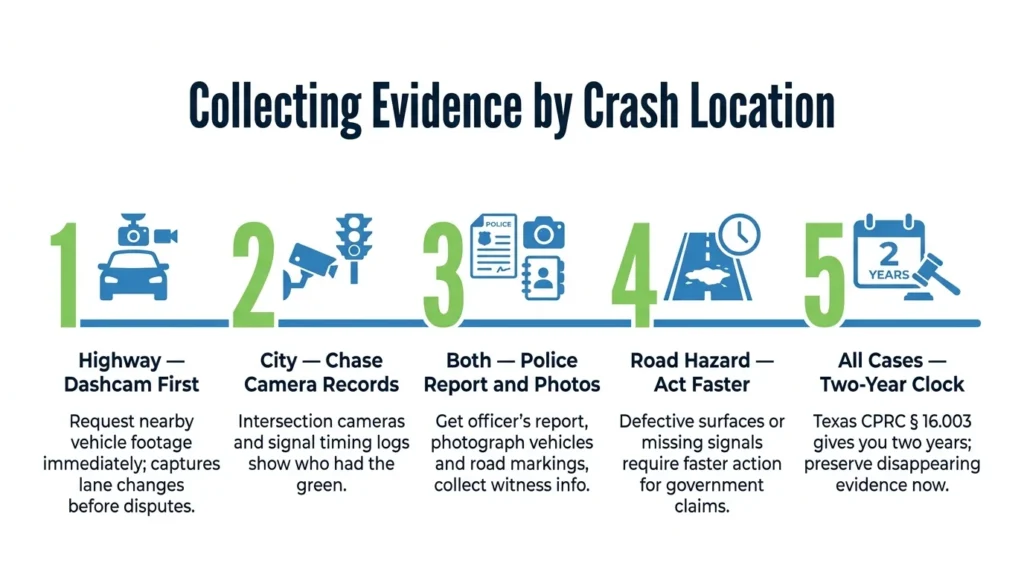
Highway crash priority: secure dashcam and vehicle data. Footage from nearby vehicles and the other driver’s black-box data can lock in the lane-change sequence before anyone disputes it.
City street crash priority: chase down camera and signal records. Intersection cameras and traffic signal timing logs show who had the green, but businesses and agencies overwrite them fast.
Both environments: capture the basics immediately. Get the police crash report, photograph every vehicle position and road marking, save medical records from the day of the crash, and collect contact details for all witnesses.
You also have a hard deadline. Texas gives you two years from the date of injury to file a personal injury lawsuit under CPRC § 16.003. Waiting that long is risky, because surveillance footage and signal records are often gone within days.
When a road hazard played a part, the timeline tightens further. A pothole, missing guardrail, or failed signal can pull a government agency into your claim, and those claims carry shorter notice deadlines. Acting early protects options on these motorcycle accident claims that you can otherwise lose in a matter of weeks.
Talk to a Lawyer About Your Case
A crash on I-35 and a crash in downtown Austin can look similar from the outside, but the path to recovery runs differently through each. Angel Reyes & Associates has spent more than 30 years helping injured Texans sort out fault, gather the right proof, and pursue what they are owed. You can see how we have handled past claims through our client case results, and we have more than $1 billion recovered for clients.
We offer free initial consultations and work on contingency, which means no fee unless we win. We are available 24/7 and serve riders across the entire state of Texas, from highway wrecks to intersection collisions and the families left behind in wrongful death cases. Reach out to us for a free consultation in English or Spanish.
Past results do not guarantee future outcomes.
Motorcycle Accident FAQs
Does not wearing a helmet affect a Texas motorcycle injury claim?
Not wearing a helmet does not bar your claim, but the other side may argue it worsened your head injuries and ask the court to assign you a share of fault under Texas’s proportionate responsibility rules. If your injuries have nothing to do with head trauma, helmet use is unlikely to affect your recovery at all.
Is lane splitting legal in Texas?
No. Texas Transportation Code § 545.0605, which took effect in September 2023, prohibits lane splitting and lane filtering statewide. If you were splitting lanes when the crash happened, the other side will likely raise that as evidence of fault.
Can a motorcycle passenger file their own injury claim?
Yes. A passenger injured in a Texas motorcycle crash can file a claim against any driver whose negligence caused the wreck, including the operator of the bike they were riding. Passengers are rarely assigned fault, which puts them in a strong position to recover their full damages.
Does Texas require uninsured motorist coverage on a motorcycle policy?
Texas insurers must offer uninsured and underinsured motorist coverage with every auto and motorcycle policy, but riders can reject it in writing. Given that roughly one in seven Texas drivers carries no insurance, keeping that coverage is worth considering before you ride.
What options do I have if the driver who hit me fled the scene?
Your own uninsured motorist coverage is typically the primary path to recovery after a hit-and-run, because it treats an unidentified driver the same as an uninsured one. Most policies require a police report and, in many cases, physical contact between the vehicles, so reporting the crash immediately matters.
About the Authors

Angel Reyes
Writer
Angel L. Reyes, III is the Founder and Managing Partner of Angel Reyes & Associates. A nationally recognized trial attorney and business leader, Angel has helped over 70,000 injury victims recover more than $1 billion since founding the firm in 1993. Named to the Texas Super Lawyers list annually since 2008, Angel brings Wall Street experience, Ivy League education, and a deep commitment to client advocacy. He is a frequent legal commentator and published author with extensive contributions to legal scholarship, trial strategy, and consumer protection.

Kyle Nicolas
Editor
Kyle Nicolas is the Web Content & SEO Manager at Angel Reyes & Associates. He has more than 10 years of experience as a marketing co...

Angel Reyes
Reviewer
Angel L. Reyes, III is the Founder and Managing Partner of Angel Reyes & Associates. A nationally recognized trial attorney and business...