Motorcycle Accidents While Riding for Work in Texas


Every article on this site is researched by our internal team, reviewed for legal accuracy against current Texas law, and held to State Bar of Texas advertising standards before publication. We do not publish content that overstates outcomes or makes promises about results.
Learn more about our
editorial standards .
Key Takeaways
- Texas Labor Code § 417.001 lets injured workers sue the at-fault driver and collect workers' comp.
- Workers' comp pays no pain and suffering, so the third-party claim fills the biggest recovery gap.
- Riders found 51% or more at fault recover nothing from the at-fault driver under CPRC Chapter 33.
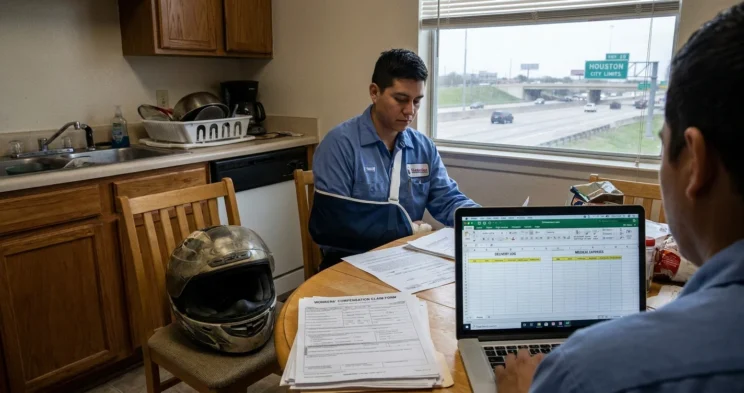
You were halfway through a delivery run, riding your bike down a Houston feeder road, when a driver merged into your lane without looking, leaving you laid up with a broken collarbone, your route is gone, and your paycheck depends on a job you can’t physically do.
Workers’ comp paperwork is on the kitchen table, but no one has explained whether you can also go after the driver who hit you. The answer isn’t always clear, and it matters more than most people realize.
What “Course & Scope of Employment” Means for Riders
Texas courts ask one core question: were you furthering your employer’s business when the crash happened? If the answer is yes, you were acting in the course and scope of employment. That covers tasks your employer authorized, required, or reasonably expected you to perform while on the clock.
Common qualifying scenarios for riders include making deliveries, hauling materials between job sites, running an errand at a supervisor’s direction, or handling on-call duties. If your work depends on the motorcycle, your time on the road usually counts.
The going-and-coming rule is the main exception. Routine commuting to and from a fixed worksite generally does not qualify. But exceptions kick in when your employer provides the vehicle or fuel, when you have no fixed place of business, or when the trip serves a dual business purpose.
Classification matters too, as independent contractors and gig workers face the same third-party claim pathway as W-2 employees. Your status affects workers’ comp eligibility, but it does not erase your right to sue an at-fault driver. If you ride for income, Texas motorcycle accident claims are open to you whether you carry a 1099 or a W-2.
Texas Workers’ Comp & the Exclusive Remedy Rule
Texas workers’ comp runs as a parallel system to a personal injury claim. It can pay medical bills and partial wage replacement, but it shuts the door on certain lawsuits. Understanding which door it closes, and which one stays open, is the difference between a narrow recovery and a full one.
Subscribing Employers & the Exclusive Remedy Bar
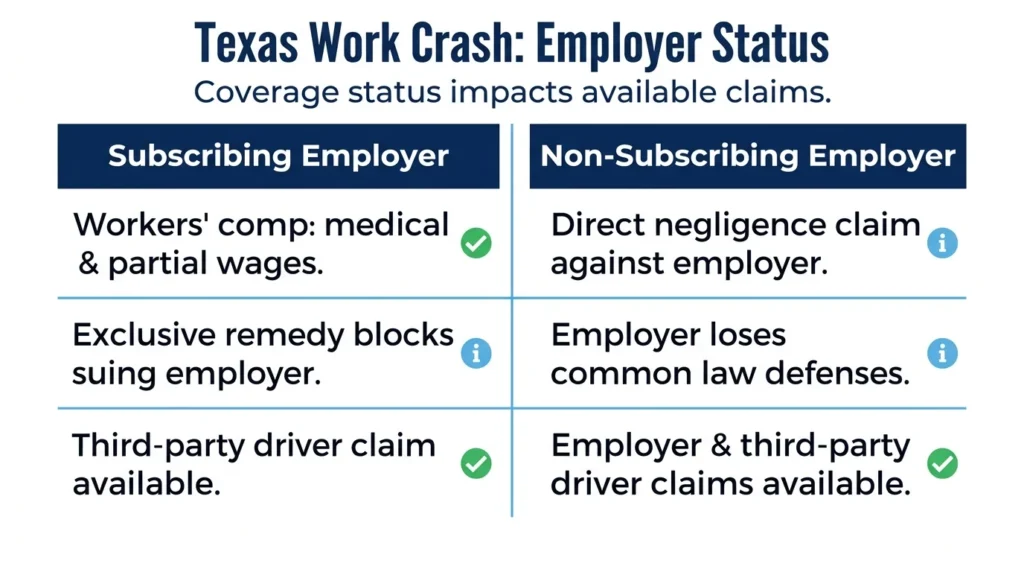
Texas is a voluntary workers’ comp state. Private employers choose whether to carry coverage under the Texas Labor Code (Labor Code) § 406.002. Those that opt in are called subscribing employers.
If your employer subscribes, the exclusive remedy rule under Labor Code § 408.001 blocks you from suing that employer for negligence. You receive medical and wage-replacement benefits through the comp system instead.
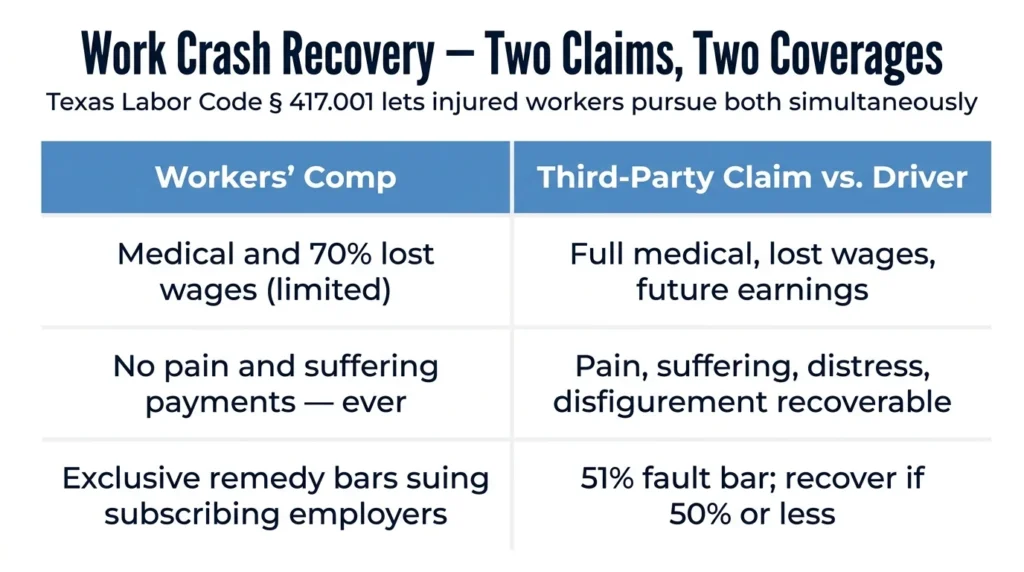
Those benefits have limits, as wage replacement under Texas workers’ comp is calculated at 70 percent of your lost wages (the difference between your pre-injury and post-injury average weekly wage) and is subject to a state-set weekly maximum and minimum that change each year. The system pays nothing for pain and suffering. The claim against the at-fault driver is what fills that gap.
Non-Subscribing Employers
According to the most recent data from the Texas Department of Insurance, roughly one in four Texas private employers does not subscribe to the workers’ compensation system. If you were riding for a non-subscriber, you may bring a direct negligence claim against your employer in addition to the third-party claim against the driver.
Non-subscribers also lose key statutory defenses. They cannot rely on contributory negligence, assumed risk, or the fellow-servant rule to defeat your case. That changes the leverage significantly.
Verify your employer’s status early. The Texas Department of Insurance Division of Workers’ Compensation keeps records of subscribing employers and certified self-insurers.
Suing the At-Fault Driver While Collecting Workers’ Comp
Labor Code § 417.001 expressly authorizes injured employees to file a personal injury claim against a liable third party while receiving workers’ comp benefits. The two claims run on parallel tracks, not competing ones.
The third-party claim is where the real money usually sits. It can recover pain and suffering, full lost wages beyond the workers’ comp cap, complete medical expenses, and future loss of earning capacity. Workers’ comp covers none of those in full.
Subrogation can assert a lien to recoup part of the paid workers’ comp benefits from your third-party settlement or verdict. The amount is often negotiable, but you need to know about it before you sign anything. An attorney can help you weigh how a subrogation lien affects the allocation of medical bill payments after a Texas crash before any offer is accepted.
Fault is evaluated under Texas proportionate responsibility rules in Texas Civil Practice and Remedies Code (CPRC) Chapter 33, meaning you can recover as long as your share of fault is 50 percent or less. Once your percentage of responsibility is 51 percent or more, you recover nothing from the at-fault driver. If your fault is 50 percent or below, your damages are reduced by your percentage of fault, and tracking lost wage documentation after a Texas crash early helps protect that part of your recovery.
What Injured Motorcycle Workers Can Recover
A third-party claim opens up two categories of damages.
- Economic damages cover hard-dollar losses: past and future medical care, hospital and surgical bills, rehabilitation, adaptive equipment, lost income during recovery, and lost future earning capacity if you cannot return to the same line of work.
- Non-economic damages cover what workers’ comp ignores entirely: physical pain and suffering, emotional distress, disfigurement, and loss of enjoyment of life. For a working rider, these are often the largest part of the case.
Motorcycle crashes produce serious injuries because there is no metal cage around the rider. Traumatic brain injury, spinal cord damage, road rash requiring surgical debridement, and orthopedic fractures are common results. Many of these common injuries from motorcycle accidents end a rider’s ability to work in skilled trades or delivery roles.
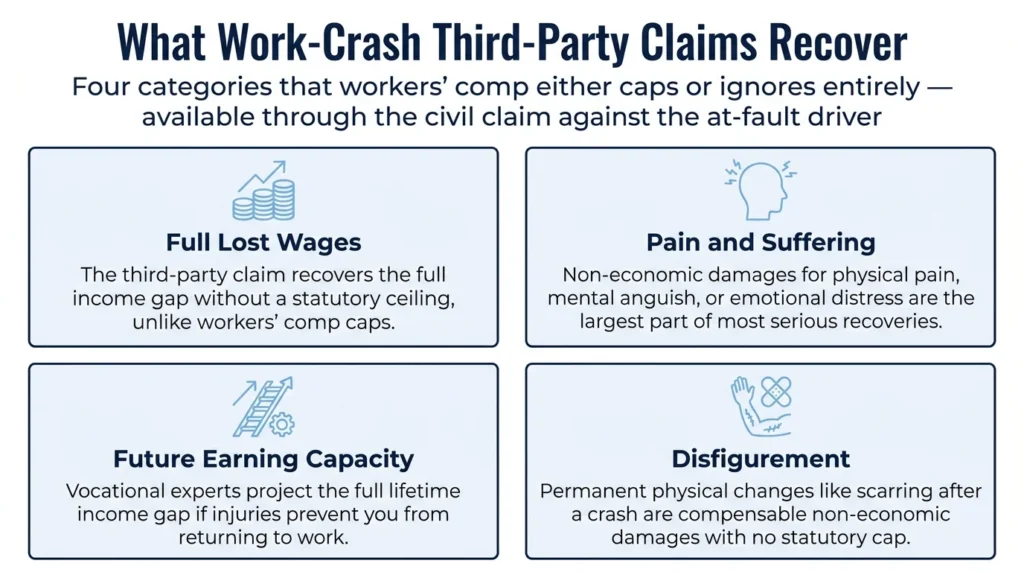
Delivery workers, contractors, and gig riders face compounded losses because their income depends on physical ability, meaning you should pull your full income history early. Gig-platform earnings statements, 1099s, and bank deposits all matter when calculating lost earning capacity. Reviewing our motorcycle and auto case results can help you understand the range of recoveries other injured riders have achieved, though past results do not guarantee future outcomes.
Get Legal Help After a Work-Related Motorcycle Crash
A work-related motorcycle crash usually means two claims running at the same time, and the third-party case against the at-fault driver is where the broader recovery happens. Getting that piece right matters for your medical care, your lost income, and your future ability to work.
Angel Reyes & Associates has been helping Texans navigate these complex injury landscapes for over 30 years. Our team of more than 600 dedicated professionals operates out of more than 20 offices across Texas, providing the deep resource network required to handle motorcycle accident cases for injured workers. We have recovered more than $1 billion for clients.
We handle these cases on a strict contingency fee basis, meaning there is no fee unless we win. Our firm is available 24/7 and proud to offer legal services in both English and Spanish to ensure clear communication throughout your case.
Schedule a free consultation to talk through your crash, your employment situation, and what your claim against the at-fault driver may be worth. Contact us today to review your legal options with an experienced Texas motorcycle accident attorney.
Past results do not guarantee future outcomes.
Work-Related Motorcycle Crash FAQs
What is the deadline to file a personal injury claim after a motorcycle crash while working in Texas?
Texas gives you two years from the date of the crash to file a personal injury claim against the at-fault driver under Texas Civil Practice and Remedies § 16.003. Missing that deadline typically bars your recovery entirely, no matter how strong your case is.
What if the at-fault driver does not have enough insurance to cover my injuries?
If the driver who hit you carries minimal or no liability coverage, your own uninsured or underinsured motorist coverage may help fill the gap, if your motorcycle policy includes it. Texas does not require motorcyclists to carry uninsured motorist coverage, so whether you have it depends on your own policy terms.
Does my workers' comp claim affect the value of my personal injury case against the at-fault driver?
The workers’ comp carrier’s subrogation lien reduces how much of the settlement you actually keep, but it does not reduce the gross value of your claim against the driver. Your personal injury damages are calculated on their own merits, independent of what workers’ comp has paid.
Can a passenger on a work-related motorcycle ride also file a claim after a crash in Texas?
A passenger injured in a motorcycle crash generally has the same right to file a personal injury claim against an at-fault driver as the rider does. Their workers’ comp eligibility would depend on whether they were also acting in the course and scope of employment at the time of the crash.
About the Authors

Angel Reyes
Writer
Angel L. Reyes, III is the Founder and Managing Partner of Angel Reyes & Associates. A nationally recognized trial attorney and business leader, Angel has helped over 70,000 injury victims recover more than $1 billion since founding the firm in 1993. Named to the Texas Super Lawyers list annually since 2008, Angel brings Wall Street experience, Ivy League education, and a deep commitment to client advocacy. He is a frequent legal commentator and published author with extensive contributions to legal scholarship, trial strategy, and consumer protection.

Kyle Nicolas
Editor
Kyle Nicolas is the Web Content & SEO Manager at Angel Reyes & Associates. He has more than 10 years of experience as a marketing co...

Angel Reyes
Reviewer
Angel L. Reyes, III is the Founder and Managing Partner of Angel Reyes & Associates. A nationally recognized trial attorney and business...