Motorcycle vs. Car Accidents in Texas


Every article on this site is researched by our internal team, reviewed for legal accuracy against current Texas law, and held to State Bar of Texas advertising standards before publication. We do not publish content that overstates outcomes or makes promises about results.
Learn more about our
editorial standards .
Key Takeaways
- Motorcyclists are nearly 27 times more likely to die in a crash than car occupants per mile traveled.
- Texas law bars any recovery if a claimant is found more than 50% at fault for the crash.
- Biker bias from adjusters and juries can inflate fault percentages and reduce valid recoveries.
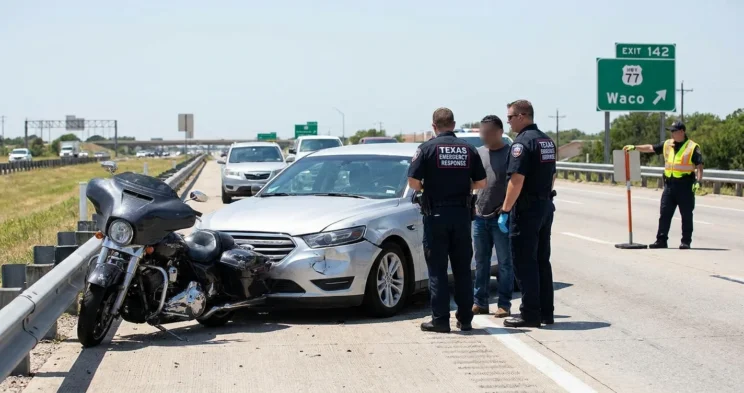
You were heading home along the I-35 corridor south of Austin when a driver turning left across traffic never saw you. Your bike went down. The car that hit you has a crumpled fender. You have a broken femur, road rash across your forearm, and a hospital bill that started climbing the moment the ambulance arrived.
The other driver’s insurance company called the next day. The adjuster was polite, but something in the questions felt off. You got the sense that being on a motorcycle was already working against you before anyone looked at the facts.
Why Motorcycle Crashes Cause Worse Injuries
Motorcyclists absorb the full force of a collision. There is no crumple zone between you and the asphalt, no airbag that fires when impact is detected, no reinforced steel frame that takes the hit before it reaches your body.
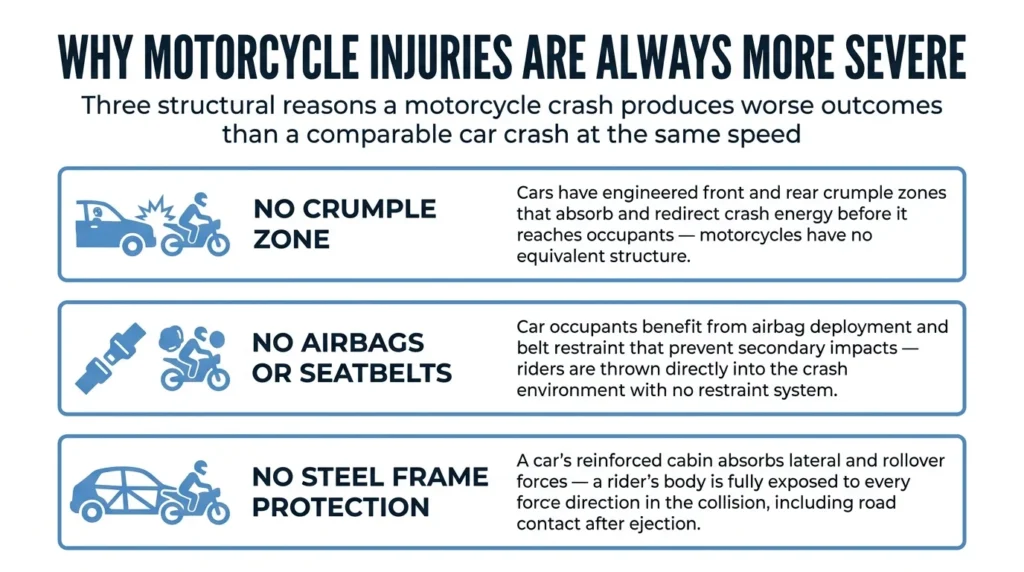
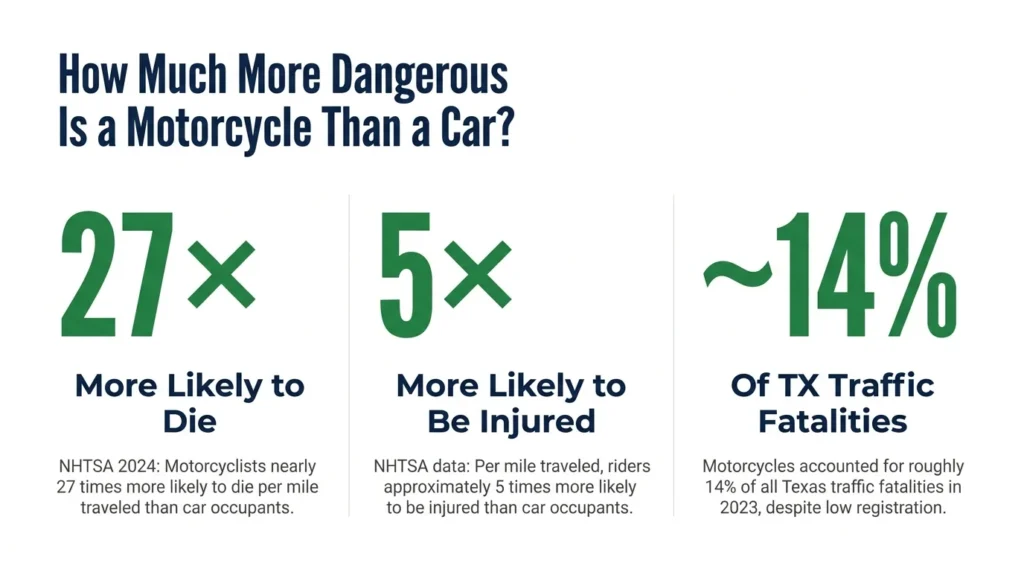
Per federal crash data, motorcyclists in 2024 were nearly 27 times more likely to die in a crash than passenger car occupants per vehicle mile traveled, and about 5 times more likely to be injured. Car occupants sit inside engineered protection systems. Riders do not.
The injuries that follow from that gap are not just more frequent. They are more severe. Traumatic brain injury, spinal cord damage, road rash deep enough to require skin grafts, and orthopedic fractures that need surgical repair are all far more common in motorcycle crashes than in typical car crashes.
For more detail on the injury types riders most commonly face, our overview of common injuries in motorcycle accidents walks through what the medical picture typically looks like after a serious crash.
In Texas, that severity is reflected in the data. Nearly 600 motorcyclists were killed on Texas roads in 2023, with more than 2,400 others seriously injured, according to the Texas Department of Transportation crash records. Motorcycles represent a fraction of registered vehicles but accounted for approximately 14% of all traffic fatalities in Texas in 2023, based on state crash records.
For a broader look at Texas-specific figures, our summary of motorcycle accident statistics in Texas covers the most recent available data.
Even a low-speed crash carries serious risk. When there is no vehicle structure to absorb energy before it reaches you, slow does not mean safe.
How Injury Severity Drives Higher Damages
The physical gap between motorcycle and car crashes translates directly into larger claims. When injuries are more serious, the costs that attach to them are higher across every category.
Economic Damages
Economic damages are measurable financial losses. In motorcycle crash claims, these numbers are typically much larger than in comparable car crashes because the injuries are worse and recovery takes longer.
Medical costs are the clearest example. A motorcyclist with a fractured pelvis, spinal cord injury, or traumatic brain injury faces emergency surgery, a possible ICU stay, extended inpatient care, and months of physical therapy. A car occupant with soft-tissue injuries from a similar-speed collision may treat with a doctor and a chiropractor for a few weeks.
Lost wages follow the same pattern. If you cannot work for months, or at all, the income you have lost becomes a damages category in your claim. For many riders who work in trades or physically demanding jobs, even a “minor” orthopedic injury can mean weeks without a paycheck.
Loss of earning capacity is a separate category when a crash permanently limits your ability to do the work you did before. A long-haul trucker or a construction worker who loses full use of a limb or sustains a back injury that does not fully heal is not looking at weeks of lost wages. They are looking at a different income ceiling for the rest of their working life.
Non-Economic Damages
Non-economic damages cover real harms that do not show up on a medical bill. They are harder to quantify, but Texas law recognizes them as legitimate components of a personal injury recovery.
Chronic pain from nerve damage, orthopedic injury, and road rash is more common in motorcycle crashes and more likely to persist. Mental anguish, including the psychological aftermath of a life-altering injury, is its own damages category. Physical impairment, scarring, and disfigurement from road rash or amputation each support additional recovery.
An attorney experienced with motorcycle crash claims can help document non-economic damages in a way that counters the insurer’s default instinct to minimize them. Our overview of how motorcycle accident settlements work in Texas covers how damages are evaluated and what adjusters typically push back on.
What Biker Bias Is and Why It Matters
Biker bias is a documented pattern: insurance adjusters, law enforcement, and jurors tend to assume a motorcyclist was riding recklessly or taking on extra risk, even when the evidence does not support that assumption.
You may have already felt it. The adjuster’s first offer opened low. The police report describes your speed without a witness to confirm it. The narrative, before anyone reviewed the crash, leaned toward the rider being responsible.
This bias shows up in three places. Police reports sometimes assign fault based on assumptions about how motorcyclists drive, not on direct observation. Adjusters open with low offers because they expect riders to accept them or believe the case is weaker than it is.
Jurors who have never ridden a motorcycle bring preconceptions about risk-taking that can affect how they evaluate fault.
The assumption of risk argument takes this further. Defense attorneys and adjusters sometimes contend that choosing to ride a motorcycle is itself evidence of risk acceptance, separate from anything the rider actually did on the road.
In Texas, that argument has real financial stakes. Under the Texas Civil Practice and Remedies Code (CPRC) Chapter 33, a claimant who is found more than 50% responsible for their own injury cannot recover anything. Biker bias inflates the fault percentage assigned to riders.
Push a legitimate claim past that threshold and the recovery disappears entirely, regardless of how seriously the rider was hurt.
Helmet use adds another layer. The Texas Transportation Code Chapter 661 allows riders 21 and older who have completed an approved safety course or carry qualifying health insurance to ride without a helmet. But if you were not helmeted and sustained a head injury, the defense may argue that choice contributed to the severity of your injuries.
That argument can increase your assigned fault percentage even if the crash was entirely the other driver’s fault. Our look at what percentage of motorcycle accidents are fatal provides context for why these legal details carry such weight in serious claims.
How to Counter Biker Bias in a Texas Claim
A well-documented claim is the most reliable counter to biker bias. Evidence does not carry preconceptions. Your attorney uses it to build a version of events that the facts actually support, rather than the version an adjuster or jury might assume.
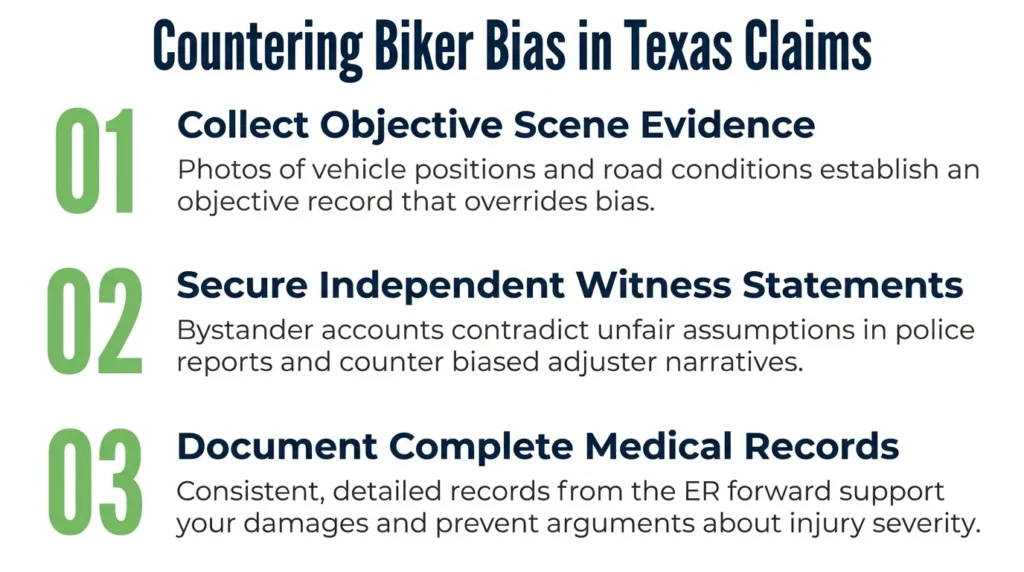
Here is what strong documentation looks like in a motorcycle crash claim:
Step 1: Preserve crash scene evidence. Photos of vehicle positions, tire marks, road conditions, signals, and sight lines taken immediately after the crash are harder to dispute than anything collected later. If you were injured and could not take photos yourself, ask a bystander, a family member, or your attorney to secure them as quickly as possible.
Step 2: Gather independent witness statements. A witness who saw the crash and can describe what the other driver did contradicts a police report that assigned fault by assumption. Witness statements collected early, before memories fade, carry significant weight.
Step 3: Obtain a complete medical record from the start. Every injury documented from the emergency room forward supports your damages. Gaps in medical care are used by adjusters to argue that injuries were not as serious as claimed, or that they came from somewhere else.
Step 4: Retain accident reconstruction if the crash is serious. An accident reconstruction specialist can use physical evidence to produce an objective account of how the collision occurred and who was responsible. This is especially valuable when the police report is unfavorable or when the other driver’s account of the crash conflicts with the physical evidence.
Having representation early changes the dynamic. Adjusters who believe a rider is unrepresented may be more aggressive with low offers or comparative fault arguments. Our motorcycle accidents practice area page explains what legal representation in a motorcycle claim typically involves.
Consulting with an attorney before accepting any settlement offer gives you the chance to understand what the full value of your claim actually is, before you sign away the right to ask for more.
When a Motorcycle Crash Results in a Fatal Injury
When a motorcycle crash causes a death, the legal pathway shifts. Surviving family members do not inherit the injured rider’s personal injury claim. They have their own right to pursue a wrongful death claim under different rules.
Under the Texas Civil Practice and Remedies Code Chapter 71, the spouse, children, and parents of a person killed in a crash may file a wrongful death claim. Damages in these cases include funeral and burial costs, the financial support the deceased would have provided, loss of companionship, and mental anguish suffered by surviving family members.
Biker bias does not stop at the injury claim. Insurers and defense attorneys may assign elevated fault to a deceased rider, reducing the family’s recovery under the same proportionate responsibility rules that apply in injury cases. A surviving family assigned partial blame receives a proportionally reduced recovery.
If the deceased rider is found more than 50% at fault, the family recovers nothing.
Both personal injury and wrongful death claims in Texas carry a two-year filing deadline under CPRC section 16.003. Families who delay pursuing a claim, assuming there is time to decide later, can lose the right to recover entirely. Our office locations across Texas can connect you with an attorney in your area quickly.
Talk to an Attorney About Your Motorcycle Crash
The injury gap between motorcycle and car crashes is real, and so is the bias that follows it. Riders who have been seriously hurt face higher medical costs, longer recoveries, and a claims process that often starts with an assumption that the rider was at fault.
Angel Reyes & Associates has handled motorcycle accident claims across Texas for over 30 years. We work on contingency, which means no fees are owed unless we recover for you. We offer free consultations, and our attorneys are available 24/7.
If you were injured in a motorcycle crash or lost a family member in one, contact us for a free consultation to understand what your claim may be worth.
Past results do not guarantee future outcomes.
Car Vs. Motorcycle Accident FAQs
Can a motorcycle passenger file a separate injury claim in Texas?
Yes. A passenger on a motorcycle can file a claim against the at-fault driver, whether that is the motorcycle operator, another vehicle’s driver, or a third party. Passengers are almost never found at fault for a crash because they have no control over how the bike is operated.
What are the minimum insurance requirements for motorcycles in Texas?
Texas requires motorcyclists to carry at least $30,000 per person and $60,000 per accident in bodily injury liability coverage, plus $25,000 in property damage liability. These minimums are the same as for car drivers, but they often fall short of covering the full cost of a serious motorcycle crash.
What happens if the driver who hit me has no insurance?
If the at-fault driver is uninsured, you can file a claim through your own uninsured motorist coverage if you purchased it. Texas insurers must offer this coverage, but riders can reject it in writing. Without it, you may need to pursue the at-fault driver directly, which can be difficult if they have limited assets.
How long does a motorcycle accident claim typically take to settle in Texas?
Claims that settle through negotiation can resolve in a few months, but cases involving serious injuries often take 12 to 24 months or longer. The more disputed the liability or the greater the injury severity, the longer the process tends to run.
Does not wearing a leather jacket or other protective gear affect my claim?
Unlike helmet use, the absence of a jacket or gloves is rarely raised as a formal comparative fault argument in Texas. Insurers focus comparative fault challenges primarily on helmet use and traffic law compliance, not on discretionary protective clothing.
About the Authors

Angel Reyes
Writer
Angel L. Reyes, III is the Founder and Managing Partner of Angel Reyes & Associates. A nationally recognized trial attorney and business leader, Angel has helped over 70,000 injury victims recover more than $1 billion since founding the firm in 1993. Named to the Texas Super Lawyers list annually since 2008, Angel brings Wall Street experience, Ivy League education, and a deep commitment to client advocacy. He is a frequent legal commentator and published author with extensive contributions to legal scholarship, trial strategy, and consumer protection.

Kyle Nicolas
Editor
Kyle Nicolas is the Web Content & SEO Manager at Angel Reyes & Associates. He has more than 10 years of experience as a marketing co...

Angel Reyes
Reviewer
Angel L. Reyes, III is the Founder and Managing Partner of Angel Reyes & Associates. A nationally recognized trial attorney and business...