Pain and Suffering in Rideshare Accident Claims


Every article on this site is researched by our internal team, reviewed for legal accuracy against current Texas law, and held to State Bar of Texas advertising standards before publication. We do not publish content that overstates outcomes or makes promises about results.
Learn more about our
editorial standards .
Key Takeaways
- Texas recognizes pain, suffering, mental anguish, and transportation anxiety as recoverable harm
- The active TNC coverage period caps your recovery, from $50,000 up to a $1 million policy
- Fault over 50 percent bars recovery, and you have two years to file under Texas law

You climbed into a Houston Uber expecting a routine ride, and now you flinch every time a car door closes. The physical injuries from your rideshare accident are healing, but the anxiety about getting back in a vehicle is not. That emotional harm is real, and Texas law lets you pursue compensation for it.
What Non-Economic Damages Cover in a Texas Rideshare Claim
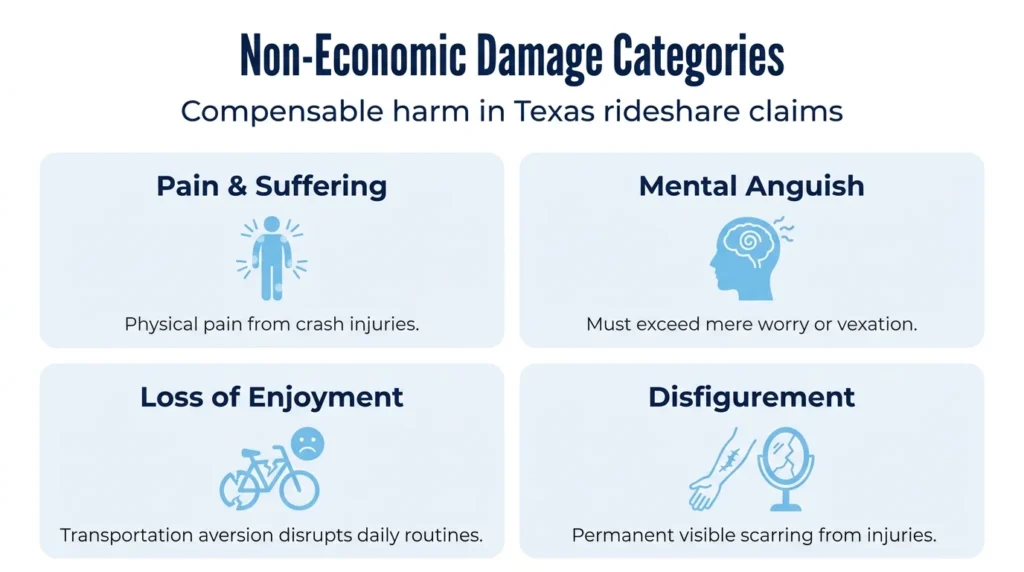
Texas recognizes non-economic harm well beyond your medical bills, and rideshare injury victims can pursue every category. The core categories are physical pain and suffering, mental anguish, loss of enjoyment of life, and disfigurement.
These losses sit alongside your economic damages in any Texas rideshare accident claim. They account for how the crash changed your daily life, not just your bank balance.
Rideshare cases carry a harm pattern that ordinary car wrecks often do not. Many victims develop a specific aversion to this type of transportation that disrupts commutes and daily routines.
That transportation anxiety qualifies as a distinct loss of enjoyment of life rather than a one-off symptom. It is itself documentable, and it deserves its own line in your demand, separate from general pain and suffering principles.
Mental anguish carries a higher bar under Texas law. Courts require proof of more than mere worry, anxiety, or vexation. The harm must be substantial enough to disrupt the claimant’s daily routine, a standard developed through Texas case law and applied alongside the noneconomic damages framework in Texas Insurance Code (CPRC) Chapter 41.
PTSD, recurring nightmares, and a diagnosed adjustment disorder documented by a treating provider satisfy that threshold.
How the Active Insurance Period Sets Your Recovery Ceiling
The coverage period active at the moment of impact caps every damage category in your claim, including pain and suffering. Texas Insurance Code Chapter 1954 sets four tiers for transportation network company drivers.
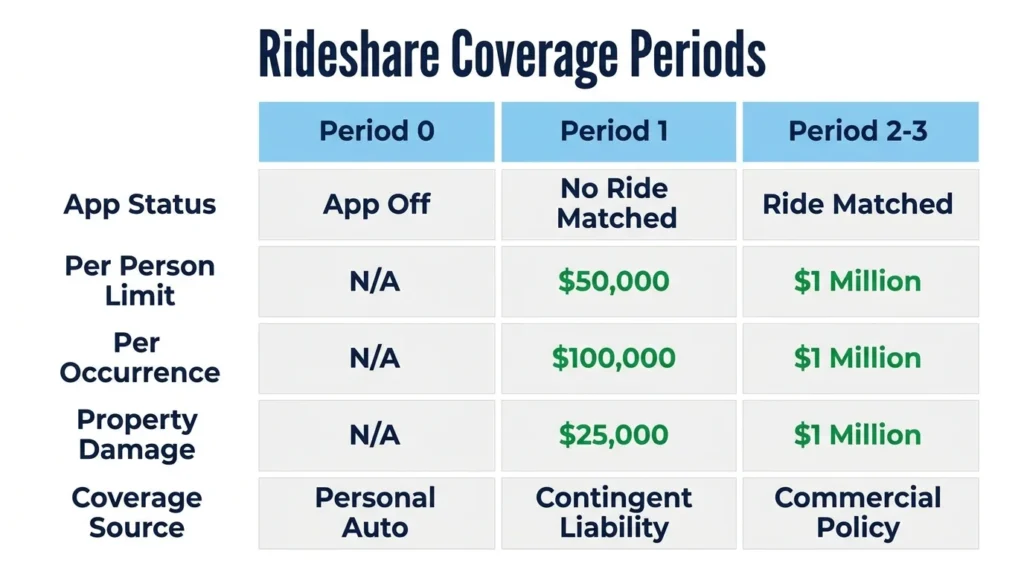
Period 0 means the app was off and only personal auto coverage applies. Period 1 means the app was on with no ride matched, triggering contingent liability of $50,000 per person, $100,000 per occurrence, and $25,000 property damage. Periods 2 and 3, when a ride is matched or a passenger is aboard, trigger the full $1 million commercial policy.
Each period changes what you can realistically recover. You can review Uber and Lyft insurance coverage periods for more information about how they work.
In a Period 1 crash, the $50,000 per-person ceiling applies to all damages combined. Medical expenses alone can consume that figure before any pain and suffering is ever addressed.
Periods 2 and 3 offer far more room. The $1 million policy gives serious injury cases meaningful headroom, though policy limits never equal automatic payment, and insurers still contest the value of subjective harm. Average outcomes vary widely.
Pinning down the active period requires timestamped trip data from Uber or Lyft. An attorney can retrieve that data through a preservation letter or discovery request before the evidence window closes.
How Pain and Suffering Damages Are Calculated
Adjusters and Texas courts use two primary valuation methods, and neither produces a fixed result. Both rely on the strength of your supporting evidence.
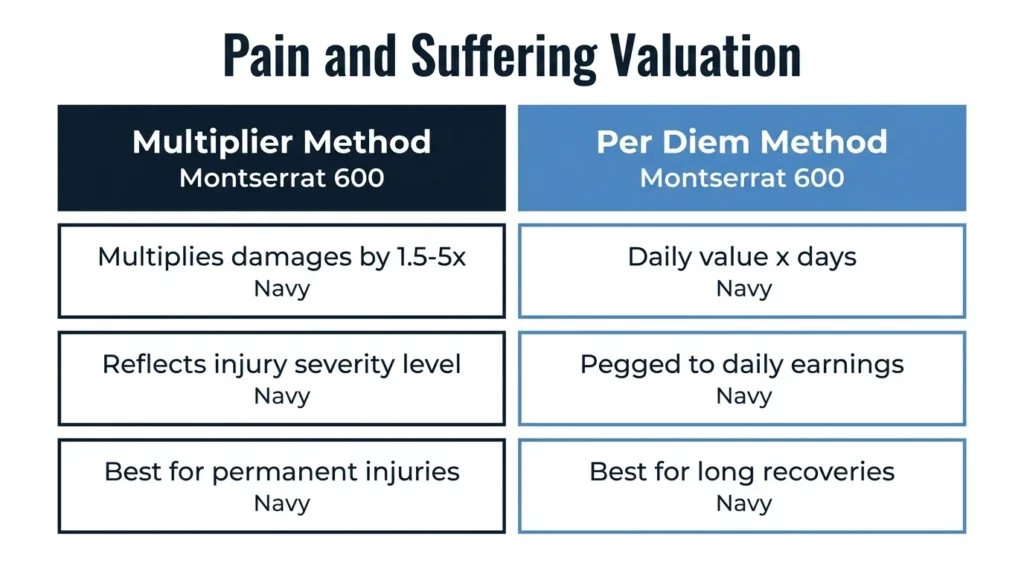
The multiplier method multiplies your total verifiable economic damages by a factor, typically between 1.5 and 5, to produce a non-economic figure. The number selected reflects injury severity, recovery length, and documentation quality. A permanent or ongoing condition commands a higher multiplier than a fully resolved soft-tissue injury.
The per diem method assigns a daily dollar value to your suffering, often pegged to your daily earnings, then multiplies it by the days from injury to maximum medical improvement. It tends to produce higher figures in long-recovery cases.
Dated pain journals, daily function logs, and treating provider notes give per diem figures a factual foundation that adjusters cannot dismiss as speculative. Insurers routinely attack non-economic figures as exaggerated, so knowing both methods helps you recognize when an offer ignores this type of harm entirely and why insurance companies underpay Texas claims.
Documenting Non-Economic Harm After a Rideshare Crash
Non-economic damages are won or lost at the documentation stage. A disciplined evidence record is what separates a paid claim from a denied one.
Start with physical injury records. Emergency room reports, diagnostic imaging, surgical notes, physical therapy records, and treating physician narratives that describe your pain and physical/functional limits form the foundation.
Mental health records matter just as much when you claim mental anguish. Evaluation and treatment records from a licensed psychologist, psychiatrist, or clinical social worker should diagnose the condition and tie it to the crash.
Keep a detailed pain and symptom journal. A dated daily log of pain levels, sleep disruption, activity limits, and emotional state is admissible evidence and feeds both valuation methods.
Document the transportation anxiety specifically. Records of cancelled commutes, avoidance of rideshare apps, therapy notes referencing vehicle aversion, and witness statements from family or coworkers all support that loss as a separately articulated component.
How Texas Comparative Fault Can Reduce or Bar Your Recovery
Texas proportionate responsibility rules apply in full to rideshare claims, and insurers raise fault arguments to shrink what they owe. Under the Texas Civil Practice and Remedies Code (CPRC) Chapter 33, your non-economic damages drop in light of your assigned fault.
A claimant found 20 percent at fault on a $200,000 non-economic award recovers $160,000. The math is unforgiving, and the percentage is contested in nearly every rideshare claim.
A harder limit lurks above that. A claimant found more than 50 percent responsible cannot recover any damages at all, economic or non-economic, making fault allocation a threshold issue.
Insurers know this and push for it. Uber and Lyft carriers frequently argue that a passenger distracted the driver, failed to buckle up, or rode despite known hazards.
Time is its own threshold. The two-year filing deadline under Texas Insurance Code (CPRC) Section 16.003 runs from the date of the crash.
Talk to an Experienced Attorney About Your Non-Economic Damages
A victim still in recovery who delays risks losing the right to pursue non-economic damages at all, so reviewing your options with our attorneys early protects the claim.
Angel Reyes & Associates has over 30 years of experience representing injury victims across Texas, with more than $1 billion recovered for clients. If you were hurt in an Uber or Lyft crash and face a settlement offer that ignores your pain, suffering, mental anguish, or transportation anxiety, we are here to help.
Our attorneys are available 24/7 for a free consultation, and there is no fee unless we win. Se habla espanol. Reach out to us today.
Past results do not guarantee future outcomes.
Pain and Suffering From Rideshare Accidents: FAQs
Does Texas cap pain and suffering damages in rideshare accident cases?
Texas does not impose a statutory cap on non-economic damages in personal injury cases arising from vehicle accidents, including rideshare crashes. Damage caps in Texas apply to medical malpractice claims and to punitive damages, not to pain, suffering, or mental anguish awards in standard negligence cases.
Can a rideshare passenger recover pain and suffering if the only harm was emotional?
Texas follows the impact rule, which requires a plaintiff to have sustained a physical injury to recover mental anguish as part of a negligence claim. A passenger who was not physically injured in the crash generally cannot bring a standalone emotional distress claim under Texas negligence law, though limited exceptions exist for bystanders who witness a close relative’s serious injury.
What if my pain and suffering stems from a pre-existing condition the crash made worse?
Under the eggshell plaintiff doctrine, a defendant in Texas is responsible for the full extent of harm caused, even if a pre-existing condition made the claimant more vulnerable to injury. Recovery is limited to the aggravation itself rather than the underlying condition, and Texas Pattern Jury Charge 8.5 instructs juries to exclude the pre-existing baseline while compensating for any worsening the crash produced.
Can my own uninsured or underinsured motorist coverage pay for pain and suffering?
Yes. Texas UM/UIM bodily injury coverage compensates for the same categories of harm available in a direct liability claim, including pain and suffering, mental anguish, and loss of enjoyment of life, up to your own policy limits. In rideshare cases where an at-fault driver carries no insurance or insufficient coverage, your personal UM/UIM policy and any UM/UIM coverage Uber or Lyft carries during active app phases can both serve as sources of recovery.
Does reporting the accident through the Uber or Lyft app affect a pain and suffering claim?
Reporting the crash through the app is a recommended step and does not by itself harm a claim. However, any descriptions of injury severity or fault provided in the in-app report can be reviewed by the insurer during the claims process, so victims should report the incident factually without characterizing their injuries or accepting any share of fault before consulting an attorney.
About the Authors

Angel Reyes
Writer
Angel L. Reyes, III is the Founder and Managing Partner of Angel Reyes & Associates. A nationally recognized trial attorney and business leader, Angel has helped over 70,000 injury victims recover more than $1 billion since founding the firm in 1993. Named to the Texas Super Lawyers list annually since 2008, Angel brings Wall Street experience, Ivy League education, and a deep commitment to client advocacy. He is a frequent legal commentator and published author with extensive contributions to legal scholarship, trial strategy, and consumer protection.

Kyle Nicolas
Editor
Kyle Nicolas is the Web Content & SEO Manager at Angel Reyes & Associates. He has more than 10 years of experience as a marketing co...

Angel Reyes
Reviewer
Angel L. Reyes, III is the Founder and Managing Partner of Angel Reyes & Associates. A nationally recognized trial attorney and business...