Common Car Accident Injuries in Texas


Every article on this site is researched by our internal team, reviewed for legal accuracy against current Texas law, and held to State Bar of Texas advertising standards before publication. We do not publish content that overstates outcomes or makes promises about results.
Learn more about our
editorial standards .
Key Takeaways
- TxDOT logged 251,977 Texas crash injuries and 18,218 classified as serious in 2024.
- Car accident injuries often include whiplash, brain injuries, fractures, and internal organ damage.
- Texas Civil Practice and Remedies Code § 18.001 lets affidavits prove medical costs were reasonable and necessary to treat injuries after car accidents.
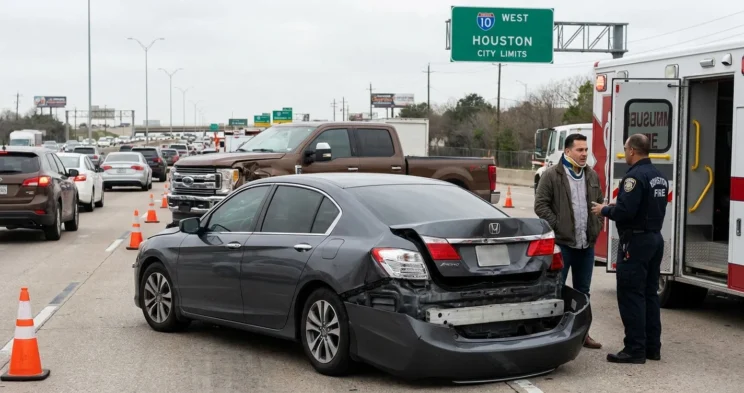
You’re driving home on Allen Parkway near downtown Houston when a truck rear-ends you at a red light. Your neck already aches, but adrenaline makes it hard to gauge the damage. Car accidents cause a wide range of injuries, and each one has its own warning signs and treatment path.
Whiplash & Spinal Cord Injuries
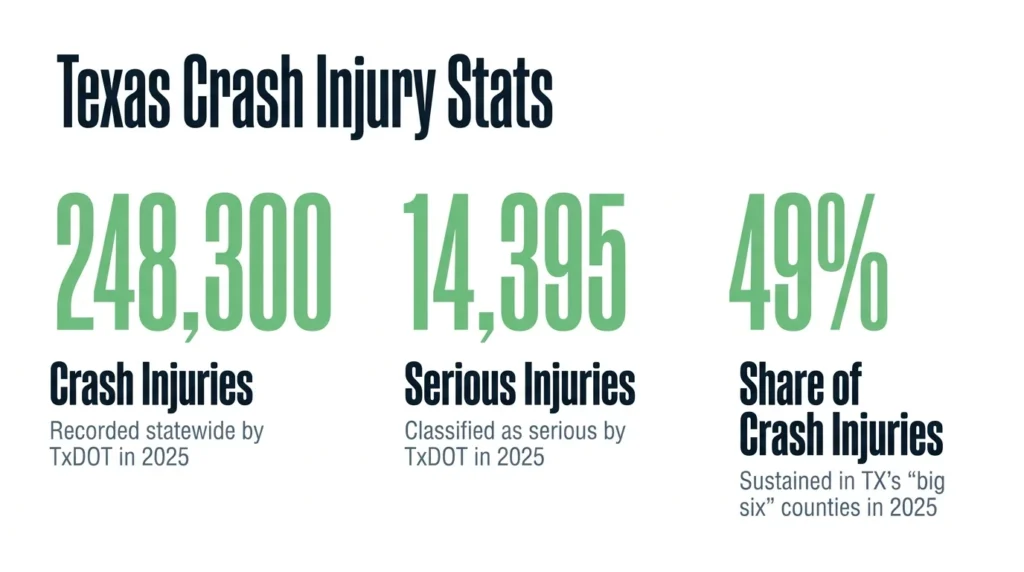
Whiplash and spinal injuries are among the most common results of a Texas crash. TxDOT recorded 248,300 crash injuries statewide in 2025. Of those, 14,395 were classified as serious, a category that covers fusions, brain injuries, and lasting impairment.
Pain related to neck and spinal injuries does not always show up right away. Delayed symptoms after car accidents are common, so it’s important to know the types of injuries that may occur.
Whiplash & Neck Injuries
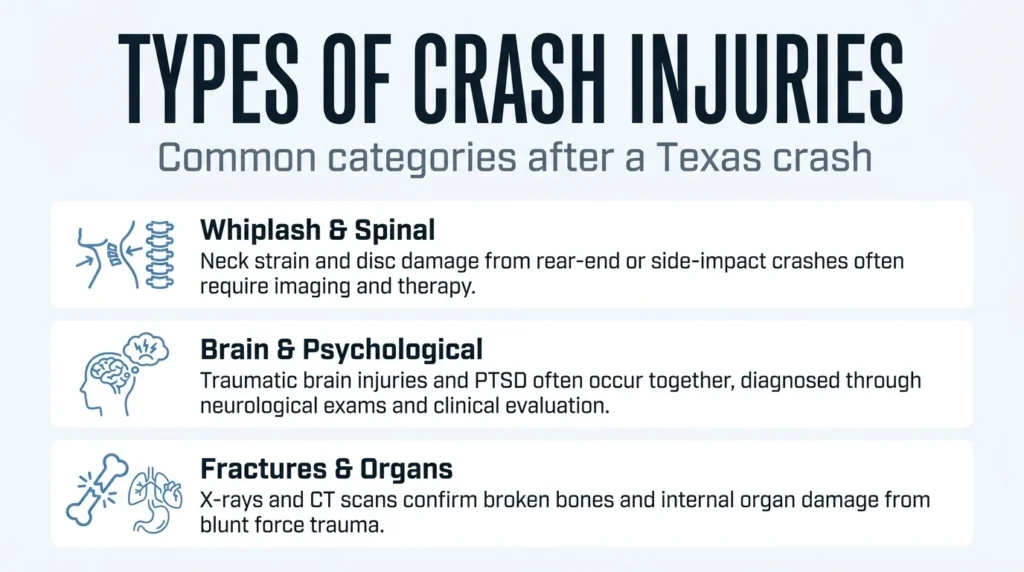
Whiplash happens when a rear-end crash snaps your head forward, then back. Your neck muscles can’t brace fast enough, and the sudden motion tears muscles, ligaments, and tendons.
Doctors diagnose it based on your symptoms and a physical exam. Signs include neck pain, stiffness, headaches at the base of the skull, and trouble turning your head. A doctor may order imaging like an X-ray or MRI if the exam suggests something more serious.
Treatment usually starts with physical therapy and over-the-counter pain relief. Cases that don’t improve within a few weeks often move to prescription medication or injections. That escalation shows an insurer the injury was not minor.
A treatment record should track this progression: therapy notes, medication changes, and any injections. That record turns a sore neck into documented proof of a real injury.
Spinal Cord & Disc Damage
A herniated disc happens when crash impact ruptures the cushioning between two vertebrae. Disc material then presses on a nearby nerve. Side impact and T-bone crashes are especially likely to cause this, since the force compresses the spine sideways instead of front to back.
Because X-rays don’t show soft tissue like disc material, doctors confirm disc and spinal cord injuries with a neurological exam and an MRI. Symptoms include:
- Shooting pain down an arm or leg
- Numbness
- Tingling
- Loss of motor control, in severe cases
Treatment for a herniated disc ranges from physical therapy to epidural injections. A spinal cord injury that affects movement or feeling may require surgery. Surgical cases, including spinal fusion, are part of why Texas classifies thousands of crash injuries as serious every year.
An MRI report, a neurologist’s findings, and a documented treatment plan establish how serious a spinal injury really is to support your claim.
Brain Injuries & Psychological Trauma
Traumatic brain injury (TBI) and the psychological trauma that follows it often go hand in hand after a serious crash. Motor vehicle crashes are among the leading causes of TBI-related emergency department visits nationally. Rates are especially high for people aged 15 to 44.
Traumatic Brain Injuries
A TBI happens when a violent jolt or direct head impact shakes the brain inside the skull. Even a crash that leaves no visible mark can cause this kind of harm.
Doctors diagnose a TBI through a neurological exam, cognitive testing, and CT scans or MRIs. Symptoms include confusion, memory problems, severe headaches, and light sensitivity.
Mild concussions often improve with rest and monitoring over a few weeks. More severe injuries require neurorehabilitation, sometimes for months. That longer treatment path is itself evidence of how serious the injury was.
Imaging results, a specialist’s diagnosis, and a documented treatment timeline turn a claimed brain injury into a proven one.
Psychological Trauma & PTSD
The trauma of the crash itself, not a physical blow, can cause PTSD, anxiety, and depression. Flashbacks, nightmares, and a fear of driving are common signs.
A licensed mental health provider diagnoses these conditions through clinical evaluation. Treatment typically involves therapy and, in some cases, medication. That diagnosis and treatment history prove the injury is real, even when it doesn’t show up on a scan.
Chronic pain from a crash often compounds the psychological toll. Chronic pain that does not resolve after a crash raises its own compensation questions, separate from the diagnosis itself.
Fractures & Internal Organ Damage
Broken bones and internal organ damage are both forms of blunt force trauma. Both usually need imaging to confirm how serious they are.
Broken Bones & Fractures
Fractures happen from direct impact with the steering wheel, dashboard, or door, or from bracing against the crash. Ribs, collarbones, wrists, and ankles are among the most commonly broken bones.
An X-ray or CT scan confirms the fracture. Imaging also shows whether it is a simple break or one that has damaged nearby organs or tissue. Treatment ranges from a cast for a simple fracture to surgical fixation with plates or screws for a complex one.
A fracture that requires surgery, or that leaves lasting limitations, often becomes central to a Texas car accident claim. That kind of record shows the injury changed your daily life, not just caused temporary pain.
Internal Organ Damage
Blunt trauma to the abdomen or chest can damage the spleen, liver, kidneys, or lungs. This can come from the crash itself, or from a seatbelt during a hard stop.
These injuries are especially dangerous because symptoms can take time to appear. Belly pain, dizziness, and a rapid heart rate can develop while internal bleeding continues. Doctors rely on imaging and vital sign monitoring to catch this, especially when you look otherwise uninjured.
Treatment ranges from observation and rest to emergency surgery. The right approach depends on how much bleeding occurred and which organ was affected. Imaging that shows organ-specific damage, combined with the emergency treatment record, proves how severe the injury really was.
Proving Injury Severity as Evidence
All car crash injuries depend on the same thing to hold up in a claim: a medical record that clearly shows what happened. Under Texas Civil Practice and Remedies Code (CPRC) § 18.001, a medical provider’s affidavit can establish that billed treatment was reasonable and necessary. Live testimony at trial isn’t necessary—just the doctor’s written statement.
The other side can respond with a counter-affidavit. That counter-affidavit must come from a qualified expert who disputes part of the record.
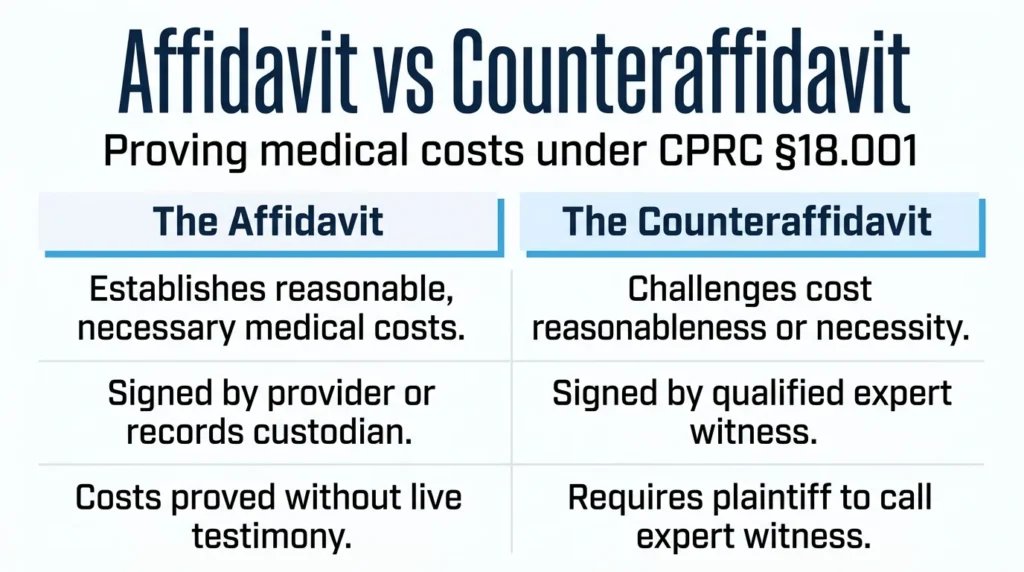
CPRC § 18.001 only addresses whether treatment was reasonable and necessary. Thorough documentation after a car accident gives medical providers and affiants a clear, dated record to work from.
However, this statute doesn’t decide who caused the crash or who ultimately pays the bill. Sorting out who pays for treatment after a car accident is a separate question from proving how serious the injury was. Good documentation makes the process of establishing fault easier, and working with an experienced lawyer gives you someone on your side to handle the claim while you focus on recovery.
Work with a Texas Injury Attorney
Insurance companies look for reasons to pay less. This is especially true for injuries like whiplash or psychological trauma that don’t always show up on a scan. Angel Reyes & Associates has spent more than 30 years fighting for Texas crash victims, building documented, evidence-backed cases.
You pay nothing unless we win your case. Our case results reflect decades of holding insurers accountable for injuries they tried to minimize, and we’ve recovered over $1 billion for our clients.
If you are dealing with any of the injuries covered here, contact us for a free case review.
Past results do not guarantee future outcomes.
Car Accident Injury FAQs
What does "suspected serious injury" mean in Texas crash data?
It is TxDOT’s classification for the injury tier directly below a fatality. TxDOT switched to this term from “incapacitating injury” starting with 2010 crash reports.
Does a car accident injury claim still work if I had a pre-existing condition?
Yes. Texas jury instructions require the at-fault driver to pay for any worsening of a pre-existing condition, even if the resulting harm is more severe than expected.
Does a CPRC § 18.001 counter-affidavit have to come from a medical doctor?
No, Texas law only requires the counter affiant to be qualified by knowledge, skill, experience, training, or education. They do not need the same medical credentials as the original affiant.
How much time does the other side have to file a § 18.001 counter affidavit?
Texas law generally allows up to 120 days after the defendant’s answer is filed to serve a counter affidavit, though earlier expert-designation deadlines can shorten that window.
What insurance covers car accident injuries in Texas?
The at-fault driver’s bodily injury liability coverage pays for injuries they caused. Texas requires minimum coverage of $30,000 per person and $60,000 per accident.
Personal Injury Protection (PIP) coverage pays medical bills regardless of fault, but only if someone purchased PIP. Many Texas drivers decline PIP coverage to reduce premium costs.
About the Authors

Angel Reyes
Writer
Angel L. Reyes, III is the Founder and Managing Partner of Angel Reyes & Associates. A nationally recognized trial attorney and business leader, Angel has helped over 70,000 injury victims recover more than $1 billion since founding the firm in 1993. Named to the Texas Super Lawyers list annually since 2008, Angel brings Wall Street experience, Ivy League education, and a deep commitment to client advocacy. He is a frequent legal commentator and published author with extensive contributions to legal scholarship, trial strategy, and consumer protection.

Kyle Nicolas
Editor
Kyle Nicolas is the Web Content & SEO Manager at Angel Reyes & Associates. He has more than 10 years of experience as a marketing co...

Angel Reyes
Reviewer
Angel L. Reyes, III is the Founder and Managing Partner of Angel Reyes & Associates. A nationally recognized trial attorney and business...