What Is the Average Settlement for Being Rear-Ended by a Commercial Truck?


Every article on this site is researched by our internal team, reviewed for legal accuracy against current Texas law, and held to State Bar of Texas advertising standards before publication. We do not publish content that overstates outcomes or makes promises about results.
Learn more about our
editorial standards .
Key Takeaways
- Texas law presumes the trailing truck driver failed to keep a safe following distance.
- Carriers dispute fault by citing sudden stops, brake failure, or a loaded rig's stopping distance.
- Settlement ranges climb with severity, from whiplash claims to seven-figure spinal cord injuries.
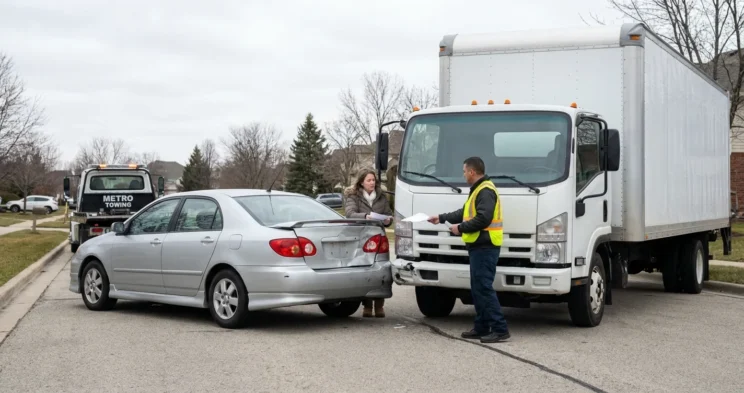
You are stopped at a red light along I-45 in Houston when a loaded tractor-trailer crashes into the back of your car. Your neck already aches, and within a day, an adjuster is calling it a minor bump.
You want to know if the truck driver is automatically at fault and what your claim might actually be worth. The answers depend on how Texas law treats rear-end crashes and the evidence showing your losses.
Why Rear-End Truck Crashes Presume Fault
A rear-end crash can be evidence that the trailing driver followed too closely, although the collision alone does not automatically establish negligence. Under Texas Transportation Code § 545.062, drivers must leave enough space to stop safely behind the vehicle ahead.
When a commercial truck hits you from behind, the evidence will often focus on whether its driver maintained a safe following distance and reacted in time. The trucking company may still argue that another factor caused the crash, but it must support that explanation with evidence.
NHTSA’s research on rear-end crashes and near-crashes backs this up. Most rear-end crashes happen because the trailing driver reacts late, often due to distraction, rather than simply following too closely. Driver attention, following distance, speed, and braking records may all help establish fault in a rear-end collision claim.
What Gets Disputed After a Rear-End Crash
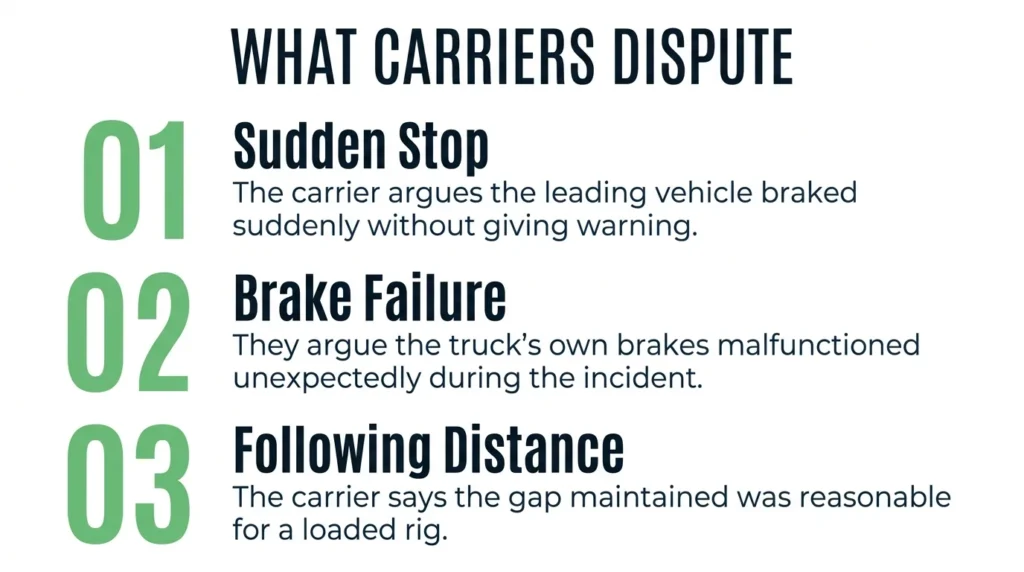
A truck driver or carrier may still dispute fault after a rear-end crash. Common arguments include that the vehicle ahead stopped suddenly, the truck’s brakes failed, or the driver left what seemed like a reasonable following distance for a loaded rig. Evidence showing how following distance contributed to the crash can help determine whether any of these arguments hold up.
A loaded tractor-trailer needs far more room to stop than a car does. The Large Truck Crash Causation Study documents how brake problems and driver error contribute to large truck crashes. Evidence from the truck itself can help determine whether the driver left enough room to stop safely.
In some cases, both drivers may share responsibility. Under Texas Civil Practice and Remedies Code § 33.001, you cannot recover compensation if you are found 51% or more at fault.
If you are found 50% or less at fault, your recovery is reduced by your percentage of responsibility. Knowing how Texas’s 51% rule affects your compensation can help you evaluate a settlement offer.
Common Injuries in Rear-End Truck Accidents
Common injuries include whiplash, spinal injuries, traumatic brain injury, broken bones, internal injuries, and post-traumatic stress disorder.
Insurers often label this neck-and-spine pattern as routine “soft tissue” damage. That label can apply regardless of how severe your symptoms actually are. If your neck or back pain lingers, ask about a whiplash and neck injury evaluation.
Settlement Value by Injury Severity
Reported 18-wheeler accident settlement amounts in Texas vary widely by injury type and severity. These are commonly reported ranges drawn from personal injury and law firm case data, not official government statistics.
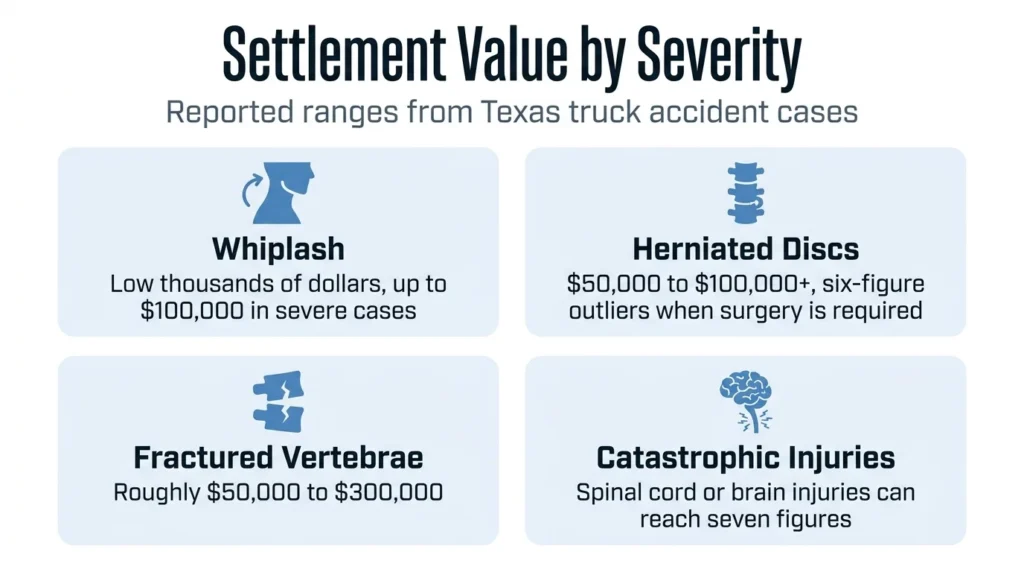
- Whiplash and soft tissue injuries: typically the low thousands of dollars, up to roughly $100,000 in more severe cases.
- Herniated cervical discs: commonly $50,000 to $100,000 or more, with six-figure outliers when surgery is required.
- Fractured vertebrae: roughly $50,000 to $300,000.
- Catastrophic spinal cord or brain injuries: these claims can reach seven figures.
Several factors affect where a case falls within its range, including property damage, injury severity, medical expenses, lost wages, pain and suffering, comparative fault, insurance coverage, and the quality of legal representation.
Federal rules require certain motor carriers to carry minimum levels of liability insurance. That coverage may provide a source of compensation, but it does not determine the value of your claim.
Is an Employer Liable for an Employee’s Accident?
A trucking company is generally liable for a driver’s crash when it happens within the scope of employment. If the driver was making a delivery or otherwise doing their job, the company is responsible alongside the driver.
A driver on a personal errand, unrelated to work duties, is the main exception. In that case, liability may fall on the driver alone. Determining employer liability when an employee causes a crash requires looking at what the driver was doing and whether the company exercised control over that work.
Work with a Truck Accident Attorney
Angel Reyes & Associates has represented injured Texans in commercial truck accident claims for more than 30 years. We have recovered more than $1 billion for our clients, and we work on contingency, so you pay no attorney fees unless we win.
A rear-end crash with a commercial truck moves fast, and insurers often move faster. Let us review your claim and explain your options at no cost to you. Contact us today for a free consultation.
Past results do not guarantee future outcomes.
Rear-End Truck Claim FAQs
How long do I have to file a claim after being rear-ended by a commercial truck in Texas?
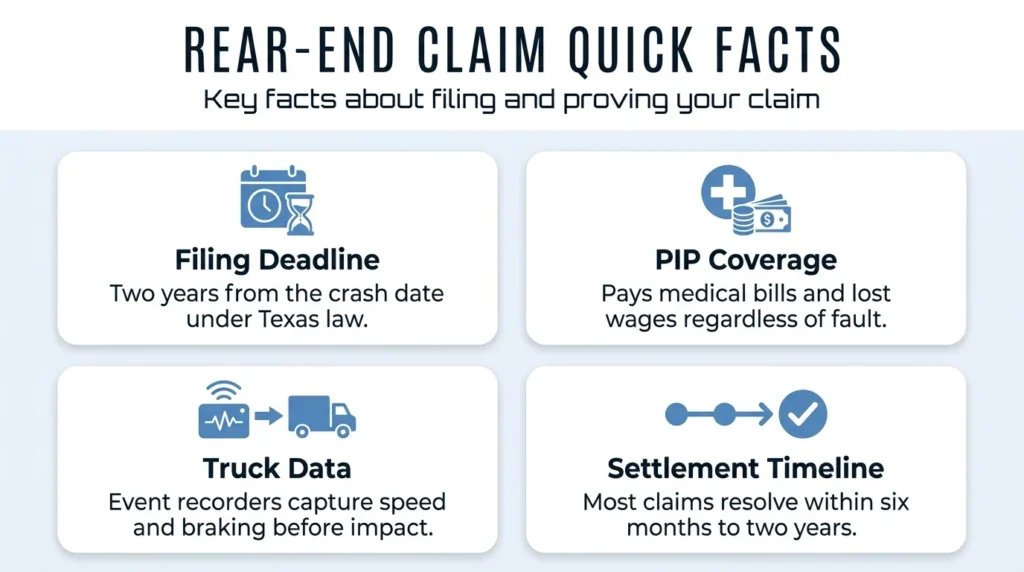
Texas law gives you two years from the date of the crash to file a personal injury lawsuit under Civil Practice and Remedies Code Section 16.003. Missing that deadline usually means losing your right to sue, even with strong evidence of fault.
Will my own car insurance pay my medical bills while the truck accident claim is pending?
If you carry Personal Injury Protection, which Texas insurers must offer unless you reject it in writing, it can cover medical bills and lost wages right away, regardless of fault. That coverage can pay out before any settlement is reached with the trucking company’s insurer.
How does data from the truck itself help prove what happened in a rear-end crash?
Many commercial trucks store event data recorder information, including speed, braking, and engine activity, in the seconds before a crash. That data can show whether the driver braked too late or was speeding, independent of what the driver later claims happened.
Can the trucking company's insurer use my pre-existing neck or back condition to deny my claim?
An insurer can point to a prior injury to question how much of your current pain is new, but Texas law still lets you recover for any aggravation or worsening of an existing condition. The trucking company remains responsible for the difference between your condition before and after the crash.
How long does it typically take to settle a commercial truck accident claim?
Many claims resolve within six months to two years, depending on how quickly injuries stabilize and how much evidence and negotiation the case requires. Cases with serious or long-term injuries tend to take longer because full medical treatment must be documented before a fair value can be set.
About the Authors

Alex Ivanov
Writer
Alex Ivanov is a personal injury attorney at Angel Reyes & Associates, focused on car, truck, and motorcycle accident cases. Licensed in Texas and multiple federal districts, Alex brings international legal experience and a global education to his practice. He earned his LL.M. from Texas A&M University School of Law after graduating from Belarussian State University in 2016. Alex is fluent in Russian, English, Ukrainian, and Belarussian, and is recognized by multiple national trial lawyer associations for his results and leadership under 40.

Kyle Nicolas
Editor
Kyle Nicolas is the Web Content & SEO Manager at Angel Reyes & Associates. He has more than 10 years of experience as a marketing co...

Angel Reyes
Reviewer
Angel L. Reyes, III is the Founder and Managing Partner of Angel Reyes & Associates. A nationally recognized trial attorney and business...