Shuttle Bus Accidents in Texas


Every article on this site is researched by our internal team, reviewed for legal accuracy against current Texas law, and held to State Bar of Texas advertising standards before publication. We do not publish content that overstates outcomes or makes promises about results.
Learn more about our
editorial standards .
Key Takeaways
- Texas shuttle operators are common carriers and owe passengers the highest degree of care.
- You have two years to sue a private shuttle operator, but six months to notify a government one.
- A shuttle passenger can still recover damages if their share of fault is 50 percent or less.
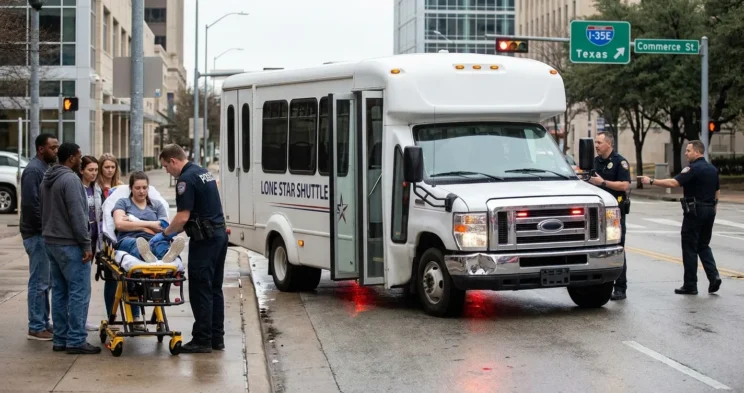
You boarded the hotel shuttle near the Galleria, tired after a long trip and ready to reach your room. The driver braked hard for a light on Westheimer Road, and you were thrown forward against the seat in front of you. Now your neck hurts, the bills are coming in, and you are not sure who you can even hold responsible.
Common Carrier Duty in Texas Shuttle Cases
Texas courts have long recognized shuttle bus operators as common carriers, which means they owe you the highest degree of care consistent with the practical operation of the vehicle, a standard that sits well above the ordinary care most drivers owe.
That duty comes from decades of Texas common law, preserved and reinforced by Texas Transportation Code Chapter 5, which prevents carriers from contracting away their common-law obligations.
In practice, a common carrier must do everything a very careful operator would do to keep you safe. That includes training drivers properly, maintaining the vehicle, and providing safe conditions for boarding and getting off.
Breaches show up in familiar ways. A sudden unexplained stop, unsecured luggage, worn or slippery steps, or a driver who was never properly vetted can all signal a failure of that duty. When the operation rises to a bus and passenger carrier service, this heightened standard governs how the claim is judged.
Some shuttles answer to federal rules too. Airport and hotel shuttles that meet certain thresholds fall under federal passenger carrier regulations, which set minimum insurance and safety requirements on top of Texas law.
Who Is Liable in a Shuttle Bus Accident?
The shuttle operator that employs the driver is usually the primary defendant, because the common carrier standard applies to it directly. But the business that hired or hosted that shuttle often carries its own separate exposure, and that second layer depends on the type of operation.
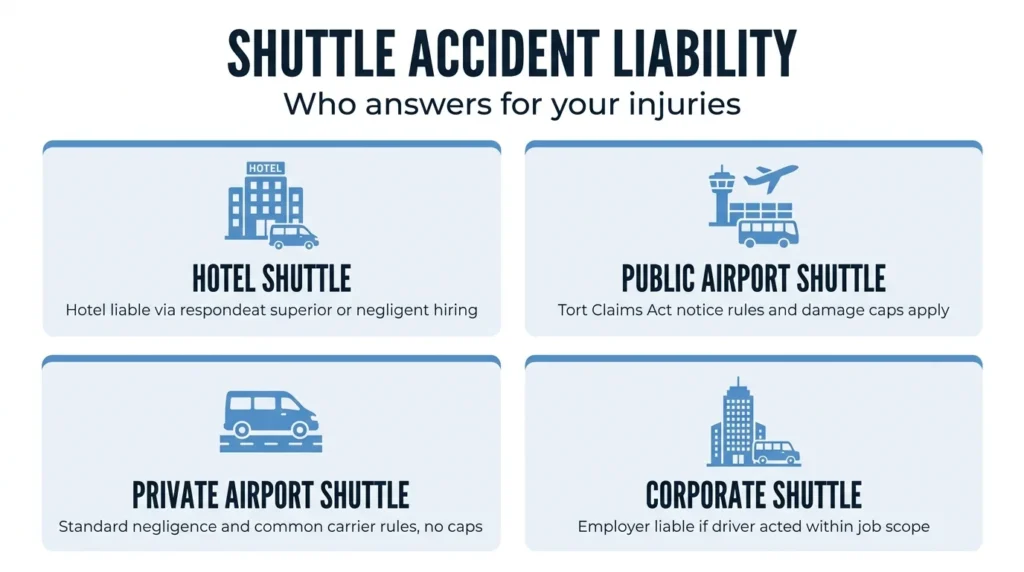
Hotel & Airport Shuttle Liability
Hotels and airports follow a similar pattern, but they differ sharply on the host side. A hotel usually owns or contracts the shuttle outright, while an airport may bring a government authority into the picture.
When a hotel employs the driver, the hotel is often responsible for that driver’s conduct under a rule called respondeat superior. If the driver is an independent contractor instead, the hotel may still face liability for negligent hiring. These claims can overlap with property owner safety duties when an unsafe loading area contributed to your injury.
Airport shuttles are trickier. A shuttle run by a public airport authority can trigger the Texas Tort Claims Act, which gives up the government’s usual immunity only under specific conditions and adds strict notice rules and damage caps, or limits. A private company that merely contracts with an airport is not a government entity, so claims against it proceed under standard negligence and common carrier rules with no caps.
Corporate Shuttle Liability
An employer that buses workers to a job site owes a duty under respondeat superior, because it is both the host and the operator. If the driver caused your crash while working within the scope of the job, the employer is jointly responsible for your injuries.
Federal rules can apply here as well, since employer-related transportation is regulated when it meets certain conditions. A third party who hits the shuttle is liable under ordinary negligence, and the shuttle company can still owe you regardless of how fault is split between the two vehicles.
When another motorist is involved, the principles behind ordinary Texas car accident claims help sort out that driver’s share of fault.
Filing Deadlines & Government Entity Rules
You generally have two years from the date of your injury to sue a private shuttle operator. That deadline comes from Texas Civil Practice and Remedies Code (CPRC) § 16.003, and missing it almost always ends your claim for good.
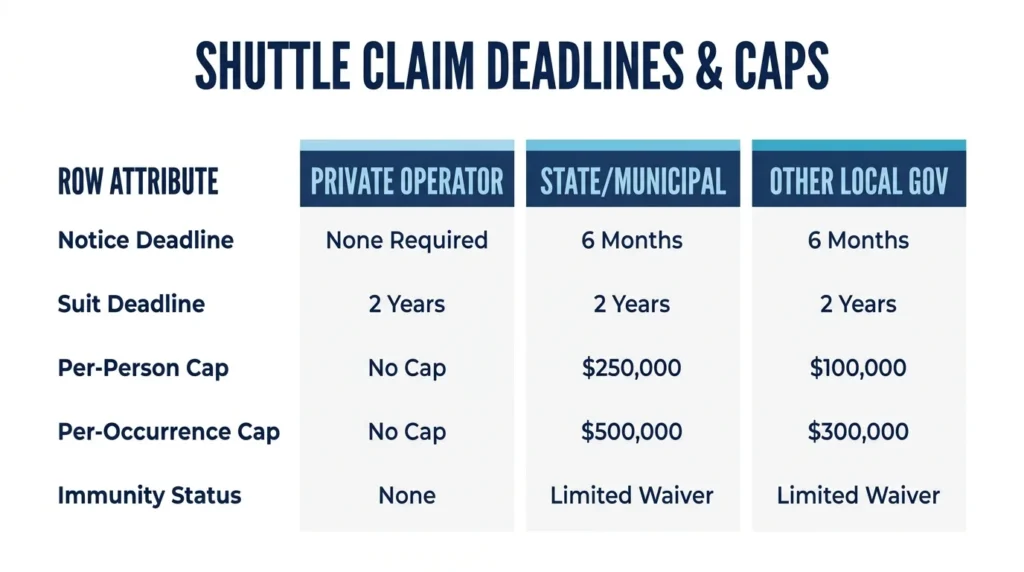
Government-operated shuttles run on a faster clock. Under the Texas Tort Claims Act, you must give the government entity written notice within six months of the incident, well before the two-year suit deadline. Some Houston-area entities enforce an even shorter 90-day notice window.
The Tort Claims Act also limits what money you can recover from a government entity. For claims against the state or a municipality, those limits are $250,000 per person and $500,000 per occurrence under Texas Civil Practice and Remedies Code Chapter 101. For other units of local government (such as a county or a transit or airport authority that is not a city), the caps are lower: $100,000 per person and $300,000 per occurrence. Private operators face no such cap.
If you thought you were riding a private shuttle but it was actually run under a government contract, verify that status right away. Misreading the entity type can quietly forfeit your notice rights.
Comparative Fault & Shuttle Injury Claims
You can still recover money even if you were partly at fault, as long as your share is 50 percent or less. Under Texas Civil Practice and Remedies Code Chapter 33, your compensation is simply reduced by your percentage of fault.
Expect the defense to push that percentage up. Common arguments are that you were not seated when the vehicle moved, that you added to overcrowding, or that you ignored a warning from the driver.
The common carrier standard works in your favor here. Because the operator owes the highest duty of care, its conduct gets scrutinized first, which makes attempts to shift blame onto you harder to sustain. Passengers weighing their options can review how courts handle liability in a Texas bus accident across several parties.
Coverage matters to your bottom line. Texas Transportation Code Chapter 601 requires shuttle operators to carry minimum insurance, and any gap between that coverage and your actual damages can shape settlement talks.
Speak to an Attorney About Your Case
Angel Reyes & Associates has spent more than 30 years handling Texas bus and passenger carrier injury claims across the state. We have more than $1 billion recovered for clients, and we take shuttle accident cases on a contingency basis, which means no fee unless we win. Our track record is reflected in our case results and in what our clients say about working with us.
Reach out for a free consultation and we will help you identify the right defendants and the deadlines that apply to your claim.
Past results do not guarantee future outcomes.
Shuttle Bus Accident FAQs
Does a Texas shuttle bus driver need a commercial driver's license?
A shuttle driver operating a vehicle designed to carry 16 or more passengers (including the driver) must hold a CDL with a passenger endorsement under federal and Texas rules. Smaller shuttles below that seat threshold may not require a CDL, but a driver who lacks the required license when the crash occurs strengthens a negligent-hiring argument against the operator.
What happens if a family member was killed in a Texas shuttle bus accident?
Under Texas Civil Practice and Remedies Code Chapter 71, a surviving spouse, child, or parent may file a wrongful death claim against the responsible party. If the shuttle was government-operated, the same Texas Tort Claims Act caps that apply to injury claims apply here: $250,000 per person and $500,000 per occurrence.
Can an employee injured on a corporate shuttle collect workers' compensation and still sue the shuttle operator?
If your employer carries Texas workers’ compensation coverage, that coverage is typically the exclusive remedy against the employer for on-the job injuries, including shuttle rides to a job site. You may still file a separate personal injury claim against a third party, such as a driver from another vehicle who caused the crash, to recover damages workers’ comp does not cover.
How long does a child have to file a claim after being injured on a Texas shuttle?
When a minor is injured, the two-year filing deadline is paused until the child turns 18, giving the child until their 20th birthday to file. Parents, however, must bring their own claims for medical expenses within two years of the accident, because those costs belong to the parents.
What evidence should you try to preserve right after a Texas shuttle bus accident?
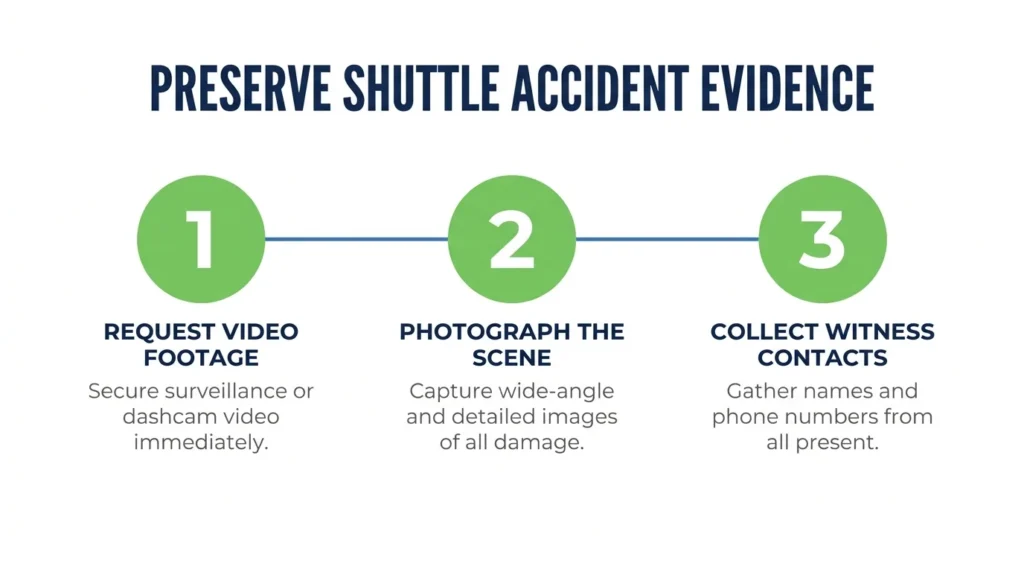
Request any onboard or external surveillance footage as quickly as possible, because carriers typically overwrite, or delete, video within 30 to 72 hours. Photograph the interior, the vehicle number, and any visible defects, and collect contact information from witnesses before leaving the scene.
About the Authors

Angel Reyes
Writer
Angel L. Reyes, III is the Founder and Managing Partner of Angel Reyes & Associates. A nationally recognized trial attorney and business leader, Angel has helped over 70,000 injury victims recover more than $1 billion since founding the firm in 1993. Named to the Texas Super Lawyers list annually since 2008, Angel brings Wall Street experience, Ivy League education, and a deep commitment to client advocacy. He is a frequent legal commentator and published author with extensive contributions to legal scholarship, trial strategy, and consumer protection.

Graham Griffin
Editor
Graham Griffin is the Web & Content Manager at Angel Reyes & Associates, where he oversees content strategy, AI-powered workflows, a...

Spencer Browne
Reviewer
Spencer Browne is a partner at Angel Reyes & Associates and a Board Certified personal injury trial lawyer with nearly 100 jury trials a...