Texas Bus Accident Guide for Pedestrians


Every article on this site is researched by our internal team, reviewed for legal accuracy against current Texas law, and held to State Bar of Texas advertising standards before publication. We do not publish content that overstates outcomes or makes promises about results.
Learn more about our
editorial standards .
Key Takeaways
- Being outside a crosswalk does not automatically dismiss your Texas bus injury claim.
- If you are found to be 50% or less at fault for an accident in Texas, then your compensation is reduced, not dismissed.
- Claims against a city bus like METRO or DART often require notice within six months of the crash.
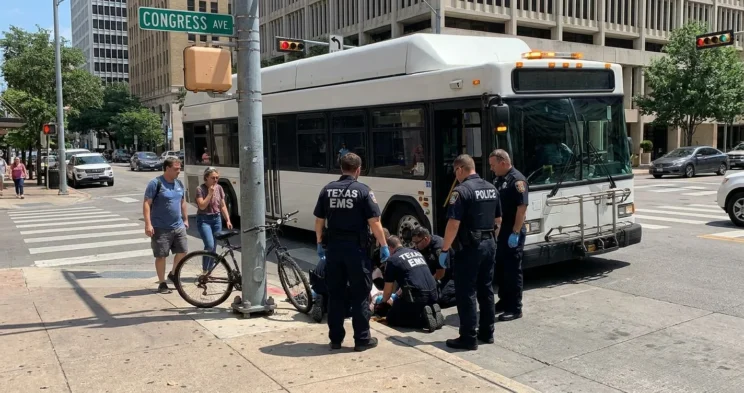
You stepped off the curb near Houston’s Museum District after a long shift, focused on getting home, when a city bus turning through the intersection struck you unexpectedly. Now, you are facing injuries and medical bills you never planned for, and you’re worried that you were not in the crosswalk when it happened. You are not sure who is responsible or if you can even recover any damages.
Who Is Liable for a Pedestrian Bus Accident?
Liability for a pedestrian bus accident depends on who was operating the bus. A city transit agency (like Houston’s METRO, Dallas’s DART, or San Antonio’s VIA) follows one set of rules. A private charter, tour, or shuttle company follows another.
Who was operating the bus determines which deadlines and standards apply to your bus accident claim. A privately operated bus generally follows ordinary negligence rules, which is how liability works in most Texas bus accidents.
However, a government-operated bus follows the Texas Tort Claims Act. This law has its own deadlines and limits. You can still sue a government-operated transit system, but suing public transportation has stricter requirements than an ordinary claim.
If you share some of the blame for the accident, this does not automatically dismiss your claim. Under the Texas Civil Practice and Remedies Code (CPRC) § 33.012, your recovery is reduced by your percentage of fault instead.
Common Carrier Duty of Care for Pedestrians
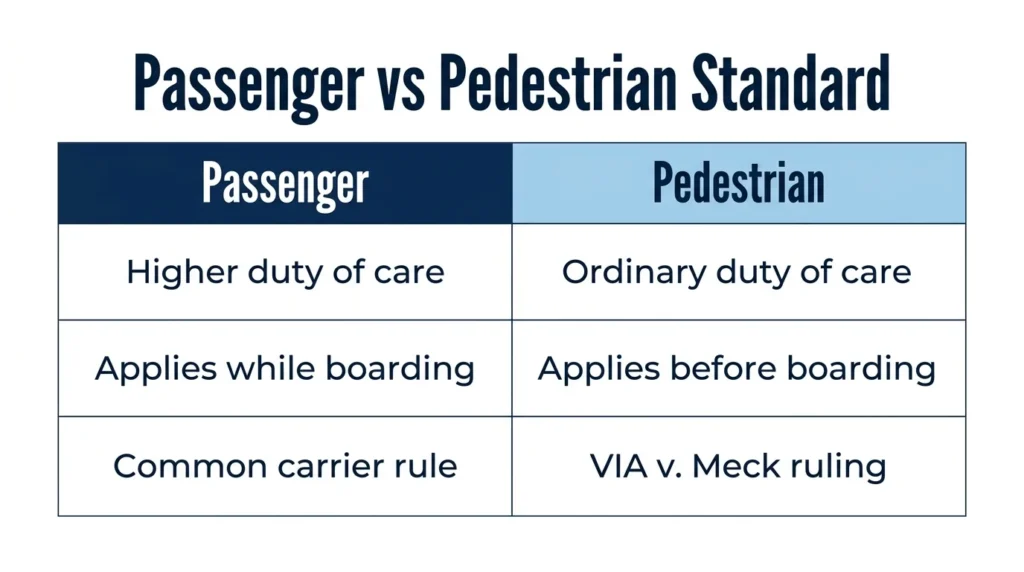
Texas holds buses to a higher standard of care to protect their passengers, but this does not apply to everyone near the road. Whether the standard applied to you depends on where you were located in relation to the bus when you were hit.
If You Were A Passenger
Texas courts hold buses that operate as common carriers (a vehicle that transports citizens, such as a bus, train, taxi, or airline) to a higher standard of care to protect their passengers. This standard is in effect from the moment you board the bus until the moment you safely step off the bus.
If You Were A Pedestrian
If you were on foot and never boarded the bus, then the bus owed you an ordinary standard of reasonable care, not the higher standard of care reserved for passengers. In VIA Metropolitan Transit v. Meck, the Texas Supreme Court confirmed that the higher standard of care only applies to passengers from boarding through safe exit of the bus. The higher standard of care does not extend to pedestrians who were never onboard the bus.
However, the ordinary standard of care is still important. If a driver knows that pedestrians are nearby—especially children close to a bus stop or school crossing—the driver must take extra care to avoid them. A driver who ignores this risk may be liable for any injuries that follow.
If You Were Outside A Crosswalk
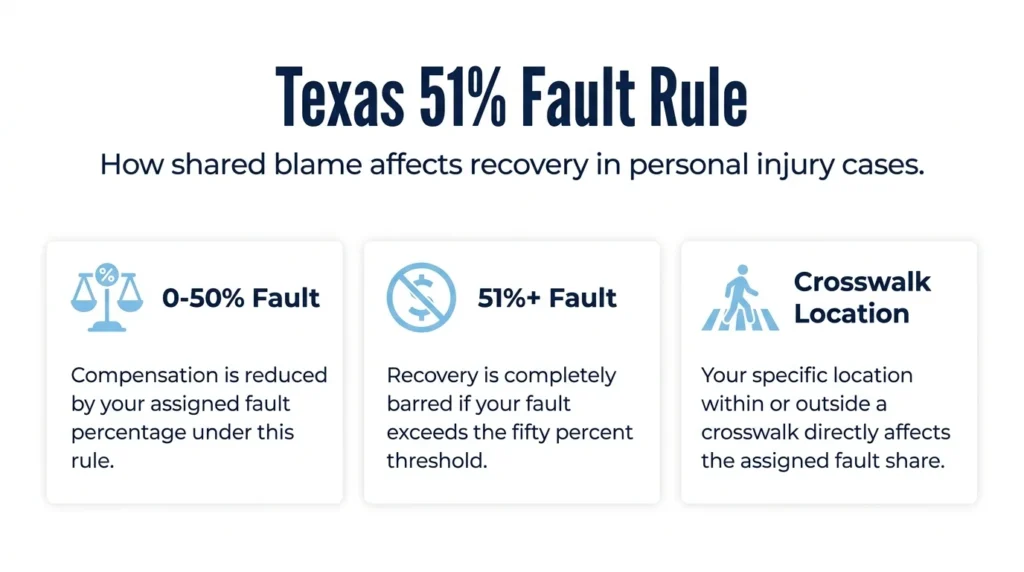
If you were outside a crosswalk when a bus hit, your claim is not automatically dismissed. It does change how much fault you are assigned, but you can likely still recover damages.
In a marked crosswalk, you generally have the legal right of way under the Texas Transportation Code § 552.003. A bus driver who fails to yield in a crosswalk is often at fault on that basis alone. The rules for pedestrian right of way in Texas explain when this protection applies.
However, if you step outside the crosswalk, then the court may decide you were partially at fault for the accident. Texas dismisses your recovery only if your share of fault is more than 50%, under CPRC § 33.001. If you are 50% or less at fault, then your compensation is reduced by your percentage of fault, but you can still recover damages. Learn more about how the Texas 51% fault rule actually applies to your case.
Just because you were standing outside a crosswalk, you may not be totally at fault. However, insurers for bus companies often argue that because you were standing outside the crosswalk, you were mostly to blame for the accident, so documenting exactly where the collision happened can protect your share of the recovery.
City Bus Accident Claims in Texas
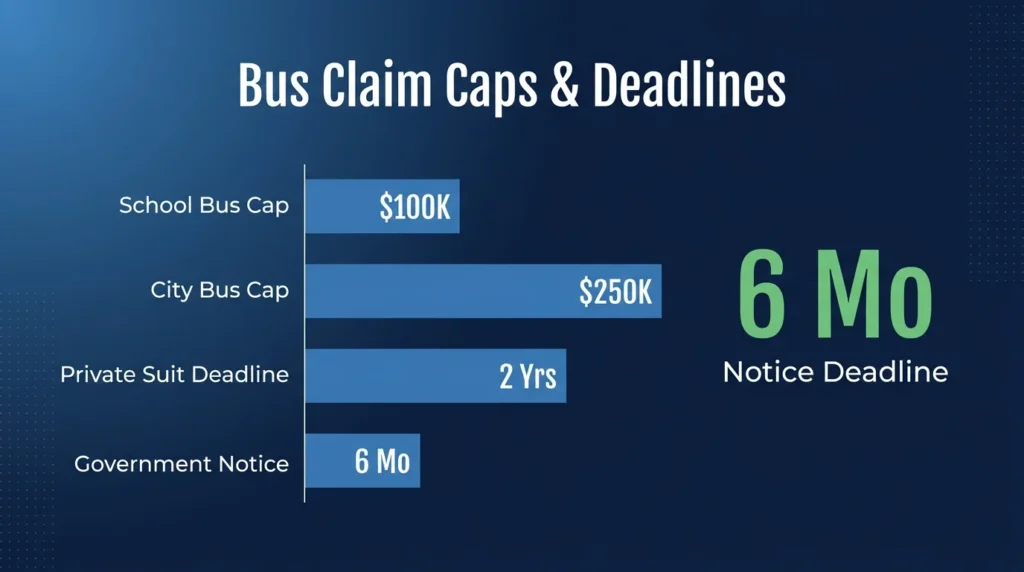
When a government-operated bus hits you, you may have a shorter deadline to take legal action than you expect. A claim against a transit agency requires written notice to the government unit—generally within six months of the crash—under CPRC § 101.101. That deadline is far shorter than the standard deadline for a private claim, which is why preserving evidence early is vital.
Texas law also limits the damages you can recover against a city-operated bus, under CPRC § 101.023. These limits do not apply if a private bus company is at fault.
Work with an Attorney on Your Pedestrian Bus Accident Claim in Texas
A pedestrian bus accident leaves you dealing with serious injuries, mounting bills, and deadlines that arrive faster than you expect. Angel Reyes & Associates has guided injured Texans through moments like this for more than 30 years.
Our consultations are free, and you pay no fee unless we win, so getting answers costs you nothing up front. We have recovered more than $1 billion for clients. We serve the entire state of Texas and handle most cases remotely. Schedule your free consultation today.
Past results do not guarantee future outcomes.
Pedestrian Bus Accident FAQs
Are Texas school buses covered by the same rules as city buses like METRO or DART?
No. School districts are government units, too, but Texas law sets a lower limit on how much you can recover if a school bus caused the accident. A school bus claim is capped at $100,000 per person, while a claim against a system like METRO or DART is capped at $250,000 per person.
What is the deadline to sue a private bus company after a pedestrian accident in Texas?
You generally have two years from the date of the crash to file a lawsuit against a private bus company, under the standard Texas personal injury deadline, which is longer than the six-month notice deadline required for a claim against a government transit agency.
Do federal safety rules apply to charter or tour buses in Texas?
Yes. Interstate charter and tour buses must follow federal safety rules from the Federal Motor Carrier Safety Administration. These rules limit how many hours a bus driver can be on the road before taking a required break or rest period, as well as how much insurance coverage drivers are legally required to carry, in addition to regular Texas traffic laws.
What evidence helps prove fault in a bus pedestrian accident?
Surveillance video from nearby businesses, the bus’s onboard event data recorder, and statements from independent witnesses are often the strongest proof of what happened. Texas courts can accept this video evidence—even without an eyewitness—as long as the recording system is reliable.
What kind of compensation can I recover after a pedestrian bus accident?
You may recover economic losses like medical bills and lost income, plus non-economic losses like pain and suffering. If you are filing a claim against a private bus company, extra damages meant to punish especially reckless conduct (called “punitive damages”) may also be available, but these do not apply to claims against a government transit agency.
About the Authors

Angel Reyes
Writer
Angel L. Reyes, III is the Founder and Managing Partner of Angel Reyes & Associates. A nationally recognized trial attorney and business leader, Angel has helped over 70,000 injury victims recover more than $1 billion since founding the firm in 1993. Named to the Texas Super Lawyers list annually since 2008, Angel brings Wall Street experience, Ivy League education, and a deep commitment to client advocacy. He is a frequent legal commentator and published author with extensive contributions to legal scholarship, trial strategy, and consumer protection.

Graham Griffin
Editor
Graham Griffin is the Web & Content Manager at Angel Reyes & Associates, where he oversees content strategy, AI-powered workflows, a...

Angel Reyes
Reviewer
Angel L. Reyes, III is the Founder and Managing Partner of Angel Reyes & Associates. A nationally recognized trial attorney and business...