Texas Motorcycle Laws Every Rider Should Know


Every article on this site is researched by our internal team, reviewed for legal accuracy against current Texas law, and held to State Bar of Texas advertising standards before publication. We do not publish content that overstates outcomes or makes promises about results.
Learn more about our
editorial standards .
Key Takeaways
- Riders under 21 must always wear a helmet; adults need a course or insurance to skip it.
- Lane splitting is illegal in Texas because riders must stay within a single lane.
- A Class M license requires passing an approved motorcycle operator training course first.
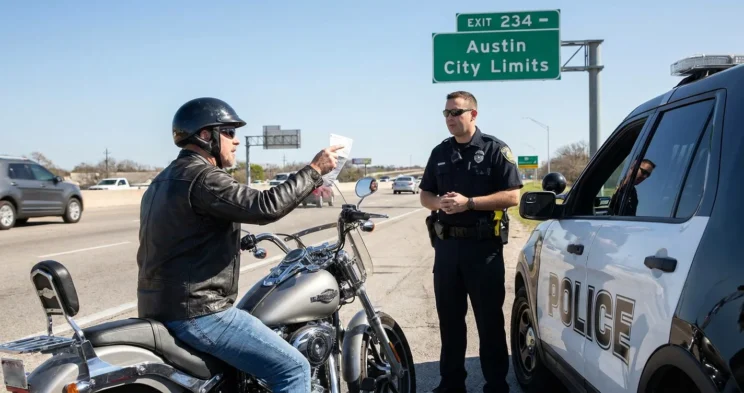
You were riding home through the Fort Worth Stockyards on a clear evening when a driver drifted into your lane and clipped your handlebar. Now you are sorting through medical bills, a damaged bike, and an insurance adjuster who keeps asking what gear you had on. The questions feel less like concern and more like a search for blame.
Knowing the laws that govern how you ride protects you on the road and in any claim that follows.
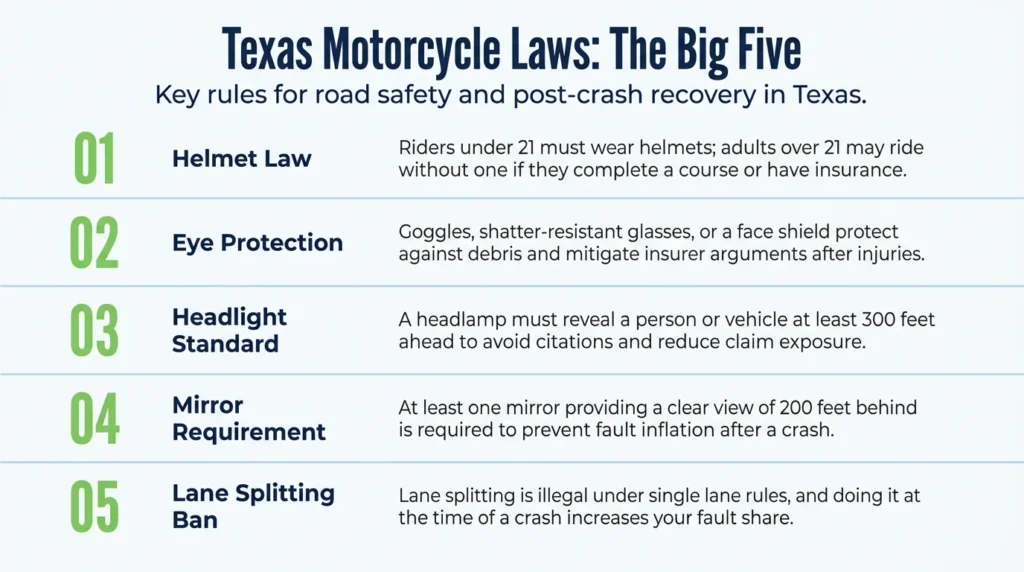
Texas Helmet Law for Motorcycle Riders
Every motorcycle operator and passenger in Texas must wear approved protective headgear on public roads, with one exception for adults. Texas Transportation Code § 661.003 sets this requirement and defines who can ride without a helmet.
If you are under 21, you must wear a helmet at all times. There is no way around it.
Riders 21 and older can legally ride without a helmet only under two conditions. You must have completed an approved safety course, or you must carry health insurance that covers motorcycle injuries.
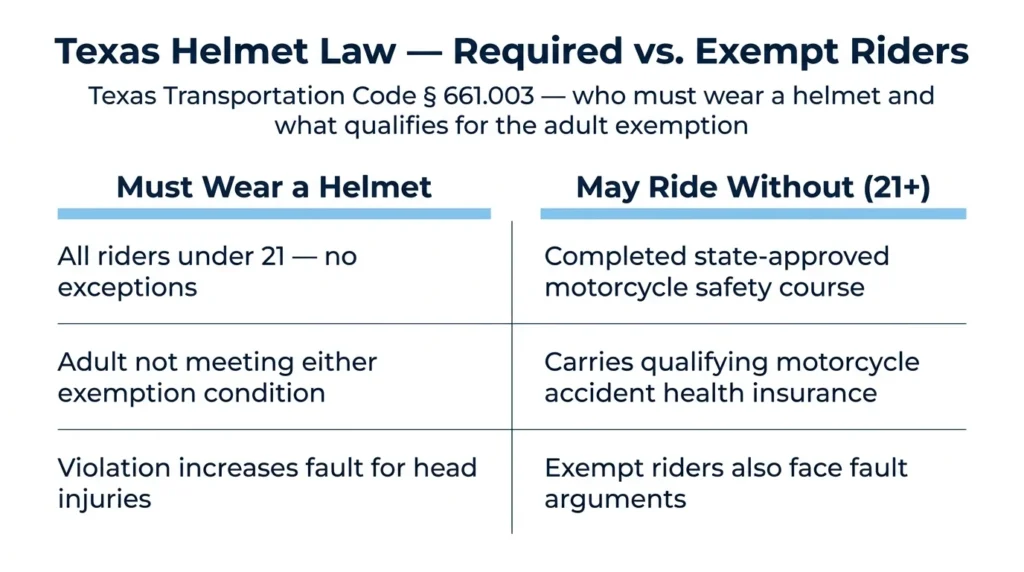
The safety course requirement points back to the state’s motorcycle operator training program under Texas Transportation Code Chapter 662. Passing one of these approved courses allows motorcyclists over 21 to ride helmet-free.
An officer cannot pull you over just to check whether you qualify for the exemption. The stop has to have its own valid reason first.
Skipping a helmet is legal for qualifying adults, but it can still come back to hurt you after a crash.
Eye Protection, Lighting & Mirror Rules
Your bike has to meet specific equipment standards, and falling short can mean a citation or a weaker claim. The clearest rules cover your headlight and your mirror.
Eye protection is where riders get conflicting advice. Goggles, glasses, or a face shield guard against wind, dust, and road debris that can blind you for the split second a crash needs. Texas does not clearly require eye protection by statute, but treats it as a basic safety habit rather than an optional extra.
Your headlight has to do real work at night. Texas Transportation Code § 547.801 requires a headlamp bright enough to reveal a person or vehicle at least 300 feet ahead.
Your motorcycle also needs a mirror. Under Texas Transportation Code § 547.602, the mirror must give you a clear view of at least 200 feet behind you.
These equipment rules feel minor until a dispute over fault begins. An insurer reviewing how a motorcycle accident settlement is calculated will look closely at whether your bike met every requirement.
Lane Splitting & Single-Lane Rules in Texas
Lane splitting is illegal in Texas, and the reason surprises most riders. No statute anywhere in the Transportation Code authorizes a motorcycle to ride between lanes of traffic. The prohibition comes from a general rule that applies to every vehicle. Texas Transportation Code § 545.060 requires you to drive as much as you can within a single lane.
Because the law expects you to stay in one lane, weaving between cars to beat traffic breaks that rule. This holds true even when traffic is stopped or barely moving.
You can review whether splitting lanes is legal in Texas and why it is unsafe to drive beside a motorcycle in tight traffic for more information.
Class M License & Training Requirements
You need a Class M license or endorsement to legally operate a motorcycle on Texas public roads. Texas Transportation Code § 521.084 creates this license class specifically for motorcycle operation.
Getting that authorization takes a few clear steps.
Step 1: Complete an approved motorcycle operator training course. The state requires this course before it will add motorcycle authorization to any license. Details on motorcycle endorsements come from the Texas Department of Public Safety.
Step 2: Visit a driver license office and pass the required tests. You bring proof that you finished the training course.
Step 3: Pay the fee and receive your Class M license or endorsement. You can carry it as a standalone license or add it to your existing driver license.
Riding without proper licensing carries its own penalties. It can also give an insurer one more argument that you were not riding responsibly.
How Violations Become Comparative Fault
Breaking any of these laws can shrink or erase what you recover after a crash, even when another driver caused it. Texas follows a fault-sharing system called proportionate responsibility under the Texas Civil Practice and Remedies Code (CPRC) § 33.001.
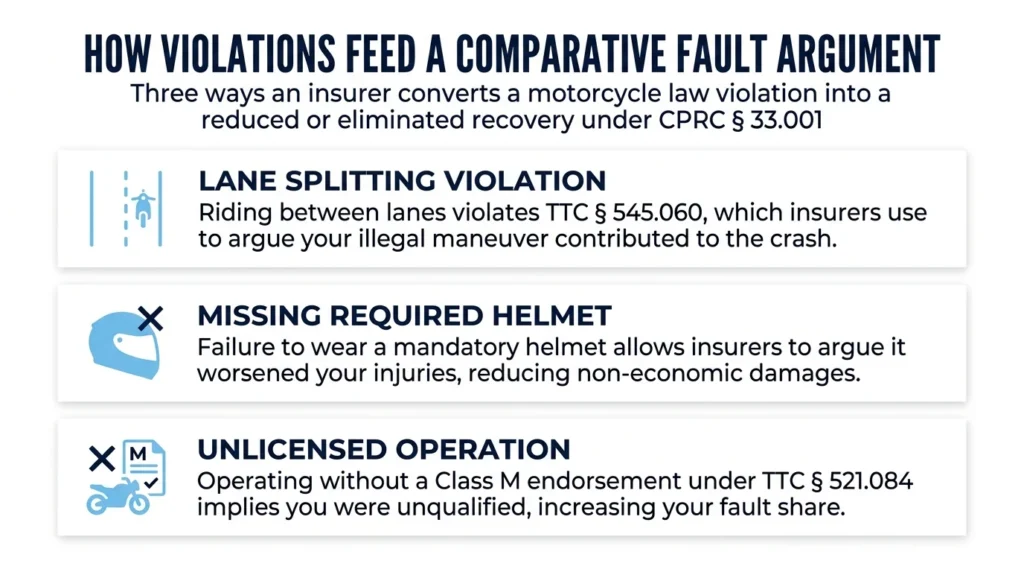
Under § 33.001, a jury gives a percentage of fault to each person involved. If you are found more than 50 percent at fault, you recover no compensation at all.
This is where a statutory violation becomes a weapon for the insurer. If you were lane splitting, riding without a required helmet, or operating without a Class M license, the adjuster will argue those choices made you partly to blame.
The argument does not have to be fair to work. An adjuster’s job is to close your claim for as little as possible, and a rule violation gives them an easy place to start. If you are unsure how a citation could affect your case, learning how fault gets divided in a motorcycle accident claim before you talk to an adjuster can protect you.
Following these statutes does more than keep you ticket-free. It removes the openings an insurer uses to blame the crash on you.
Talk with an Experienced Attorney
When an adjuster starts hunting for reasons to blame you, the right guidance changes everything. Angel Reyes & Associates has spent over 30 years helping injured Texans hold insurers accountable and recover what they are owed.
We work on a contingency basis, which means no fee unless we win, though you may still be responsible for court costs and case expenses. Our consultations are always free, and we serve riders across the entire state of Texas.
You can schedule a free consultation to review your options, or read more about how we have helped injured Texans for more than three decades. Every case is different, and the sooner you understand your rights, the better you can protect them.
Texas Motorcycle Law FAQs
What is the minimum age to ride as a passenger on a motorcycle in Texas?
A passenger generally must be at least five years old. The motorcycle must also have footrests and handholds for the passenger to use.
How much motorcycle insurance does Texas require?
Texas requires at least 30/60/25 liability coverage: $30,000 per injured person, $60,000 per accident, and $25,000 for property damage. You must carry proof of insurance whenever you ride.
How old do you have to be to get a Class M license in Texas?
You can apply at age 15. Riders who are 15 to 17 receive a restriction that limits when and where they can ride until they meet further requirements.
What happens if you ride a motorcycle without insurance in Texas?
You can face fines starting around $350, license suspension, and possible impoundment of your bike. Penalties increase for repeat violations.
Does a motorcycle have to pass a state inspection in Texas?
Motorcycles must meet equipment standards such as working lights and a mirror to be legal on the road. Check current Texas Department of Public Safety rules before riding, since inspection requirements have changed in recent years.
About the Authors

Angel Reyes
Writer
Angel L. Reyes, III is the Founder and Managing Partner of Angel Reyes & Associates. A nationally recognized trial attorney and business leader, Angel has helped over 70,000 injury victims recover more than $1 billion since founding the firm in 1993. Named to the Texas Super Lawyers list annually since 2008, Angel brings Wall Street experience, Ivy League education, and a deep commitment to client advocacy. He is a frequent legal commentator and published author with extensive contributions to legal scholarship, trial strategy, and consumer protection.

Kyle Nicolas
Editor
Kyle Nicolas is the Web Content & SEO Manager at Angel Reyes & Associates. He has more than 10 years of experience as a marketing co...

Angel Reyes
Reviewer
Angel L. Reyes, III is the Founder and Managing Partner of Angel Reyes & Associates. A nationally recognized trial attorney and business...