How Traffic Camera Footage Can Help Your Motorcycle Accident Case


Every article on this site is researched by our internal team, reviewed for legal accuracy against current Texas law, and held to State Bar of Texas advertising standards before publication. We do not publish content that overstates outcomes or makes promises about results.
Learn more about our
editorial standards .
Key Takeaways
- TxDOT highway cameras stream live video only and do not retain any recorded footage.
- Most surveillance systems overwrite footage within 72 hours without a preservation letter on file.
- Texas gives you two years from the crash date to file a personal injury lawsuit.
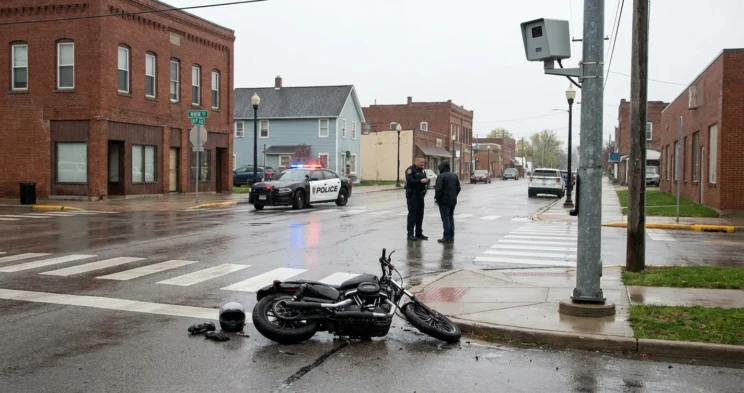
You were riding home from a job site in San Antonio, heading west on Fredericksburg Road near the Medical Center. A driver ran a red light and hit your motorcycle broadside. The intersection had at least two cameras pointing in your direction. But by the time you made it home from the hospital, three days had passed, and you’re wondering whether any traffic camera footage still exists.
What Cameras Can Capture a Motorcycle Crash?
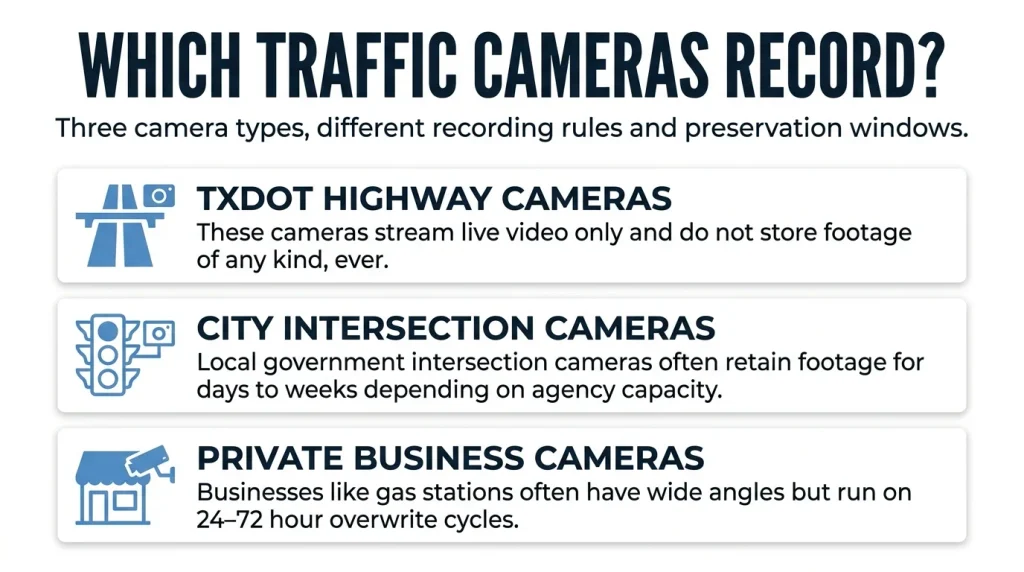
Not every camera near your crash actually recorded it, and knowing the difference saves you time. TxDOT highway cameras stream live video only. They do not store recordings, so no footage from a TxDOT camera exists to request regardless of how many were mounted near the crash site.
City-operated cameras at signalized intersections and red-light enforcement systems are different. Local governments often retain that footage for days to weeks, depending on the agency and its storage capacity. These are your primary government source for recorded crash video.
Private business cameras mounted on storefronts, gas stations, parking structures, and ATMs often have the widest angles and the longest retention windows. Dashcams in other vehicles and body cameras worn by responding officers can fill gaps when other sources come up short. Texas motorcycle accident statistics show that riders face severe crash outcomes at rates far above car occupants, which is exactly why every available evidence source counts.
Why Crash Footage Disappears So Quickly
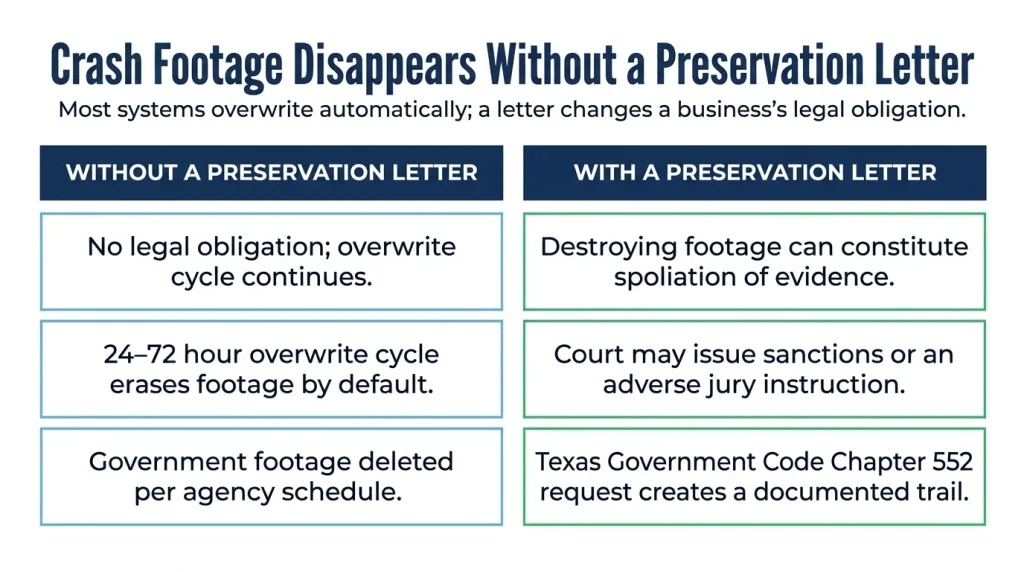
Most surveillance systems overwrite footage automatically, and many run on 24- to 72-hour cycles. Some systems retain footage for 7 to 30 days, but businesses have no legal obligation to hold any of it unless someone asks.
A preservation letter changes that. It is a written demand directing a business or agency to hold specific footage because litigation is anticipated. Once a business receives that letter, destroying the footage can constitute spoliation of evidence. A court may then issue sanctions or an adverse jury instruction against the party that destroyed it.
Without a letter, there is no legal obligation, and the footage disappears on schedule. An attorney can send those letters the same day you reach out, before the system overwrites footage of injuries from your motorcycle crash.
How to Request Traffic Camera Footage in Texas
Acting within the first 48 hours gives you the best chance of recovering recorded footage. Here are the steps.
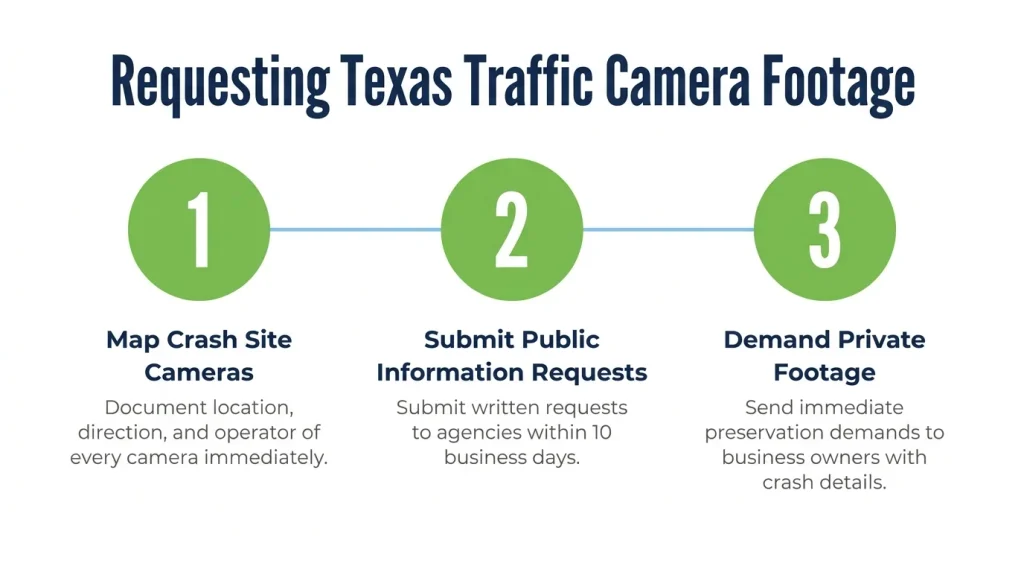
Step 1: Map every camera at the crash location. Note each camera’s mounting point, direction, and the name and address of the business or agency that operates it.
Step 2: For government-owned cameras, file a written open records request. Texas Government Code Chapter 552 governs the Public Information Act process. The agency has 10 business days to respond and may charge a processing fee.
Step 3: For privately-owned cameras, send a direct preservation and production request. Address it to the business owner or manager and include the date, time, and the direction the camera was facing at the time of the crash.
Step 4: Document every request. Keep copies of what you sent, who received it, and when. A paper trail of your preservation efforts matters if a dispute arises over destroyed footage.
How Video Evidence Shapes a Liability Argument
Clear footage showing the other driver running a red light or cutting into your lane can lock in fault before an insurer disputes it. Video replaces competing witness accounts with an objective record of what happened.
Insurers sometimes use footage selectively, pulling frames that support their defense while ignoring the full sequence. An attorney can challenge that approach and present the complete video in context.
Texas uses a proportionate fault framework. Under Texas Civil Practice and Remedies Code (CPRC) Chapter 33, your recovery decreases by your share of fault. A finding of more than 50 percent fault bars recovery entirely. Video that establishes the other driver’s fault directly affects that calculation.
You also have a deadline. CPRC § 16.003 gives you two years from the date of the crash to file a personal injury lawsuit. Missing it ends your right to sue regardless of how clear the video evidence is. Understanding how motorcycle accident settlements work in Texas helps you evaluate how footage factors into your claim value before you accept any offer.
Get Help from an Experienced Attorney
Footage preservation is time-sensitive, and the window to act closes faster than most riders expect.
Angel Reyes & Associates has represented motorcycle accident victims across Texas for more than 30 years. We have recovered more than $1 billion for our clients. We offer free initial consultations and work on a no-fee-unless-you-win basis.
To start a conversation about your situation, contact us for a free consultation.
Past results do not guarantee future outcomes.
Traffic Camera Footage FAQs
Can I request traffic camera footage myself, or do I need an attorney?
You can submit a Public Information Act request to a government agency yourself; no attorney is required for that step. Only an attorney can send a legally enforceable preservation letter to a private business, which is often the more time-sensitive part of the process.
Can the other driver's insurance company request the same footage?
Yes, insurers conduct their own investigations and can request footage from government agencies and private businesses through the same channels you can. Acting quickly to send preservation demands and request footage yourself reduces the chance it disappears before you have a copy.
Does requesting footage under the Texas Public Information Act cost money?
Small requests are often free, but government agencies can charge fees for labor and production, typically $15 per hour for staff time when a request is complex. If costs will exceed $40, the agency must send you a cost estimate before starting work on your request.
What if the footage was already deleted before I asked for it?
If footage was deleted after the business or agency received notice of a likely claim, that deletion may constitute spoliation of evidence and a court can draw negative conclusions against the party responsible. If it was deleted before any notice was given, that avenue is usually unavailable, but other evidence may still establish the same facts.
Can I use my own dashcam or helmet camera footage as evidence?
Yes, video from your own dashcam or helmet camera is admissible evidence and is often the most reliable footage available because it captures your exact position at the moment of the crash. Preserve it immediately by saving a backup copy and making sure the device does not overwrite it.
About the Authors

Angel Reyes
Writer
Angel L. Reyes, III is the Founder and Managing Partner of Angel Reyes & Associates. A nationally recognized trial attorney and business leader, Angel has helped over 70,000 injury victims recover more than $1 billion since founding the firm in 1993. Named to the Texas Super Lawyers list annually since 2008, Angel brings Wall Street experience, Ivy League education, and a deep commitment to client advocacy. He is a frequent legal commentator and published author with extensive contributions to legal scholarship, trial strategy, and consumer protection.

Kyle Nicolas
Editor
Kyle Nicolas is the Web Content & SEO Manager at Angel Reyes & Associates. He has more than 10 years of experience as a marketing co...

Angel Reyes
Reviewer
Angel L. Reyes, III is the Founder and Managing Partner of Angel Reyes & Associates. A nationally recognized trial attorney and business...