Weather-Related Bus Accidents in Texas


Every article on this site is researched by our internal team, reviewed for legal accuracy against current Texas law, and held to State Bar of Texas advertising standards before publication. We do not publish content that overstates outcomes or makes promises about results.
Learn more about our
editorial standards .
Key Takeaways
- Texas treats bus companies as common carriers, owing passengers a higher duty of care.
- Bad weather alone is not a defense unless the storm was truly unforeseeable.
- Government bus claims demand written notice within 180 days under the Tort Claims Act.
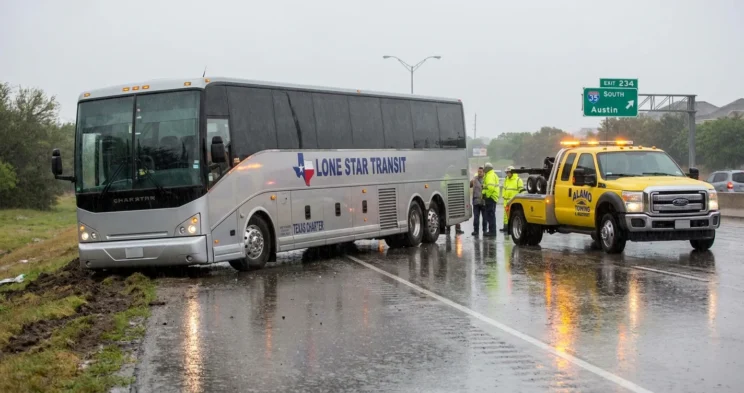
You were riding home on a city bus through Houston when a storm rolled in off I-45; the driver kept the same speed as the rain turned the road to glass. Then the bus slid, and you ended up hurt. Now the bus company is hinting that the weather was to blame, and you are staring down medical bills with no idea if you have any claim at all.
Texas Bus Companies Face a Higher Duty of Care
Texas law treats bus companies as common carriers, meaning they owe their passengers a higher degree of care than ordinary drivers owe each other. That heightened duty is the foundation of how courts judge a Texas bus company’s liability after a crash, even when bad weather is part of the story.
Texas courts have held that even slight negligence can establish liability under the common carrier standard. Because the margin for operator error is far narrower than in an ordinary car accident case, a small lapse that a regular driver might survive can expose a bus company to real responsibility.
This elevated duty does not relax when the weather turns dangerous. A bus company cannot point to rain or ice as an excuse when it failed to exercise the high level of care the law demands before, during, or after conditions worsened.
The standard itself comes from Texas common law. Federal rules reach commercial operators, too. Under 49 CFR § 392.14, drivers must slow down or stop running when hazardous weather makes safe operation impossible.
Weather Texas Buses Face Most Often
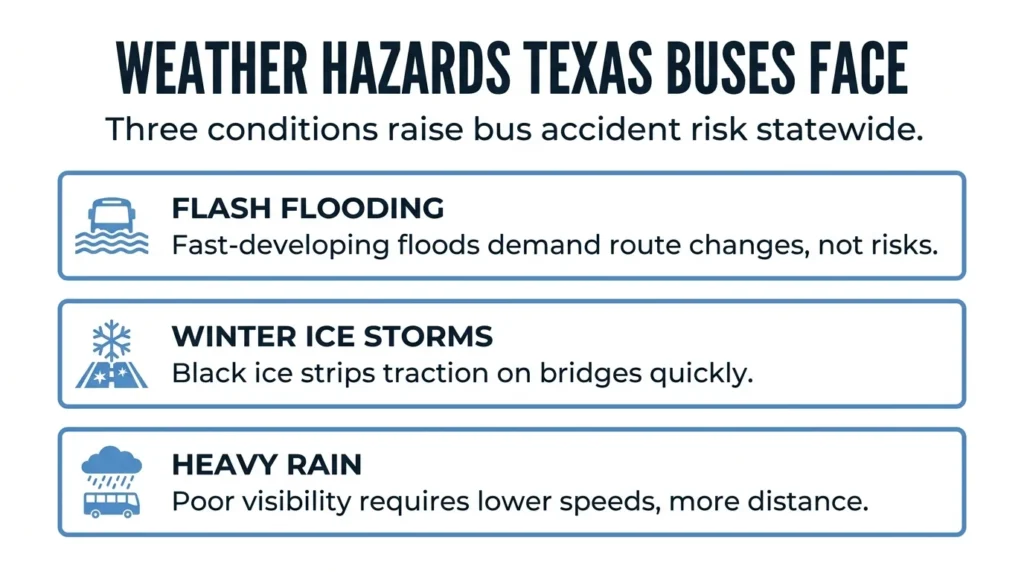
Flash flooding is the single most dangerous weather hazard on Texas roads, and bus operators know it. Flash flood warnings go out across the state regularly, and a flooded roadway calls for a route change or a halt in service, not a gamble.
Flash floods develop fast, often faster than a driver expects. A carrier that sends a bus into an area with a known flood warning is making a choice, and that choice can support a claim when passengers get hurt.
Winter ice storms bring a different danger. Black ice on bridges and overpasses can strip a bus of traction in an instant. A driver who fails to reduce speed for those conditions violates Texas Transportation Code § 545.351, and that violation is itself evidence of negligence.
Heavy rain and poor visibility call for lower speeds and more following distance. When a carrier dispatches a bus into a severe storm without watching conditions, liability can land on the company, not just the person behind the wheel. Our breakdown of who can be held responsible after a bus crash walks through how that works.
State crash data backs this up. TxDOT crash records document how often weather plays a role in commercial vehicle crashes, and that record can become evidence in your claim.
When Weather Is Not a Defense
Bad weather alone does not let a bus company off the hook in Texas. The act-of-god defense applies only when a weather event was so extraordinary and unforeseeable that no precaution could have prevented the crash, and Texas courts set a high bar for that.
Professional carriers are expected to watch the forecast and adjust how they operate. A foreseeable storm, a known ice event, or a posted flood warning undercuts the defense before the bus ever leaves the depot.
Negligence before the crash does not disappear just because the weather played a part. Failing to inspect tires, running defective wipers, or sending out a fatigued driver into bad conditions all stay alive as claims. Bad weather does not erase the road conditions that a careful carrier should have planned for.
If you believe your crash involved a weather condition the carrier should have seen coming, an attorney can evaluate whether the company took the precautions the law required of a public transit operator.
Texas also uses a proportionate responsibility system under the Texas Civil Practice and Remedies Code (CPRC) Chapter 33. Weather being a partial cause does not automatically defeat your claim. Fault gets divided among all responsible parties, and your recovery is reduced in proportion to your own share of fault, as long as your share does not exceed 50 percent; if a jury finds you more than 51 percent or more responsible, you cannot recover under Texas law.
Government-Operated Buses & Special Rules
How you file depends on who operated the bus. A claim against a private company follows one set of rules. A claim against a public agency follows another, and the differences are sharp.
Filing Claims Against Private Bus Companies
Claims against private carriers run on the standard two-year personal injury deadline under Texas Civil Practice and Remedies Code § 16.003. Charter buses, private school transportation, and commercial tour operators all fall here.
Step 1: Track the two-year deadline from the crash date. The clock starts the day of the accident. Miss the two-year window and your right to recover is gone, no matter how strong your evidence is.
Step 2: Identify every party that may share fault. The bus company is rarely the only party at fault; the vehicle manufacturer may be liable if a defect contributed, and the entity responsible for road maintenance may share blame too. Our guide to filing a bus accident claim in Texas covers how to sort this out.
Filing Claims Against Government Bus Operators
The Texas Tort Claims Act (TTCA) governs claims against public transit authorities like METRO, DART, and VIA, along with cities running school buses or transit. The notice and timing rules differ sharply from private claims.
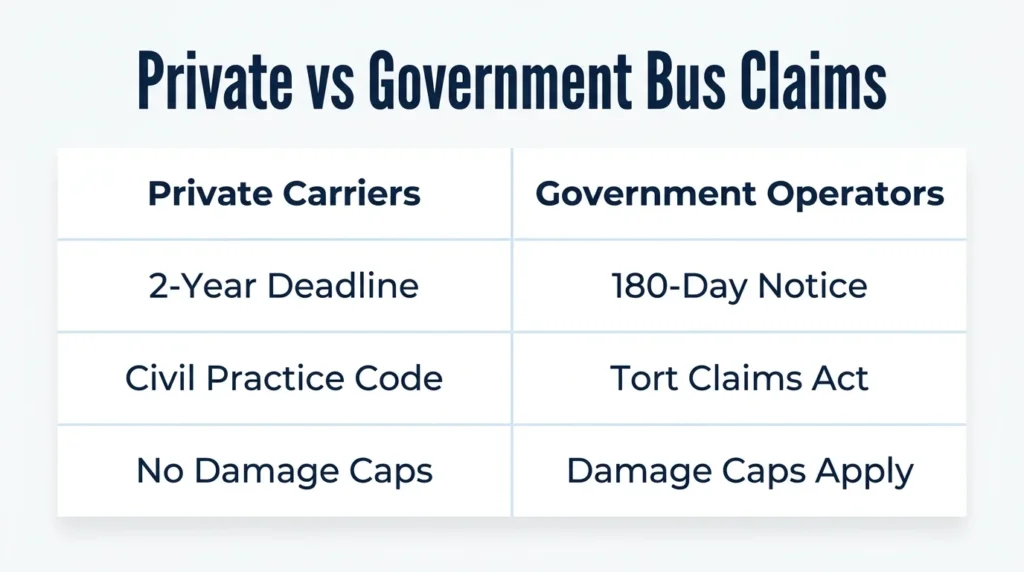
Under the TTCA, you must give written notice of your claim within 180 days for most government entities. Some Texas cities, including Houston and San Antonio, set even shorter notice windows.
Damage caps also apply to government defendants. The Tort Claims Act limits what you can recover in ways that do not apply to a private carrier, and our overview of how the TTCA limits affect bus cases explains where those caps land.
Wrongful Death & Weather-Related Bus Crashes
When a passenger dies in a weather-related bus crash, certain family members can bring a wrongful death claim under Texas Civil Practice and Remedies Code Chapter 71. Spouses, children, and parents are the eligible claimants.
The damages in a wrongful death case can reach beyond medical bills. Families may recover for lost financial support, lost companionship and society, mental anguish, and funeral expenses.
The same negligence arguments carry over from injury cases. A bus company that failed to take weather precautions stays liable even when the storm was severe, and the act-of-god defense faces the same high bar it does in any other claim.
If you lost a loved one in a weather-related bus crash, you can look at how other families have worked with us before the limitations period closes.
Talk to a Texas Bus Accident Attorney
A weather defense does not have to close the door on your case. The law still protects passengers when a bus company fails to take the precautions that hazardous conditions demand.
Angel Reyes & Associates has spent over 30 years representing injured passengers and grieving families across Texas. We offer free initial consultations and work on a contingency basis, which means no fee unless we win, and we have recovered more than $1 billion for clients over the years.
We serve clients throughout the state and can handle most, if not all, of your case remotely. Reach out to us for a free consultation to find out where you stand.
Past results do not guarantee future outcomes.
Weather-Related Bus Accidents FAQs
What should a passenger do right after a weather-related bus crash in Texas?
Call 911, get medical attention, and document the scene with photos if you can do so safely. Capture the bus number, driver information, and any weather conditions visible at the scene, and get contact information from witnesses before they leave.
Can a bus passenger be found partly at fault for their own injuries in a crash?
It is uncommon for a seated passenger to bear fault, but Texas law allows fault to be assigned to anyone whose actions contributed to the crash or their own injuries. As long as your share of fault stays below 51 percent, you can still recover damages, though the amount would be reduced by your percentage at fault.
Does Texas require bus companies to carry a minimum amount of insurance?
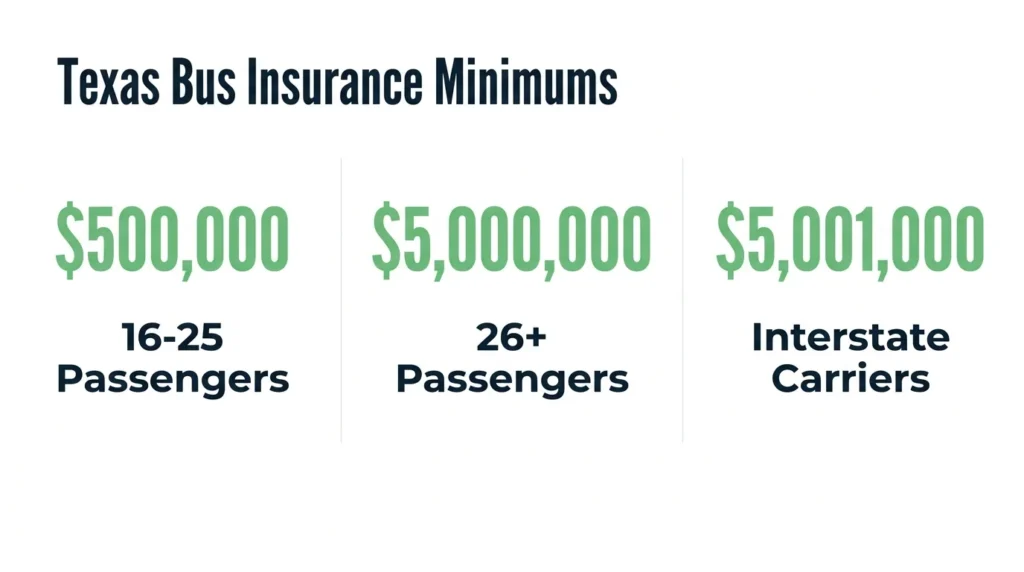
Yes. Under federal and Texas rules, intrastate buses carrying 16 to 25 passengers must carry at least $500,000 in liability coverage, and buses carrying 26 or more passengers must carry at least $5,000,000. Interstate passenger carriers with 16 or more seats generally must carry $5,001,000.
What records from the bus company can help prove negligence in a weather-related crash?
Driver logbooks, pre-trip inspection reports, maintenance records, and electronic data from the vehicle’s onboard systems can all show what the carrier knew and what it failed to fix. These records can be overwritten or discarded quickly, so preserving them through a legal hold request is time-sensitive.
Can an injured passenger sue both the bus driver and the bus company?
Yes. Under Texas law, a bus company is responsible for its drivers’ negligence when the driver was on duty and acting within the scope of their job. Both the driver and the company can be named in a lawsuit, and the company’s liability does not require proving the company itself did anything wrong beyond employing the driver.
About the Authors

Angel Reyes
Writer
Angel L. Reyes, III is the Founder and Managing Partner of Angel Reyes & Associates. A nationally recognized trial attorney and business leader, Angel has helped over 70,000 injury victims recover more than $1 billion since founding the firm in 1993. Named to the Texas Super Lawyers list annually since 2008, Angel brings Wall Street experience, Ivy League education, and a deep commitment to client advocacy. He is a frequent legal commentator and published author with extensive contributions to legal scholarship, trial strategy, and consumer protection.

Kyle Nicolas
Editor
Kyle Nicolas is the Web Content & SEO Manager at Angel Reyes & Associates. He has more than 10 years of experience as a marketing co...

Angel Reyes
Reviewer
Angel L. Reyes, III is the Founder and Managing Partner of Angel Reyes & Associates. A nationally recognized trial attorney and business...