What Are the Four Elements of a Negligence Claim?


Every article on this site is researched by our internal team, reviewed for legal accuracy against current Texas law, and held to State Bar of Texas advertising standards before publication. We do not publish content that overstates outcomes or makes promises about results.
Learn more about our
editorial standards .
Key Takeaways
- All four must hold: duty, breach, proximate cause, and damages. Missing one ends the claim.
- Proximate cause in Texas means cause in fact plus foreseeability, not just loose causation.
- Texas gives you two years from the crash to file, and proof weakens long before that.
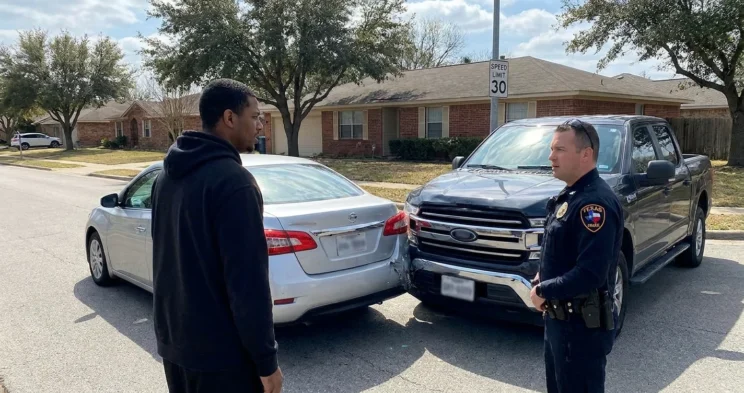
After a wreck on I-20 or the LBJ Freeway, proving the other driver was careless can feel like the whole case. It is not. A Texas negligence claim rests on four things, a legal duty, a breach of that duty, proximate cause, and damages.
All four have to hold. Prove three and miss one, and the claim fails no matter how strong the other three looked to you, to your doctor, or even to a jury.
The Four Elements of a Negligence Claim in Texas
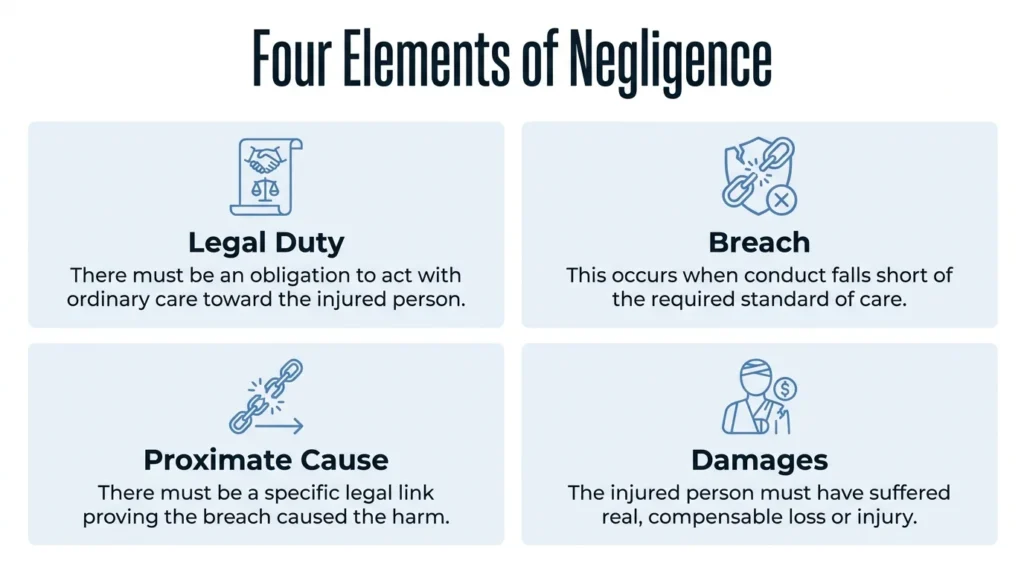
The negligence elements Texas plaintiffs prove come in a fixed order, and each one has to stand on its own:
- A legal duty. An obligation to act with ordinary care toward the injured person.
- A breach of that duty. Conduct that falls short of that standard.
- Proximate cause. A specific legal link between the breach and the harm.
- Damages. Real, compensable loss.
The Supreme Court of Texas states the same rule in three parts in Tenaris Bay City Inc. v. Ellisor (Tex. 2025): the existence of a legal duty, a breach of that duty, and damages proximately caused by the breach. Causation and damages sit in one clause there, so the four-part list states separately what that third element already contains.
The four-part version is the standard way the elements are taught and used in practice, and the proof burden is identical either way.
That structure is why a plaintiff who proves three of four still loses. A clearly careless driver and genuine injuries are not enough without proximate cause.
These same four elements decide cases that have nothing to do with driving, including premises liability claims.
How Duty & Breach Work in a Texas Crash Case
Duty is the threshold question and it belongs to the judge. Breach belongs to the jury:
- Duty. Whether a duty exists, how far it reaches, and what it requires are questions of law for the court.
- Breach. Whether the driver fell short of ordinary care is a fact question, reviewed on appeal only for legal sufficiency.
Every Texas driver owes other road users ordinary care, and the Transportation Code supplies concrete standards. Section 545.351 states that a driver may not travel faster than is reasonable and prudent under the circumstances then existing, must control speed to avoid colliding with others lawfully on the road, and must reduce speed for intersections, curves, narrow roads, weather, and other special hazards.
A driver can be negligent while driving under the posted limit.
An unexcused traffic violation is strong evidence of breach, and a court may adopt the statute as the standard of conduct after weighing the factors from Perry v. S.N. (Tex. 1998). A citation is not automatic liability.
In practice, duty is rarely the contested ground in a two-driver collision. It becomes a live fight when the defendant is someone other than the at-fault driver. In Elephant Insurance Company, LLC v. Kenyon (Tex. 2022), an auto insurer owed no duty to a policyholder’s spouse who was struck while photographing a crash scene.
Breach is usually the best-documented element in a crash case. Photographs, witness accounts, and the officer’s report all speak to it. That evidence is how fault gets established after a Texas crash, and in a car accident claim it still leaves the last two elements to prove.
Proximate Cause Is the Element Texas Defines Most Precisely
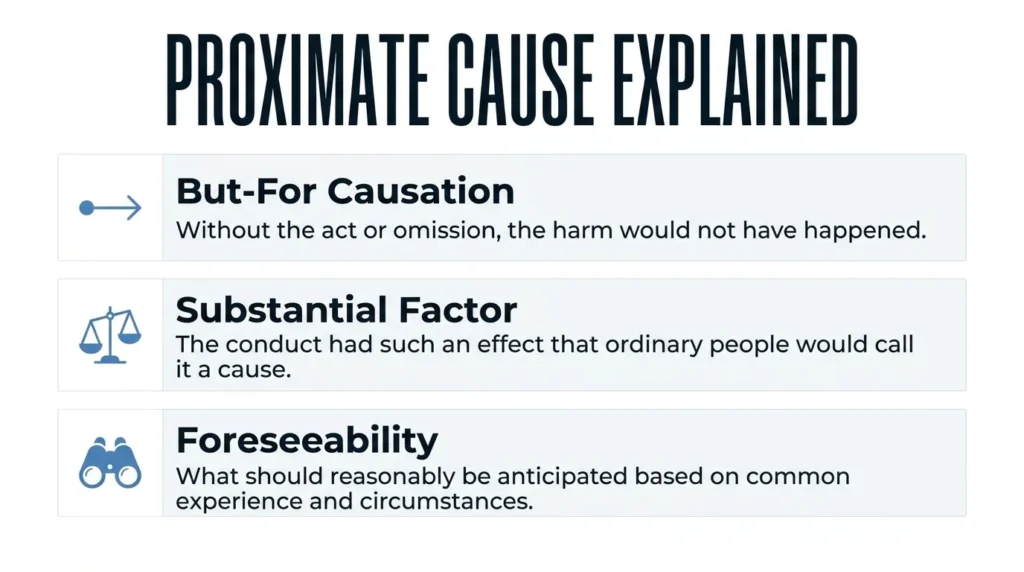
Proximate cause is where Texas law gets specific. In practice, it is the element that undoes claims in which duty and breach were never seriously in doubt.
It has two parts, and the first part has two parts of its own:
- Cause in fact, which requires both of the following:
- But-for causation. Without the act or omission, the harm would not have happened.
- Substantial factor. The conduct had such an effect in producing the harm that ordinary people would call it a cause. Conduct that merely furnishes the condition making harm possible is not a substantial factor as a matter of law.
- Foreseeability. What should reasonably be anticipated in light of common experience applied to the surrounding circumstances.
Both halves of cause in fact are required. A definition that drops the but-for question is incomplete.
Either half can fail on its own. In Tenaris, the 2025 flooding case above, the plaintiffs’ expert showed that design flaws added to the flooding but could not say the damage to these specific properties would have been avoided without it. Evidence that a defendant made things worse somewhere is not evidence that the defendant caused this loss.
Proximate cause is a jury question reviewed for legal sufficiency. That is how a plaintiff who wins at trial can still lose on appeal.
Where Motor Vehicle Claims Break Down
Werner Enterprises, Inc. v. Blake (Tex. 2025) shows the pattern. A pickup carrying a mother and her three children lost control on an icy interstate, crossed a 42-foot median, and struck an 18-wheeler. One occupant was killed and three were severely injured.
The plaintiffs proved at trial that the truck’s speed was below the limit but unsafe for the icy conditions, and that the crash would likely have been less severe without it.
The Supreme Court of Texas still rendered judgment for the defense. The truck’s speed and presence furnished the condition that made the injuries possible but did not proximately cause them.
The holding turns on those facts, and the Court reaffirmed that there can be more than one proximate cause of an injury.
This is the four-element point in action. Duty and breach were not the problem. Truck accident claims and car cases alike turn on this element.
Damages & the Fight Over the Number
The Texas third element is expressly about damages, so a claim with no compensable loss is not a claim at all. Texas divides them into economic damages, meaning actual economic or pecuniary loss, and noneconomic damages, covering physical pain, mental anguish, disfigurement, physical impairment, loss of consortium, loss of enjoyment of life, and similar nonpecuniary losses.
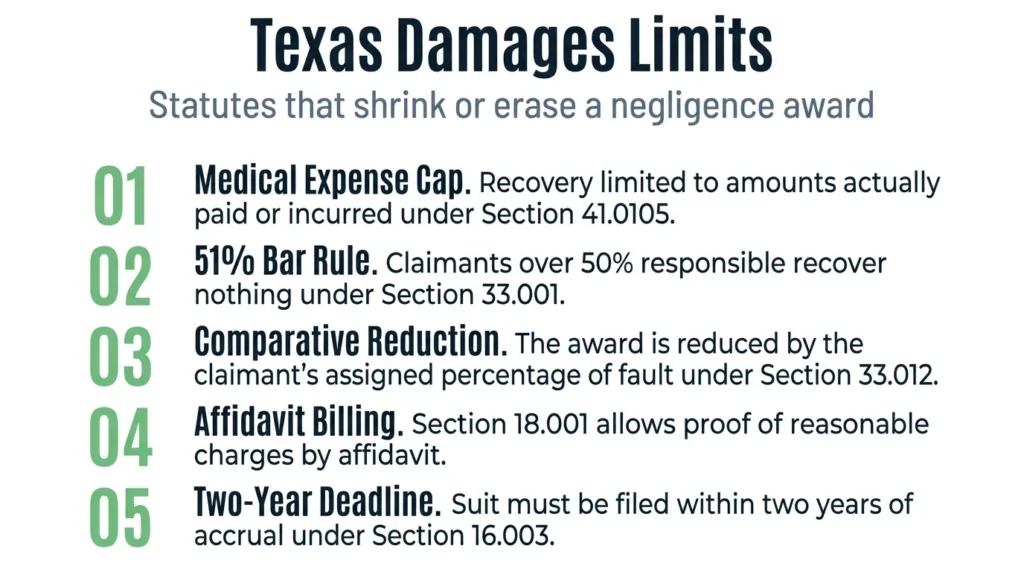
Several statutes then shrink or erase the award:
- Recovery of medical expenses is limited to the amount actually paid or incurred by or on behalf of the claimant under Texas Civil Practice and Remedies Code § 41.0105. The sticker price on a hospital bill is not automatically the recoverable figure.
- A claimant whose percentage of responsibility is greater than 50 percent recovers nothing under § 33.001. Below that line, comparative responsibility reduces the award by the claimant’s percentage under section 33.012. The factfinder assigns a whole number percentage of responsibility to each party, so those percentages are part of the damages fight.
- Section 18.001 allows proof of reasonable and necessary charges by affidavit. Subsections (d) and (e) set the service windows for the affidavit and any counteraffidavit.
- Suit must be brought within two years of accrual under § 16.003, and a wrongful death claim accrues on the date of death.
In practice, the damages fight is about the size of the number, not about whether you were hurt.
Mapping Your Evidence to Each Element
The fastest way to find the weak spot in your own file is to line the available proof up against each element:
| Element | Who decides | Evidence that carries it |
| Duty | Court, as a matter of law | The relationship between the parties and statutory standards of conduct |
| Breach | Jury | Officer’s collision report, scene and vehicle photographs, witness statements, citations, dashcam and commercial-vehicle engine data, weather records, reconstruction testimony |
| Proximate cause | Jury | Reconstruction establishing both but-for and substantial-factor causation, treating-physician testimony tying these injuries to this collision, review of prior records. Usually the thinnest row. |
| Damages | Jury, constrained by statute | Bills at the amount actually paid or incurred, affidavits served on time, wage and employment records, testimony supporting the noneconomic categories |
An officer’s collision report is required when a crash causes injury, death, or apparent property damage of $1,000 or more, and Texas Transportation Code Chapter 550 governs its release. The report is a starting point for investigation. The case itself is built on the underlying evidence.
Talk to a Lawyer About Your Claim
Every element is proven with evidence, and evidence fades. Witnesses move, vehicles get repaired, and the two-year deadline keeps running from the day of the crash.
Angel Reyes & Associates has guided injured Texans for over 30 years. Contact Angel Reyes & Associates for a free consultation to review your options.
Past results do not guarantee future outcomes.
Negligence Claim Elements FAQs
Does a pre-existing injury prevent someone from recovering damages after a Texas crash?
Not necessarily. The key issue is whether the accident legally caused or aggravated the claimed injury, which may require medical evidence connecting the condition to the collision.
What happens if the other driver has no insurance in Texas?
An injured person may have potential claims under uninsured or underinsured motorist coverage, if applicable, and the availability of that coverage can depend on the policy and circumstances of the crash.
Are the full charges on a medical bill automatically recoverable in Texas?
No. Texas Civil Practice and Remedies Code Section 41.0105 limits recovery of medical expenses to the amount actually paid or incurred by or on behalf of the claimant.
About the Authors

Angel Reyes
Writer
Angel L. Reyes, III is the Founder and Managing Partner of Angel Reyes & Associates. A nationally recognized trial attorney and business leader, Angel founded the firm in 1993, which has gone on to help over 70,000 injury victims recover more than $1 billion. Named to the Texas Super Lawyers list annually since 2008, Angel brings Wall Street experience, Ivy League education, and a deep commitment to client advocacy. He is a frequent legal commentator and published author with extensive contributions to legal scholarship, trial strategy, and consumer protection.

Kyle Nicolas
Editor
Kyle Nicolas is the Web Content & SEO Manager at Angel Reyes & Associates. He has more than 10 years of experience as a marketing co...

Angel Reyes
Reviewer
Angel L. Reyes, III is the Founder and Managing Partner of Angel Reyes & Associates. A nationally recognized trial attorney and business...