What Is Rental Reimbursement Coverage?


Every article on this site is researched by our internal team, reviewed for legal accuracy against current Texas law, and held to State Bar of Texas advertising standards before publication. We do not publish content that overstates outcomes or makes promises about results.
Learn more about our
editorial standards .
Key Takeaways
- Check your declarations page and endorsement to confirm rental limits before you book a car.
- Your own rental benefit can help while the other driver's insurer investigates fault.
- Keep invoices and repair dates to pursue an unpaid rental shortfall and deductible later.
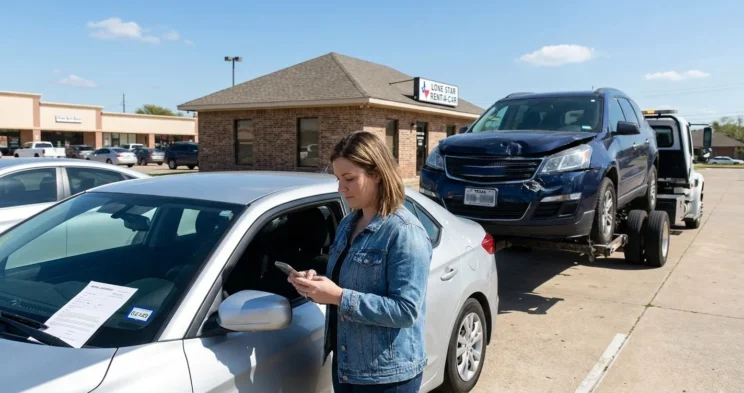
Rental reimbursement coverage is optional coverage in your own Texas auto policy that helps pay for substitute transportation after a covered loss. If your car is at a body shop after a crash, this benefit may help you get to work, school, and medical appointments while the other driver’s insurer investigates fault.
Your policy’s terms, daily limit, and total maximum still apply, so you may have to pay part of the rental bill.
What Does Rental Reimbursement Coverage Pay For?
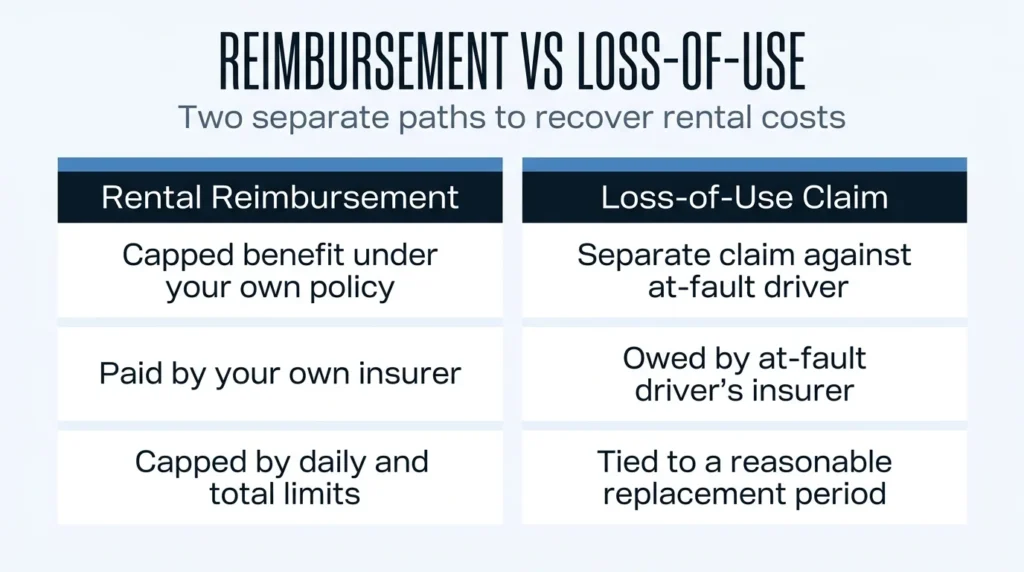
Rental reimbursement coverage pays toward substitute transportation while your car is out of service after a covered event, up to your policy limits. The Texas Department of Insurance (TDI) explains that this coverage can pay for a rental while your car is repaired after a covered accident or theft. Some policies also cover taxis or ride-hailing services.
Not every policy includes this coverage. Your declarations page shows your insured vehicle and coverage amounts, while the endorsements identify any changes to the policy. The TDI auto insurance glossary explains both documents. Read them with the complete policy and check the covered vehicle and effective dates.
Some policies call this benefit “rental reimbursement,” while others call it “transportation expense.” One provision may apply to a collision, while another may apply only to a narrower event such as theft.
This benefit is separate from the collision or comprehensive coverage that pays to repair your car. That underlying coverage usually has its own deductible.
Before you rent, ask your adjuster to confirm these details in writing:
- The endorsement that applies to this crash
- The date your eligibility starts
- The daily limit and the total maximum
- Any cap on the number of days
- The event that ends the benefit
- The charges that qualify
When Should You Use Your Own Coverage After a Crash?
If you already have rental reimbursement coverage and need a car now, you can ask your insurer to authorize the rental while the other driver’s insurer investigates fault. You can use your own coverage regardless of who caused the crash, subject to your policy’s terms and your insurer’s approval. Payment may not be immediate.
The other driver’s insurer may not approve a rental until it accepts responsibility. TDI’s guidance on dealing with the other driver’s insurance explains that payment may be delayed or denied when fault is disputed, the driver’s liability limits are too low, or the insurer cannot reach its insured.
Follow these steps to use your own coverage:
1. Report the crash to your insurer and open a claim.
2. Confirm that your rental benefit applies to this crash and find out when it starts.
3. Ask whether the rental company can bill your insurer directly or you must pay and submit receipts.
4. Keep every receipt, and save written messages from your adjuster.
Progressive explains that own-policy rental reimbursement commonly has no separate deductible. The related collision claim may still have one, so check your policy. Coverage added after the crash will not apply to that crash.
If the wreck also left you hurt, rental expenses may be only one part of your Texas car accident claim.
How Do Daily & Total Limits Compare With the Rental Bill?
Your policy’s daily limit and total maximum may be lower than the cost of an eligible rental. If the rental exceeds either limit, you may have to pay the difference. TDI’s auto insurance guide explains that rental coverage has dollar limits and pays a daily amount during a reasonable repair or replacement period.
The total maximum is the most the policy will pay. Your endorsement determines how long the coverage lasts and which charges qualify.
Get an itemized quote from a rental company before you book, whether you live off I-35 in Austin or near the LBJ Freeway in Dallas. Ask your insurer whether taxes and fees count toward the daily limit and whether you must pay the deposit or optional add-ons yourself. Compare the quote with your declarations page and endorsement.
Which Dates & Records Determine How Long You Need the Rental?
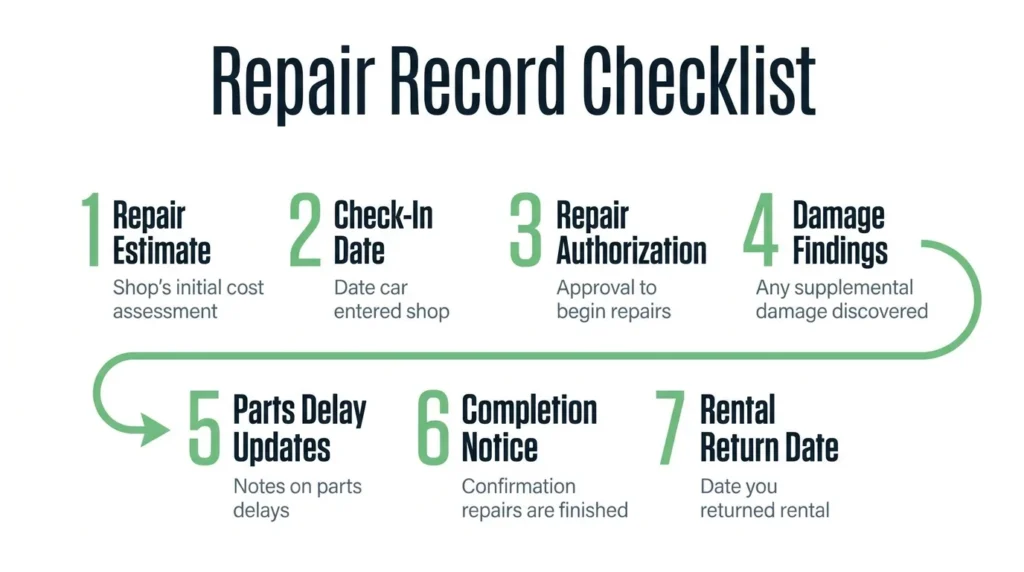
Your endorsement sets how long your own benefit lasts. Your repair or replacement timeline shows how long you actually needed transportation. Confirm the covered end date with your insurer, especially after a total-loss decision, because no single Texas cutoff or automatic extension applies to every policy.
Keep these repair records:
- The repair estimate
- The date you checked the car in at the shop
- The repair authorization
- Any supplemental damage findings
- Updates about parts delays
- The completion notice
- The date you returned the rental
If the insurer declares your car a total loss, keep the total-loss determination and every message about the settlement offer. Ask the insurer to confirm your last covered rental day in writing.
Tell your adjuster when repairs stall. TDI’s auto insurance guide says that when the other driver’s insurer pays for your rental, you may be able to receive an extension for repair delays. Those payments may also stop a few days after you learn the car is totaled. That guidance applies to a third-party claim. Your own rental benefit follows the duration and termination terms in your endorsement.
Compare your itemized invoices with your insurer’s payments, repair timeline, and endorsement. This record shows what was covered and what remained unpaid.
Recovering Rental Costs & Your Deductible
You may be able to recover these costs, but recovery is not automatic. Rental reimbursement is a capped benefit under your own policy. Loss-of-use damages are a separate claim against the person responsible for the crash.
You may pursue reasonable, documented unpaid rental expenses and your collision deductible from the at-fault driver or that driver’s insurer. The result depends on fault, available coverage, and your supporting records. Progressive’s rental reimbursement guidance explains that the responsible driver’s insurer may reimburse the out-of-pocket portion of a rental.
The Supreme Court of Texas addressed loss of use in J&D Towing, LLC v. American Alternative Insurance Corp. The court held that loss-of-use damages can apply when property is totally destroyed. The losses cannot be speculative and must be caused by the wreck and tied to a reasonable replacement period. An unreasonable delay cannot increase the recovery.
The ruling doesn’t expand your own policy’s rental benefit. Your policy’s rental cap also doesn’t set the value of a separate loss-of-use claim.
Keep your unpaid rental charges and your collision deductible as two separate totals. TDI explains that your insurer may seek repayment from the other side. It also says you might get your deductible back if your insurer recovers money. Coordinate your claims with your insurer so that no amount is counted twice.
Talk With Angel Reyes & Associates About Your Rental Costs
Angel Reyes & Associates has guided injured Texans for over 30 years. Reach our team 24/7 to discuss your options after a crash.
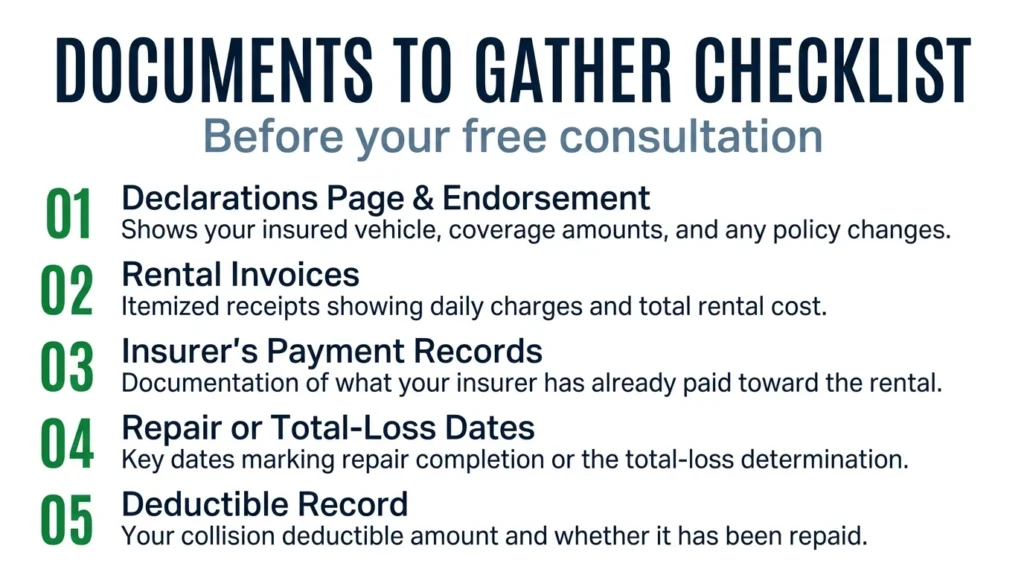
Before your free consultation, gather these documents:
- Your declarations page and endorsement
- Your rental invoices
- Your insurer’s payment records
- Your repair or total-loss dates
- Your deductible record
Contact Angel Reyes & Associates for a free consultation about your rental coverage, unpaid rental costs, and deductible.
Past results do not guarantee future outcomes.
Texas Rental Coverage FAQs
Can I get rental reimbursement coverage if my car is still drivable after an accident?
Rental reimbursement coverage generally applies when a covered loss makes your vehicle unusable, including while it undergoes necessary repairs. If your car remains safe to drive, your insurer may not authorize a rental until repairs begin, depending on your policy.
Does Texas rental reimbursement coverage pay for a rental car of the same size as mine?
Your insurer may allow a comparable rental vehicle, but your policy’s dollar limits still apply. If you need a larger vehicle for passengers or accessibility reasons, ask whether your coverage accommodates that need.
What happens if I get into an accident while driving a rental car in Texas?
Your existing auto insurance may extend certain protections to a temporary rental vehicle, depending on your policy and the circumstances. Rental reimbursement coverage itself pays toward transportation costs and does not automatically provide collision or liability protection for the rental.
Can I receive compensation for not having a car if I borrow one instead of renting?
Under Texas law, loss-of-use damages may be available even without an actual rental expense, depending on the evidence and circumstances. The amount must reasonably reflect the loss of your vehicle’s use, not an assumed or unsupported rental charge.
Does rental reimbursement coverage apply if my car breaks down in Texas?
Rental reimbursement coverage generally does not pay for transportation after an ordinary mechanical breakdown or routine maintenance. Mechanical breakdowns typically fall outside the covered losses that trigger this benefit, unless the policy expressly provides otherwise.
About the Authors

Angel Reyes
Writer
Angel L. Reyes, III is the Founder and Managing Partner of Angel Reyes & Associates. A nationally recognized trial attorney and business leader, Angel founded the firm in 1993, which has gone on to help over 70,000 injury victims recover more than $1 billion. Named to the Texas Super Lawyers list annually since 2008, Angel brings Wall Street experience, Ivy League education, and a deep commitment to client advocacy. He is a frequent legal commentator and published author with extensive contributions to legal scholarship, trial strategy, and consumer protection.

Kyle Nicolas
Editor
Kyle Nicolas is the Web Content & SEO Manager at Angel Reyes & Associates. He has more than 10 years of experience as a marketing co...

Angel Reyes
Reviewer
Angel L. Reyes, III is the Founder and Managing Partner of Angel Reyes & Associates. A nationally recognized trial attorney and business...