What Is a Cervical Sprain or Strain?


Every article on this site is researched by our internal team, reviewed for legal accuracy against current Texas law, and held to State Bar of Texas advertising standards before publication. We do not publish content that overstates outcomes or makes promises about results.
Learn more about our
editorial standards .
Key Takeaways
- A cervical sprain injures ligament, while a cervical strain injures muscle or tendon.
- A grade three cervical strain or sprain is a structural injury, not just a sore neck.
- Texas generally allows two years to file a personal injury lawsuit after a crash.
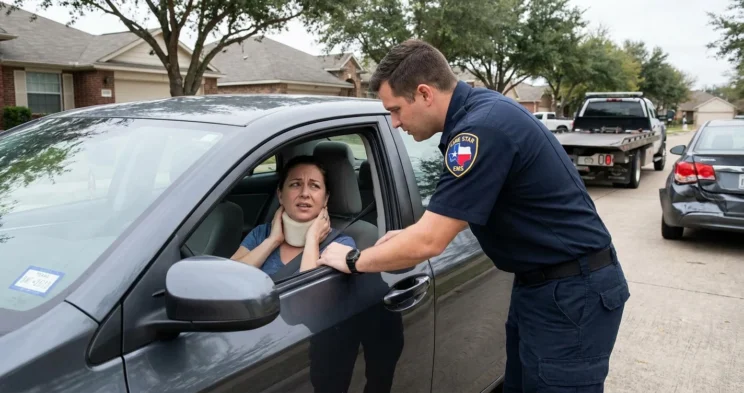
You left the emergency room holding a discharge summary that says cervical sprain, or cervical strain, or both, and nobody stopped to explain the difference. Those two words are not interchangeable, and neither one is simply a formal way of writing “whiplash.”
A cervical sprain is an injury to the ligaments that hold your neck bones together. A cervical strain is an injury to the muscle or tendon that moves your neck. Same collision, same aching neck, two different tissues.
The distinction shapes your recovery, because ligament and muscle tissue heal on different timelines. It also shapes an injury claim. The specific diagnosis in your chart, along with the grade your doctor assigns, is what an insurance adjuster reads when deciding how seriously to treat your neck injury.
How a Cervical Sprain Differs From a Cervical Strain
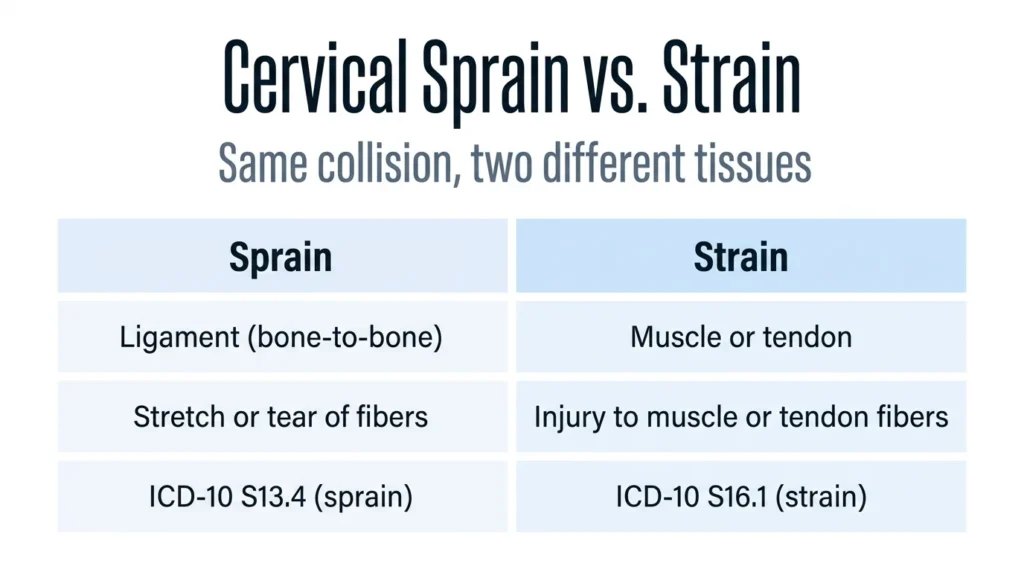
The difference is the tissue that got hurt. The American Academy of Orthopaedic Surgeons defines a sprain as a stretch or tear of a ligament, the strong band of connective tissue that connects the end of one bone to another. A strain is an injury to a muscle or a tendon, the fibrous cord that attaches muscle to bone.
Your cervical spine depends on both. Ligaments keep the vertebrae stable and aligned. Muscles and tendons let you turn your head, check a blind spot, and hold your head up through a full workday.
A rear-end collision loads all of that tissue at once. The NIH StatPearls clinical reference on cervical sprain describes acceleration-deceleration forces affecting multiple structures together, including the paraspinal muscles, facet joints, intervertebral discs, and craniocervical ligaments.
That is why a single chart often carries both diagnoses. A sprain and a strain are not competing theories about your injury. They frequently happen in the same crash, in the same neck, in the same instant.
“Whiplash” is where the confusion usually starts. Whiplash is an injury that happens when sudden force or movement strains the neck and spine, and explains that the mechanism leads to a form of neck sprain. Whiplash names how you got hurt. It does not name what got hurt.
Neck injuries are a routine result of Texas car accidents, and this tissue-level question is usually the first one an injured driver thinks to ask.
How Doctors Grade a Cervical Sprain or Strain

The grade is what separates a minor injury from a structural one, and two different grading systems are in use. They measure different things, so their numbers are not interchangeable.
The AAOS scale grades how badly the ligament tissue itself is damaged:
- Grade 1 (mild): slight stretching and some damage to the fibers of the ligament.
- Grade 2 (moderate): partial tearing of the ligament, with abnormal looseness in the joint.
- Grade 3 (severe): complete tear of the ligament, which may cause significant instability.
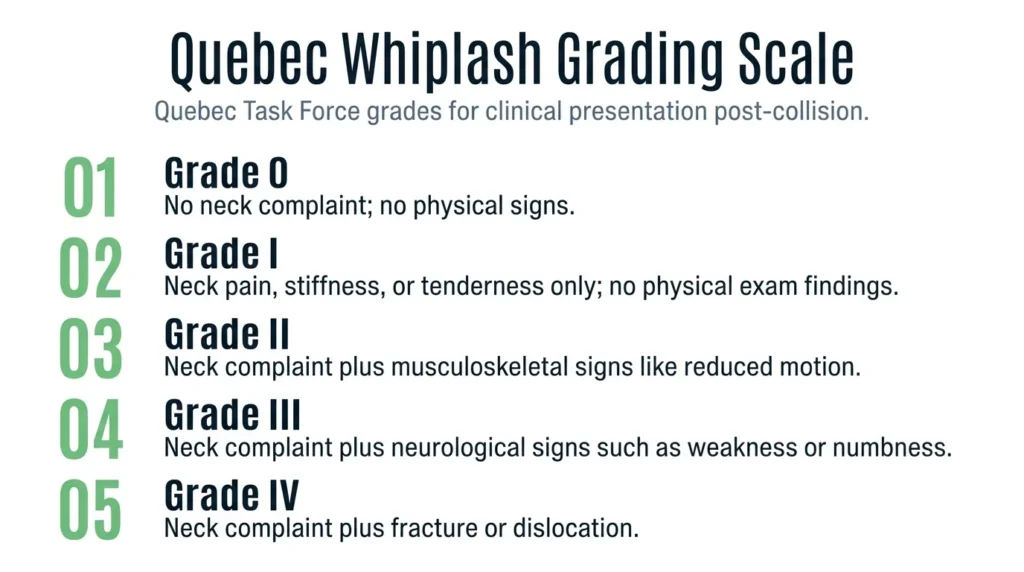
The Quebec Task Force Whiplash-Associated Disorder scale grades your clinical presentation after a collision, as set out in the StatPearls reference and in a peer-reviewed reliability study:
- Grade 0: no neck complaint and no physical signs.
- Grade I: neck pain, stiffness, or tenderness only, with no physical exam findings.
- Grade II: neck complaint plus musculoskeletal signs, such as decreased range of motion or point tenderness.
- Grade III: neck complaint plus neurological signs, including weakness, sensory deficits, or reduced reflexes.
- Grade IV: neck complaint plus fracture or dislocation.
Under either scale, a grade three finding describes a structural injury rather than a sore neck. A complete ligament tear or documented neurological involvement changes both the treatment plan and the evidence a claim needs.
One honest caveat belongs here. That same reliability study found only fair to good agreement among examiners applying these grades, because the original classification does not specify how to apply its criteria. The grade anchors your documentation. It is not a mechanical formula, and two doctors can read the same patient differently.
What Imaging & Range-of-Motion Records Show About Severity
Severity gets documented in stages: the physical exam first, then imaging when the exam calls for it, then measurements repeated over time.
Cleveland Clinic describes that usual order as physical examination, then X-ray, CT, and MRI as the presentation indicates.
MRI is not a routine test for an uncomplicated cervical sprain or strain. StatPearls describes it as the escalation test, indicated when there is concern for neurologic injury, traumatic disc herniation, ligament injury, or suspected cervical instability that a CT scan does not explain.
That is the grade three scenario. Once neurological signs appear, imaging stops being optional and becomes the record of what happened inside your neck.
Range of motion matters for a different reason. It is measured with a goniometer, a tool that measures the angle of joint movement, and repeated readings let a clinician evaluate progress or the lack of it and modify treatment accordingly.
A single measurement is a snapshot. A series of measurements across visits shows a direction: improving, plateaued, or getting worse. Decreased range of motion is also the musculoskeletal sign that defines Grade II on the Quebec Task Force scale.
The same clinical reference is candid that the standard goniometer’s reliability is still debated, though certain device-specific tools measure more consistently. Serial range-of-motion testing is meaningful, standard documentation rather than a flawless instrument, and it carries the most weight alongside the exam findings and your physician’s specific tissue diagnosis.
Why the Words in Your Medical Record Matter
Two charts can describe the same neck and land very differently with a claims reviewer.
“Whiplash” arrives carrying baggage. The claims industry publication CLM Magazine calls whiplash a perennial thorn in the insurance industry’s side and cites Insurance Research Council data estimating that 21% of bodily injury claims in a national study showed the appearance of fraud or claim buildup. Those claims frequently involved chiropractic care, physical therapy, and pain clinic treatment, which is the same pattern a legitimate neck injury often requires.
Formal medical coding is far more precise than the lay term. ICD-10-CM S13.4 covers sprain of ligaments of the cervical spine, and its official inclusion terms list whiplash injury of the cervical spine under that sprain code. ICD-10-CM S16.1 covers strain of muscle, fascia, and tendon at neck level, coded separately, with a note directing ligament and joint sprains elsewhere.
No published source puts a dollar figure or a percentage on what specific diagnostic wording is worth in a settlement, so treat any such claim with skepticism.
What the wording does affect is how verifiable your injury looks. A named tissue, an assigned grade, imaging where the clinical picture calls for it, and range-of-motion deficits measured across visits give an adjuster findings to check. The label “whiplash,” standing alone, gives them something to discount instead.
That is a practical reason to be specific with your treating physician about what hurts, when it started, and what you can no longer do that you could do before the crash.
What a Cervical Strain Means for a Texas Injury Claim
Texas sets a deadline. Under Texas Civil Practice and Remedies Code § 16.003, a person generally must bring suit for personal injury no later than two years after the day the cause of action accrues.
Two years can feel generous while you are still in physical therapy. The documentation that carries a neck injury claim, including the specific diagnosis, the grade, any imaging, and the measured range-of-motion trend, is built in the weeks and months right after the crash rather than in the final stretch before a filing deadline.
Talk to an Attorney About Your Diagnosis
If a collision left you with a cervical sprain or cervical strain diagnosis, you do not have to sort out what it means for your claim by yourself.
Angel Reyes & Associates has guided injured Texans through the legal process for more than 30 years. The team includes board-certified personal injury attorneys along with investigators and accident reconstruction specialists, and you can reach the firm 24/7.
Request a free consultation to review your diagnosis, your medical records, and your options.
Past results do not guarantee future outcomes.
Cervical Sprain vs. Strain FAQs
Is a cervical sprain the same thing as whiplash?
No, whiplash names the mechanism of injury, not a specific tissue. The force behind whiplash can cause a cervical sprain (ligament damage), a cervical strain (muscle or tendon damage), or both in the same crash. The diagnosis written in your chart, not the word "whiplash," identifies which tissue was actually hurt.
Can someone have a cervical sprain and a cervical strain at the same time?
Yes, the two injuries often occur together in the same collision. A rear-end crash can load the paraspinal muscles, facet joints, discs, and ligaments all at once, so a single medical record can carry both diagnoses. They describe two different tissues hurt in one event, not competing theories.
When does a cervical sprain or strain require an MRI?
MRI is not a routine test for an uncomplicated cervical sprain or strain. It becomes necessary when there is concern for neurological injury, a traumatic disc herniation, ligament damage, or instability that an X-ray or CT scan does not explain. That situation typically matches a grade three finding, marked by neurological signs such as weakness or sensory changes.
About the Authors

Angel Reyes
Writer
Angel L. Reyes, III is the Founder and Managing Partner of Angel Reyes & Associates. A nationally recognized trial attorney and business leader, Angel founded the firm in 1993, which has gone on to help over 70,000 injury victims recover more than $1 billion. Named to the Texas Super Lawyers list annually since 2008, Angel brings Wall Street experience, Ivy League education, and a deep commitment to client advocacy. He is a frequent legal commentator and published author with extensive contributions to legal scholarship, trial strategy, and consumer protection.

Kyle Nicolas
Editor
Kyle Nicolas is the Web Content & SEO Manager at Angel Reyes & Associates. He has more than 10 years of experience as a marketing co...

Angel Reyes
Reviewer
Angel L. Reyes, III is the Founder and Managing Partner of Angel Reyes & Associates. A nationally recognized trial attorney and business...