What Is Considered a Motorcycle in Texas?


Every article on this site is researched by our internal team, reviewed for legal accuracy against current Texas law, and held to State Bar of Texas advertising standards before publication. We do not publish content that overstates outcomes or makes promises about results.
Learn more about our
editorial standards .
Key Takeaways
- Texas law defines a motorcycle as any motor vehicle with a rider's saddle and no more than three wheels.
- Mopeds, autocycles, and ATVs each have separate classifications with different license and insurance rules.
- Your vehicle's legal classification directly affects how an insurer evaluates your accident claim.
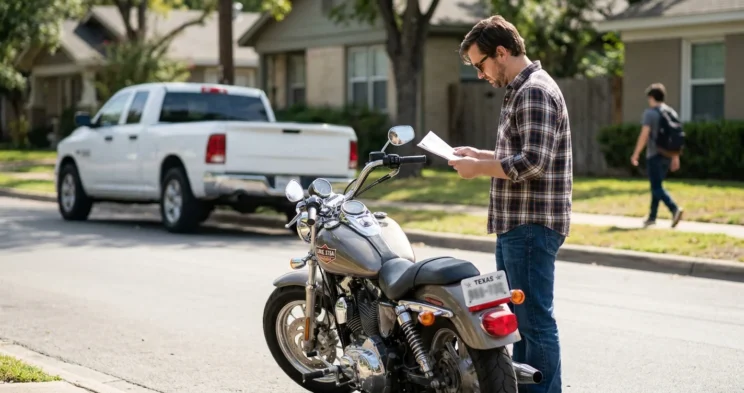
You bought a three-wheeled cruiser last spring and registered it without a second thought. Then a car ran a red light on Loop 410 and hit you broadside. Now the insurance company is asking questions you did not expect, and one of them is about your vehicle’s classification.
The answer to “What is considered a motorcycle in Texas?” shapes your licensing obligations, your insurance requirements, and how your claim gets handled after a crash.
The Texas Legal Definition of a Motorcycle
Texas law defines a motorcycle in Texas Transportation Code §541.201. The definition has three elements: the vehicle must be a motor vehicle, it must be equipped with a rider’s saddle, and it must be designed to have no more than three wheels on the ground when it moves.
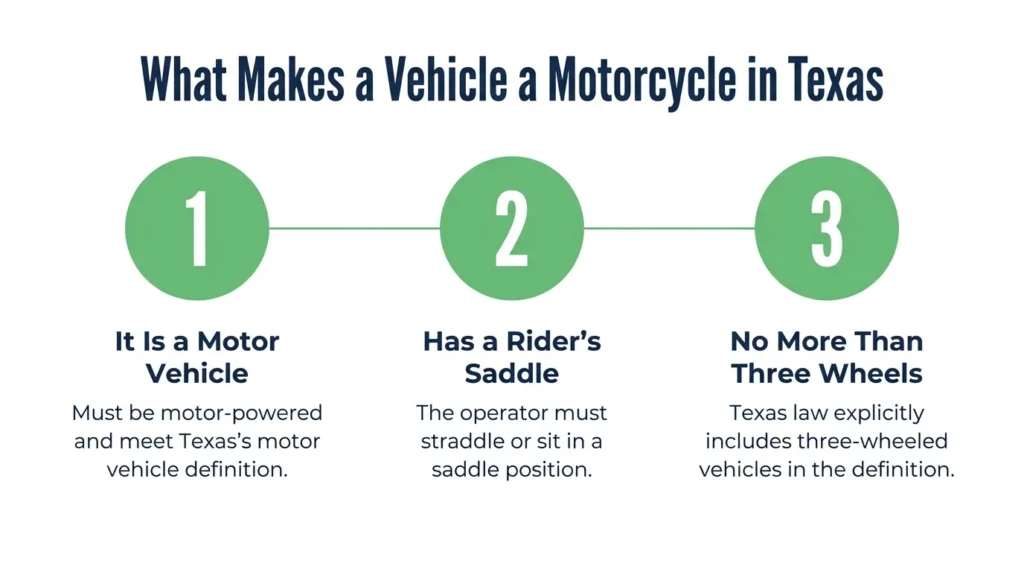
That three-wheel rule surprises people. Texas law does not require two wheels. A three-wheeled vehicle with a saddle qualifies as a motorcycle as long as it is not a tractor or a moped.
The same statute excludes tractors and mopeds from the motorcycle definition. Those vehicles follow their own set of rules when it comes to accidents and personal injury claims.
Vehicles That Don’t Qualify as Motorcycles in Texas
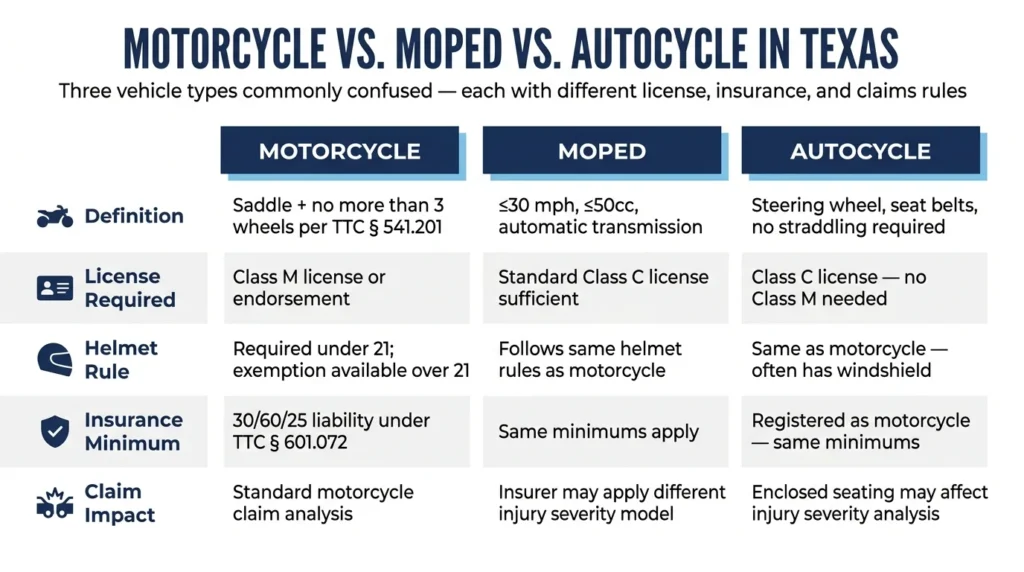
Three vehicle types are commonly confused with motorcycles. Each has its own classification under Texas law, and the distinction is important when you need to prove compliance or pursue a claim.
Mopeds
A moped, under §541.201, is a motor-driven cycle that cannot exceed 30 mph and whose engine cannot produce more than five brake horsepower. For internal combustion engines, displacement must be 50cc or less and the transmission must be automatic.
Because mopeds are excluded from the motorcycle definition, moped operators do not need a Class M motorcycle license. They operate under a restricted license tied to the moped’s performance limitations.
If you were riding a moped when a crash happened, the license and insurance rules that apply are different from those for a motorcycle. An insurer handling your claim will use the rules that match your vehicle’s actual classification, not the one you assumed.
E-Bikes
Electronically assisted bicycles, often called “e-bikes” are growing rapidly in popularity, particularly with children and teens. E-bikes come in a variety of different forms, but most are generally considered “electronically assisted bicycles” because they do still require the rider to pedal. They are also generally speed-governed to below the limits placed by Texas law.
Autocycles
An autocycle is a newer classification Texas established in 2015 under the bill S.B. 449. An autocycle has a steering wheel instead of handlebars, seat belts, and seating that does not require the operator to straddle the vehicle. It is certified to comply with federal motorcycle safety standards.
The Texas DPS guidance on autocycles confirms that autocycle operators need only a Class C driver license, not a Class M motorcycle endorsement.
Autocycles are registered as motorcycles for titling purposes, but the licensing rule is different. A rider who holds only a Class M license and no Class C may face questions about whether they were properly licensed at the time of the crash.
ATVs
All-terrain vehicles are not classified as motor vehicles for public road purposes under Texas law. They are regulated separately for off-highway use. An ATV operated on a public road at the time of a crash is in a different legal category than a motorcycle, and the coverage analysis, the fault analysis, and the applicable safety standards all change accordingly.
Motorcycle Licensing Requirements in Texas
A Class M license is required to operate a motorcycle on Texas public roads. To get one, you must pass both a written exam and an on-cycle skills test, or you can complete an approved motorcycle safety course that waives the testing requirement. You must already hold a valid Class C driver license before applying for a Class M.
The Texas DPS motorcycle license page details the current requirements and acceptable safety courses.
Riding without the correct license can complicate a claim. If you were on a vehicle classified as a motorcycle but you held only a moped-restricted license or no motorcycle license at all, the opposing party’s attorney will emphasize that fact. Under Texas’s comparative fault rules, the degree to which your licensing status contributed to the accident can reduce what you recover.
If you were hurt in a crash and questions about your license or vehicle classification have come up, an attorney can explain how those facts affect your options, including by reviewing how Texas motorcycle accident settlements work.
Insurance Requirements for Texas Motorcycles
Texas treats motorcycles as motor vehicles for insurance purposes. Under Texas Transportation Code §601.072, the minimum liability coverage is $30,000 per person and $60,000 per accident for bodily injury, plus $25,000 for property damage. That is the same 30/60/25 standard that applies to passenger car drivers.
A moped’s limited speed typically reduces injury severity compared to a motorcycle crash. An autocycle, because of its enclosed seating and seat belts, may be evaluated differently by an insurer even though it is registered as a motorcycle.
Uninsured and underinsured motorist coverage is not mandatory in Texas, but motorcycle riders face statistically higher injury severity than car occupants. Carrying UM/UIM coverage protects you when the at-fault driver has no coverage or insufficient coverage.
Reviewing Texas common motorcycle accidents claims gives you a better idea of what to expect.
How Classification Affects a Motorcycle Accident Claim
When a crash happens, the vehicle’s legal classification determines how the insurer reviews the claim. Insurers internally treat motorcycle collision claims differently from standard auto claims because injury severity tends to be higher. The classification is not just a technical detail. It determines which coverage rules apply, what safety standards the rider was expected to follow, and how fault gets distributed.
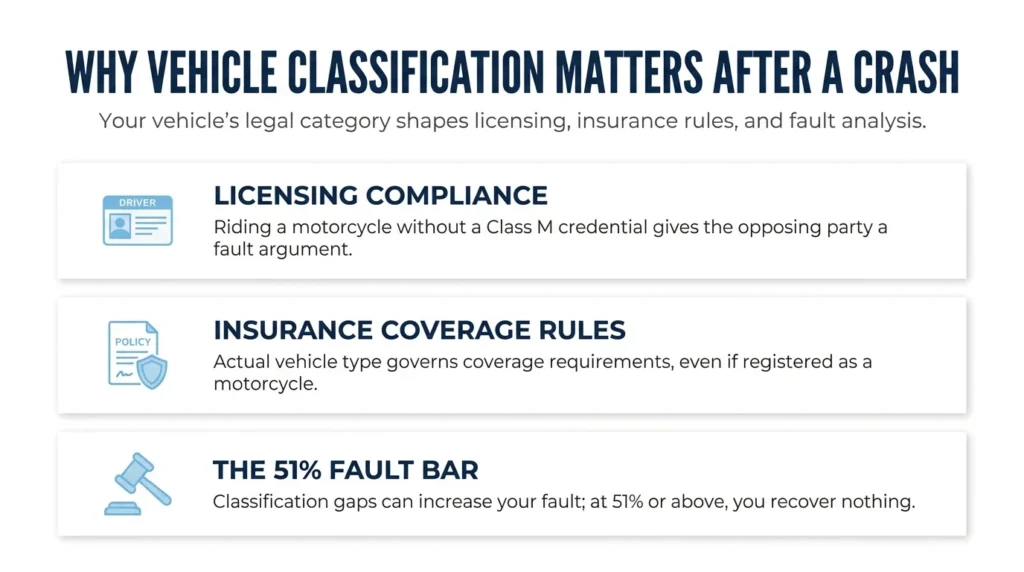
If your vehicle was actually a moped or an autocycle at the time of the crash, the fault analysis and injury valuation may be different from what would apply to a standard motorcycle claim. The insurer will look at what license and what coverage the law required for that specific vehicle. Gaps between what was required and what you had can reduce your recovery, or compensation.
Texas follows a modified comparative fault rule. If you are found more than 50 percent responsible for the accident, you receive nothing. A licensing violation does not automatically put you over that threshold, but it gives the opposing side an argument.
Texas motorcycle accident data shows crash rates remain high across the state, and classification disputes can surface in claims that might otherwise be straightforward.
Talk to an Attorney After a Motorcycle Crash
Vehicle classification questions come up more often than most riders expect after a crash. An attorney who handles motorcycle cases can assess how your vehicle’s classification affects the strength of your claim and what compensation you may be owed, including reviewing details about common injuries in motorcycle accidents to build an accurate picture of your damages.
Angel Reyes & Associates has spent over 30 years helping injured Texans understand their rights after crashes. We handle motorcycle accident cases across the entire state, offer free initial consultations, and you pay nothing unless we win. Contact us to review your situation with our team. You can also learn more about our firm’s background and experience before you call.
Past results do not guarantee future outcomes.
Motorcycle Type FAQs
Does Texas require helmets for motorcycle riders?
Texas requires all riders under 21 to wear a DOT-approved helmet. Riders 21 and older can ride without a helmet only if they have completed a state-approved motorcycle safety course or carry health insurance that covers motorcycle accident injuries.
Can I register a moped the same way I register a motorcycle in Texas?
Mopeds and motorcycles follow a similar registration process through TxDMV, but they carry different license requirements and are classified separately under Texas Transportation Code §541.201, which affects how they are treated for insurance and legal purposes.
What happens if I ride a motorcycle without a Class M license in Texas?
Operating a motorcycle without the proper license is a traffic violation, and in an accident, the opposing party may argue your unlicensed status as a factor in their comparative fault argument. Texas’s modified comparative fault rule bars recovery if you are found more than 50 percent responsible, so the licensing issue can matter depending on the other circumstances.
About the Authors

Angel Reyes
Writer
Angel L. Reyes, III is the Founder and Managing Partner of Angel Reyes & Associates. A nationally recognized trial attorney and business leader, Angel has helped over 70,000 injury victims recover more than $1 billion since founding the firm in 1993. Named to the Texas Super Lawyers list annually since 2008, Angel brings Wall Street experience, Ivy League education, and a deep commitment to client advocacy. He is a frequent legal commentator and published author with extensive contributions to legal scholarship, trial strategy, and consumer protection.

Kyle Nicolas
Editor
Kyle Nicolas is the Web Content & SEO Manager at Angel Reyes & Associates. He has more than 10 years of experience as a marketing co...

Angel Reyes
Reviewer
Angel L. Reyes, III is the Founder and Managing Partner of Angel Reyes & Associates. A nationally recognized trial attorney and business...