What to Expect After a Motorcycle Accident in Texas


Every article on this site is researched by our internal team, reviewed for legal accuracy against current Texas law, and held to State Bar of Texas advertising standards before publication. We do not publish content that overstates outcomes or makes promises about results.
Learn more about our
editorial standards .
Key Takeaways
- Texas law requires you to stop, check for injuries, and call 911 after a crash.
- Texas gives you two years from the crash date to file a motorcycle injury lawsuit.
- A rider found more than 50% at fault for their injuries cannot recover any damages.
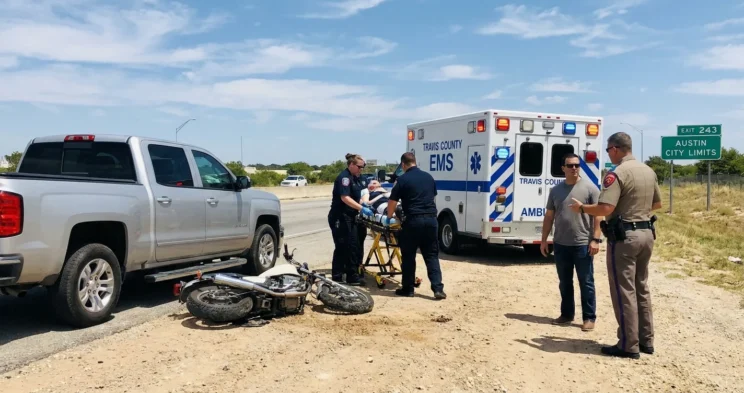
You were riding home along I-35 near Deep Ellum when a car drifted into your lane and clipped your bike. Suddenly, you find yourself sprawled on the pavement, your heart pounding, your gear scattered across the road. The next few hours feel like a blur, and insurers are already calling. What you do right now can shape everything that comes after.
What to Do Right After a Crash Happens
Texas law requires you to stop at the scene, check for injuries, and call for help before you do anything else. These first few minutes after a crash will be the foundation of your claim.
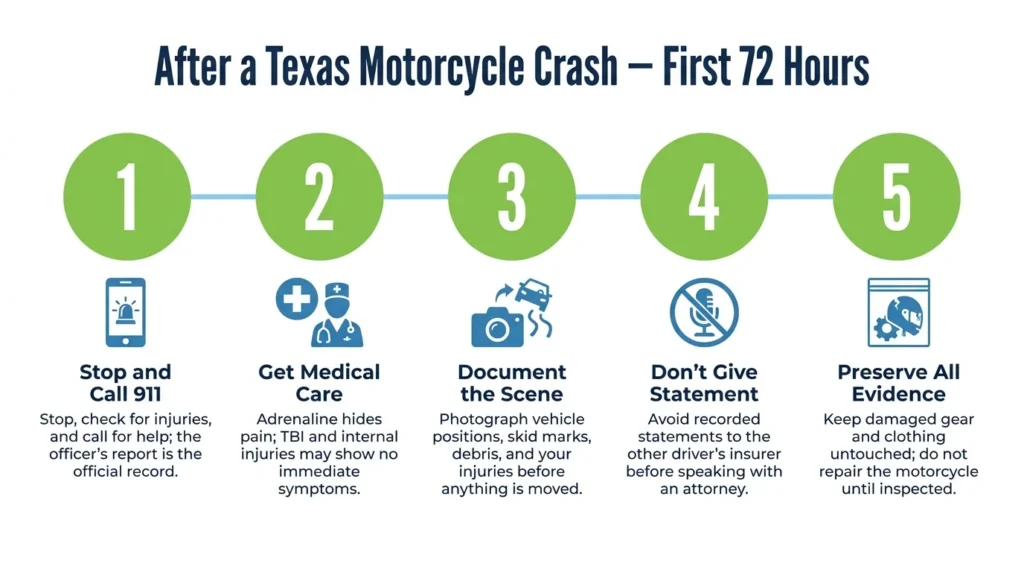
Take a deep breath and work through each step in order:
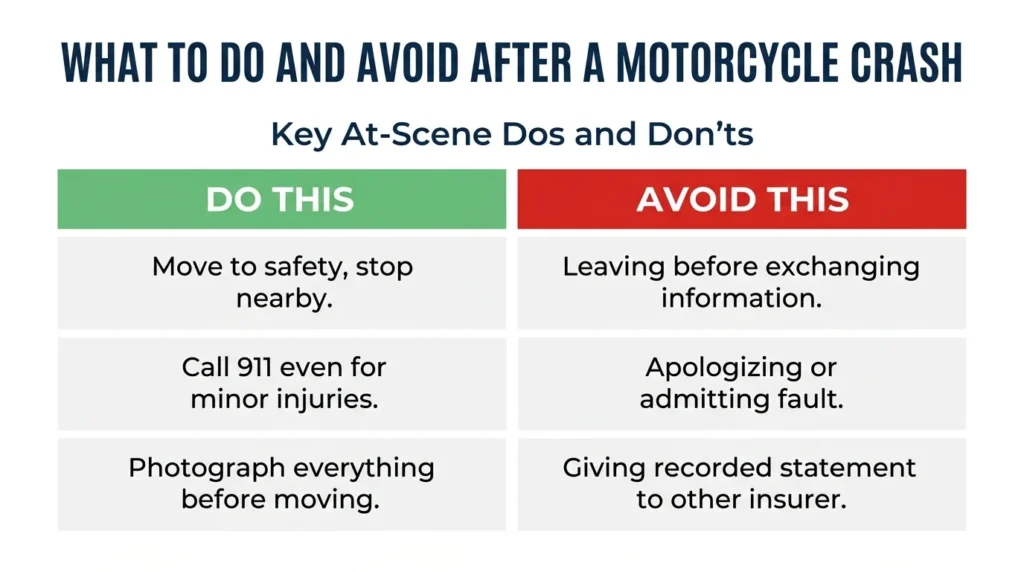
- Step 1: Move to safety, then stop. Texas law requires every operator in a crash to stop at or near the scene and check to see whether anyone needs help. This duty applies under Texas Transportation Code § 550.021 when the crash involves injury, death, or property damage. A similar duty for crashes that only involve property damages appears in § 550.022.
- Step 2: Call 911 even when injuries look minor. You must contact law enforcement when a crash causes injury, death, or property damage of $1,000 or more. The officer’s report will become the official record of what happened.
- Step 3: Share your information and help the injured parties. Texas Transportation Code § 550.023 requires you to give your name, address, registration, and insurance details and to assist anyone who is hurt.
- Step 4: Exchange details with everyone involved. Collect names, phone numbers, license plate numbers, driver’s license numbers, and insurance carriers from every driver at the scene.
- Step 5: Do not admit fault or apologize. Anything you say can be used later when determining fault. Keep your statements factual and brief.
- Step 6: Document the scene before anything can be altered. Photograph vehicle positions, skid marks, debris, traffic signals, and your injuries. Video captures more than still photos, so try to record plenty of video footage.
Medical Care After a Motorcycle Crash
See a doctor right away, even if you feel fine. Adrenaline and shock often hide pain for hours, and serious conditions can be undetectable at first. A traumatic brain injury, internal bleeding, or spinal damage may not show symptoms right away. An emergency medical evaluation can catch injuries that you cannot feel right after a crash. Never “tough it out” after a motorcycle crash, because riders can suffer severe injuries.
Make sure to tell your medical provider exactly what happened. Name the crash as the cause of your injuries in every record from the first visit onward. Insurers will use any gaps in the chain of events linking your injuries to the crash as an opening to dispute your claim. A clear, consistent record prevents that from happening.
Make sure to follow every medical treatment plan and attend every follow-up visit. Insurers often point to missed appointments to argue that your injuries are not serious.
Helmet Use
It’s important to clarify helmet use under Texas Transportation Code § 661.003, which allows riders aged 21 and older to ride without a helmet if they have completed an approved motorcycle safety course or are covered by a qualifying health insurance plan that covers motorcycle injuries.
Even so, an insurer may say that not using a helmet is what caused your head injuries, not the crash itself. Under Texas’s fault-sharing system, that argument can reduce your recovery.
Ask an attorney to explain how your medical documentation affects the value of your claim before you speak with any insurers.
How to Get Your Crash Report in Texas
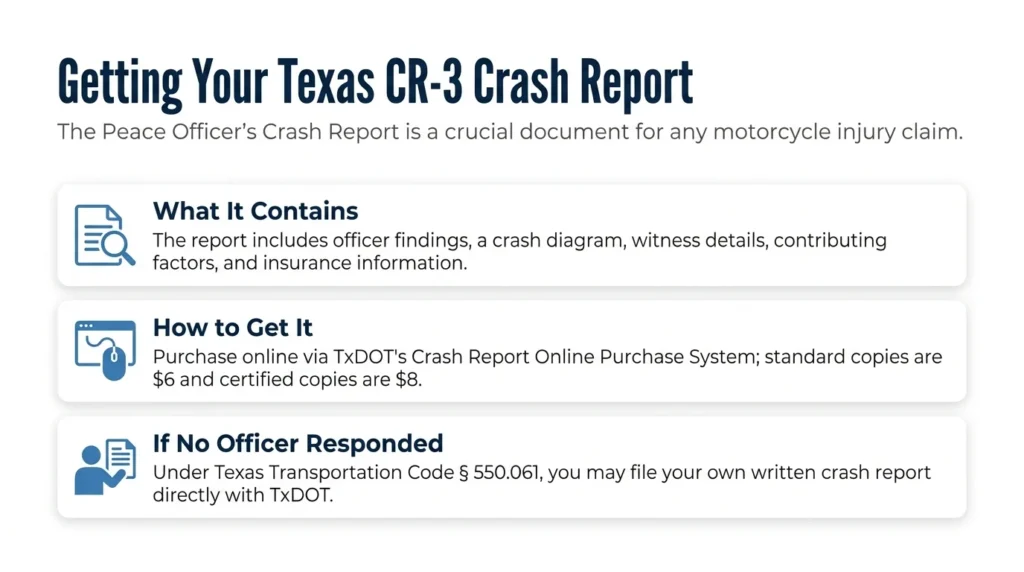
When an officer responds to a serious crash, they must file a written report with TxDOT within 10 days. That report is the CR-3, also known as “the Peace Officer’s Crash Report.” The CR-3 contains the officer’s findings, the contributing factors to the crash, a crash diagram, witness details, and insurance information from everyone involved. It is one of the most important documents in a motorcycle accident claim.
The CR-3 is required under Texas Transportation Code § 550.062 for crashes involving injury, death, or property damage of $1,000 or more.
You can buy a CR-3 online through TxDOT’s Crash Report Online Purchase System. Standard copies cost $6, and certified copies cost $8.
You can also request it by mail using TxDOT form CR-91. You can find the instructions on TxDOT’s crash reports and records page.
Sometimes, no officer responds, or the officer decides no report is needed. In that case, you can file your own written report with TxDOT directly under § 550.061, which requires operators to report qualifying crashes that are not investigated by law enforcement.
To understand how the crash report shapes your case, our explanation of why you need a police report after a crash is a useful starting point. You can also see how police reports affect your case.
Protecting Your Claim in the First 72 Hours
The first three days decide more about your claim than almost anything that follows. What you say, post online, and keep track of during this window can either protect your recovery or damage it.
First, do not give a recorded statement to the other driver’s insurer. Adjusters use these statements to lock in early admissions of guilt and minimize your injuries. Insurers are expected to follow fair settlement practices under Texas Insurance Code § 541.060, but you do not have to provide a statement to insurers before you talk to an attorney.
Keep in mind that Texas follows a fault-sharing rule that can block your claim entirely. Under Texas Civil Practice and Remedies Code (CPRC) Chapter 33, a rider found more than 50% responsible for their own injuries cannot recover any compensation at all.
Early statements that hint at fault are the most common way riders fall into this trap. A few careless words can erase a strong case. Learning how the 51% rule works in Texas can help you understand what’s at stake.
Second, notify your own insurer as soon as possible. Your policy likely requires you to notify them about the crash quickly to ensure that your coverage is valid, so report the facts without saying who you think was at fault.
Third, preserve every piece of physical evidence. Keep your damaged gear, clothing, and helmet exactly as they are. Do not repair the motorcycle until photographs and an independent inspection are finished. Once the bike is fixed, that evidence is gone for good.
Fourth, do not post about the crash on social media. Insurers and opposing legal counsel watch claimants’ accounts, and a single post about your injuries or activities can work against you to reduce your claim.
Fifth, riders who consult with an attorney in the first 72 hours are better positioned to preserve evidence and avoid mistakes that reduce your claim’s value. See our guide on legal strategies to use after a motorcycle accident to help you plan your next move.
Finally, remember your deadline. Texas Civil Practice and Remedies Code § 16.003 gives you two years from the date of the crash to file a personal injury lawsuit. Miss that window, and your right to sue is almost certainly gone.
Work with an Attorney on Your Motorcycle Accident Claim
The first hours after a crash are incredibly stressful, and you do not have to handle fault rules and insurer tactics alone. Angel Reyes & Associates has spent over 30 years helping injured Texans move forward after motorcycle crashes. We offer free initial consultations, and we charge no fee unless we win. With more than $1 billion recovered for clients, our team knows how to help you recover damages.
Reach out to us for a free consultation. We will review what happened and go over your options.
Past results do not guarantee future outcomes.
Motorcycle Accident FAQs
What if the other driver in my motorcycle accident had no insurance?
If the at-fault driver has no insurance, your own uninsured motorist (UM) coverage can pay for your injuries and damages. Texas insurers are required to offer UM coverage, but you can reject it in writing, so check your policy to confirm whether you have it.
What if the driver who hit me fled the scene?
Report the hit-and-run to the police immediately and get a case number. Your uninsured motorist coverage typically applies to hit-and-run crashes, but most policies require you to report the incident to law enforcement promptly for the coverage to be valid.
Can a passenger on my motorcycle file a claim after a crash?
Yes. A passenger injured in a motorcycle crash can file a claim against the at-fault driver. Depending on the facts of your case, a passenger may also have a claim against the motorcycle driver if their negligence contributed to the crash.
Is lane splitting legal in Texas, and how does it affect an injury claim?
Lane splitting is illegal in Texas. A rider who was splitting lanes at the time of the crash can be assigned a share of fault under Texas’s fault-sharing rules, which can reduce or eliminate their recovery, depending on how much fault they are assigned.
Who can file a claim if someone died in a motorcycle crash in Texas?
Texas law allows a surviving spouse, children, and parents to file a wrongful death claim. The same two-year deadline that applies to personal injury claims also applies to wrongful death cases. The countdown starts from the date of the crash.
About the Authors

Alex Ivanov
Writer
Alex Ivanov is a personal injury attorney at Angel Reyes & Associates, focused on car, truck, and motorcycle accident cases. Licensed in Texas and multiple federal districts, Alex brings international legal experience and a global education to his practice. He earned his LL.M. from Texas A&M University School of Law after graduating from Belarussian State University in 2016. Alex is fluent in Russian, English, Ukrainian, and Belarussian, and is recognized by multiple national trial lawyer associations for his results and leadership under 40.

Kyle Nicolas
Editor
Kyle Nicolas is the Web Content & SEO Manager at Angel Reyes & Associates. He has more than 10 years of experience as a marketing co...

Angel Reyes
Reviewer
Angel L. Reyes, III is the Founder and Managing Partner of Angel Reyes & Associates. A nationally recognized trial attorney and business...