When Do Most Motorcycle Crashes Occur in Texas?


Every article on this site is researched by our internal team, reviewed for legal accuracy against current Texas law, and held to State Bar of Texas advertising standards before publication. We do not publish content that overstates outcomes or makes promises about results.
Learn more about our
editorial standards .
Key Takeaways
- Texas motorcycle fatalities peak from May through September, with Saturdays being the deadliest day of the week.
- The 3 PM to 9 PM window is the highest-risk block each day, especially on weekend evenings when impaired drivers are more common.
- Crash timing does not determine legal fault in Texas; proportionate responsibility turns on what each driver actually did.
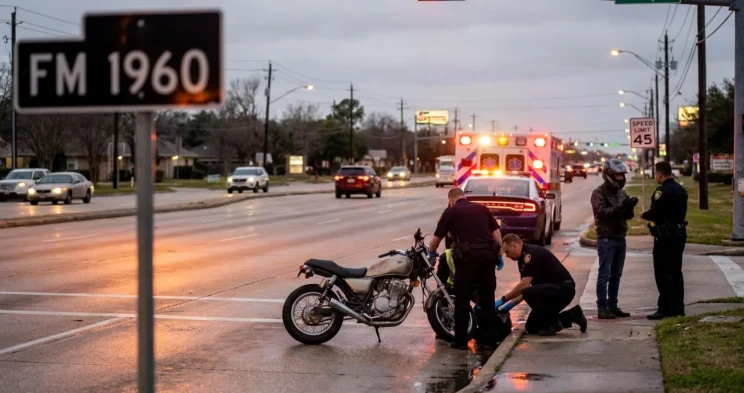
You left work on a Friday evening and merged onto I-35 heading north out of San Antonio, traffic thickening around you the way it always does after 5 PM. You were riding carefully, watching the cars ahead. Then a driver changed lanes without looking and clipped your front wheel.
The timing was not a coincidence. Friday evenings on Texas highways are among the most dangerous windows of the week for motorcyclists.
When Crashes Peak by Month & Season
Texas motorcycle fatalities concentrate heavily between May and September, a pattern that matches national data from TxDOT’s crash records. The NHTSA’s Traffic Safety Facts report on motorcycles shows that roughly 59% of motorcyclist deaths nationally happen during those five months.
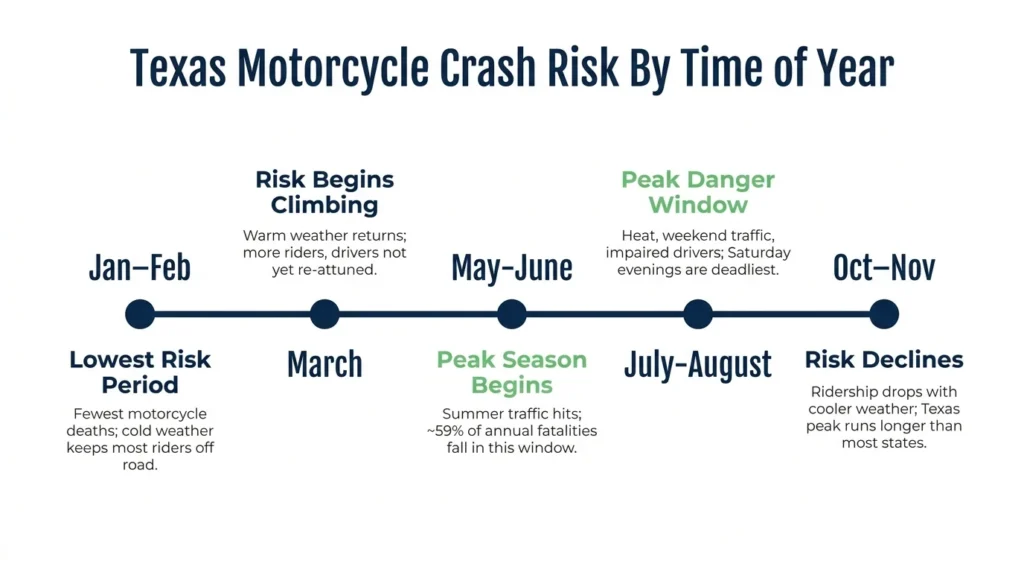
More riders on the road explains part of this. But volume alone does not account for all of it. Other drivers who rarely see motorcycles during winter are less attuned to watching for them. Intersections that feel familiar become more dangerous when a rider enters the equation that a car driver did not expect.
In Texas, the elevated risk window runs longer than in most of the country. The warm climate keeps riders on the road from March through October, and Texas motorcycle crash data confirms this extended season in the fatality counts. January and February see the fewest motorcycle deaths.
March marks the start of the climb. Summer months hold the peak, and the numbers do not drop off sharply until late fall.
Summer heat also changes road conditions in ways that are easy to underestimate. Asphalt softens in extreme Texas temperatures, which can reduce tire grip during hard braking. This is not a dramatic effect, but in a situation where fractions of a second determine whether a rider stops in time, it contributes.
Peak Days & Times for Motorcycle Crashes
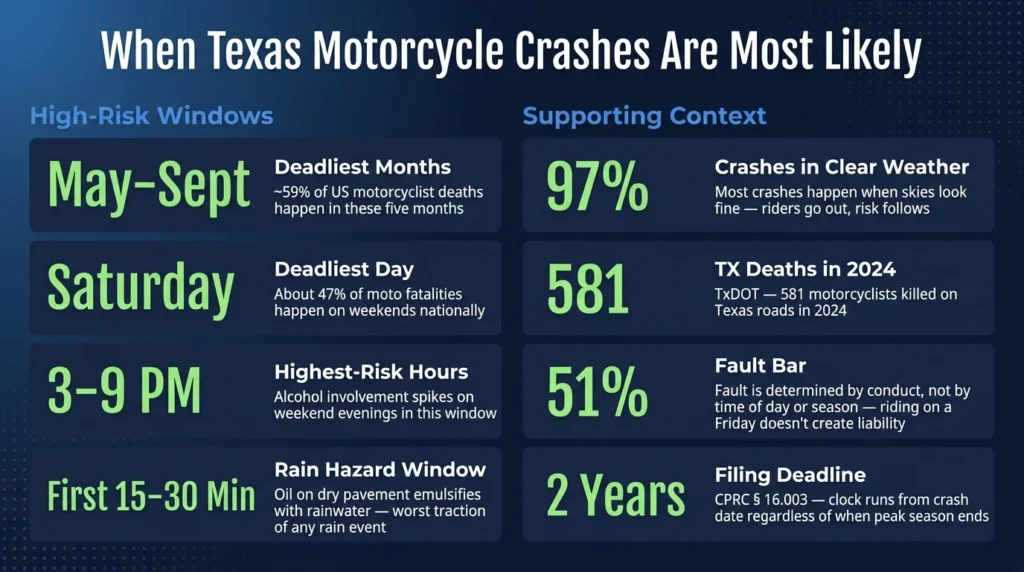
The most dangerous time of the week for motorcyclists runs from Friday evening through Sunday night. About 47% of motorcycle fatalities nationally occur on weekends, based on the NHTSA Traffic Safety Facts 2023 Motorcycles report. Saturday is consistently the deadliest single day.
The 3 PM to 9 PM window accounts for a disproportionate share of crashes on any given day. On weekends, that window extends into late evening as more impaired drivers enter the road. Alcohol-related motorcycle crashes concentrate heavily in those later hours.
Weekday rush hours carry a different risk profile. The crashes that happen between 4 PM and 7 PM on weekdays typically involve distracted drivers, intersection errors, and left-turn collisions. A driver pulling out of a parking lot or turning left across traffic frequently misjudges a motorcycle’s speed or simply does not see it at all.
Riders who commute face fatigue risks that compound these hazards, especially on the return commute after a long workday.
High-Risk Conditions Within Any Ride
Knowing the peak months and hours is useful. What catches many riders off guard is how conditions within a single ride can spike risk without any obvious warning sign.
Dusk and dawn are consistently dangerous transition points. At dusk, riders’ eyes are still adjusting from daytime brightness while oncoming drivers are already struggling to see into the fading light.
Motorcycles are narrow and their headlights can disappear into the visual clutter of a busy road.
At dawn, low-angle sunlight blinds drivers at certain intersections, making it easy to miss a motorcycle crossing in front of them.
The first rain after a dry stretch is another specific hazard. Oil, rubber residue, and road dust accumulate on dry Texas pavement. When rain begins, water lifts that material from the surface before washing it away. The first 15 to 30 minutes of rain after a long dry spell often produce worse traction than steady rain on a road that has already been rinsed clean.
TxDOT’s data confirms that Texas roads carry elevated crash risk during and after precipitation events.
One of the more counterintuitive findings in crash data: roughly 97% of motorcycle crashes happen in clear or cloudy conditions, not during active storms. Riders stay home in bad weather. They go out when conditions look favorable, which means most crashes happen on days that seemed fine before they went wrong.
How Crash Timing Affects Your Claim
When a crash happens late on a Friday night or during a peak summer weekend, insurers sometimes raise timing as a factor in the claim. The argument goes like this: you knew it was a high-risk period, you rode anyway, and that choice contributed to the outcome. This framing misrepresents how Texas law actually assigns fault.
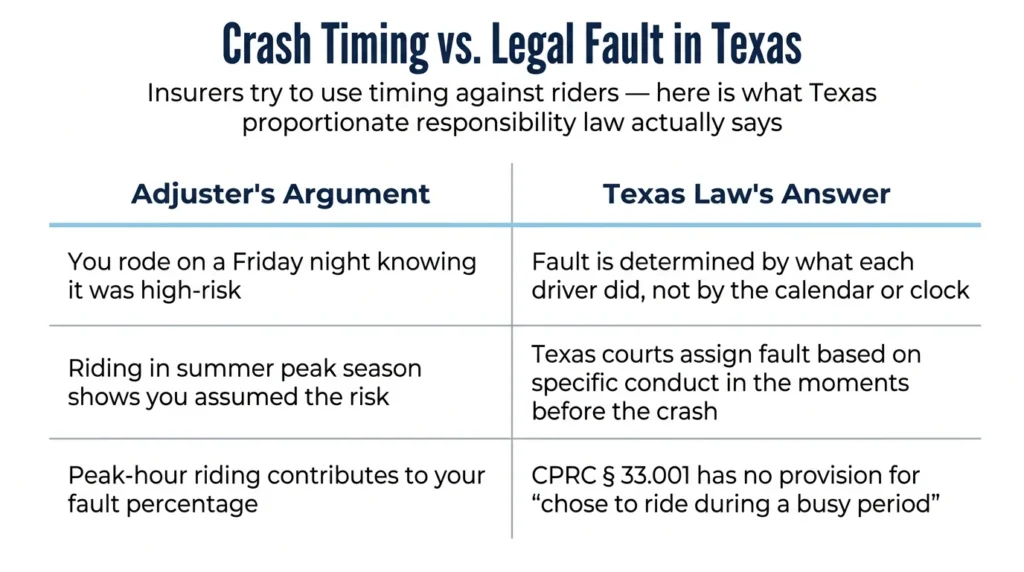
Texas uses a proportionate responsibility system under the Texas Civil Practice and Remedies Code (CPRC) Chapter 33. A court or jury assigns each party a percentage of fault based on what they actually did in the moments leading up to the crash.
If a rider is found more than 50% responsible, they cannot recover damages, or compensation. But fault is determined by conduct, not by the calendar or the clock.
Riding on a Friday evening does not make a rider legally responsible for a driver who failed to yield. Riding in July does not make a rider legally responsible for a driver who was texting. The Texas comparative negligence rules do not include a provision for “chose to ride during a busy period.” What they evaluate is what each driver did or failed to do at the moment of the crash.
That said, understanding how adjusters think about timing helps you prepare. They look for anything that shifts responsibility toward the rider. Dashcam footage, witness statements, and an accurate police report all help anchor the facts to what actually happened.
What to Do After a Motorcycle Crash in Texas
Crash timing statistics explain a great deal about when and why crashes happen. They do not explain what to do next. If another driver’s actions caused your crash, an attorney who handles motorcycle accident claims can help you understand your options and gather evidence before it becomes unavailable.
An attorney can also assess how the other driver’s specific actions, not the time of day or the season, determined who was actually at fault in your crash. If you were injured in a Texas motorcycle crash, you can also learn about your options.
Angel Reyes & Associates has guided Texas motorcyclists through injury claims for over 30 years. We work on contingency, which means no upfront costs and no fee unless we win your case. Our team is available 24/7, and we serve riders across the entire state of Texas from more than 20 office locations.
If you were injured in a motorcycle crash, reach out to us for a free consultation to review your options. We can assess what the evidence shows and explain what your claim may be worth.
Past results do not guarantee future outcomes.
Motorcycle Crash Timing FAQs
Are most Texas motorcycle crashes in cities or on rural roads?
Most Texas motorcycle crashes by total count happen in urban areas, where traffic volume and intersections create more opportunities for collisions. Rural crashes, while fewer in number, tend to be more severe because speeds are higher and emergency response takes longer.
What role does alcohol play in late-night motorcycle crashes?
Nationally, 44% of motorcyclists killed at night had a blood alcohol concentration at or above the legal limit, according to NHTSA’s 2023 data. This is why the late-evening hours on weekends carry a compounded risk: more impaired drivers on the road combined with reduced visibility.
How many motorcyclists are killed in Texas each year?
TxDOT recorded 581 motorcycle fatalities in 2024 and 599 in 2023, meaning more than 500 riders die on Texas roads every year. Motorcyclists make up roughly 15% of all traffic deaths in the state despite being a small fraction of vehicles on the road.
Does not wearing a helmet affect my motorcycle injury claim in Texas?
Texas law requires riders under 21 to wear a helmet, but riders 21 and older can legally ride without one if they meet certain conditions. If you were not wearing a helmet, an insurer may argue it contributed to your head injuries, which could reduce your compensation under Texas’s proportionate responsibility rules.
Does the time of year affect how long it takes to resolve a motorcycle injury claim?
The time of year does not directly affect claim timelines, but crashes that happen during peak months often involve higher traffic volumes and more complex evidence, such as multiple vehicles or unclear fault. Gathering witness statements and preserving physical evidence quickly matters regardless of when a crash occurs.
About the Authors

Angel Reyes
Writer
Angel L. Reyes, III is the Founder and Managing Partner of Angel Reyes & Associates. A nationally recognized trial attorney and business leader, Angel has helped over 70,000 injury victims recover more than $1 billion since founding the firm in 1993. Named to the Texas Super Lawyers list annually since 2008, Angel brings Wall Street experience, Ivy League education, and a deep commitment to client advocacy. He is a frequent legal commentator and published author with extensive contributions to legal scholarship, trial strategy, and consumer protection.

Kyle Nicolas
Editor
Kyle Nicolas is the Web Content & SEO Manager at Angel Reyes & Associates. He has more than 10 years of experience as a marketing co...

Angel Reyes
Reviewer
Angel L. Reyes, III is the Founder and Managing Partner of Angel Reyes & Associates. A nationally recognized trial attorney and business...