Why Don’t School Buses Have Seat Belts in Texas?


Every article on this site is researched by our internal team, reviewed for legal accuracy against current Texas law, and held to State Bar of Texas advertising standards before publication. We do not publish content that overstates outcomes or makes promises about results.
Learn more about our
editorial standards .
Key Takeaways
- Federal compartmentalization rules let large school buses skip seat belts entirely.
- Texas requires three-point belts on all school buses by September 1, 2029.
- You must give a school district written notice of a claim within six months of a bus crash.
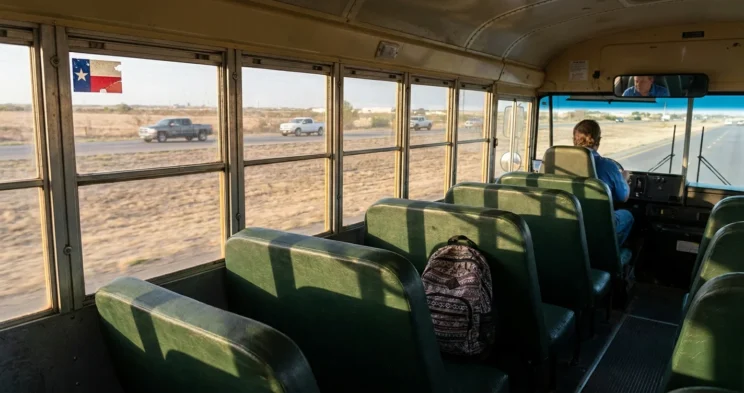
Your kid climbs onto the big yellow bus every morning near your home in San Antonio, and you buckle up the second you get in your own car. Suddenly, it hits you, there are no seat belts on that bus at all. What is actually keeping your child safe if something were to happen out on Loop 410?
Compartmentalization: The Federal Rule Behind No Seat Belts
Large school buses skip seat belts because federal safety rules let them. The design they use instead is called compartmentalization, and it has protected passengers for decades without a single restraint.
Regulators designed this system around closely spaced, padded, high-backed seats meant to absorb crash energy and hold passengers in place. This approach is codified under the Federal Motor Vehicle Safety Standard (FMVSS) No. 222 as the official occupant-protection method for big school buses.
The whole idea is built around a forward-impact crash. The seats work like padded cells that limit how far a child can move when a bus hits something head-on.
Smaller buses follow a different rule. Buses under 10,000 pounds must have seat belts, so the exemption only covers the heavy buses above that weight.
Two federal agencies have disagreed on this for years. The National Transportation Safety Board (NTSB) has pushed for three-point belts on new large buses, while the National Highway Traffic Safety Administration (NHTSA) has never required them nationwide. You can review the NHTSA’s current position through its school bus safety overview.
Texas School Bus Seat Belt Law: Where It Stands
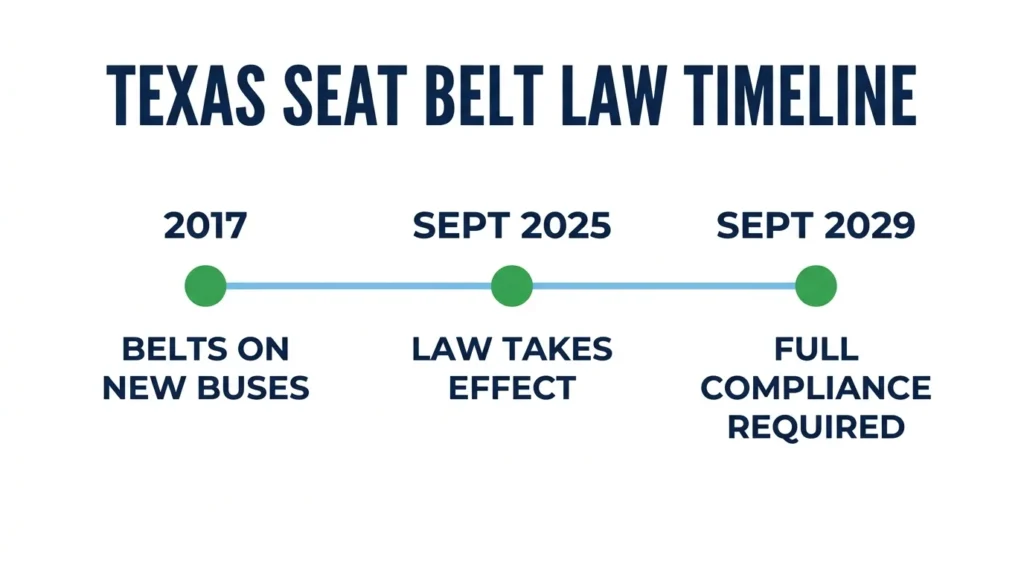
Texas now requires three-point seat belts on every school bus that carries students under Texas Transportation Code § 547.701, following the passage of Senate Bill 546. Although the law officially took effect September 1, 2025, it grants school districts a four-year transition period to upgrade or phase out their fleets. Full compliance is not required until September 1, 2029, meaning the majority of buses currently on the road can legally operate without them until that deadline arrives.
An older state requirement from 2017 only applied to buses of model year 2018 or later, which left many existing older buses and tight-budget districts untouched. Cost reporting tied to the new mandate is tracked through the Texas Education Agency’s SB 546 guidance.
When a bus does have belts, your child has to use them. The Texas Education Code Chapter 34 requires students to wear seat belts on equipped buses and lets districts enforce that.
Here is the practical takeaway for your family today. Most Texas school buses you see still lack three-point belts, and school bus seat belts and the injuries tied to their absence remain a live concern until 2029. If your child rides a bus, our Texas bus accident claims page explains how these cases work.
Injury Risks When Compartmentalization Fails
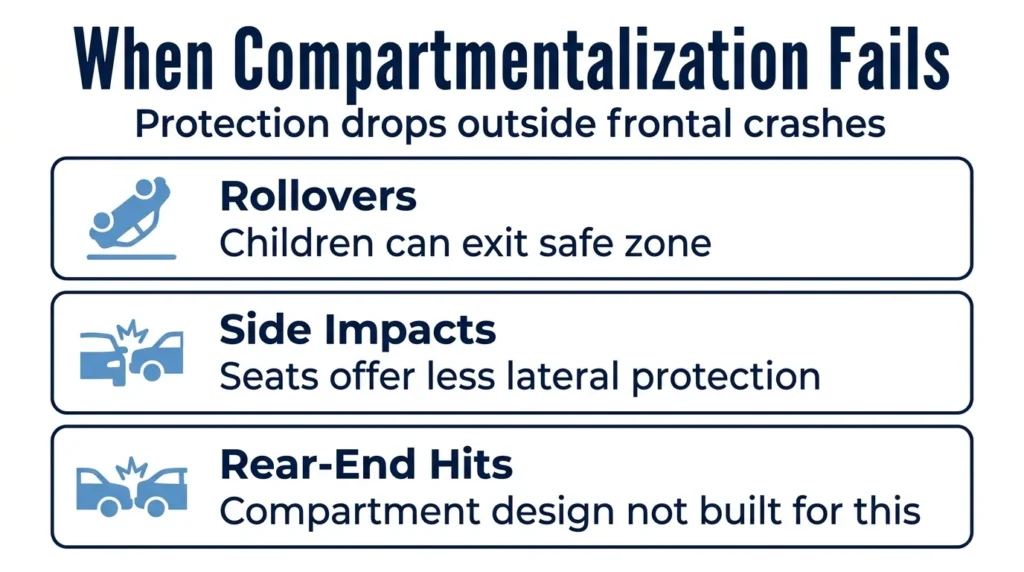
Compartmentalization works well when a bus crashes head-on, but it offers far less protection in rollovers, side impacts, and rear-end hits. In those crashes, a child can travel outside the safe zone that the seats were designed to create.
Ejection is the worst outcome when a bus rolls without belts. A passenger thrown from the bus faces a far higher risk of fatal or catastrophic injury than one who stays inside.
Head, neck, and spinal injuries show up most often in these non-frontal crashes. Children are especially exposed because the seat spacing assumes adult-sized bodies, not small ones.
The numbers offer some reassurance and a clear warning at the same time. National Safety Council school bus data shows that bus passengers make up only a small share of deaths in school-bus crashes. Most fatalities involve pedestrians, people in other vehicles, and bystanders.
That small share is no comfort when your child is the one who gets hurt. The severity of those injuries is the real concern, which is why questions of fault matter so much. Our breakdown of who is liable in a Texas bus accident walks through how responsibility gets sorted out.
If your child was hurt in a school bus crash, an attorney can review whether the crash circumstances support a claim before evidence fades.
Suing a School District: Texas Tort Claims Act Rules
You can sue a public school district after a bus crash, but only in limited situations. The Texas Civil Practice and Remedies Code (CPRC) Chapter 101, known as the Texas Tort Claims Act, controls whether that door is open.
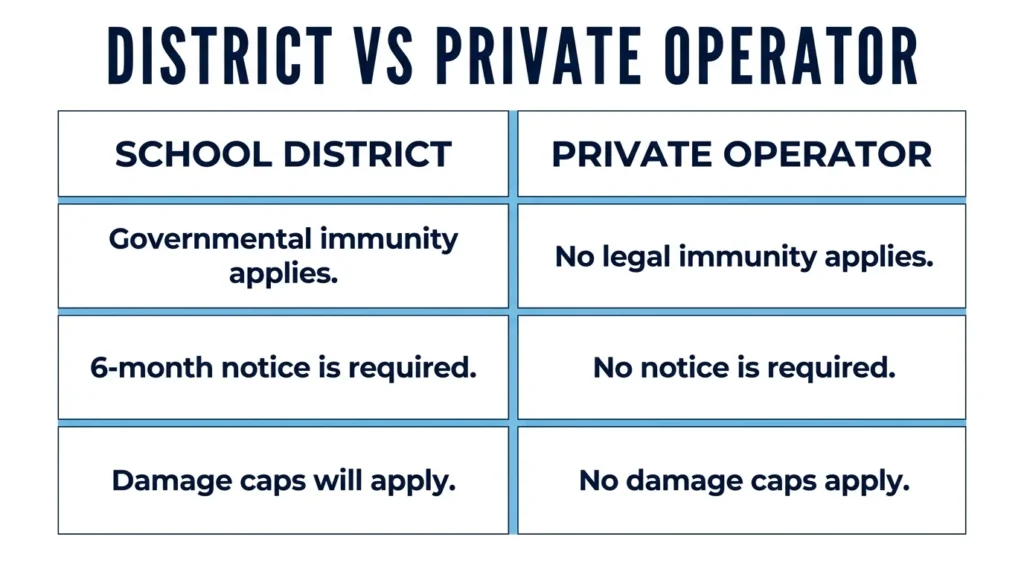
Public districts normally carry governmental immunity, which shields them from most lawsuits, and the Tort Claims Act waives that immunity only in specific cases.
One of those cases is the motor vehicle exception. When a district employee’s negligence in operating a vehicle causes injury, immunity falls away. A bus driver who causes a crash fits squarely inside that exception.
The procedure is strict and unforgiving. You must serve a written notice of claim on the district within six months of the crash; if you miss that window, your claim dies, no matter how strong it is. Our guide to the Tort Claims Act limits on bus accident claims explains how this notice rule works in practice.
The Act also caps how much you can recover from a government entity. Those caps apply even when injuries are devastating, so they shape how families weigh a claim. If you are starting from scratch, our walkthrough on how to file a Texas bus accident claim lays out the steps.
Beyond the notice window, the clock matters in two other ways. The standard two-year deadline under CPRC § 16.003 governs most personal injury claims. For an injured child, the minor-tolling rule under § 16.001 pauses that two-year clock until the child turns 18.
Private bus operators are a different story. Charter companies and contracted transportation firms have no governmental immunity, so claims against them follow ordinary negligence rules without the strict notice overlay.
Texas School Bus Injury Claims: Talk to an Attorney
A school bus crash leaves you juggling medical bills, a frightened child, and a complex legal system. Angel Reyes & Associates has guided injured Texans through situations exactly like this for over 30 years. You can see what past clients say through our client reviews.
The deadlines here move fast. The six-month notice rule for school district claims and the minor-tolling rule both make early action important, and waiting can cost you options. Because early action is so critical, we offer free initial consultations to help families understand their rights before time runs out.
If you want a sense of what these cases can involve, our overview of the average Texas bus accident settlement offers context. Our firm operates on a no-fee unless we win basis and has recovered more than $1 billion for our clients across Texas. When you are ready to explore your options with zero obligations, reach out for a free consultation.
Past results do not guarantee future outcomes.
No Seat Belts in Texas School Buses FAQs
Does the minor-tolling rule also pause the six-month notice deadline for school district claims?
No. Texas courts have held that the minor-tolling provision does not extend the six-month written notice requirement under the Texas Tort Claims Act. That notice deadline is a separate procedural rule, not a statute of limitations, so parents must still serve written notice on the district within six months of the crash even when the injured victim is a child.
What are the damage caps on a school district claim in Texas?
Under Texas Civil Practice and Remedies Code § 101.023, a school district’s liability is capped at $250,000 per person and $500,000 per occurrence for bodily injury and death. Those limits apply even when the injuries are severe, which is one reason families often explore whether other defendants can be named.
Can the bus manufacturer be sued separately from the school district?
Yes. A claim against the manufacturer for a defective bus or an unsafe seat design is a products liability claim, not a Tort Claims Act claim, so governmental immunity does not apply. That avenue follows standard negligence and products liability rules and is not subject to the TTCA’s notice requirements or damages caps.
What should a parent do right away after a school bus crash injures their child?
Call 911, get the child medical attention, and photograph the scene and bus before anything is moved or repaired. The six-month notice deadline for school district claims starts running on the date of the crash, so contacting an attorney early helps make sure that deadline is not missed.
Can a district still be liable for a crash before 2029, even though buses without seat belts are currently legal?
The absence of seat belts is lawful until the 2029 deadline, so a district will not be penalized simply for running buses without them. However, the crash circumstances, driver conduct, bus maintenance, and road conditions can still support a negligence claim under the Texas Tort Claims Act motor vehicle exception, separate from the seat belt question.
About the Authors

Angel Reyes
Writer
Angel L. Reyes, III is the Founder and Managing Partner of Angel Reyes & Associates. A nationally recognized trial attorney and business leader, Angel has helped over 70,000 injury victims recover more than $1 billion since founding the firm in 1993. Named to the Texas Super Lawyers list annually since 2008, Angel brings Wall Street experience, Ivy League education, and a deep commitment to client advocacy. He is a frequent legal commentator and published author with extensive contributions to legal scholarship, trial strategy, and consumer protection.

Kyle Nicolas
Editor
Kyle Nicolas is the Web Content & SEO Manager at Angel Reyes & Associates. He has more than 10 years of experience as a marketing co...

Spencer Browne
Reviewer
Spencer Browne is a partner at Angel Reyes & Associates and a Board Certified personal injury trial lawyer with nearly 100 jury trials a...